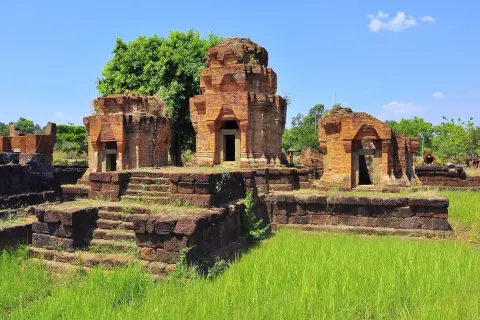
Most visitors come to Buriram for Phanom Rung and Muang Tam, and that is a good reason. But the Khmer empire left far more in this province than one hilltop temple. There is a Baphuon-style brick sanctuary of three towers standing in a rice field. There are kilns that once turned out glazed pottery on an industrial scale, a sandstone quarry that supplied the builders, hospital chapels that locals call hermit huts, and a roadside rest house that once sheltered travellers. Most of these places are small. Many are no more than a wall and some grass. Put on one map, though, they show that Buriram sat on the old road between Phimai and Angkor.
This page ranks the sites by how worthwhile they are, says plainly which ones are small or ruined, which ones have staff and opening hours and which are open-air with no ticket booth, and explains how to reach them without a car, how to build half-day and full-day plans, and how to combine them with Phanom Rung and Muang Tam and Lam Nang Rong dam. Hours and fees are as of 6 Nov 2026. Check hours again before you go, especially around Ban Kruat, which is close to the border. Read border-area access before you plan.
We earn a commission if you book through our links. The price you pay does not change. How we choose
Buriram Khmer sites beyond Phanom Rung at a glance
| Site | Where | What remains | Time to allow | Hours and fee |
|---|---|---|---|---|
| Prasat Nong Hong | Non Din Daeng, under 2 km from the Lam Nang Rong dam crest | Three brick towers on one laterite base, Baphuon style | 15 to 30 min | Open ground, normally no ticket booth, free. Check before you go |
| Ban Kruat kiln display centre and kiln sites | Ban Kruat district, about 66 km from Buriram city | Glazed pottery from local kilns, and an excavated kiln pit under a roof at Sawai | 1 h to half a day | Centre about 08:30 to 16:30 Mon to Fri, free. Call first |
| Ban Kruat stone quarry | Ban Kruat to Ta Phraya road, about 7 km from the district town | Cut grooves and half-removed sandstone blocks | 45 to 60 min | About 08:00 to 17:00. Border zone: check first |
| Prasat Thong, Ban Kruat | Ban Kruat district | Brick and sandstone doorway with a carved lintel | 20 to 30 min | Check hours with the municipality |
| Prasat Wat Khok Ngio | Highway 348, about 3 km before Pakham town | Small laterite tower, wall, pond, two stone figures | 20 to 30 min | Inside a temple, free, daytime |
| Kuti Rishi Nong Bua Rai | About 3 km south of the foot of Phanom Rung | Laterite tower, wall, long earth embankment | 15 to 20 min | No ticket booth, daytime |
| Kuti Rishi Khok Mueang | North-west of Muang Tam | Laterite walls with sandstone door and window | 15 to 20 min | Village centre open 08:00 to 17:00 |
| Prasat Ban Bu | Inside Ban Bu Witthayasan school, about 2 km east of the foot of Phanom Rung | Rectangular laterite building, a former rest house | 15 min | Inside a school: ask permission |
| Ku Suan Taeng | Ku Suan Taeng district, far north of the province, about 110 km from Buriram city | Three brick towers on one base, Angkor Wat style | 30 to 45 min | Check hours before you go |
| Wat Khao Angkhan | About 20 km past Phanom Rung on the same road | Dvaravati boundary stones, red-brick ordination hall, Jataka murals | 30 to 45 min | 08:00 to 17:00 daily |
Every site in this table needs your own vehicle or a hired driver, because no public bus reaches them. Distances are rough road figures. The Ban Kruat group and Nong Hong are in the south and near the border. Wat Khok Ngio, the hospital chapels, Ban Bu, Ku Suan Taeng and Wat Khao Angkhan are well inland.
If you only have half a day and want the best of the small sites, choose Prasat Nong Hong plus Lam Nang Rong dam, or the Kuti Rishi chapels plus Ban Bu after you finish Phanom Rung. Ban Kruat is for people with a real interest in pottery who have already checked the situation.
Hours and fees as of 6 Nov 2026. Many small sites have no staff, so the times above are only daylight guidance. Call the office that looks after the site before a long drive.
The Buriram Khmer heritage map: how temples, kilns, a quarry and roadside buildings fit together
Buriram has far more than Phanom Rung. The province lies along the old road between Phimai and Angkor, and what the Khmer built along it still stands at intervals. Once you know what each type of building was for, a ruin that is only a wall becomes much more interesting, because you can see it as part of one system.
Four roles for Khmer remains in Buriram
| Role | Buriram examples | What you see today |
|---|---|---|
| Temple-mountain, the religious centre | Phanom Rung, Muang Tam | Large restored sandstone temples with staff and ticket offices. See Phanom Rung and Muang Tam |
| Small brick temples | Prasat Nong Hong, Ku Suan Taeng | Three small brick towers on one base, ruined, few visitors |
| Roadside rest houses and hospitals | Prasat Ban Bu (rest house), Kuti Rishi Khok Mueang and Nong Bua Rai, Prasat Wat Khok Ngio (hospital chapels) | Small laterite buildings with a wall and a pond, spaced along the route |
| Workshop and raw material | Ban Kruat kilns, Ban Kruat stone quarry | Kiln pits, broken pottery, grooves cut in rock |
Rest houses, hospital chapels and the "hermit huts"
In the reign of Jayavarman VII, around the late 12th and early 13th century, the Khmer state built two kinds of roadside buildings. The first is the dharmasala, sometimes translated as "house with fire": a rest house for travellers. About 120 of them are known across the empire, spaced roughly 10 to 15 km apart. The second is the arogyasala, a hospital chapel, of which about 102 are known across the empire.
In Thailand villagers call many of these "kuti rishi" or "ku rishi", meaning a hermit's hut. Archaeologically they are hospitals, not hermit huts. The pattern is easy to remember: one small laterite tower facing east, a hall, a surrounding wall with a gateway and a pond. Wat Khok Ngio and the two Kuti Rishi near Phanom Rung follow it. Prasat Ban Bu is a rest house.
Why you see brick, laterite and sandstone
The materials give a rough clue to age and status. Older sanctuaries such as Nong Hong are brick on a laterite base, while the great later temples such as Phanom Rung and Muang Tam use carved sandstone. The sandstone for many temples in lower Isan was cut at the Ban Kruat quarry. Laterite is softer and easier to cut, so builders used it for platforms, walls and the small roadside buildings. Rust-brown, pitted blocks stacked in rows are laterite. A door frame or lintel with carving is sandstone.
Baphuon, Angkor Wat and Bayon styles
| Style | Rough date | Example on this page | What to look for |
|---|---|---|---|
| Baphuon | About the 11th century | Prasat Nong Hong | Brick towers, false doors on three sides, lintels with Hindu scenes |
| Angkor Wat | About the 11th to 12th century | Ku Suan Taeng | Three brick towers on one base, small library in front |
| Bayon | About the late 12th to early 13th century | Kuti Rishi chapels, Ban Bu, Wat Khok Ngio | Laterite, small roadside buildings, lintels with a seated Buddha (Mahayana) |
Dates are approximate, so read them as broad periods. The Ban Kruat kilns produced pottery over several centuries, from about the 9th to the 14th century, roughly a thousand years ago.
Figures for rest houses, hospital chapels and kilns are rough totals for the whole empire or district, not counts of what survives in Buriram. Kiln mounds in Ban Kruat and neighbouring Lahan Sai are counted at about 100 to over 200 depending on the method.
How to read a small Khmer ruin in five minutes
Many of the small sites have no signs and no staff. Knowing what to look for makes 15 minutes at a heap of stone far more rewarding. This checklist works at every site.
- Direction. Almost every Khmer sanctuary faces east. Find the real door on that side first. The other three sides usually have false doors, door frames that are not cut through.
- Base. The tower stands on a raised platform. At Nong Hong and Ku Suan Taeng one base carries three towers.
- Door frames and lintels. The carved stone beam above a door is the lintel. Where it survives you can see a god or a Buddha. Many original lintels have been moved to museums, leaving an empty frame.
- Library. A small building with a curved roof beside the main tower once stored scriptures. There are often two flanking the entrance.
- Wall and gateway. A laterite enclosure marks the sacred ground.
- Pond or moat. The U-shaped moat at Nong Hong, the pond at Khok Ngio and the great baray at Muang Tam are the remains of the water around each site.
If you travel with children or older relatives, warn them that these are ruins, not complete temples like Phanom Rung, and that the ground is grass and uneven laterite. Shoes with grip help.
English spellings of small sites vary a lot, so try more than one when you search maps. The table of spellings under practical details below lists the common ones.
The Ban Kruat kilns and display centre: the pottery workshop of the Khmer empire
Ban Kruat district town is about 66 km south of Buriram city on Highway 2075. It was one of the biggest centres of Khmer pottery in lower Isan. Kiln sites are spread over a wide area and glazed sherds turn up in the fields. The Fine Arts Department has excavated two kilns: the Nai Chian kiln at Ban Thanon Noi in Hin Lat subdistrict and the Sawai kiln at Ban Khok Yai in Non Charoen subdistrict. Both lie roughly 5 to 10 km from the district town.
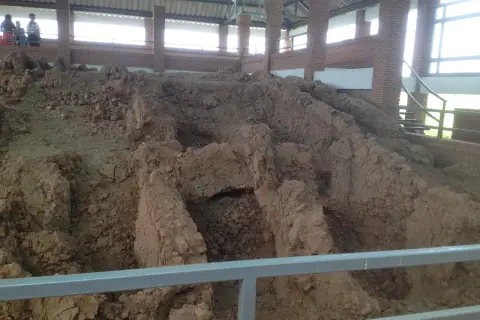
What Khmer ware is and why it matters
The pottery made here is mostly brown-glazed stoneware, with some green-glazed pieces, made in large numbers for towns across the Khmer world. That makes it an industry, not a village craft. The kilns date from roughly the 9th to the 14th century, about a thousand years ago.
Ban Kruat district has both the kilns and the sandstone quarry that supplied the temples. Put the two side by side and a temple like Phanom Rung stops looking like a monument in empty land. It had craftwork and transport behind it.
What the display centre has
The kiln display centre is on Highway 2075 between km 21 and 22, in Prasat subdistrict. It shows glazed pottery from local kilns. The excavated kiln pits are at Sawai and Nai Chian.
| Location | Highway 2075 km 21 to 22, Prasat subdistrict, Ban Kruat |
|---|---|
| Distance from Buriram city | About 66 km by road |
| Hours | About 08:30 to 16:30 Monday to Friday. Check whether it opens at weekends |
| Fee | Free. Check before you go |
| Time to allow | About 45 to 60 min at the centre, half a day if you add the Sawai and Nai Chian kilns |
| Contacts | School 044 679 098, Fine Arts Office 10 Nakhon Ratchasima 044 471 518, Ban Kruat municipality 044 679 067 |
Directions to the centre can be confusing, so phone before you set off and ask exactly where to park. Go on a weekday, because a centre inside a school may be shut on days off.
Sawai and Nai Chian kilns
These are the two kilns the Fine Arts Department excavated. Sawai has a roofed shelter over the kiln pit, where you can see the clay walls and fire channels. Nai Chian at Ban Thanon Noi is a set of exposed kiln foundations in farmland, with no ticket booth, no visitor centre and almost no signs. Entry is free. See the display centre first: once you have seen real pottery, the pits in the field are much easier to read.
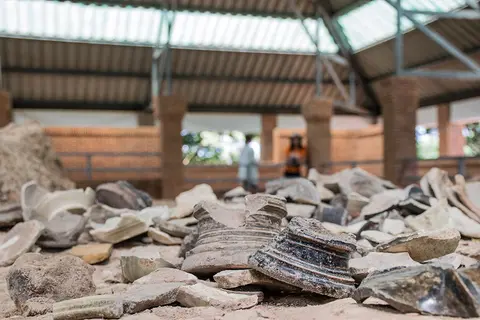
Do not take sherds home and do not climb on the kiln walls. If you want to handle a piece, ask the staff. Many of the pieces are a thousand years old and count as archaeological evidence.
The Thousand-Year Ceramics festival
Ban Kruat holds a yearly festival called the Thousand-Year Ceramics, Ban Kruat Tradition and Red Cross Fair. The 34th edition ran from 28 Feb to 5 Mar 2026. It has archaeology displays, pottery demonstrations and sales, performances and a Red Cross fair. A replica kiln stands in the town and there is a free light and sound show at night. The 2027 dates have not been announced, so phone the municipality before planning a trip around it.
Food
Ban Kruat town has a fresh market and small restaurants. Eat lunch there, since the kiln sites in the fields have no food, and carry water and snacks.
Is it worth the trip?
Yes if you care about pottery or archaeology, or are driving through Ban Kruat anyway. It is not worth a long journey if you only like temples, because what you see is a pit in the earth and broken pots rather than fine architecture. Read border-area access first.
 KKday
Private Transfer between Bangkok and Buriram
From US$126.03 (Starting price per car)
Price as of 6 Nov 2026Arriving from Bangkok for several days of ruins and kilns? This private car with driver picks you up at a Bangkok hotel or address and drops you at a hotel or address in Buriram city, or runs the other way. Free cancellation up to 3 days ahead. Arrange a separate local driver for the Ban Kruat day, because this is an intercity transfer, not a tour of the province.
Car Bangkok to Buriram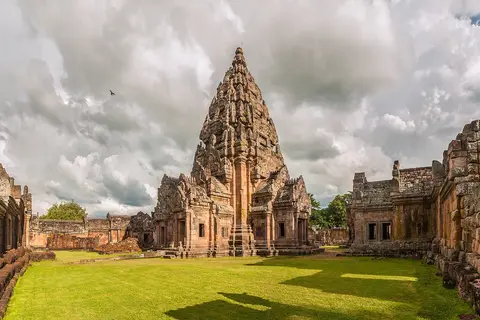 Klook
Buriram Province Car Rental
From US$37.55 (Starting price per day, compact car, as of 13 Nov 2026)
Price as of 13 Nov 2026A rental car from the supplier on the booking page, pick-up and drop-off at the places you choose, insurance and terms as listed. Check the driver age and the deposit on the booking page. Cancellation terms differ by car. See the booking page.
Book on KlookBan Kruat stone quarry: the sandstone source behind the temples
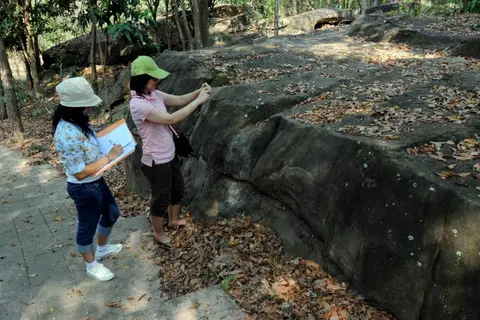
Much of the sandstone for Khmer temples in lower Isan was cut here. The quarry covers about 7 square km, roughly 4,600 rai, at Khao Kloi and Khao Krachiao. It lies about 7 km from Ban Kruat town on the road to Ta Phraya, then about 3 km off the main road. What you see are grooves and chisel holes in the rock face, and sandstone blocks that were pried out and left behind.
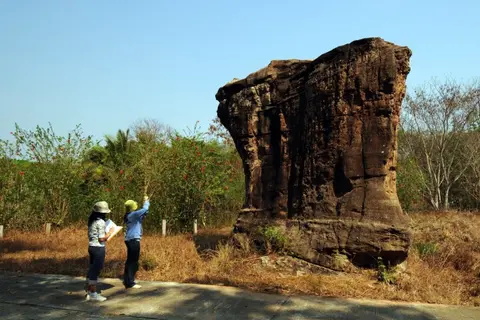
The cuts are straight and deep, and in places you can still see rows of chisel marks on the rock face.
| Location | Prasat subdistrict, Ban Kruat, near Wat Pa Lan Hin Tat on the Ban Kruat to Ta Phraya road |
|---|---|
| Hours | About 08:00 to 17:00 daily. Check before you go |
| Fee | Check before you go |
| Time to allow | About 45 to 60 min |
| Status | In the border zone. Always check first. See border-area access |
| Contacts | Wat Pa Lan Hin Tat 085 668 3710, Fine Arts Office 10 044 471 518, Phanom Rung Historical Park 044 666 251 |
If conditions are normal and it is open, go in the morning or late afternoon, when low light puts shadows in the grooves. Wear sturdy shoes, since the rock is slippery after rain, and stay on the marked path. The quarry is nearer the border than Ban Kruat town, so do not wander off the route or enter anywhere signed as closed.
If you have to choose between the pottery display centre and the quarry, pick the centre first: it has a roof and staff. Visit the quarry only if the office or the temple confirms it is open that day.
Prasat Thong and other small ruins in Ban Kruat
Ban Kruat district has several more small ruins. Prasat Thong is a brick and sandstone doorway with a carved lintel above the door, about 9 km from the district town. Prasat Thamo is further, about 18 km from the district centre, with less to see and no clear opening information. Check the locations with the municipality before you go.
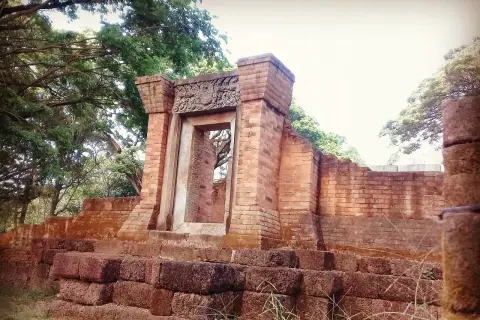
Treat these as stops once you are in Ban Kruat, not as a reason to drive far. Search by name, trying more than one spelling, and ask the municipality which ones you can visit that day. Small ruins closer to the border than these are not advised for visitors at the moment.
Prasat Ta Muen Thom is in Surin province on the border, and some governments list it as closed to tourists. See the Surin Khmer temples page for the latest.
Border-area access: what is fine and what to check first
Southern Buriram touches Cambodia, so some of the sites on this page lie in an area covered by foreign travel advice. The situation can change, so check each time.
- Land border crossings between Thailand and Cambodia were suspended as of 6 Nov 2026, so do not plan to cross from Buriram.
- The UK government advises against all but essential travel within 20 km of the land border and mentions unexploded landmines in the area. It also lists some tourist sites near the border as closed, including Preah Vihear, Ta Kwai and Ta Muen Thom.
- The Canadian government advises avoiding travel within 50 km of the border and describes security in the area as unpredictable.
- Inside Buriram, whether a given site is open depends on the office that looks after it, and that can change. The Ban Kruat festival ran from 28 Feb to 5 Mar 2026, but that does not mean everywhere is open every day.
Sites grouped by distance from the border
| Group | Sites | Advice |
|---|---|---|
| Well inland | Phanom Rung, Muang Tam, Wat Khok Ngio, Kuti Rishi chapels, Ban Bu, Ku Suan Taeng, Wat Khao Angkhan | Further from the border. Check opening hours around festivals and holidays as usual |
| Southern part of the province | Prasat Nong Hong near Lam Nang Rong dam, Non Din Daeng | Phone or ask your hotel first. If you meet signs or a checkpoint, follow the officials |
| Close to the border | Ban Kruat quarry, small ruins in Ban Kruat and Lahan Sai | Check with the municipality or the Fine Arts Office first. If it is unclear, skip it |
What to do before you set off
- Phone Ban Kruat municipality on 044 679 067 during office hours (Monday to Friday, about 08:30 to 16:30) and ask if the place you plan to visit is open.
- For the quarry or kilns, also try the Fine Arts Office 10 Nakhon Ratchasima on 044 471 518 or Phanom Rung Historical Park on 044 666 251.
- Ask your hotel or a local driver whether the road you plan to use is normal.
- If you meet a sign, a checkpoint or advice from soldiers or officials, follow it at once, and never walk into closed or marked areas.
- Check that your travel insurance covers areas near the border. Some policies exclude places your government advises against.
If you are still unsure after checking, skip the southern group and visit the Kuti Rishi chapels, Ban Bu and Wat Khao Angkhan instead. They are on the Phanom Rung route.
Government advice as of 6 Nov 2026. Check your own government's latest travel advice before you go.
Prasat Nong Hong, Non Din Daeng: three brick towers in Baphuon style near Lam Nang Rong dam
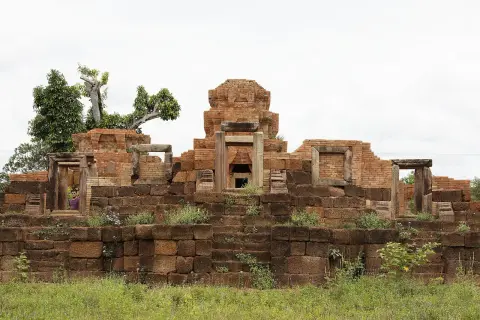
Prasat Nong Hong stands in Moo 9, Non Din Daeng subdistrict, on the left side of the Lam Nang Rong dam crest and under 2 km from it. It is a small brick sanctuary from about the 11th century and one of the oldest in this group. It was built as a Hindu shrine.
What remains
- Three brick towers on one laterite base, facing east, with the middle one larger.
- Only the front door of the central tower is a real entrance. The other doors are false. The plan is square with indented corners.
- A laterite library stands facing the southern tower.
- A laterite wall encloses the site, with gateways at the front and back and a U-shaped moat outside it.
- The original lintels showed Hindu scenes: Vishnu on Garuda on the north tower, Indra on the elephant Erawan in the centre and Shiva on the bull on the south.
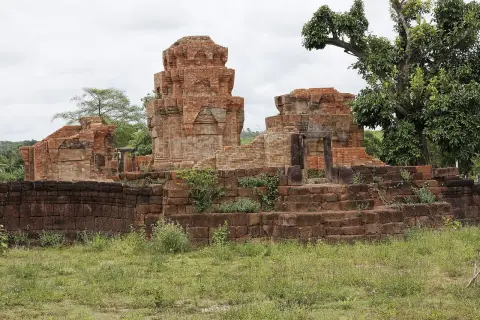
Parts of the towers have been restored and the side tower is visibly ruined. This is a place to look at from outside and to photograph, and it suits anyone interested in Khmer architecture before the Angkor Wat era.
The lost lintel that came home
A lintel showing Yama on a buffalo, which belongs to Nong Hong, went missing in the 1960s. It later turned up in the Asian Art Museum in San Francisco and was returned to Thailand on 28 May 2021. It has been displayed at the Phanom Rung information centre since 30 Jun 2022. Check it is still on show. If you want to see it, do it when you visit Phanom Rung rather than driving to Nong Hong for it.
| Location | Moo 9, Non Din Daeng subdistrict and district, left of the Lam Nang Rong dam crest |
|---|---|
| Distance | About 42 km from Nang Rong to the dam, about 45 min. From Buriram city about 98 km, 1.5 to 2 h by car. From Phanom Rung about 45 km |
| Hours and fee | Open ground. Normally no ticket booth and no staff, free. Check before you go |
| Time to allow | 15 to 30 min. With the dam, about half a day |
| Facilities | No shade and nothing sold at the site. Restaurants are in Non Din Daeng town and near the dam |
| Best time | Early morning or before sunset, November to February |
Getting to Nong Hong
You need a car or a motorbike, because no public transport comes this far south. The simplest method is to pin Prasat Nong Hong in your map app, or to search for Lam Nang Rong dam and look for the temple pin near the crest. From Buriram city one route goes via Highway 219 to Prakhon Chai, Highway 2075 to the Ban Kruat industrial estate, a right turn on Highway 2121 to Lahan Sai, then left on Highway 3068 through Non Din Daeng and left to the dam. The route from Nang Rong is shorter. For the dam and the approach from Nang Rong, see the Lam Nang Rong dam page.
Few people come here. That means quiet photos, and also that nobody can help if the car breaks down or you get lost. Fill the tank in Nang Rong or Non Din Daeng and download an offline map, because mobile signal in the fields can be patchy.
For photos, go in the early morning or late afternoon, when the light suits the brick. Cows sometimes graze on the grounds and give a sense of scale. Do not go close to them.
 12Go
Bangkok to Phanom Rung private car on 12Go
From US$215 (As of 6 Nov 2026: 3-seat comfort cars from about US$215 per car, SUVs about US$219, 9-seat vans about US$233. Prices change by date and operator)
Price as of 6 Nov 2026To see Phanom Rung and Nong Hong on one trip from Bangkok, this private car collects you from a Bangkok hotel or from Suvarnabhumi or Don Mueang airport and takes you to Phanom Rung. Then arrange a local driver for the leg to Nong Hong. The booked ride is one way to Phanom Rung and does not include touring.
Car to Phanom RungPrasat Wat Khok Ngio, Pakham: a hospital chapel in a temple yard on the Nang Rong to Pakham road
Prasat Wat Khok Ngio is inside the grounds of Wat Khok Ngio, Ban Khok Ngio, Pakham district, on Highway 348 between Nang Rong and Pakham, about 3 km before Pakham town. It is an arogyasala from the reign of Jayavarman VII, around the late 12th and early 13th century, one of 102 hospital chapels. The plan is a rectangle facing east.
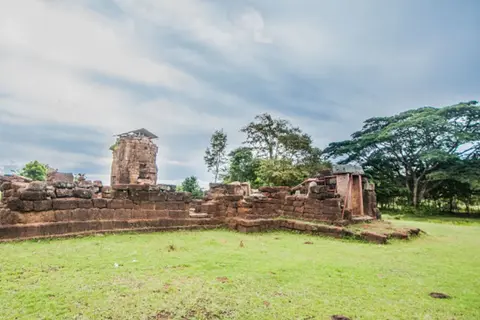
Inside are a main laterite tower, a hall, a wall with a gateway and a pond. Two carved stone figures are identified as Bhaisajyaguru, the healing Buddha, and Avalokiteshvara, both tied to healing. A curved bronze plate with Khmer script, about 13.5 by 21.7 cm, was also found. It is a small building with one tower, not a major temple-mountain, so a short stop is enough.
| Location | Highway 348, about 3 km before Pakham town, in Wat Khok Ngio |
|---|---|
| Hours and fee | No gate or ticket booth. Free, in daylight, since it is a temple yard. Check before you go |
| Time to allow | 20 to 30 min |
| Facilities | No shade over the ruins and no shops. Use your own vehicle |
| Pairs with | Prasat Nong Hong |
Because it is a working temple, dress modestly, take your shoes off before entering any building with a Buddha image, and do not climb the walls or step on the base. Wear shoes with grip, because grass and stone are uneven.
This site is in the inland part of the province. Pick it when you want to see a real hospital chapel with its layout still readable. Skip it if you do not care for deeper Khmer history.
Kuti Rishi Nong Bua Rai, Khok Mueang and Prasat Ban Bu: hospital chapels and a rest house near Phanom Rung
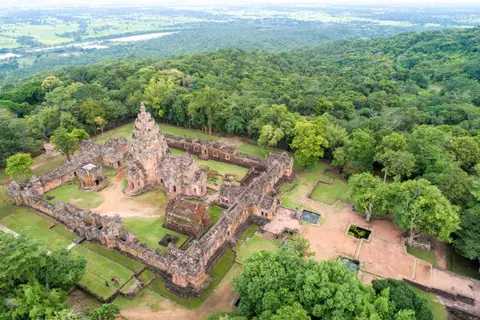
These three sit around the foot of Phanom Rung and Muang Tam, about 15 to 20 minutes apart by car, so they make a good add-on after Phanom Rung. With a car, allow about 1 to 1.5 hours in all.
Kuti Rishi Nong Bua Rai
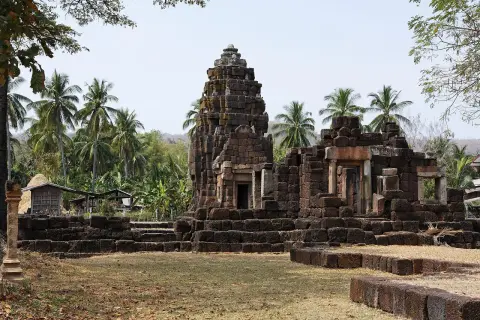
In Moo 7, Chorakhe Mak subdistrict, Prakhon Chai, about 3 km south of the foot of Phanom Rung on the Phanom Rung to Prakhon Chai road. It is a laterite tower about 5 m wide with an east door, false doors on the other three sides, a lintel with a seated Buddha above a kirtimukha and a four-tier lotus top. A laterite wall and an east gateway survive, along with an earth embankment about 2 m high and over 1 km long. The style is Bayon, from the time of Jayavarman VII, and it is a Mahayana Buddhist hospital chapel. It was registered as an ancient monument in the Royal Gazette on 8 Mar 1935. The Fine Arts Department looks after it through Phanom Rung Historical Park.
Kuti Rishi Khok Mueang
North-west of Muang Tam, about 800 m on foot from Muang Tam. It is another hospital chapel of Jayavarman VII, from the same period. What stands is a tall laterite wall with a doorway and a window framed in sandstone, in an open field. The light is nicest in the morning or late afternoon.
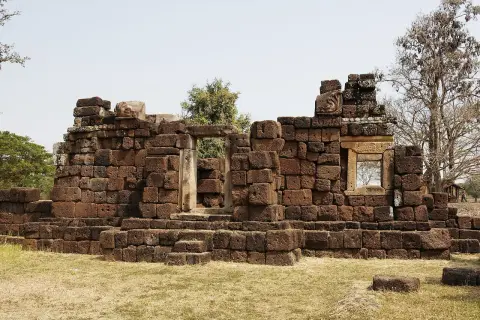
Khok Mueang village is a community tourism village open from 08:00 to 17:00 daily. Activities include an ox-cart ride around the village, the Kuti Rishi and the baray, silk woven in the local phakkut fern pattern, and reed mats. Phone 08 8193 8840 or 08 0282 8239 beforehand to ask about activities and prices.
Prasat Ban Bu
Inside Ban Bu Witthayasan school, about 2 km east of the foot of Phanom Rung. It is a rectangular laterite building, a dharmasala or rest house from the time of Jayavarman VII, on the plain beside the old road linking Angkor and Phimai. The surviving building has window openings in its wall. Since it is inside a school, go when the school allows and ask the staff before you enter. If the school is closed on days off, go on a weekday.
| Site | Type of building | Rough distance | Time to allow |
|---|---|---|---|
| Kuti Rishi Nong Bua Rai | Arogyasala (hospital) | About 3 km south of the foot of Phanom Rung | 15 to 20 min |
| Kuti Rishi Khok Mueang | Arogyasala (hospital) | About 800 m on foot from Muang Tam | 15 to 20 min, or about 1 h with the village |
| Prasat Ban Bu | Dharmasala (roadside rest house) | About 2 km east of the foot of Phanom Rung | 15 min |
The distances between these sites vary with the route you drive, so think of them as a loop around Phanom Rung, not a walk. For Phanom Rung, Muang Tam and Plai Bat see Phanom Rung and Muang Tam.
In the hot months from March to May, do Phanom Rung before 11:00 and visit the chapels in the late afternoon. The low light makes the red laterite glow and it is much cooler.
 12Go
Bangkok to Phanom Rung private car on 12Go
From US$215 (As of 6 Nov 2026: 3-seat comfort cars from about US$215 per car, SUVs about US$219, 9-seat vans about US$233. Prices change by date and operator)
Price as of 6 Nov 2026If you want one car from Bangkok all the way to Phanom Rung and then the chapels and Ban Bu, agree the day and timing with a local driver. The private car here takes you to Phanom Rung as booked.
Car to Phanom RungKu Suan Taeng: three brick towers in Angkor Wat style in the north of the province
Ku Suan Taeng is in the north of the province, far from the Phanom Rung line and far from the border. It lies at Ban Dong Yang, Ku Suan Taeng subdistrict, west of Ku Suan Taeng Phitthayakhom school. Three brick towers stand in a north to south row on a single laterite base and face east. There is one real door. In front are two laterite libraries and an old pond. There is no enclosing gallery. It was built in the Angkor Wat style, around the 11th to 12th century, and is a registered monument of about 5 rai.
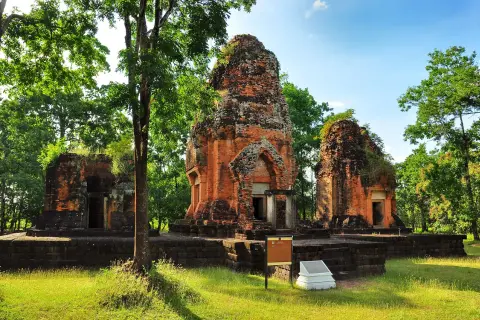
From Buriram city it is about 110 km, using Highway 219 and Highway 202. That is nearly a day round trip, so it is not worth making your only target.
| Location | Ban Dong Yang, Ku Suan Taeng subdistrict and district, west of the Ku Suan Taeng Phitthayakhom school |
|---|---|
| Distance | About 110 km from Buriram city, about 2 h. Check before you go |
| Hours and fee | Check hours before you go |
| Time to allow | 30 to 45 min |
Go only if you are already travelling through the north of the province or want to collect all the brick sanctuaries of this type. If time is short, spend it at Nong Hong or the Kuti Rishi chapels.
Wat Khao Angkhan: Dvaravati boundary stones on an extinct volcano, past Phanom Rung
Wat Khao Angkhan sits on Khao Angkhan, an extinct volcano in Chaloem Phra Kiat district, about 20 km past Phanom Rung on the same road (through Nang Rong, Ban Tako and Ban Ta Pek). The temple holds sandstone boundary stones from the Dvaravati period, carved with figures, stupas, lotuses and the wheel of law, from about the 7th to 9th century. These are far older than the Khmer ruins on this page, so this is a different layer of history, not a Khmer monument.
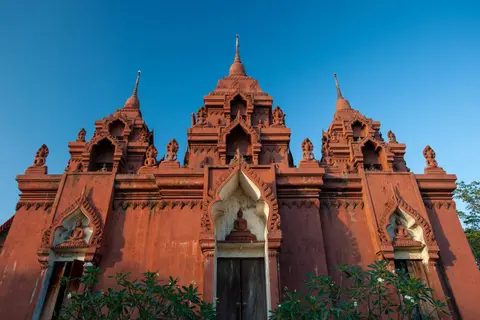
What you actually see on arrival is a striking brick-red ordination hall against the sky. Inside are Jataka murals with English captions. The Dvaravati stones are the old evidence, but the hall that photographs well is modern. Stop if you want good pictures or to pay respects. Skip it if you want Khmer stone temples.
| Hours | 08:00 to 17:00 daily |
|---|---|
| Location | Ban Charoen Suk, Chaloem Phra Kiat district, about 20 km past Phanom Rung |
| Time to allow | 30 to 45 min |
| Best light | Morning or late afternoon on the brick-red hall |
Dress modestly and take shoes off inside the hall. It makes a good last stop on a full Phanom Rung day when you drive back the same way.
Plans for the small ruins and kilns: half day, full day and two days
The small sites lie in different directions, so planning by geography avoids doubling back. The times are estimates from approximate distances. Add 20 to 30 per cent to cover parking, photos and wrong turns.
| Plan | Route in short | Total time | Suits | Booking |
|---|---|---|---|---|
| A: after Phanom Rung | Phanom Rung in the morning, then Muang Tam, Kuti Rishi Nong Bua Rai, Ban Bu, Kuti Rishi Khok Mueang, and Wat Khao Angkhan if time allows | Full day, about 8 to 9 h | Anyone already visiting Phanom Rung who wants extras without a long drive | Car to Phanom Rung |
| B: Nang Rong day | Nang Rong, Wat Khok Ngio (Pakham), then Nong Hong and Lam Nang Rong dam | Half to full day, about 5 to 7 h | Quiet brick ruins and a reservoir view | Car Bangkok to Buriram |
| C: Ban Kruat day (check the situation first) | Buriram city, display centre, Sawai and Nai Chian kilns, lunch in Ban Kruat, return | Half day, about 5 to 6 h with 2.5 h of driving | People interested in pottery and archaeology | One-way car Bangkok to Buriram |
| D: two days | Day 1 Phanom Rung, Muang Tam and the Kuti Rishi chapels. Day 2 Wat Khok Ngio, Nong Hong and the dam | 2 days, 1 night in Nang Rong | People who want both the big and small temples without hurrying | Trains, buses, flights |
 Klook
Buriram Province Car Rental
From US$37.55 (Starting price per day, compact car, as of 13 Nov 2026)
Price as of 13 Nov 2026A rental car from the supplier on the booking page, pick-up and drop-off at the places you choose, insurance and terms as listed. Check the driver age and the deposit on the booking page. Cancellation terms differ by car. See the booking page.
Book on KlookPlan A by the clock: Phanom Rung, then the chapels and Ban Bu
| Time | Where | Notes |
|---|---|---|
| 06:30 to 09:30 | Phanom Rung Historical Park | Open 06:00 to 18:00, 200 baht for foreigners, 20 for Thais. See Phanom Rung |
| 09:30 to 10:30 | Prasat Muang Tam | Combined ticket with Phanom Rung: 250 baht foreigners, 30 Thais |
| 10:45 to 11:15 | Kuti Rishi Khok Mueang and the village | Right after Muang Tam |
| 11:30 to 12:15 | Kuti Rishi Nong Bua Rai and Prasat Ban Bu | Ban Bu is in a school: ask first |
| 12:00 to 13:30 | Lunch near Nang Rong or Prakhon Chai | Restaurants are in the district towns, none at the small ruins |
| 14:00 to 15:00 | Wat Khao Angkhan, if you still have energy | 08:00 to 17:00, about 20 km past Phanom Rung |
Plan B by the clock: the Nang Rong day
| Time | Where | Notes |
|---|---|---|
| 08:00 | Leave Nang Rong | Fill the tank and buy water first |
| 08:30 to 09:00 | Prasat Wat Khok Ngio (Highway 348) | Dress modestly, it is a temple yard |
| 10:30 to 11:15 | Prasat Nong Hong | Morning light is still good and not too hot |
| 11:30 to 13:30 | Lam Nang Rong dam and lunch | More on the dam page |
| 14:00 to 15:00 | Drive back to Nang Rong | About 42 km, about 45 min from the dam |
The Plan B times depend on the drive from Wat Khok Ngio to Nong Hong, which varies with the route you choose. Open your map app on the day to see the real time.
Continuing to Surin or Sisaket
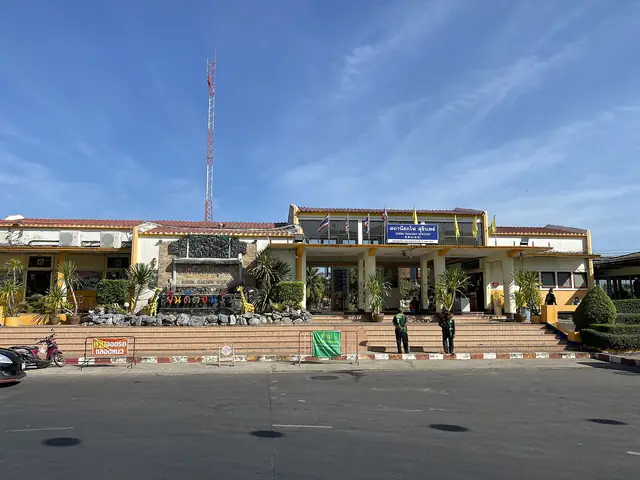
If you want more Khmer temples across the provincial line, Surin is about 52 km from Buriram and the train between the two takes only about 30 to 55 minutes depending on the train. Surin has Prasat Sikhoraphum, Ban Phluang, Phum Pon and Mueang Thi: see the Surin Khmer temples page. Sisaket has Prasat Sa Kamphaeng Yai and Ta Len: see the Sisaket Khmer temples page. Both provinces are over 50 km from Buriram and need at least half a day. If you stay there overnight, take the train or bus across and hire a local car.
 12Go
Buriram to Surin on 12Go
From US$2 (As of 6 Nov 2026: trains from about US$2, a sedan taxi about US$44 per car. Prices change by date and class)
Price as of 6 Nov 2026The train from Buriram to Surin takes about 30 to 55 minutes depending on the train. It suits visitors who want to go on to Prasat Sikhoraphum and the other Surin temples.
Book on 12Go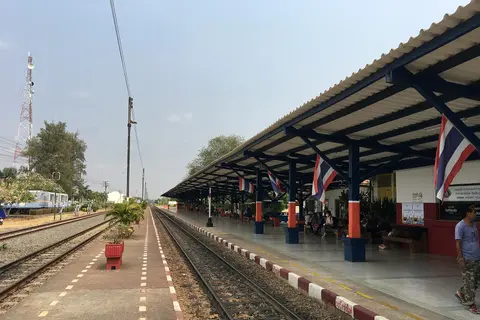 12Go
Si Sa Ket to Buriram on 12Go
From US$2 (As of 6 Nov 2026 (sample travel date 13 Nov): Class 3 train seats from about US$2 to US$3, Class 2 seats about US$5. Prices change by date and operator)
Price as of 6 Nov 2026Trains between Sisaket and Buriram, for people who visit the Sisaket Khmer temples and then continue to Buriram, or the reverse.
Book on 12GoGetting there, hours, fees, season and what to bring
How to get around without a car
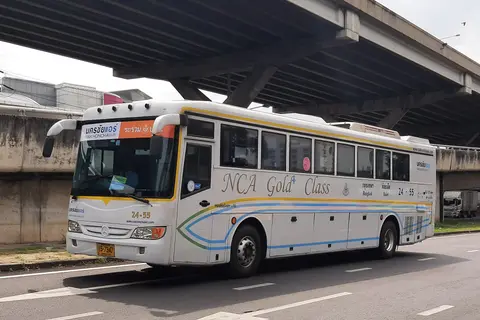
None of the small ruins on this page can be reached by public bus. Without a car you have three real options. Ask your hotel in Nang Rong to arrange a driver for the day, which is usually simpler and more reliable than hoping for a ride-hailing car in the countryside. Or rent a motorbike (ask your hotel) for the area near Phanom Rung, if you ride confidently. Or hire a taxi or minivan in Buriram city. Prices are not fixed, so ask several drivers and keep the route, price and waiting time in a chat message.
For flights and trains from Bangkok to Buriram see the Buriram getting there page. Train, bus and flight options are all bookable from the same listing.
 12Go
Bangkok to Buriram on 12Go
From US$6 (As of 6 Nov 2026 (sample travel date 13 Nov): Class 3 trains from about US$6 to US$7, Class 2 air-conditioned seats about US$14, buses from about US$12, Nakhonchai Air from about US$15, Thai AirAsia flights from about US$56, sedan taxis from about US$144 per car. Prices change by date and operator)
Price as of 6 Nov 2026Trains, buses and flights from Bangkok to Buriram, before you hire a local car for the small ruins.
Book on 12Go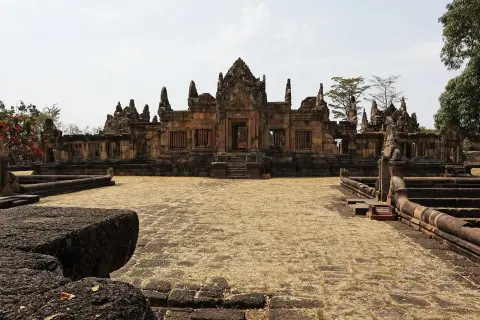 KKday
Bangkok to Buriram Private Transfer
From US$139.45 (Starting price per car)
Price as of 6 Nov 2026A private car with driver, one way, from Bangkok city to the address you give in Buriram. Tolls, fuel, driver and insurance are included as described on the booking page. Touring the small ruins needs a separate local car.
Car Bangkok to Buriram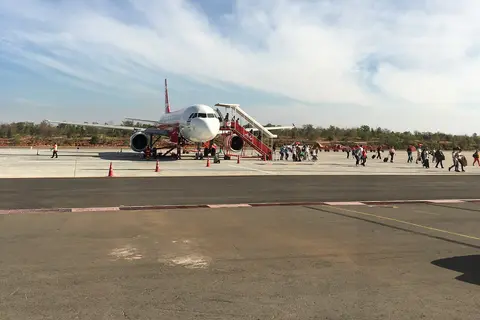 Klook
Buriram Province Car Rental
From US$37.55 (Starting price per day, compact car, as of 13 Nov 2026)
Price as of 13 Nov 2026A rental car from the supplier on the booking page, pick-up and drop-off at the places you choose, insurance and terms as listed. Check the driver age and the deposit on the booking page. Cancellation terms differ by car. See the booking page.
Book on KlookSpellings to search and how to brief a driver
English spellings of small Thai sites vary a lot, so try more than one if the first pin looks wrong. Ask your hotel to write the Thai name of each place on a card or in a chat message for the driver, and show the card rather than reading the name aloud.
| Place | Spellings you may need |
|---|---|
| Prasat Nong Hong | Prasat Nong Hong, Nong Hong Sanctuary |
| Ban Kruat kilns | Ban Kruat ancient kiln site, Tao Sawai, Nai Chian kiln, Ban Thanon Noi kiln |
| Ban Kruat quarry | Ban Kruat stone quarry, Wat Pa Lan Hin Tat |
| Wat Khok Ngio | Prasat Wat Khok Ngio, Khok Ngio sanctuary |
| Hospital chapels | Kuti Rishi, Kuti Ruesi, Ku Rishi (Nong Bua Rai, Khok Mueang) |
| Ban Bu | Prasat Ban Bu |
| Ku Suan Taeng | Ku Suan Taeng, Prang Ku Suan Taeng |
| Wat Khao Angkhan | Wat Khao Angkhan, Khao Angkan |
| Lam Nang Rong Dam | Lam Nang Rong Dam, Lamnangrong reservoir |
Hours, fees and time to allow (as of 6 Nov 2026)
The Ban Kruat display centre and the Khok Mueang village have staff. The rest are mostly open ground in farmland or temple yards, with no ticket booth and no shops. For Phanom Rung and Muang Tam hours and fees see Phanom Rung and Muang Tam.
Best season
- November to February: cool and dry. The most comfortable season for open-air ruins.
- March to May: very hot, and the small ruins have no shade. Go at first light and finish by 11:00.
- June to October: rain. Laterite and grass are slippery, and field roads can turn to mud. It is green and pretty, but allow extra time.
What to bring and how to behave
- At least 1.5 to 2 litres of water each, a hat, sunscreen and shoes with grip.
- An offline map on your phone, and a full tank before leaving the main road.
- Small cash for temple donations and drinks from roadside stalls.
- Modest clothing in temples or wherever there is a Buddha image, and shoes off where indicated.
- Do not climb walls or step on the bases, and do not take stones or pottery sherds.
- Do not fly a drone over a heritage site without permission.
Where to eat
The small ruins have almost no restaurants. Plan lunch in a district town: Nang Rong, Prakhon Chai, Ban Kruat or Non Din Daeng. Keep water and snacks in the car. Some small-town shops close early, so aim to eat before 13:30.
What to see, what to skip and common mistakes
Who each site suits
| If you | Go to | You can skip |
|---|---|---|
| Have half a day and are already at Phanom Rung | Kuti Rishi Khok Mueang, Nong Bua Rai, Ban Bu | Ban Kruat, Ku Suan Taeng |
| Like photographing quiet brick ruins | Nong Hong, Ku Suan Taeng | The quarry |
| Are interested in pottery and archaeology | Ban Kruat display centre, Sawai kiln | Ku Suan Taeng, Wat Khao Angkhan |
| Travel with children or older relatives | Wat Khao Angkhan, Kuti Rishi Khok Mueang | The quarry, which involves walking on rock |
| Dislike long drives and worry about the border | All of Plan A | Everything in the south |
| Have no car and do not want to hire one | Phanom Rung and Muang Tam | Everything else on this page for now |
Common mistakes
- Going to Ban Kruat or the quarry without phoning to check the status.
- Expecting a ticket booth and staff, and finding open ground with nobody there.
- Visiting Ban Bu or the centre inside a school on a weekend and finding the gate shut.
- Underestimating drive times. Distances look short on a map but country roads are slow.
What is still uncertain
Three things are not settled: the real opening hours of the centre inside the school and of the quarry, the status of the border-area sites, and the dates of the 2027 Thousand-Year Ceramics festival. Phone before you go.
Where to sleep if you plan to see the small ruins
The best base for the small ruins is Nang Rong, about 26 km by road from Phanom Rung and about 42 km from Lam Nang Rong dam, on the way to Wat Khok Ngio. From there you can go either way without returning to Buriram city, which is about 55 km from Nang Rong. For Ban Kruat itself Buriram city is closer. For city hotels and race weekends see where to stay in Buriram.

Phanomrungpuri Hotel
212 Prachantakhet Road, Nang Rong
A hotel in Nang Rong town, a practical base for Phanom Rung, Ban Bu, the Kuti Rishi chapels and for the Nang Rong day to Wat Khok Ngio and Nong Hong. It has free parking and a shuttle service.
See prices and availability on the booking page
Choose Nang Rong when you spread the trip over more than a day, as in Plan D. With one day only you can do the round trip from Buriram city, but start early, because Phanom Rung opens at 06:00 and the drive from the city takes about 1 to 1 h 15 min.
Frequently asked questions
Where is Prasat Nong Hong, what time does it open and what does it cost?
It is in Non Din Daeng subdistrict, on the left of the Lam Nang Rong dam crest and under 2 km from it. It is open ground with normally no ticket booth and no staff, and entry is free. Allow 15 to 30 minutes. There is no shade, so go early in the morning or late in the afternoon. Check before you go, because it is in the south of the province.
How is Nong Hong different from Phanom Rung?
Nong Hong is three small brick towers on one laterite base, in Baphuon style from about the 11th century, and largely ruined. Phanom Rung is a restored sandstone temple on an extinct volcano, with staff, fees and a naga bridge. If time is short, go to Phanom Rung first. Nong Hong suits people who like earlier Khmer architecture and want to combine it with Lam Nang Rong dam.
What is a kuti rishi, and was it really a hermit's hut?
No. Kuti rishi is a name locals gave to the arogyasala, or hospital chapel, from the time of Jayavarman VII, around the late 12th and early 13th century. It has a small laterite tower, a hall, a wall and a pond. Two stand near Phanom Rung, at Nong Bua Rai and Khok Mueang. Wat Khok Ngio is also a hospital chapel.
What is Prasat Ban Bu and can I visit?
It is a dharmasala, a rest house for travellers, from the time of Jayavarman VII, inside Ban Bu Witthayasan school about 2 km east of the foot of Phanom Rung. It is a rectangular laterite building. Because it is inside a school, go when the school allows and ask first. It may be closed at weekends and takes 15 minutes or less.
Are the Ban Kruat kilns open, and how far are they?
Ban Kruat town is about 66 km from Buriram city. The display centre is open about 08:30 to 16:30 Monday to Friday and is free. The Sawai and Nai Chian kilns are roughly 5 to 10 km from the town, on open ground. Ban Kruat is near the border, so phone the municipality on 044 679 067 or the school on 044 679 098 before every visit.
Is it safe to visit Ban Kruat and the border-area ruins now?
Land border crossings with Cambodia were suspended as of 6 Nov 2026 and several governments advise caution within 20 to 50 km of the border. Check with the municipality or the Fine Arts Office 10 before you go, follow the officials, and stay out of areas with warning signs. If in doubt, choose the ruins on the Phanom Rung route instead.
Can I see these ruins without a car?
It is difficult. No public bus reaches them. Options are to ask your hotel in Nang Rong to arrange a driver for the day, rent a motorbike if you ride well, or hire a taxi or minivan from Buriram city. Agree the price and route first. From Bangkok you can book a private car to Phanom Rung or to Buriram city, then arrange a local car for the rest.
Can I combine Prasat Nong Hong with Lam Nang Rong dam?
Yes, and you should. The ruins are under 2 km from the dam crest. From Nang Rong it is about 42 km to the dam, around 45 minutes. A good half day: Wat Khok Ngio on Highway 348 in the morning, then Nong Hong, the dam and lunch.
Are Ku Suan Taeng and Wat Khao Angkhan worth visiting?
Ku Suan Taeng is in the north of the province, about 110 km from Buriram city, three brick towers in Angkor Wat style. Go only if you are travelling that way. Wat Khao Angkhan is about 20 km past Phanom Rung, open 08:00 to 17:00, with Dvaravati boundary stones and a brick-red hall. Stop if you have time, but it is not a Khmer temple.
How much time do I need for the small Khmer sites?
After Phanom Rung, about 1 to 1.5 hours for the Kuti Rishi chapels and Ban Bu. A Nang Rong day with Wat Khok Ngio, Nong Hong and the dam takes about 5 to 7 hours. A Ban Kruat day takes about 5 to 6 hours including the drive. To see it all, stay two days and one night in Nang Rong.
Where the facts come from
Keep planning
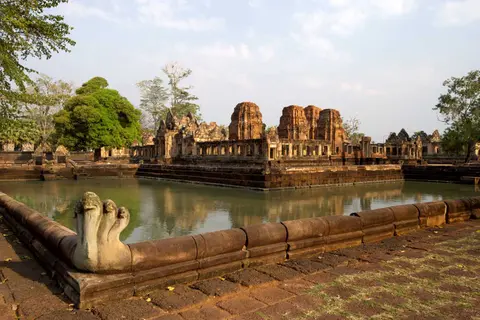 Buriram: Phanom Rung, Chang Circuit and Khmer sitesOverview of the province by zone, with fees, best season, transport and where to stay
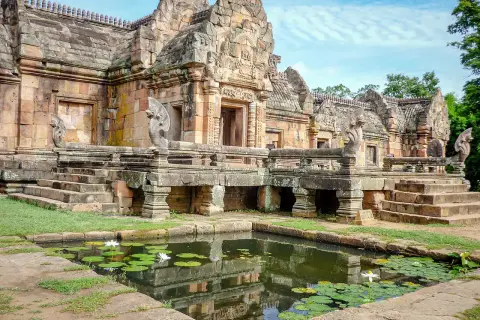 Buriram in 1 to 2 daysOne-day Phanom Rung plan, 2 days 1 night, race and football weekends
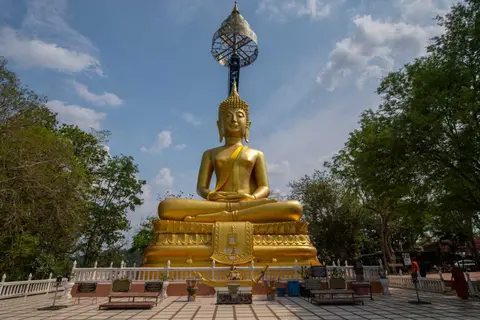 Phanom Rung, Muang Tam and Khao KradongFees, hours, the sun through 15 doors, and how to go without a car
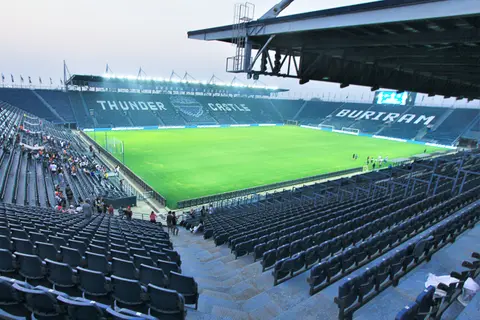 Buriram city, Chang Circuit and Chang ArenaRace track, Buriram United, city pillar shrine, walking street and food
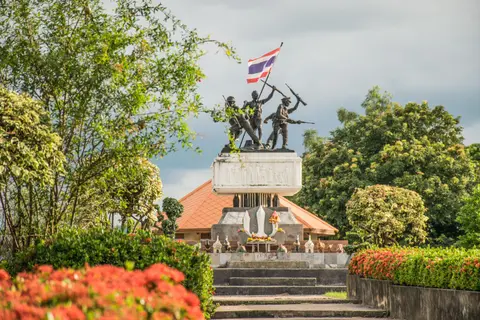 Lakes and Nang RongLam Nang Rong dam, cranes, basalt columns, and Nang Rong as a base
 Getting to BuriramTrain, bus, flight and car from Bangkok, Korat and Surin
 Where to stay in BuriramNear the circuit and arena, city centre, station side and Nang Rong; booking race weekends
 Buriram deals this monthTransport, private cars, hotels and how to buy race tickets