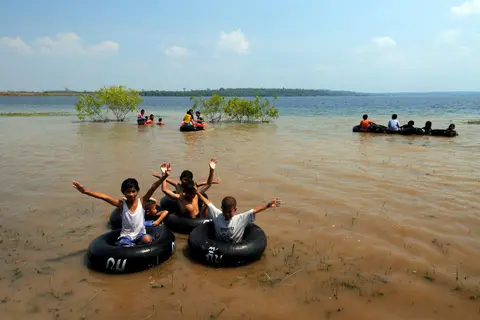
Most visitors come to Buriram for the Khmer temples and the racing circuit, and leave without knowing the province also has wide water, wet grassland and a lava rock wall. In the far south is Lam Nang Rong dam, which locals call the sea of Buriram: a big freshwater reservoir with a sand beach and inner tubes for hire. Close to Buriram city are the wetlands where Thailand's Sarus cranes have been released back into the wild. And around the town of Nang Rong, the closest base to Phanom Rung, you can see basalt columns that formed when lava cooled, which look nothing like the sandstone temples.
This page is organised by the trips you can actually make, not by a list of names. Prasat Nong Hong, next to the dam, is covered on the Khmer sanctuaries page. Phanom Rung has its own page: Phanom Rung and Muang Tam. The city, Chang Arena and the circuit are on Buriram city and sports. Each trip comes with distances, hours, what is free, what must be booked by phone, the best season and the usual mistakes, plus transport options at the point where you decide.
We earn a commission if you book through our links. The price you pay does not change. How we choose
Choosing your trip: the Buriram lakes and Nang Rong at a glance
Read this table first to see how far each place is from Nang Rong and who it suits. Distances are approximate by road. Hours and fees should be checked before you go, because most of these places are run by the irrigation department or by villages and have no website of their own.
| Place | From Nang Rong (about) | Hours and cost | Time needed | Best for |
|---|---|---|---|---|
| Lam Nang Rong dam and beach | About 42 km, 45 min (about 98 km from Buriram city) | Beach and lakeside stalls about 08:30 to 22:00, free; check before you go | 1.5 to 3 hours | Families, lakeside sitting, pairing with Prasat Nong Hong |
| Khao Krapot, Dong Yai (gaur viewing) | About 35 km beyond the dam; book by phone | No general opening hours; entry only by appointment | Half a day or more | Wildlife and photography |
| Huai Chorakhe Mak crane centre | Near Buriram city, about 16 km (not via Nang Rong) | Centre about 08:30 to 16:30, free; check before you go | 2 to 3 hours | Birders, photographers, older children |
| Huai Talat and the bird park | Near Buriram city, about 15 km | No fixed hours; best at dusk | 1.5 to 2 hours | Egrets flying to roost |
| Sanam Bin reservoir (Prakhon Chai) | About 35 km from Nang Rong, about 41 km from Buriram city | Wildlife non-hunting area, no fixed hours | 1 to 2 hours | Winter waterbirds, pairing with Muang Tam |
| Thung Laem reservoir | About 5 km on Highway 24 towards Phanom Rung | Free, no gate | 30 to 60 min | A quick early stop |
| Basalt columns ("Grand Canyon Buriram") | About 6.5 km, about 11 min | About 06:00 to 18:00, free; check before you go | 30 to 60 min | Photos, geology |
| Nang Rong town | A base about 26 km from Phanom Rung | Walking street about Fri and Sat; check before you go | Half a day to overnight | Anyone doing Phanom Rung who wants a nearby bed |
With one day and an interest in birds, go to the city side: Huai Chorakhe Mak in the afternoon and Huai Talat at dusk. If you want a lake, a beach and a pair of small Khmer towers, go to the dam from Nang Rong, leaving early. The two sides lie in different directions and should not be squeezed into one day.
Lam Nang Rong dam, the sea of Buriram
Lam Nang Rong is an earth-fill dam about 23 m high and 1,500 m long, holding roughly 120 million cubic metres of water. It sits in Non Din Daeng district, in the far south of Buriram, not far from the Cambodian border. It was built between 1979 and 1982 after a royal initiative to develop the Lam Nang Rong river basin, and it now supplies irrigation water to about 48 villages in five districts. That makes it a working reservoir first and a leisure spot second, and it feels like one: simple, local and not polished for tourists.
What to know before you go
| Where | Non Din Daeng district. About 98 km from Buriram city (about 1 h 35 min by car), about 42 km from Nang Rong (about 45 min), about 45 km from Phanom Rung (about 55 min) |
|---|---|
| Hours | Beach and lakeside restaurants about 08:30 to 22:00; check before you go because seasonal hours can change |
| Entry | Free. You pay for tube hire, life jackets and food at the stalls |
| Phone | Irrigation project office 0 4460 6336, office hours (extension 159 for the guesthouse, meeting room and camping area); Thai only |
| Public transport | None direct. A car, or a car with a driver |
| Best months | November to February for cool, clear weather. March to May is hot with little shade |
The beach and what you can do
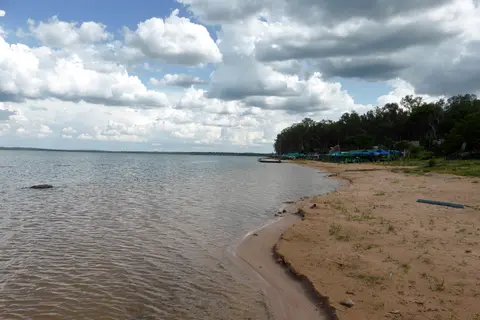
The beach is fine sand running along the edge of the reservoir, with a row of tarpaulin-roofed stalls selling simple Isaan food, drinks and snacks. Stalls often rent inner tubes and life jackets; ask the price before you hire. The water by the shore is shallow, and local children float about on tubes. Most visitors come to take photos, sit with a drink by the water, watch the sunset and walk along the top of the dam.
Do not assume there is a lifeguard, and do not rely on swimming rules you may have heard about from earlier years. Look at the signs at the gate and ask staff or the stall owner whether people may go into the water that day. If you bring children, keep life jackets on them the whole time and keep them near the shore, because water levels change with the season.
The dam crest road
The top of the dam is a paved road about 8 m wide with open views of blue water all the way along. It is a pleasant walk or a slow drive in the early morning or late afternoon. Whether cars may drive on the crest can change, so ask at the entrance. If unsure, park below and walk up; the round trip takes about 30 to 45 minutes.
Staying at the dam
The irrigation project offers a guesthouse, a meeting room and a camping area. Booking is by phone with the project office in Thai during office hours, so ask your hotel or driver to call if you do not speak Thai. Bring your own drinking water and sun protection.
A short history that explains the place
In the late 1970s this border area was unsettled, and villagers moved to Ban Non Din Daeng. In late 1978 King Rama IX directed development of the Lam Nang Rong basin; the Khlong Manao reservoir followed in 1979, and the main dam was finished around 1982. Knowing that, the lake reads less as a scenic stop and more as the reason people settled here.
Mistakes people make
- Visiting on a weekend or public holiday and expecting an empty beach. These are the busiest days. For quiet, go on a weekday before 9 am.
- Arriving at high water and expecting a broad sand beach. At the end of the rainy season some of the sand sits under the water. The beach is wider when the water level drops in the dry months.
- Forgetting sun protection and drinking water. There is very little shade, especially on the dam crest.
- Coming by public transport with no ride back. There is no direct bus. If you get off in Non Din Daeng town you still need a motorbike taxi or a taxi to cover the last stretch, and it is not certain a ride will be waiting for the return.
- Forgetting you are near a border. Carry your passport or a copy, follow official announcements and do what local officials ask.
The best light is before 9 am and late afternoon, when low sun turns the sand orange and reflections show clearly in the water. From Nang Rong, leave before 07:30 and you can combine the beach with Prasat Nong Hong before the heat.
Prasat Nong Hong sits beside the dam: see the Khmer sanctuaries page
If you are not yet sure where to sleep, jump to the Nang Rong section below for the hotels there.
 12Go
Bangkok to Phanom Rung private car on 12Go
From US$215 (As of 6 Nov 2026: 3-seat comfort cars from about US$215 per car, SUVs about US$219, 9-seat vans about US$233. Prices change by date and operator)
Price as of 6 Nov 2026Coming from Bangkok and happy to base yourself in Nang Rong? A private car with driver takes you from a Bangkok hotel or airport to Phanom Rung; choose a car size on the booking page. For the dam itself, hire a local driver or drive from Nang Rong.
Book on 12GoNon Din Daeng: the Rao Su monument, Prasat Nong Hong and lunch
The district around the dam holds a few small stops that form a good half-day loop, all within a few kilometres of the reservoir.
Rao Su monument
The monument stands beside Highway 348, about 200 m before the dam. It was built in 1979 to honour villagers, police and soldiers who died while a strategic road was being built in a time of unrest. King Rama IX named it Rao Su, meaning We Fight, and it opened on 26 August 1980. Entry is free and it is open air. A stop of 10 to 15 minutes is enough, and it helps explain why this dam exists.
Prasat Nong Hong
Three small brick towers on a laterite base stand very close to the dam, about 2 km away or less. There is no ticket office and very few visitors. It is a 15 to 30 minute stop, with no shade and nothing for sale. The history and what to look for are on the Khmer sanctuaries page. Here the advice is simply to visit before the sun is high and wear shoes that cope with grass.
Where to eat
The lakeside restaurants are simple places serving Isaan and Thai dishes and cold drinks. For more choice, drive about 10 km into Non Din Daeng town, which has a morning market. There is nothing upmarket, so eat around midday and keep your expectations simple.
A half-day loop from Nang Rong
| Time | Where | Notes |
|---|---|---|
| 07:15 | Leave Nang Rong | About 45 minutes to the dam. Eat breakfast at your hotel or the morning market first |
| 08:00 | Prasat Nong Hong | Visit before the sun is strong. Free |
| 08:45 | Rao Su monument | Park at the roadside. 10 minutes for photos |
| 09:15 | The dam and beach | Opens about 08:30. Walk the crest and sit by the water |
| 11:30 | Lunch at the lake or in town | Ask the price before you order at the lakeside stalls |
| 13:00 | Drive back | Reach Nang Rong about 14:00. Add the basalt columns late in the afternoon if you have energy |
Non Din Daeng is close to the border. Check official announcements before you travel and follow local officials. This page covers only the dam, the monument and Prasat Nong Hong, the usual stops for local and foreign visitors.
Dong Yai Wildlife Sanctuary and Khao Krapot: book by phone to see wild gaur
Dong Yai Wildlife Sanctuary covers about 195,000 rai, roughly 340 square km, across Non Din Daeng and Pakham districts. It is part of the Dong Phaya Yen and Khao Yai forest complex, which became a UNESCO natural World Heritage site in 2005. Khao Krapot is an open grassland, nicknamed the Fuji of Dong Yai. Wild gaur, a kind of wild cattle, and sometimes elephants come out to graze, mostly in the early morning and after rain.
You must book in advance
This is not a place you can drive into on a whim. Arrange the visit with the sanctuary beforehand; staff provide a vehicle and a guide for safety. The number to call is 044-666-629, Thai only, or message the Facebook page Dong Yai Wildlife Sanctuary, Buriram. If you do not speak Thai, ask your hotel or driver to call and request a date. There is no public transport, so you need your own car or a hired one. It is about 35 km from the dam.
Costs and timing
Community activities on offer include a Khao Krapot jungle trek at about 1,000 baht, a Pha Daeng viewpoint activity at about 1,000 baht and a nature connection activity at about 600 baht. Treat these as rough figures: it is not clear whether a price is per person or per group, so ask when you call, and ask whether the vehicle is charged separately. The best months are November to February, in cool foggy mornings, and the first rains around May and June, when new grass draws the gaur.
What to prepare
- Nothing is guaranteed. If the gaur do not appear you still get open grassland and forest scenery.
- Wear long sleeves and long trousers, use insect repellent and wear shoes suitable for walking in the forest.
- Keep your distance from wild animals, follow your guide and keep your voice down.
- Leave Nang Rong about 05:30 to 06:00 so you arrive in the morning, and take water and breakfast in the car.
- The Pha Daeng viewpoint is in Ta Phraya National Park, about 30 km from the dam. Ask about its fee and hours when you book.
Phone a few days ahead so staff can confirm a date, and keep a spare day in case rain or ranger duties change the plan. Do not combine this with a Phanom Rung day: it starts very early and takes most of the morning and early afternoon.
Huai Chorakhe Mak: Sarus cranes and the wetland learning centre
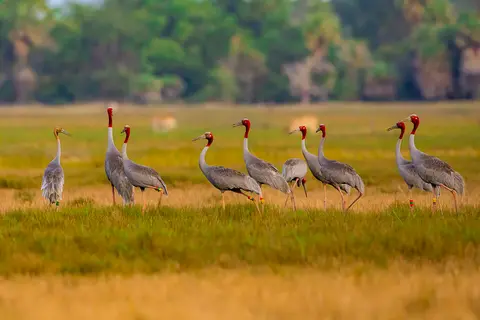
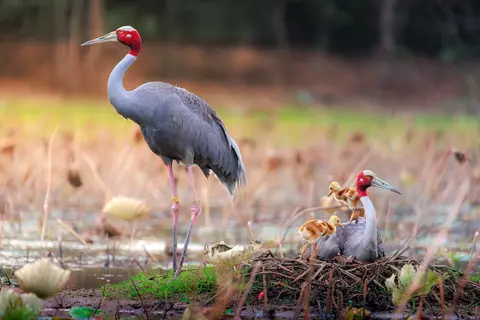
Huai Chorakhe Mak reservoir is in Mueang Buriram district, about 16 km from the city centre and roughly 20 minutes by car on the road towards Prakhon Chai. It is one of the sites where Eastern Sarus cranes have been released into the wild. This tall bird with a red head and neck had vanished from Thailand and was brought back to Buriram from 2011. A total of 105 birds were released up to 2019, and today more than a hundred live wild around Buriram's wetlands. The exact count changes with the year and the season.
The learning centre and observation tower
The wetland and Eastern Sarus Crane learning centre opened on 5 August 2019. It was set up by the Zoological Park Organization with partners and was the first crane conservation centre in Thailand. It has a four-storey observation tower, exhibits, young local guides and a small souvenir shop. Opening hours are about 08:30 to 16:30, entry is free, and you should check before you go. A binocular loan service may be offered.
How to watch without disturbing the birds
- Go between 06:00 and 09:00, or between 15:00 and 18:00, when the birds feed.
- Stay at least about 200 m from the cranes, especially in the nesting and chick season.
- Use a long lens or binoculars. Do not walk into the grassland to get closer.
- No feeding, no drones, and silence your phone.
- Some birds wear coloured leg bands, as in the photo above. Keep your distance from them as from any other crane.
Other birds
More than 170 bird species have been recorded around the wetland. In winter you can see ducks such as garganey, spot-billed duck and cotton pygmy goose, as well as grey-headed swamphen, watercock and purple heron, plus migrants. You do not need to be a serious birder: there is an observation tower beside the water, and two to three hours is about right.
Boat rides and winter events
In the dry season, villagers may paddle traditional narrow boats called e-pong to take visitors to see the cranes. There has been a boat programme and, in some years, a lakeside camping event in late November. Prices and dates change from year to year, so check the learning centre's Facebook page and do not pay anyone in advance who is not the centre or its official page.
Without a car
There is no public transport to the reservoir. Use a taxi or ride-hailing app from Buriram city and agree that the driver will wait or return for you, or ask your hotel to arrange a car. A good rhythm is to leave the city at about 14:30, see the centre and tower before it closes at about 16:30, then end the day with the egrets at Huai Talat and return for dinner.
Sro Ang walking street
At the Buriram Irrigation Project there is a walking street market called Sro Ang, about Friday to Sunday from 15:00 to 21:00. Check days and hours before you go. If it matches your day it makes a convenient end to the bird trip.
 12Go
Bangkok to Buriram on 12Go
From US$6 (As of 6 Nov 2026 (sample travel date 13 Nov): Class 3 trains from about US$6 to US$7, Class 2 air-conditioned seats about US$14, buses from about US$12, Nakhonchai Air from about US$15, Thai AirAsia flights from about US$56, sedan taxis from about US$144 per car. Prices change by date and operator)
Price as of 6 Nov 2026Arriving from Bangkok to see the birds near Buriram city? This page compares the train from Krung Thep Aphiwat Central Terminal, buses from Mo Chit, flights from Don Mueang and taxis, so you can pick what suits your schedule.
Book on 12GoHuai Talat and Buriram Bird Park: egrets flying home at dusk
Huai Talat reservoir is in Sakae Sam subdistrict, about 12 to 15 km from Buriram city. Take Highway 219 towards Prakhon Chai and turn left at the Ban Khok Tan health centre, then go in about 2.5 km. It is a wildlife non-hunting area with more than 100 bird species through the year, especially November to April. In some years, rare birds such as comb duck and painted stork are seen.
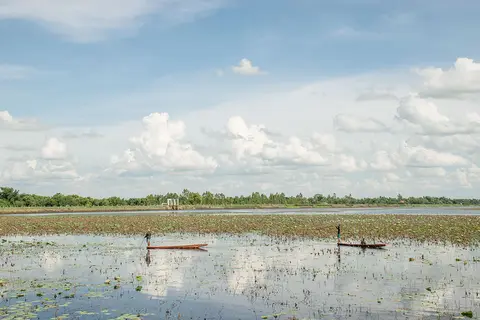
The highlight is the evening, about 17:00 to 18:00, when white egrets fly in by the thousands to roost in the trees. At some times of year the numbers reach tens of thousands. A viewing-car service is offered; the number is 0 4460 5169, so call to ask whether it runs on your day. Opening hours are not published, so it is worth phoning first.
Planning your visit
- Arrive about 16:00 so you have time to walk by the reservoir before the egrets return.
- Take binoculars if you have them, but a flock flying in a line is easy to see without them.
- In the rainy season the water is high and the birds spread out, so the show can be weaker than in the cool season and early hot season.
- There are mosquitoes in the evening, so bring repellent.
- With children, keep voices low: the birds will move away from loud noise.
Huai Talat and Huai Chorakhe Mak lie in the same direction from the city. Visit the crane centre at 15:00 and Huai Talat at 17:00 on the same afternoon, then come back for dinner.
Sanam Bin reservoir wildlife area, Prakhon Chai
The Sanam Bin reservoir non-hunting area covers about 3,568 rai. Its name, which means airfield, comes from a supply airstrip that the Allies used in the Second World War. It lies beside Highway 219 about 41 km from Buriram city, about 4 km before Prakhon Chai town, with the office on the left. From Nang Rong it is about 35 km, about 30 minutes by car.
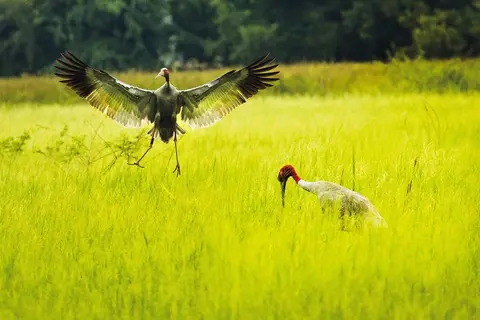
From November to April the area is good for waterbirds, including comb duck, grey duck and spoonbill, and it is the third site where cranes have been released in the province. It is a natural area with few facilities for visitors, which suits people who like quiet and have a car.
It sits on the way from Buriram city to Muang Tam and Phanom Rung, so it can join one day, but you must start early. See birds in the early morning and the temples later, or the reverse: temple at first light and birds at the end of the day. The temples are described on Phanom Rung and Muang Tam.
Nang Rong town: a base for Phanom Rung, food, markets and stays
Nang Rong is a small town of about 21,000 people in the south of the province, about 55 km from Buriram city by Highway 218, around 55 minutes. It is the closest town to Phanom Rung, about 26 km away and roughly 30 minutes by car, which is why many visitors to the temples sleep here rather than driving back to Buriram city each evening. The town is walkable, with markets, cafes, restaurants and hotels at several price levels.
Nang Rong or Buriram city?
| What you need | Stay in Nang Rong | Stay in Buriram city |
|---|---|---|
| Phanom Rung and Muang Tam | Closer, about 26 km, easy early start | About 65 to 75 km, roughly 1 to 1 h 15 min |
| Chang Arena and the circuit | Far, about 45 to 50 km. Poor for race days | Close. The arena is on the south-west side of the city |
| Lam Nang Rong dam | About 42 km, about 45 min | About 98 km, about 1 h 35 min |
| Cranes and Huai Talat | Further away | Close, about 15 to 16 km |
| Train and airport | No railway station in Nang Rong. Airport about 80 km | Station on the north side. Airport about 34 km |
| Evening atmosphere | Quiet. The walking street runs on Friday and Saturday afternoons | More restaurants and markets |
In short: if the trip is mostly Phanom Rung, Muang Tam, the dam and the basalt columns, stay in Nang Rong. If you came for racing or football, or you have no car and depend on the train, stay in Buriram city. With two nights, split them. More on the choice is on the where to stay page.
What to eat in Nang Rong
The local dish is Nang Rong kha moo, stewed pork leg served over rice. The district has promoted it at a local goods fair in front of the district office. You will also find moo kratha (pork on a skillet grill), jim jum, grilled chicken along the road towards Buriram and som tam. Have a proper breakfast in town before the drive to Phanom Rung.
Markets and walking street
- Nang Rong walking street, on Narong Damri Road, runs about Friday and Saturday from the afternoon into the evening. Check days and times before you go.
- A night market opposite the Nang Rong bus terminal opens in the evening. Check the day before you go.
- The daily fresh market is behind the supermarket in town, and a morning market is near the Nang Rong Hotel.
- Nong Ta Mu is a public pond with food stalls and a running track, and it is the venue for the town's Loy Krathong festival.
Getting to Phanom Rung from Nang Rong
No public bus climbs the hill. You can drive or ride yourself, or hire a car with a driver (your hotel can usually arrange one). Motorbike hire in Nang Rong is roughly 300 to 400 baht a day. A car with a driver for both Phanom Rung and Muang Tam starts at about 1,000 baht when agreed in advance. Both are approximate, so check before you go, and agree the price and waiting time with the driver before you set off.
Reaching Nang Rong by public transport
- From Bangkok there are buses from Mo Chit to Nang Rong taking about 5 hours or more. Check times and fares with the bus company.
- From Buriram city, buses and vans run to Nang Rong in about an hour. Check times at the Buriram bus station.
- From Korat, buses connect to Nang Rong. Check times at the Korat bus station.
- By train: there is no Nang Rong station on the north-east line. Train passengers get off at Buriram station and continue by road. The train station and the bus station are in different parts of Buriram city.
Hotels in Nang Rong
Stays in Nang Rong range from a hotel in Khmer style to simple guesthouses. Prices and availability change daily, so open the booking page for your own dates.

Phanomrungpuri Hotel
212 Prachantakhet Road, Nang Rong
A hotel on Prachantakhet Road, about 1 km from the town centre, with a pool, restaurant, free parking and a shuttle service. Good for people who want hotel-style rooms and help arranging a driver for Phanom Rung.
See prices and availability on the booking page

Nangrong Hotel
243 Pradit Pana Road, Nang Rong
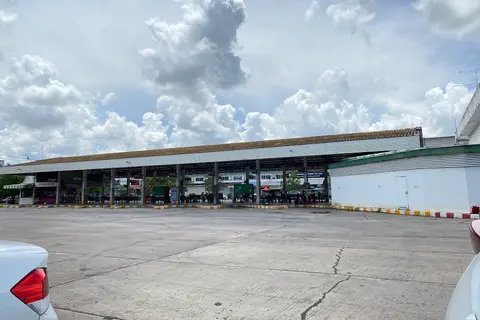
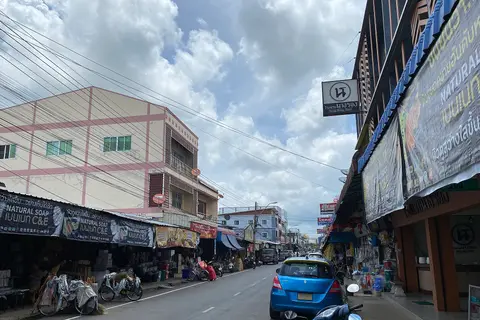
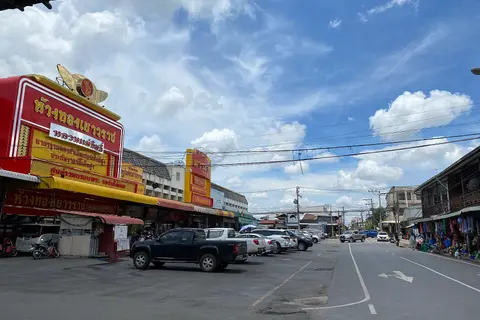
A town hotel that allows pets, with free parking, a kitchen and laundry. Its sign is the one visible on the main street in the photo above.
See prices and availability on the booking page

The Park Nangrong Resort
445/10 Praditpana Road, Nang Rong
A garden-style resort on Praditpana Road with breakfast, free parking and smoke-free rooms, for those who want quiet rather than a room on the main street.
See prices and availability on the booking page

Goodview Nangrong Guesthouse
159 Moo 3, Nang Rong
A budget guesthouse on the edge of town, with parking, family rooms and a Thai restaurant. You need a car, since it is about 6 km from the centre.
See prices and availability on the booking page
Thung Laem reservoir: a rest stop on Highway 24
Thung Laem reservoir lies beside Highway 24, about 5 km from Nang Rong and about 4 minutes by car, on the way to Phanom Rung. It is a small reservoir turned into a rest stop, with a waterside pavilion and picnic shelters, and many ducks in the dry season. Entry is free and there is no gate.
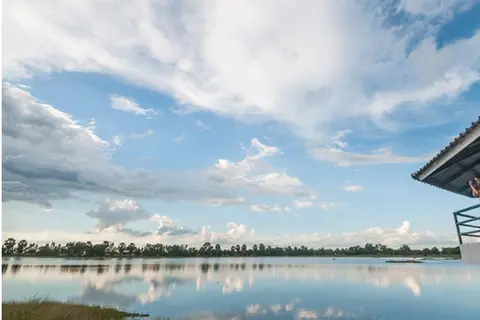
There are no shops, the toilets are basic, no boats are hired out and you should not swim. In the dry season you can see herons, kingfishers and small waders. Arrive before 08:00 for cool air and good light. Thirty to sixty minutes is enough. It suits anyone leaving Nang Rong early who wants a photo stop before the climb. Locals sometimes fish for snakehead and catfish here, so respect their space.
The basalt columns, nicknamed Grand Canyon Buriram
The basalt columns are at Ban Khok Ma Kha Ron, Sadao subdistrict, Nang Rong district, about 6.5 km from Nang Rong and about 11 minutes by car. They were found by chance while a village pond was being dug. The large columns formed when volcanic lava cooled in layers, and the best-known view is an old quarry wall with dark brown blocky columns standing upright.
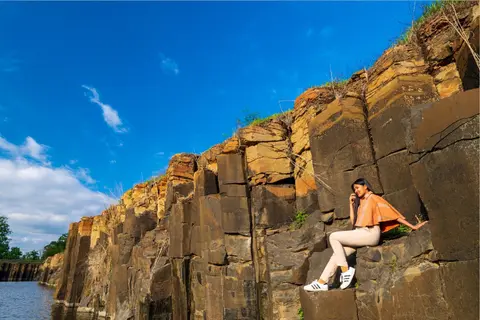
| Hours | About 06:00 to 18:00; check before you go |
|---|---|
| Entry | Free, no ticket office |
| Site | About 7 rai, with an old quarry pit deeper than 20 m |
| Shade | Almost none. Go early or late |
| Public transport | None. Car or driver from Nang Rong |
| Time | 30 to 60 minutes |
Staying safe
Some edges have no railing and the rock surface is uneven. The old quarry pit is more than 20 m deep. Keep back from the edge, do not climb unstable blocks, follow any signs, wear shoes with a good grip and keep small children right beside you.
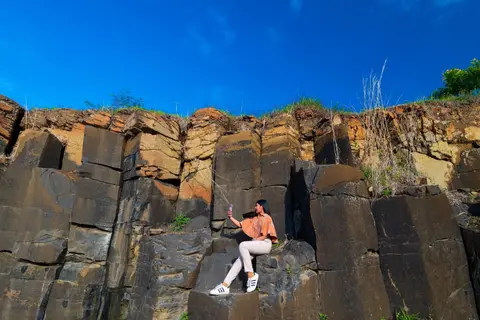
The best photos come in low sun in the early morning and late afternoon, when the stone looks darker and the sky deep blue. At midday the light is harsh and the heat strong. If you do Phanom Rung in the morning, come here in the late afternoon as a change from the sandstone.
Craft villages and temples around Nang Rong: only what you can really visit
Around Nang Rong there are several craft villages and temples, but not all welcome visitors on a regular basis. This list keeps to places you can realistically stop at.
Ban Charoen Suk: volcanic-soil cloth
A village in Chaloem Phra Kiat district that dyes cotton with volcanic soil from the extinct Khao Angkhan. The cloth, called pha phu akkhani, is soft and light, in shades from pale to reddish brown. There is a demonstration centre. Hours are about 08:00 to 17:00. It is about 14 km from Nang Rong, about 20 minutes, and about 15 km from Phanom Rung. Check before you go, especially if you want to see a demonstration.
Ban Khok Mueang
A community tourism village beside Prasat Muang Tam, with tractor-cart rides around the village, an ancient hospital chapel (kuti rishi), the baray and weaving of silk with a fern pattern and reed mats. Hours are about 08:00 to 17:00. Details are on Phanom Rung and Muang Tam.
Wat Khun Kong
An old temple about 1.6 km from the centre of Nang Rong, built in a Mahayana style and said to date from around 1607. The old ordination hall is over 400 years old, with a laterite base, a wooden roof frame and walls of brick and lime. It is an open-air site, so dress modestly. Allow 20 to 30 minutes.
Wat Phu Man Fa
Wat Phu Man Fa (Wat Phra Phutthabat Sila) is a newly built sandstone temple at Ban Sing, about 10 km and 15 minutes by car from Nang Rong. Building work is still going on, and the design draws on Phanom Rung, Phimai and Lopburi. It is open about 08:00 to 17:00 and free to enter; dress modestly and check before you go.
What to skip
The silk weaving villages of Na Pho are over 60 km north-west of Nang Rong and suit only dedicated silk collectors with a car. Several small irrigation reservoirs in Lahan Sai, Nong Ki and Krasang have no visitor facilities and can be skipped.
Prasat Thong beach, Nong Ki: ask before you drive
Prasat Thong beach grew from the old Thung Kraten reservoir, about 2,450 rai, dressed up as a freshwater sea with a sand beach. It once had banana boats, pedal boats and jet skis, and it opened officially in mid January 2016. It is in Nong Ki district, about 24 km from Nang Rong (about 20 minutes) and about 78 km from Buriram city.
Whether the water activities still run in full and what the entry costs must be asked locally before you drive out. If you plan to visit only this beach, phone the Yoei Prasat subdistrict office or ask your hotel. If in doubt, go to Lam Nang Rong dam instead, where the information is clearer.
Best time to go, water levels and weather by month
Nang Rong gets about 1,200 mm of rain a year. September is the wettest month and January the driest. The average annual daily high is about 33 C, with a record near 41 C and a record low near 8 C, so the hot season is fierce and cool-season mornings can be genuinely chilly.
| Months | Water and weather | What to see | Watch out for |
|---|---|---|---|
| November to February | Cool, clear skies, moderate water | Waterbirds, cranes, gaur in the morning, basalt photos | Cold misty mornings; busy at New Year |
| March to April | Very hot, lower water, wider beach | Waterbirds early in the period, the beach | Fierce heat. Go in the early morning and late afternoon only |
| May to June | First rains, new grass | Gaur on fresh grass at Khao Krapot | Wet roads and cloudy skies |
| July to October | Heavy rain, full reservoirs, green fields | Full lakes and green views | Some sand under water, birds scattered, slippery quarry rock |
If you can pick only one period, choose late November to February, when water, birds and weather are all comfortable. Avoid the New Year break if you dislike crowds. Water levels differ from year to year, so look at recent photos on the place's own Facebook page when you plan.
Sample plans: half a day, a full day and two days
Plan A: Nang Rong morning (no dam)
| Time | Where | Notes |
|---|---|---|
| 06:30 | Leave Nang Rong | Breakfast at the hotel or morning market |
| 06:45 | Thung Laem reservoir | Early light, 30 minutes |
| 07:30 | Basalt columns | Low sun, about 45 minutes |
| 09:00 | Wat Khun Kong or Wat Phu Man Fa | Pick one |
| 10:30 | Back in Nang Rong | Rest or lunch, then Phanom Rung in the late afternoon if it is not too hot |
Plan B: a day at the dam from Nang Rong
Follow the half-day loop table in the Non Din Daeng section. Leave at 07:15, be back in Nang Rong about 14:00 and add the basalt columns in the late afternoon if you have the energy.
Plan C: an afternoon of birds from Buriram city
| Time | Where | Notes |
|---|---|---|
| 14:30 | Leave Buriram city | Arrive at Huai Chorakhe Mak about 15:00 |
| 15:00 | Crane centre and tower | Walk, climb the tower and watch until the centre closes at about 16:30 |
| 17:00 | Huai Talat bird park | Egrets coming home |
| 18:30 | Back to the city | Dinner, and the walking street if the day matches |
Plan D: two days, one night, Nang Rong and Phanom Rung
- Day one: leave Buriram late morning, stop at Sanam Bin reservoir and Muang Tam, check in at Nang Rong and walk the market in the evening.
- Day two: leave at 06:30 for Phanom Rung, stop at Thung Laem and the basalt columns in the late afternoon, then return to Buriram or move on.
See the one-day and two-day plans for the whole province
Plan E: Khao Krapot
Make it a separate day. Leave Nang Rong about 05:30, arrive at the sanctuary at your appointed time, spend the morning there and drive back in the afternoon. Do not schedule anything afterwards, because the distance is long and travel in the forest is slow.
Getting there without a car, and which car to choose
Almost every place on this page has no direct bus. The practical idea is to reach Buriram city or Nang Rong by public transport, then continue by car or with a driver.
| From | How to reach Nang Rong | Notes | Book |
|---|---|---|---|
| Bangkok (Krung Thep Aphiwat Central Terminal) | Train to Buriram station, then road transport to Nang Rong, about 55 km | There is no train station at Nang Rong | See trains, buses and flights |
| Bangkok (Mo Chit) | Bus to Nang Rong or Buriram | Some services do not enter Buriram city, so ask where you get off | See buses |
| Bangkok (hotel or airport) | Private car with driver to Phanom Rung | Stay in Nang Rong and hire local transport | Car to Phanom Rung |
| Korat | Train to Buriram, then a bus or van to Nang Rong, or a bus to Nang Rong | Check times at the Korat bus station | See Korat to Buriram trains |
| Surin | Train to Buriram, then a bus or van to Nang Rong | Or a road service between Surin and Buriram | See Surin to Buriram trains |
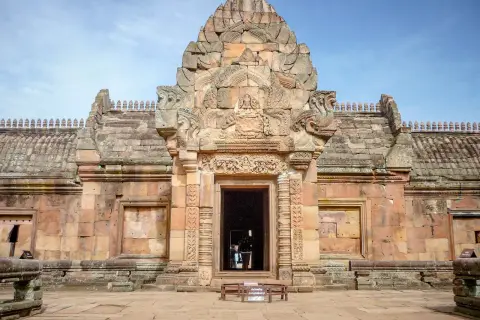
If you would rather have one driver from Bangkok all the way to Buriram, there are private cars that pick you up at a Bangkok hotel and drop you at a hotel or point in Buriram city. You can then hire or drive a local car.
 KKday
Private Transfer between Bangkok and Buriram
From US$126.03 (Starting price per car)
Price as of 6 Nov 2026A private round trip with driver between Bangkok and Buriram, with pickup at a Bangkok hotel lobby or any point in the city and drop-off at a hotel or spot in Buriram city, with free cancellation as shown on the booking page.
Book on KKday KKday
Bangkok to Buriram Private Transfer
From US$139.45 (Starting price per car)
Price as of 6 Nov 2026A one-way private car from Bangkok to Buriram, door to door, suited to travellers who continue elsewhere afterwards.
Book on KKday Klook
Buriram Province Car Rental
From US$37.55 (Starting price per day, compact car, as of 13 Nov 2026)
Price as of 13 Nov 2026A rental car from the supplier on the booking page, pick-up and drop-off at the places you choose, insurance and terms as listed. Check the driver age and the deposit on the booking page. Cancellation terms differ by car. See the booking page.
Book on KlookGetting around locally
- Drive yourselfMost flexible
Best for a trip with several stops and a very early start. Fill up at Nang Rong or Non Din Daeng before the long drives.
- Hire a motorbike in Nang RongAbout 300 to 400 baht a day; check
For confident riders with a licence. Not recommended for the long ride to the dam, because the road is long and the sun is strong.
- Hire a car with a driverAbout 1,000 baht and up for a day on short routes; check
Ask your hotel to find one. Agree the price, the waiting time and the stops before you start.
- Ride-hailing appGrab and taxis can work in the towns
Unreliable on long routes, especially for the return from the dam. Book a driver for those.
Frequently asked questions
Where is Lam Nang Rong dam and how do I get there from Buriram?
It is in Non Din Daeng district, in the far south of Buriram, about 98 km from Buriram city (about 1 h 35 min by car), about 42 km from Nang Rong (about 45 min) and about 45 km from Phanom Rung. Take Highway 348, pass the Rao Su monument and the dam is about 200 m further. There is no direct bus, so use a car or hire a driver.
What time does Lam Nang Rong dam open and is there an entry fee?
The beach and lakeside stalls run about 08:30 to 22:00 and entry is free; you pay for tubes, life jackets and food at the stalls. Hours may change with the season and holidays, so check before you go or phone the irrigation project office on 0 4460 6336 in office hours.
Can I swim at Lam Nang Rong dam?
Local children float on inner tubes in the shallows, but you should not expect a lifeguard, and the rules for entering the water can change. Check the signs at the gate and ask staff or the stalls. Always wear a life jacket, and especially with children.
Where can I see Sarus cranes in Buriram and when is best?
At the wetland and Eastern Sarus Crane learning centre at Huai Chorakhe Mak, about 16 km from Buriram city. Entry is free and there is an observation tower. The best period is November to April, in the early morning (06:00 to 09:00) or late afternoon (15:00 to 18:00). Stay at least about 200 m from the birds and do not use a drone.
What time do the egrets return to roost at the Buriram bird park?
At Huai Talat the white egrets come back to roost at about 17:00 to 18:00, in large numbers. Opening hours are not published, and a viewing-car service is offered. Phone 0 4460 5169 to ask, and arrive about 16:00 to have time to walk around the reservoir.
Do I need to book to see gaur at Khao Krapot?
Yes. It is inside Dong Yai Wildlife Sanctuary, so arrange a visit in advance with the staff, who provide a vehicle and a guide. The phone number is 044-666-629 (Thai only). Activities cost roughly 600 to 1,000 baht depending on the type; check before you go. Sightings are not guaranteed, and the best time is November to February in the morning.
Can I visit the basalt columns near Nang Rong?
Yes. They are at Ban Khok Ma Kha Ron, Sadao subdistrict, about 6.5 km and 11 minutes from Nang Rong. Entry is free and the site is open about 06:00 to 18:00; check before you go. There is no public transport. Some quarry edges have no railing, so keep back from the edge and follow any signs. Early morning or late afternoon is best.
How far is Nang Rong from Phanom Rung and how do I get there?
About 26 km and about 30 minutes by car. No public bus goes up the hill, so drive, hire a motorbike, hire a car with a driver or ask your hotel to arrange one. Agree the price and waiting time before setting off. Fees and hours for the temples are on the Phanom Rung and Muang Tam page.
Is there a train to Nang Rong?
No. There is no Nang Rong station on the north-east line. The train from Bangkok stops at Buriram station, on the north side of the city, and from there you continue to Nang Rong by bus or van, about 55 km and roughly an hour. The Buriram bus station and train station are in different places.
Which days is the Nang Rong walking street open?
The walking street on Narong Damri Road runs about Friday and Saturday from the afternoon into the evening, and a night market operates opposite the bus terminal. Days and hours can change with the season and local events, so check with your hotel before you go.
Keep planning
 Buriram: Phanom Rung, Chang Circuit and Khmer sitesOverview of the province by zone, with fees, best season, transport and where to stay
 Buriram in 1 to 2 daysOne-day Phanom Rung plan, 2 days 1 night, race and football weekends
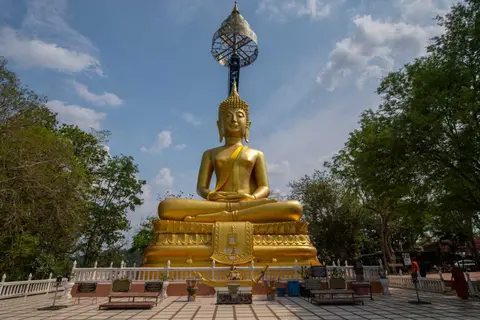 Phanom Rung, Muang Tam and Khao KradongFees, hours, the sun through 15 doors, and how to go without a car
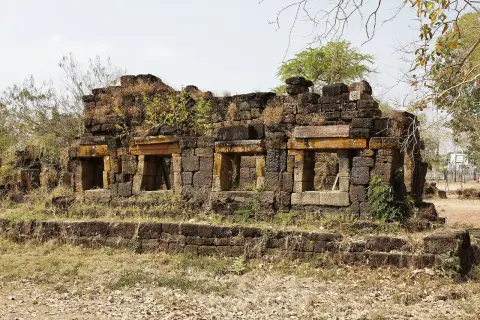 Khmer sanctuaries and ancient kilnsPrasat Nong Hong, Ban Kruat kilns, rest houses, and border-area notes
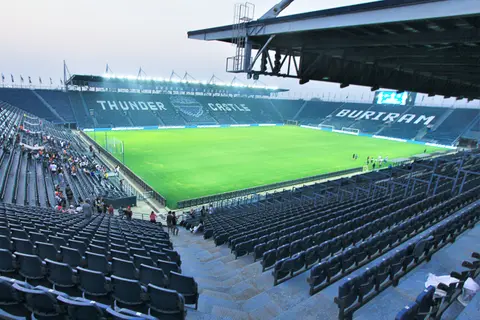 Buriram city, Chang Circuit and Chang ArenaRace track, Buriram United, city pillar shrine, walking street and food
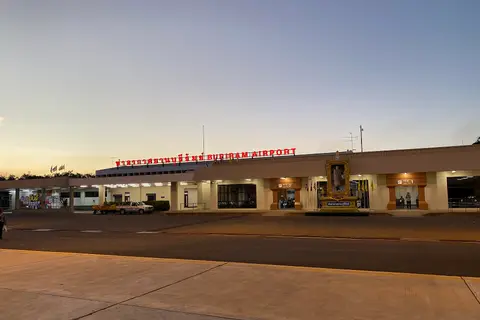 Getting to BuriramTrain, bus, flight and car from Bangkok, Korat and Surin
 Where to stay in BuriramNear the circuit and arena, city centre, station side and Nang Rong; booking race weekends
 Buriram deals this monthTransport, private cars, hotels and how to buy race tickets