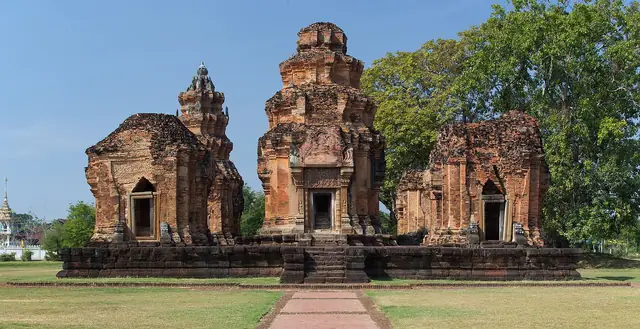
Surin lay within the ancient Khmer world, so many brick and laterite temples are scattered through its villages. Most are small ruins registered by the Fine Arts Department, not large sandstone complexes like Phimai or Phanom Rung. What makes them worth the trip is carved lintels, the shape of the buildings and the local stories. This page goes from the best first stop to the smaller ones, with the direction and distance from town, fees, a guide to reading the lintels, and loops drawn along the real arms of the road so you do not drive in circles.
Fees and hours are as of 13 Nov 2026. A few figures may differ at the gate, so they are written as about. Check at the gate. To add elephants and the town, see Surin in 1 to 2 days.
We earn a commission if you book through our links. The price you pay does not change. How we choose
Khmer temples in Surin at a glance
The table runs by direction from Surin town. Distances are rough road distances from the centre. Where no fee is listed, check at the site.
| Temple | Direction, distance | Entry | Known for |
|---|---|---|---|
| Sikhoraphum | East, about 34 km | 10 baht Thai, about 50 to 80 baht foreign | Five brick towers, a dancing Shiva lintel, apsaras on the door jambs |
| Mueang Thi | East, about 18 km | Free | Brick towers inside a temple compound, three left |
| Chom Phra | North, about 29 km | Free | A hospital chapel of Jayavarman VII, a laterite ruin |
| Ban Phlai | South, about 23 to 30 km, Prasat district | Likely free | Three brick towers, a seated deity on a lintel |
| Ban Phluang | South, about 34 km, Prasat district | 10 baht Thai, about 50 baht foreign | A single sandstone tower, Indra on Airavata lintels |
| Mi Chai (Muen Chai) | South-east, Krathiam subdistrict, Sangkha district | Likely free | A single brick tower, and the remains of a hospital chapel nearby |
| Yai Ngao | South-east, Sangkha district | Likely free | Brick towers on a laterite base, the legend of Grandmother Ngao |
| Phum Pon | South-east, about 60 km, Sangkha district | Free | The oldest of the group, dry-laid brick, a Pallava inscription |
| Ta Piang Tia | Lamduan district | Likely free | A Lao-style brick tower, not Khmer |
| Ta Muen group | On the border, Phanom Dong Rak district | Closed | Not open to ordinary visitors |
With half a day, choose the east loop, Sikhoraphum and Mueang Thi. With a full day and a car, add the south loop of Ban Phlai and Ban Phluang. Chom Phra lies to the north, so treat it as its own short trip and do not tack it onto Ban Phluang.
Short on time: which temple first
Surin's temples are not on the scale of Phimai or Phanom Rung. Most take 20 to 40 minutes each, so the real problem is not the walk but the driving between them. This table helps you choose by what you want to see.
| If you | Go to | Because |
|---|---|---|
| Have half a day and want one place that is worth it | Sikhoraphum | The largest, the dancing Shiva lintel is still in place, and its hours and fee are firmer than the others |
| Like stone carving | Ban Phluang | A small temple, but the lintels and pediment tell their stories on all four sides |
| Want the oldest | Phum Pon | Dry-laid brick from before the Angkor period, but the farthest on the loops |
| Travel with older people or small children | Sikhoraphum, Mueang Thi, Ban Phluang | Flat ground, few steps, parking close by |
| Like quiet ruins with trees growing through | Chom Phra | Laterite that has not been put back together, and few visitors |
| Want a temple that is not Khmer | Ta Piang Tia | A Lao-style lotus-bud brick tower, unlike true Khmer temples |
If you are in Surin for the Round-up and have not seen the temples, start at Sikhoraphum. On the evenings of 20 and 21 Nov 2026 there is a free light and sound show there, so you can see it by day and by night.
Group the temples so you do not drive in circles
Surin town is the hub and the temples sit on four arms. North is Chom Phra, east is Mueang Thi and Sikhoraphum, south is Ban Phlai and Ban Phluang, and south-east is the Sangkha group of Mi Chai, Yai Ngao and Phum Pon. Highway 214 leaves town both north and south, which is why people assume Chom Phra and Ban Phluang sit on one road. They sit at opposite ends of it, about 58 km apart in a straight line, so there is no loop between them.
| Loop | Temples in order | Round trip | Total time |
|---|---|---|---|
| North | Chom Phra (about 29 km on Highway 214 north) | About 58 km | About 2.5 to 3 hours with the walk |
| East | Mueang Thi (about 18 km), then Sikhoraphum (about 34 km, about 17 km after Mueang Thi) | About 70 km | Half a day, about 4 to 5 hours with lunch |
| South | Ban Phlai (about 23 to 30 km), then Ban Phluang (about 34 km, about 11 km after Ban Phlai) | About 65 to 75 km | Half a day, about 4 hours |
| South-east | Mi Chai, then Sangkha, Yai Ngao and Phum Pon (about 60 km), and back the same way | About 120 to 140 km | About 6 to 7 hours with lunch in Sangkha |
Distances are rough, from roads and maps, and times assume ordinary two-lane roads. Village lanes take longer. Three rules keep the driving down. Do not cross arms in one day. Do the far arm first, while the air is cool. And reach Sikhoraphum and Ban Phluang, which have fees and set hours, before about 3 pm in case the real closing time differs from what is written.
Ban Phlai is in Prasat district, so it pairs with Ban Phluang, but not with Phum Pon, because the two do not fit in one day. Ta Piang Tia, in Lamduan district, sits outside the four main arms. See its own section below.
If you want to continue from Chom Phra to Sikhoraphum or Mueang Thi, the straight-line gap is only about 25 to 28 km, but it uses country lanes and an unbroken paved route is not confirmed. Check a map first. The sure way is back through town and out again to the east.
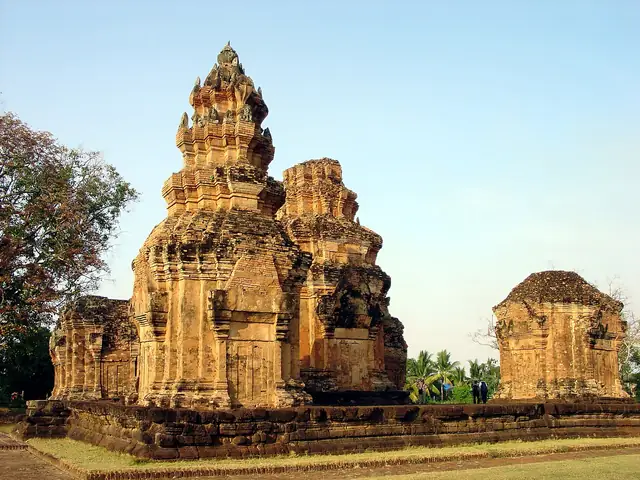
Prasat Sikhoraphum, the five brick towers
Prasat Sikhoraphum, also called Prasat Ra-ngaeng, is at Ban Prasat in Sikhoraphum district, about 34 km east of Surin town on Highway 226 and less than a kilometre from the district office. It is a Shaivite Hindu temple built in the Baphuon style running into Angkor Wat style, about the 11th to 12th century. No builder king is named with certainty. Around the 16th to 17th century it was converted into a Buddhist temple.
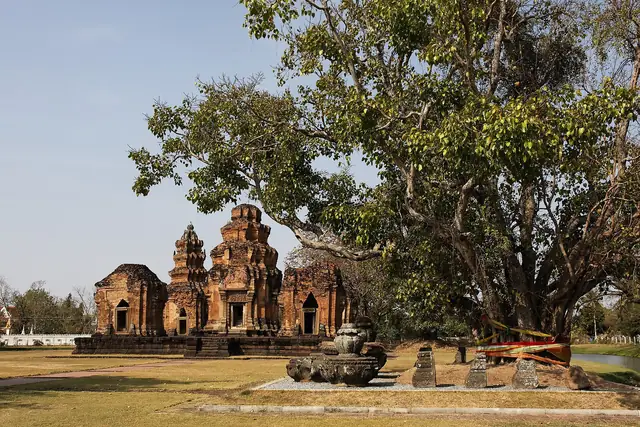
| What you see | Five brick towers on one laterite base, the main tower in the middle and satellites at the four corners, all facing east. The entrance and stairs are on the east side only. The main tower is about 32 m high and a moat runs on three sides |
|---|---|
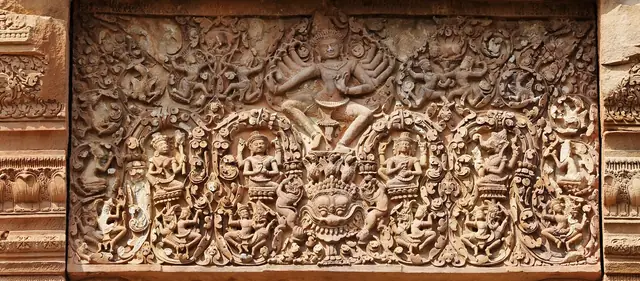
| Lintels and carving | The lintel over the main tower door is Shiva Nataraja, dancing on three geese above a kala, with musicians around him. Vishnu and Uma are on his right, Brahma and Ganesha on his left. The wall pilasters at the front carry carved apsaras |
| Satellite lintels | The two Krishna lintels from the satellite towers are no longer on site. They are kept in Phimai National Museum. See Phimai |
| Hours and entry | About 07:30 to 18:00 daily. 10 baht Thai, about 50 to 80 baht foreign. Check at the gate |
| Time needed | About 45 to 90 minutes, plus about 30 minutes if you want to photograph the lintel detail |
What to look at, in order. First, the overall view from the lawn, five towers in a row on one base. Second, the Nataraja lintel over the main door. Stand close and look up and you can see the three geese holding the dancing god up. Third, the apsaras on the front pilasters, carved down to jewellery and posture. Fourth, the large sandstone lotus-bud finial displayed under the bodhi tree in front of the temple.
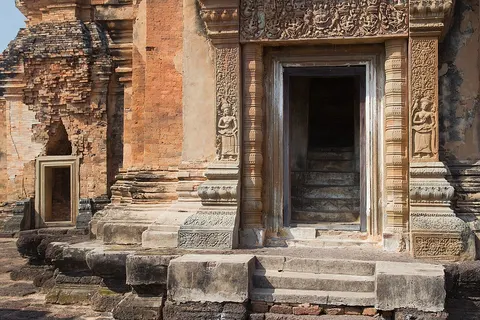
The temple is close to the market and village of Sikhoraphum, so you can eat before or after. During the Round-up there is a free light and sound show here on 20 and 21 Nov 2026 from 19:30. See elephants and the festival.
The temple faces east. Morning light, about 07:30 to 10:00, falls straight on the front and the lintel, which makes the carving easiest to read. Late afternoon gives warm side light on the orange brick and the heat is easier.
Prasat Mueang Thi
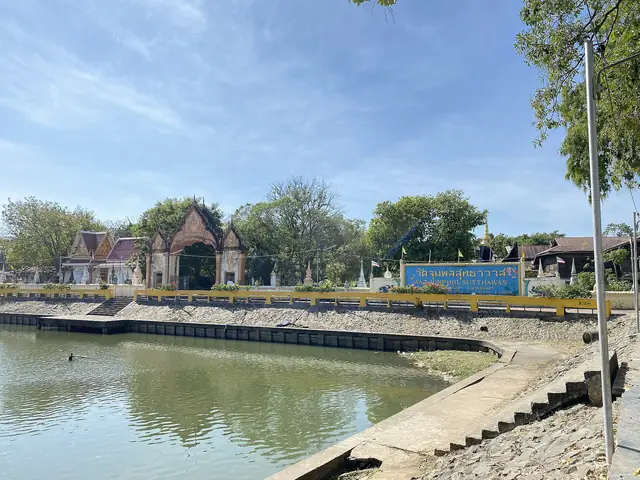
Prasat Mueang Thi is a brick temple inside Wat Chom Sutthawat, Mueang Thi subdistrict, Mueang Surin district, about 16 to 18 km from town on Highway 226, the same road you take to Sikhoraphum. Turn left into the temple at Ban Khok Lamduan. It once had five towers on one base and three remain: the centre, the north-east corner and the south-west corner.
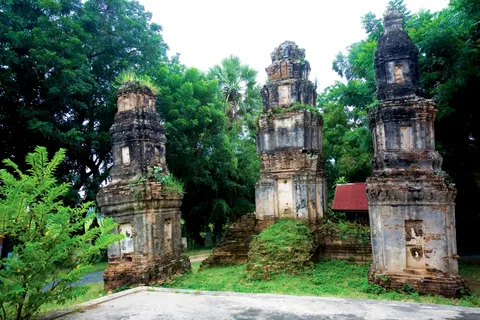
The centre tower is the largest, with stacked tiers, but its top is broken. The temple has not been restored and its age is uncertain. There are two explanations. One is that Khmer or Kui settlers of the late Ayutthaya period built or extended it into a slender form. The other is that it was an older Khmer shrine extended later, as at Sikhoraphum. What you see are slender tops and plaster added later.
The temple stands in a temple compound, so dress modestly and do not climb the base. There is no ticket gate, it is open in daylight, and it is free. A stop takes about 20 minutes. The yard is flat.
Mueang Thi sits right on the way to Sikhoraphum, so do not make it a trip on its own. Stop on the way out or on the way back, since it is only about 17 km from Sikhoraphum.
Prasat Chom Phra
Prasat Chom Phra is at Ban Si Dong Bang, Chom Phra subdistrict, Chom Phra district, about 29 km from town on Highway 214 going north. Chom Phra is north-north-east of Surin. It is an arogayasala, a hospital chapel, built under Jayavarman VII in the late 12th to early 13th century for Mahayana Buddhism. It is laterite with sandstone parts and faces east.
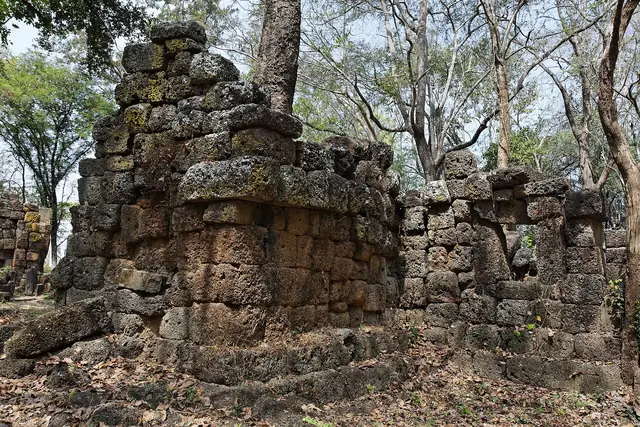
The layout has four parts: a square main tower with a front porch, a library building in front, an enclosing wall with a cross-shaped gopura, and a pond outside the wall. Digging has turned up a head of Avalokiteshvara and a figure of Vajrasattva. Today only the frame of the main tower and part of the east gopura stand. The fallen laterite was buried, and parts have been excavated and surveyed, but it has not been rebuilt.
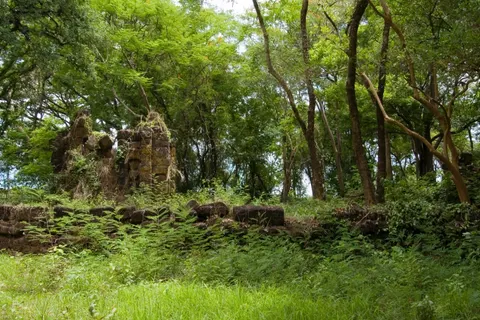
You do not come here for beauty on the Sikhoraphum scale. You come for laterite ruins with trees growing through them and a quiet setting. It is free with no ticket gate, and a visit takes 20 to 30 minutes. The ground is uneven with stones and roots and is wet in the rainy season, so older visitors should wear shoes with good grip and walk slowly.
Chom Phra works as a short morning trip before lunch and the Surin National Museum. If you want Ban Phluang next, go back through town first, because the two sit at opposite ends of Highway 214.
Prasat Ban Phluang
Prasat Ban Phluang is at Ban Phluang in Prasat district, about 33 to 34 km from town on Highway 214 going south towards Chong Chom. It is a single sandstone tower on a large laterite base in Baphuon style, from about the 11th century, facing east, with one real door and three false doors. The brick upper part collapsed, so about half the tower remains. A U-shaped moat surrounds it and a barai lies nearby. The base is 8 by 23 m, much wider than the tower, which suggests three towers were planned and the work was left unfinished. It was restored by anastylosis in about 1971 to 1973.
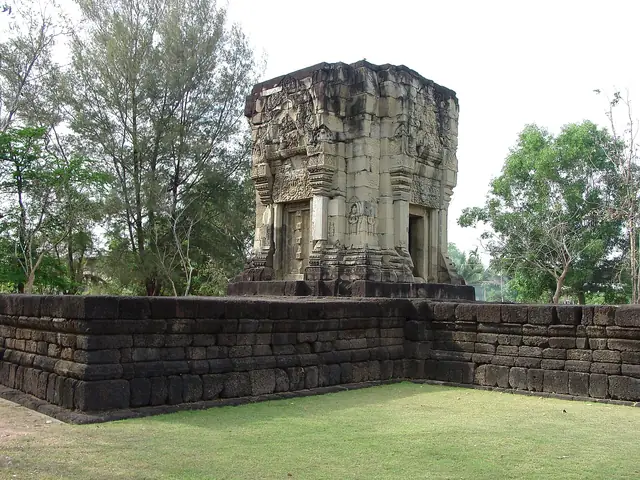
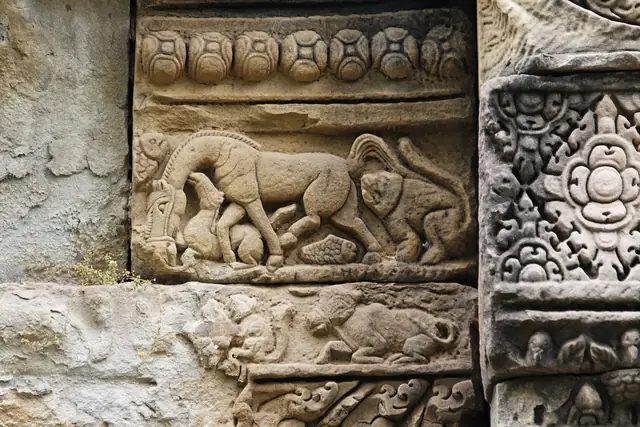
- Lintels: the east and south show Indra on the elephant Airavata, the north shows Krishna subduing the serpent Kaliya, and the west was never carved.
- The east pediment shows Krishna lifting Mount Govardhana, and there are carved squirrels and deer above the leaf pattern, which is rare on a temple to a god.
- Hours and entry: daylight hours, about 08:00 to 16:00 or longer. 10 baht Thai and about 50 baht foreign. Check at the gate.
- Time needed: 20 to 40 minutes, longer if you read all four lintels.
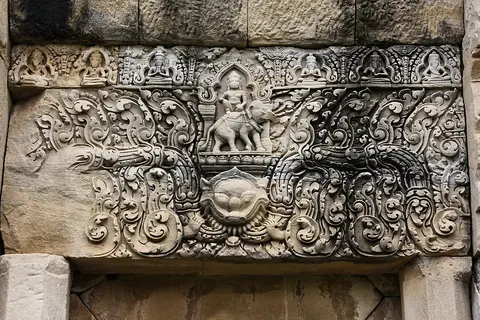
To get the most from it, walk round the base clockwise from the east. Start with the Govardhana pediment, then take the south, west and north lintels. The west side, still a plain block, is the clearest proof that the work stopped, and the over-wide base tells the same story. Bring your own water and a hat, since there may be no shops at the site.
The main carving faces east. In the morning the light falls straight on the pediment and lintels, and the small animal carvings photograph more clearly than in the afternoon.
Prasat Ban Phlai
Prasat Ban Phlai is at Ban Prasat in Prasat district, not Sangkha, about 23 to 30 km south of town. The straight-line distance is about 23 km and the road is probably a little longer. It is three brick towers in a north to south row on one laterite base, built of smooth brick, with door frames and lintels carved in sandstone and the entrance on the east. It was a Shaivite Hindu temple.
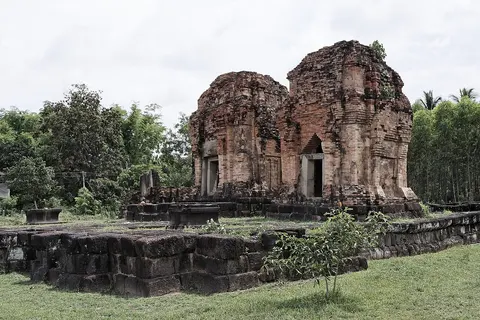
The north and centre towers are in fairly good condition. The north tower still has its lintel in place: a seated deity with one knee raised, in a niche above a kala that spews a garland, both hands holding the garland. The south tower has collapsed. No firm date is available, so no century is given here.
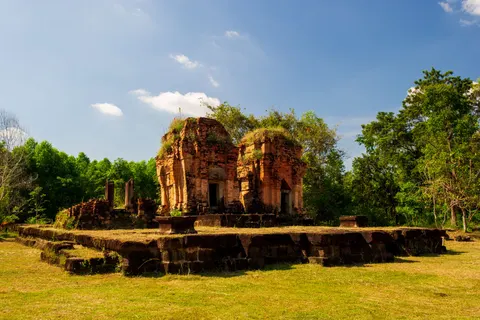
No fee is posted. It is likely free and open in daylight, and a stop takes 20 to 30 minutes. The ground is flat, so it is easy for older visitors. It makes a good first stop on the south loop, with Ban Phluang about 11 km further on in the same district.
Prasat Phum Pon, among the oldest
Prasat Phum Pon is at Ban Phum Pon, Moo 5, Dom subdistrict, Sangkha district. It is one of the oldest brick temples found in Thailand, from about the 7th century CE, before the Angkor period. There are three brick towers and one laterite building in a north to south line. The main tower is the third from the north and is dry-laid brick with three roof tiers left. The sandstone door frames carry a scroll-leaf pattern under the pediment in post-Gupta Indian style, and a Sanskrit inscription in Pallava script is among the earliest found in Thailand. A barai lies about 500 m to the north-east.
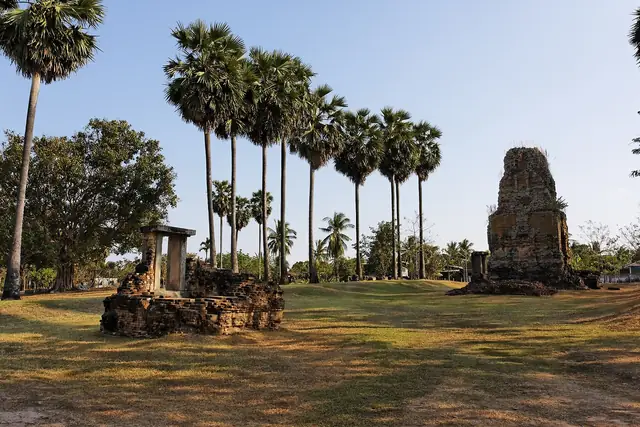
- Getting there: Highway 2077 from Surin to Sangkha, about 50 km, then towards Buachet on Highway 2124 for about 10 to 12 km, and turn right on a rural road. The temple is on the left. About 60 km in all, roughly 1 hour 15 minutes.
- Free and open daily. A visit takes about 30 minutes on flat lawn.
- Lintels, door frames and inscriptions from the site are in the Surin National Museum. See town and crafts.
This is not a showy temple. What you see is old brick laid without mortar and a plain form from before Angkor-style art appeared. If you have already seen Sikhoraphum and Ban Phluang, Phum Pon shows how Khmer art in this area changed over several centuries. If you must choose between Phum Pon and Ban Phluang with little time, pick Ban Phluang, which is about half the distance.
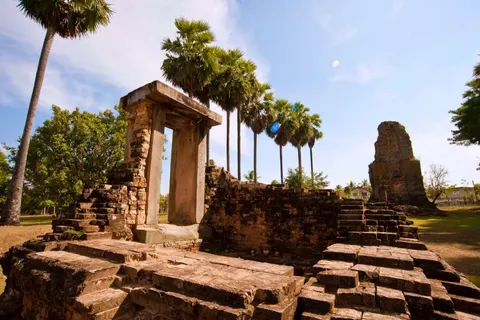
Prasat Mi Chai (Muen Chai) and Prasat Ban Prasat
Prasat Mi Chai, also called Muen Chai, is at Ban Thanon, Krathiam subdistrict, Sangkha district, on the Surin side of Sangkha town. It is about 35 km from Surin in a straight line, and the road is probably about 40 to 45 km. It is a single brick tower facing east, square in plan and 6.5 m on each side. Today only two side walls and part of the front wall remain, with traces of a U-shaped moat around it. No carvings have been found, so the tower cannot be dated.
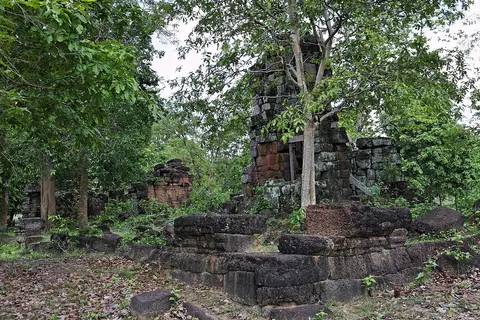
About 75 m to the east are the remains of an arogayasala, a hospital chapel, known as Prasat Ban Prasat. Arogayasalas were hospital chapels built under Jayavarman VII (see the materials section below). The exact position of these remains is not confirmed by an official listing, so ask in the village or check the map when you arrive. Both are likely free and open daily, and the two together take about 20 minutes.
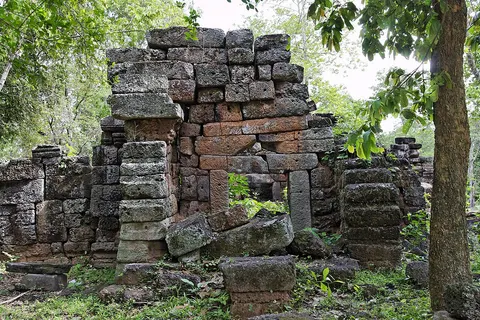
Mi Chai is the first stop of the south-east loop because it lies before Sangkha town, so you can stop without doubling back.
Prasat Yai Ngao
Prasat Yai Ngao is in Sangkha subdistrict, Sangkha district, about 51 km from Surin in a straight line. The turn is off Highway 24 between km 189 and 190, then about 800 m to the right. Two brick towers stand in a north to south row on one laterite base facing east, inside a brick wall. Carved brick frames the pediments with makara and five-headed nagas. It is dated about the 11th to 12th century. The central tower is reduced to its base and cella, and the south tower is better preserved.
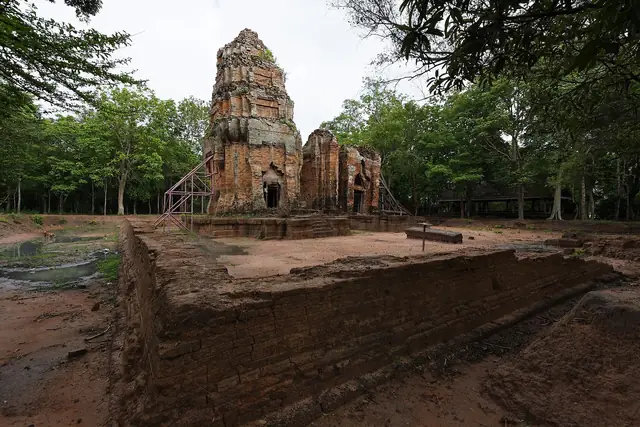
The name comes from a legend of a grandmother who waited for her husband away at war and never saw him return. It is likely free and open daily, and a stop takes about 20 minutes on flat ground. Phum Pon is about 8 km away in a straight line, so the two fit easily into the same loop.
Prasat Ta Piang Tia
Prasat Ta Piang Tia is inside Wat Prasat Thep Nimit in Lamduan district. It is not a Khmer temple but a single Lao-style brick tower with a lotus-bud top, built between late Ayutthaya and early Rattanakosin times. The name means duck pond in local Khmer.
It suits visitors who want to see how a true Khmer brick temple differs from a later Lao-style one. The Khmer temples of the province have a laterite base and sandstone lintels, while this is a brick tower of lotus-bud form inside a temple compound. It needs little time. It sits outside the four main arms, so check a map and decide on the day. It is not worth planning a trip around.
A guide to reading the lintels and pediments
A lintel is the slab of sandstone laid across the top of a doorway, and it is where Khmer carvers put most of their stories. The pediment is the triangular space above it. A simple way to read one is to start at the bottom. There is usually a kala, or kirtimukha, a monster face that spews garlands or scrolling foliage out to both sides. Then look up for the god or the story that is the main picture.
| Temple | Where | What is carved |
|---|---|---|
| Sikhoraphum | Lintel of the main tower | Shiva Nataraja, dancing on three geese above a kala, with musicians around him. Vishnu and Uma on the right, Brahma and Ganesha on the left |
| Sikhoraphum | Two satellite towers | Krishna fighting an elephant and a lion-elephant. Now kept in Phimai National Museum |
| Ban Phluang | East and south sides | Indra on the elephant Airavata |
| Ban Phluang | North side | Krishna subduing the serpent Kaliya |
| Ban Phluang | East pediment | Krishna lifting Mount Govardhana, with small animals such as squirrels and deer above leaf scrolls |
| Ban Phluang | West side | Never carved, a plain block |
| Ban Phlai | North tower | A seated deity with one knee raised in a niche above a kala spewing a garland, both hands holding the garland |
| Phum Pon | Door frame of the main tower | A scroll-leaf pattern in post-Gupta Indian style, and an inscription in Pallava script. Pieces taken from the site are in the Surin National Museum |
| Yai Ngao | Pediment frames | Makara and five-headed nagas carved in brick |
| Chom Phra | Found in digging | A head of Avalokiteshvara and a figure of Vajrasattva. Not a showpiece lintel, but proof that it was a Mahayana Buddhist site |
A few things are worth knowing before you go. Indra on Airavata is the Hindu god of rain and thunder on his elephant. Krishna subduing Kaliya and lifting Govardhana are stories about Vishnu, of whom Krishna is an avatar. Shiva Nataraja is Shiva in the dance of creation and destruction. Knowing these in outline, you recognise the pictures quickly and see why each temple's lintels face a different way or tell a different story.
To see a lintel well, go when the light comes from the side. Relief carving then throws shadows. With light from behind or at noon the picture flattens and is hard to read. Most of the temples face east, so the front carving is bright from early morning.
Brick, laterite and sandstone: how they differ
The Khmer temples of Surin use three materials for different jobs. Once you know which is which, you can tell at a glance what part of the building you are looking at.
- Brick: used for the tower bodies and the tops, orange to red. Sikhoraphum, Ban Phlai, Mi Chai and Phum Pon are brick. At Phum Pon the bricks are laid without mortar.
- Laterite: a reddish-brown, porous stone used for bases, walls and gopuras. The bases at Sikhoraphum and Yai Ngao and the wall at Chom Phra are laterite.
- Sandstone: fine-grained and easy to carve, so it is used only where decoration is wanted: lintels, door frames, wall pilasters and pediments. Ban Phluang is sandstone for nearly the whole tower, with brick only in the top that has collapsed.
An arogayasala is a hospital chapel. Jayavarman VII had about 102 of them built across the empire, each with a similar layout: one main tower, one library building, an enclosing wall and a pond. Chom Phra and Ta Muen Tot are arogayasalas. A dharmasala is a rest house for travellers beside the old roads, about 18 in all, and Ta Muen is one of them.
On direction, almost all the temples face east. These are Sikhoraphum, Ban Phluang, Ban Phlai, Mi Chai, Yai Ngao and Chom Phra. The exception is Ta Muen Thom, which faces south because it was built over a natural rock lingam and looks over the Cambodian plain.
When each temple was built, oldest to newest
In order of date you can see that Khmer art in Surin did not follow a single path. Centuries here are estimates from art style, not exact building dates.
| Temple | About when | Character |
|---|---|---|
| Phum Pon | About the 7th century CE | Before the Angkor period, dry-laid brick |
| Ban Phluang | About the 11th century | Baphuon style, sandstone, never finished |
| Sikhoraphum | About the 11th to 12th century | Baphuon running into Angkor Wat style, five brick towers |
| Yai Ngao | About the 11th to 12th century | Brick on a laterite base |
| Chom Phra | Late 12th to early 13th century, Jayavarman VII | Hospital chapel, laterite with sandstone |
| Ta Muen Tot | Late 12th to early 13th century | Hospital chapel, nearly intact, closed |
| Mueang Thi | Not settled, with later additions | Slender tops and later plaster |
| Ta Piang Tia | Late Ayutthaya to early Rattanakosin | Lao style, not Khmer |
| Ban Phlai, Mi Chai | Cannot be dated | No firm information |
To see the change in the carvers' hand, take three in order: Phum Pon, the plainest; Ban Phluang, where stories begin to appear on the lintels and pediment; and finish at Sikhoraphum, with the apsaras and the most elaborate lintel.
The Ta Muen group on the border: current status
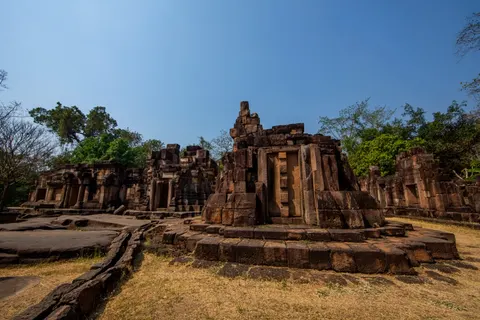
The Ta Muen group has three monuments, Ta Muen Thom, Ta Muen Tot and Ta Muen, on the Dangrek ridge at the Thai-Cambodian border in Ta Mian subdistrict, Phanom Dong Rak district. It was once a favourite goal for people who love Khmer temples because it sits on an old road, but it is now a border zone that is not open.
| Monument | What it is | Features |
|---|---|---|
| Ta Muen Thom | A Shaivite Hindu temple | The largest of the group, facing south, built over a natural rock lingam |
| Ta Muen Tot | An arogayasala, late 12th to early 13th century | One of about 102, nearly intact |
| Ta Muen | A dharmasala | A rest house on the old road from Phimai to Angkor, one of about 18. A single laterite prang with a long hall in front, about 300 m from Ta Muen Tot |
As of 13 Nov 2026 all three Ta Muen monuments are closed to ordinary visitors, and no official reopening has been announced. Thai troops have held the Ta Muen Thom area since 2025, and district officials confirmed in April 2026 that it still could not be entered. The UK government's travel advice, last updated on 12 Oct 2026, still lists Ta Muen Thom as shut and advises against non-urgent travel within 20 km of the border. Ta Kwai temple and Hill 350, which open on some days, are different places. See the next section.
Before it closed, Ta Muen was open about 09:00 to 15:00 and free, and Thai visitors left an ID card with the soldiers for a pass. What foreign visitors needed was not clear. The rules may be quite different when it reopens, so do not plan from old blog posts.
For now, treat Ta Muen as something you see in photographs and books. If you want Khmer temples that really are open, go to Phanom Rung and Muang Tam in Buriram. See the Beyond section below.
Ta Kwai and Hill 350: open on set days in 2026
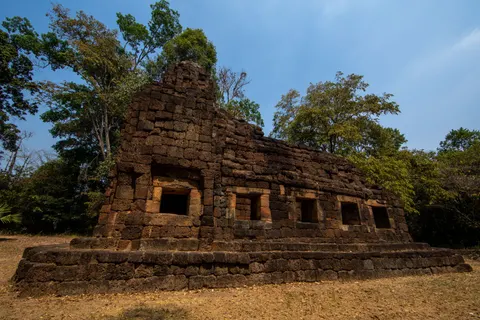
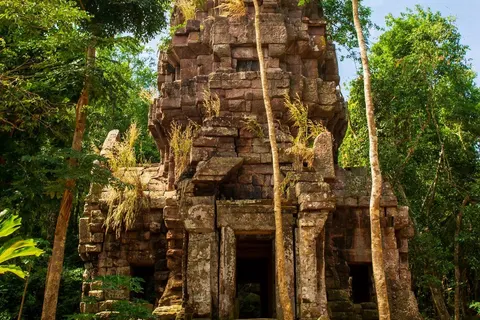
Prasat Ta Kwai is at Ban Thai Niyom Phatthana, Bak Dai subdistrict, Phanom Dong Rak district, on the Dangrek ridge about 10 m from the cliff edge. It is a cross-shaped sandstone prasat on a laterite base facing east. It is not Ta Muen Thom, and it is not open every day. It opens only on days set by the authorities.
| Round | Dates | What is known |
|---|---|---|
| April | 13 to 16 Apr 2026 | Ta Kwai and Hill 350 open, about 07:00 to 13:00. Check the real hours before you go |
| June | 6 to 7 and 13 to 14 Jun 2026 | A trial opening. Park at Ban Thai Santisuk School and take shuttle songthaews up, with no private cars on the hill. Register by app or on the spot. More than 1,000 visitors came on the first day, five of them foreign |
| November | 14 to 15 Nov 2026 | Open with the elephant festival and a run to Pha Manao. No advance registration. Park at Ban Thai Santisuk School. The return shuttle costs 100 baht, and children under 130 cm and older visitors go free. About 2,000 visitors a day are expected |
The November round does not state opening hours or an entry fee, and no documents have been announced for foreign visitors. Foreign visitors did go in the June round, so foreigners are not barred. If you read this after 15 Nov 2026, treat that round as over and check for the next one before you go.
Ta Kwai, Ta Muen Thom and Preah Vihear: what is the difference
| Name | Where | Status as of 13 Nov 2026 |
|---|---|---|
| Ta Kwai | Surin, Phanom Dong Rak, on the ridge | Open only on announced days |
| Hill 350 | Opened in the same rounds as Ta Kwai | Open only on announced days |
| Ta Muen Thom, Tot and Ta Muen | Surin, Ta Mian subdistrict, Phanom Dong Rak | Closed to ordinary visitors |
| Preah Vihear | Si Sa Ket province. See Si Sa Ket | On the list of sites shut under the UK travel advice |
Other viewpoints along the Dangrek ridge are in the border zone, which is closed or restricted, so do not go on your own outside the days when the authorities open them.
How to check the border status, and staying safe
Border status changes faster than any web page can keep up. This table sets out the sequence of events so you can see why places are closed, without taking sides.
| When | What happened | Effect on visitors |
|---|---|---|
| Jul 2025 | Fighting along the border, a ceasefire agreed on 28 Jul | Land crossings stayed shut |
| Dec 2025 | Fighting again, a ceasefire signed on 27 Dec | Closed border areas stayed closed |
| 30 Dec 2025 | TAT issued border safety measures | Ta Muen Thom, Ta Muen Tot, Ta Kwai, Chong Chom and Phanom Dong Rak were on the closed list |
| Apr to Jun 2026 | Ta Kwai and Hill 350 opened in rounds | Ta Muen Thom still could not be entered |
| 12 Oct 2026 | UK government travel advice updated | Land crossings suspended. Ta Muen Thom and Ta Kwai on the general list of closed sites |
| 14 to 15 Nov 2026 | Ta Kwai opens again with the elephant festival | Ta Muen Thom not part of this round |
The permanent Chong Chom crossing in Kap Choeng district is still closed. Army Region 2 stated on 14 Sep 2026 that there was no secret opening. The Thai-side Chong Chom market traded again around late Aug 2026, mainly at weekends. Check the days before you go. For Siem Reap, fly from Bangkok.
Who to check with before you go near the border
- The TAT contact centre, 1672.
- The TAT Surin office, 0 4451 4447 to 8.
- The Phanom Dong Rak district office, to ask whether Ta Kwai or Hill 350 is open on your date.
- Check the day before and again on the morning you travel, because closures and openings can be announced at short notice.
The border area carries warnings about unexploded landmines. On the days when the authorities open a site, walk only on the routes officers mark, do not step off into forest or towards cliffs, and follow instructions from soldiers and officials.
Fees and opening hours in one table
| Temple | Hours | Entry | Note |
|---|---|---|---|
| Sikhoraphum | About 07:30 to 18:00 | 10 baht Thai, about 50 to 80 baht foreign | Check at the gate |
| Ban Phluang | Daylight, about 08:00 to 16:00 or longer | 10 baht Thai, about 50 baht foreign | Check at the gate |
| Phum Pon, Mueang Thi, Chom Phra | Daylight | Free | No ticket gate |
| Ban Phlai, Mi Chai, Yai Ngao, Ta Piang Tia | Daylight | Likely free | Check before you go |
| Surin National Museum | Wed to Sun 09:00 to 16:00 | About 20 baht Thai, about 120 baht foreign | Closed Monday, Tuesday and public holidays. Check at the door. See town and crafts |
A worked example. One foreign visitor going to Sikhoraphum, Ban Phluang and the Surin National Museum pays about 50 to 80, plus 50, plus 120, so about 220 to 250 baht. Two people pay about 440 to 500 baht. A Thai visitor pays 10 plus 10 plus 20, about 40 baht. The other temples are free or likely free, so the main cost of a temple day is the car and fuel, not the entry.
Carry small notes and coins, since gates that charge a fee rarely have much change and probably take cash only.
For comparison, Phanom Rung in Buriram is open 06:00 to 18:00 at 20 baht Thai and 200 baht foreign, and the combined ticket with Muang Tam is 30 baht Thai and 250 baht foreign. Surin's small temples are far cheaper, and far smaller. See Phanom Rung and Muang Tam.
Sample temple plans, by car and overnight
The plans follow the arms of the road and never cross arms in one day. Times are estimates from road distances. If you start later, drop the last stop of the loop.
One day by car: the east loop plus the museum
- 08:00 Leave town on Highway 226 going east.
- 08:30 Wat Chom Sutthawat at Mueang Thi (about 18 km). See the temple for about 20 minutes.
- 09:20 Sikhoraphum (about 17 km further). See it for about 75 minutes, until about 10:35.
- 11:00 Lunch in Sikhoraphum market.
- 12:30 Back in town.
- 13:30 Surin National Museum (Wednesday to Sunday, closes 16:00). On Monday or Tuesday swap in Wat Burapharam and the night bazaar. See town and crafts.
Half a day by car: the south loop
- 07:30 Leave town on Highway 214 going south.
- 08:15 Ban Phlai (about 23 to 30 km). See it for about 30 minutes.
- 09:20 Ban Phluang (about 11 km on from Ban Phlai). See it for about 40 minutes.
- 10:00 Head back to town, about 34 km, arriving about 10:45.
- If time remains in the afternoon, go to the silk weavers of Tha Sawang or the silver village of Khwao Sinarin. See town and crafts.

Ryans Resort
Ban Khok Weng, Tabao, Prasat district
Ban Khok Weng, Tabao subdistrict, Prasat district, in the same district as Ban Phluang and Ban Phlai. It suits anyone who wants to start the south loop without driving out from town. Check the distance to each temple on the map before you book.
See prices and availability on the booking page
The north trip: Chom Phra and an afternoon in town
- 07:30 Leave town on Highway 214 going north.
- 08:10 Chom Phra (about 29 km). See it for about 30 minutes.
- 09:30 Back in town.
- 10:00 onwards: the National Museum, Wat Burapharam or a silk weaver in town.
A long half day: the south-east loop, Sangkha, Yai Ngao and Phum Pon
- 07:00 Leave town towards Sangkha (Highway 2077).
- 08:00 Prasat Mi Chai (about 40 to 45 km). Stop for about 20 minutes.
- 09:00 Prasat Yai Ngao, on Highway 24 near km 189 to 190.
- 09:45 Prasat Phum Pon. See it for about 30 minutes.
- 11:00 Lunch in Sangkha town.
- 12:30 Head back to Surin, about 60 km, arriving about 13:45.

Manee Sangkha Hotel
Chokchai-Det Udom Road, Sangkha
Chokchai-Det Udom Road, Sangkha. It suits anyone who splits the south-east loop over two days, sleeping in Sangkha and going to Yai Ngao and Phum Pon in the morning, with no drive back to town at night.
See prices and availability on the booking page
Overnight plans: 2 days 1 night and 3 days
| Day | Morning | Afternoon |
|---|---|---|
| Day 1 | East loop, Mueang Thi and Sikhoraphum | Surin National Museum or Wat Burapharam |
| Day 2 | South loop, Ban Phlai and Ban Phluang | Silk weavers or the night bazaar, or Chom Phra if you have the energy |
| Day 3 (if you have it) | South-east loop, Mi Chai, Yai Ngao, Phum Pon | Back to town, or on to Phanom Rung using the Buriram page |
Surin plans including elephants and town
If you travel by train and have no car, read the next section, and see the no-car day on the plan page.
If you do not have a car
Songthaews from the town market serve some routes on irregular schedules and do not reach many of the temples. Some ride-hailing apps cover the town, but a ride out to a country temple with a wait for the return is not reliable. Motorbike hire in town is scarce, so ask your hotel ahead, and the highways that trucks use are risky for anyone unpractised. The easy way is a hired car with a driver through your hotel, or a private transfer from Bangkok, with the driver taking you around.
What to agree with the driver
- The price per day or per loop, and whether fuel is included. Temple entry fees are paid at the gate.
- The route by arm, for example Mueang Thi with Sikhoraphum, or Ban Phlai with Ban Phluang, and not several arms in one day.
- An early start, about 07:30, and the time you will be back.
- Any extra charge for longer trips out of town, such as the Sangkha loop.
If you do not drive yourself, a private car with a driver is the easiest way to see three or four temples in a day, and it can bring you from Bangkok to Surin in the same booking.
 KKday
Private Transfer from Bangkok to Surin (or Surin to Bangkok)
From US$162.04 (Starting price per car, one way (sedan). SUV about US$180, van about US$234)
Price as of 6 Nov 2026A private transfer from Bangkok to a hotel in Surin. A sedan starts at about US$162 per car, one way, with free cancellation up to 3 days before. Price as of 6 Nov 2026. For temple days within the province, agree the price with the driver or your hotel.
Book on KKday Klook
Buriram Province Car Rental
From US$37.55 (Starting price per day, compact car, as of 13 Nov 2026)
Price as of 13 Nov 2026If you fly into Buriram or like to drive yourself, a rental car lets you reach the temples, the elephant village and the silk villages on your own timing. Pick up at Buriram Airport or in town, then drive about an hour to Surin. From about US$37.55 per day for a compact car as of 13 Nov 2026, depending on date and car. Check the driver age and deposit on the booking page.
See Buriram car rentalIf you arrive by train or bus, book the ticket ahead and hire a car by the day in town. The fares in the link below are the booking service's own prices, not the State Railway of Thailand's fares.
 12Go
Bangkok to Surin on 12Go
From US$5.39 (As of 6 Nov 2026: class 3 trains from about US$5, 2nd class air-conditioned trains about US$12, buses about US$11 to US$17, a 9-seat van taxi about US$242. Prices change by date and class)
Price as of 6 Nov 2026Bangkok to Surin. Class 3 trains from about US$5, 2nd class air-conditioned trains about US$12, buses about US$11 to US$17, as of 6 Nov 2026. Prices change by date and class. Trains leave from Krung Thep Aphiwat and arrive at Surin station.
Book on 12GoOlder visitors, small children and limited mobility
Most temples are flat and close to parking, but the temple bases have steps and you cannot go into the cella. The table is an assessment from the layout of each site, so check the real conditions before you go.
| Temple | Ground | Level |
|---|---|---|
| Sikhoraphum | Flat lawn, steps on the base, you can walk round the outside | Easy |
| Mueang Thi | Flat temple yard | Easy |
| Ban Phluang | Low base, two or three steps, flat grass, moat edge around it | Easy, watch children near the moat |
| Ban Phlai | Flat ground | Easy |
| Phum Pon | Flat lawn | Easy |
| Yai Ngao | Flat ground, a small road of about 800 m in from Highway 24 | Easy to moderate |
| Chom Phra | Laterite blocks, roots, wet ground in the rains | Moderate |
Older visitors and small children should go on a morning round while it is cool, wear shoes with good grip and not loose sandals, carry water and a hat, and rest in the car between stops, because each site has little shade. If you use a wheelchair, Sikhoraphum, Mueang Thi and Phum Pon can be reached up to the lawn in front of the temple, but you cannot get up onto the base.
On a rainy day, switch to the Surin National Museum or Wat Burapharam in town. See town and crafts. The ground at Chom Phra and the lanes into small temples are slippery and wet in the rain.
Which month to go, and how the light falls
Nearly all the temples are in the open with little shade, so weather matters more than you might think. The figures below are long-term averages for Surin from 1991 to 2020.
| Month | High / low °C | Rain mm | For temples |
|---|---|---|---|
| Jan | 31 / 19 | 7 | Very good, cool mornings and evenings |
| Feb | 33 / 20 | 10 | Very good, stronger sun by afternoon |
| Mar | 35 / 23 | 47 | Hot, go before 10:00 |
| Apr | 36 / 25 | 86 | Hottest, record high 43.5 °C |
| May | 35 / 25 | 186 | Hot, afternoon rain begins |
| Jun | 34 / 25 | 194 | Afternoon rain, go in the morning |
| Jul | 33 / 25 | 220 | Afternoon rain and wet ground |
| Aug | 32 / 25 | 271 | Wettest, country roads can be soft |
| Sep | 32 / 24 | 267 | Wettest, country roads can be soft |
| Oct | 31 / 23 | 114 | Rain easing, green grass |
| Nov | 31 / 21 | 30 | Good, little rain, cool dawn |
| Dec | 30 / 19 | 3 | Very good, the coolest of the year |
The best months are November to February, with little rain and cool mornings. November is the Round-up month, and its coldest mornings have dropped to about 12 degrees. March to May is very hot. The laterite and sandstone store heat, so aim to be finished by 09:00 and rest in the car at midday. August and September are the wettest, and country roads to the small temples can be soft, so allow extra time and avoid dirt lanes after rain.
Time of day matters too. The temples face east, so from about 07:30 to 10:00 the light falls straight on the front and the lintels, and the facade and carving photograph best. Late afternoon gives warm side light on the sides and back. Near noon the light is overhead, reliefs look flat and it is hot, so that is the time for lunch and a rest.
What to wear, what to bring and manners at the temples
- Dress modestly where the temple is inside a temple compound, as at Mueang Thi. Avoid bare shoulders and very short shorts.
- Shoes with good grip, because laterite and roots are slippery after rain.
- A hat, sunscreen and at least a litre of water per person per round.
- Insect repellent, especially for morning and evening rounds.
- Watch for snakes in long grass at lightly kept sites such as Chom Phra, where there are moats and ponds. Do not wander through long grass without need.
- Download an offline map, since phone signal can be weak in the villages.
- Small cash for entry fees of 10, 50 and 80 baht.
- Use the toilet before you leave town or at Sikhoraphum market, since the small temples may not have toilets.
On manners: do not climb the bases or step on stones that have come loose, because these are ancient monuments that can collapse further. Do not scratch or touch delicate carving. Do not fly a drone without checking the rules first. Never take stones or bricks home. And inside a temple compound, keep your voice down and take off your hat near the temple buildings.
For bigger Khmer temples, where to go next
The temples of Surin are small ruins scattered through villages. If you want large, restored sandstone temples, go on to a neighbouring province and give it a day of its own. Do not mix it into a Surin loop.
- Phanom Rung and Muang Tam, Buriram: a sandstone temple on an old volcano, open 06:00 to 18:00 at 20 baht Thai and 200 baht foreign. The combined ticket with Muang Tam is 30 baht Thai and 250 baht foreign. See Phanom Rung and Muang Tam.
- Other Khmer sites of Buriram and the Ban Kruat kilns. See Khmer sanctuaries and kilns of Buriram.
- Phimai, Nakhon Ratchasima: a large stone temple, and Phimai National Museum, which keeps the Krishna lintels of Sikhoraphum. See Phimai.
- Si Sa Ket and Ubon Ratchathani: neighbouring cities linked by train. See Si Sa Ket and Ubon Ratchathani.
Common mistakes
- Dragging Chom Phra on to Ban Phluang in one loop. They are at opposite ends of Highway 214, about 58 km apart.
- Putting Sikhoraphum and Ban Phluang in one day, when they lie in different directions.
- Assuming Ta Muen can be visited as it once could, or confusing it with Ta Kwai, which opens on some days.
- Thinking Ban Phlai is in Sangkha. It is in Prasat district.
- Expecting a large complex like Phimai. Most of Surin's temples are small ruins.
- Going to the National Museum on Monday or Tuesday, when it is closed.
- Going at midday in the hot season without a hat or water. There is little shade.
- Carrying no small change. Small temple gates often have little to give back.
- Driving into country lanes without checking the map first. Dirt lanes can be soft in the rains.
Keep reading
 Plan your Surin tripElephants, Khmer temples, silk, stays, getting there
 Surin in 1 to 2 daysTimed plans for the town, silk villages and temples
 Elephants and the Round-upRound-up 2026 dates, tickets and Ban Ta Klang
 Town, silk and craftsWat Burapharam, city pillar shrine, Ban Tha Sawang, Khwao Sinarin
 Getting to SurinTrain, bus, flight via Buriram and driving
 Where to stay in SurinWhich area to choose, especially for the Round-up
 Surin deals and transfersPrivate transfer, train and bus tickets with prices
Frequently asked questions
What are the opening hours and fee at Prasat Sikhoraphum?
About 07:30 to 18:00 daily. 10 baht for Thais and about 50 to 80 baht for foreign visitors. Check again at the gate.
How far is Prasat Sikhoraphum from Surin town?
About 34 km east on Highway 226, roughly 40 to 50 minutes by car. Prasat Mueang Thi is on the way.
What is special about Prasat Sikhoraphum?
Five brick towers on one laterite base, a dancing Shiva on the main lintel and apsaras on the pilasters. The two Krishna lintels of the satellite towers are now in Phimai National Museum.
Is Prasat Ban Phluang worth the trip?
It is a small, unfinished sandstone tower, but its lintels and pediment tell the stories of Indra on Airavata and Krishna in full. It is about 33 to 34 km south of town, takes 20 to 40 minutes, and combines well with Ban Phlai.
Which is the oldest temple in Surin?
Prasat Phum Pon in Sangkha, from about the 7th century CE. It is dry-laid brick, free and open daily, and its lintels and inscriptions are in the Surin National Museum.
Can I visit Chom Phra and Ban Phluang on the same day?
It is not sensible. Chom Phra lies north of town and Ban Phluang south, about 58 km apart in a straight line. Split them into two trips. Chom Phra takes a short morning, and Ban Phluang pairs with Ban Phlai.
Can I visit Ta Muen Thom now?
As of 13 Nov 2026 the Ta Muen group is not open to ordinary visitors. Check with TAT on 1672 or the Phanom Dong Rak district office before you plan anything near the border.
Are Ta Kwai and Hill 350 open, and can foreigners go?
They open only on set days. The latest round announced is 14 and 15 Nov 2026, with parking at Ban Thai Santisuk School and a return shuttle of 100 baht. Foreign visitors went in the June round, but documents and fees for them have not been announced. Always check first.
Can I visit the temples without a car?
Yes, with a hired car and driver. Songthaews run on irregular schedules and do not reach many temples. Choose one arm per trip, such as Mueang Thi with Sikhoraphum.
When is the best month for the temples?
November to February, with little rain and cool mornings. March to May is very hot, so go before 09:00. August and September are the wettest and country roads can be soft.
Where the facts come from
- Fine Arts Department Office 10: Prasat Sikhoraphum
- Surin National Museum: Prasat Ban Phluang
- Fine Arts Department: Prasat Phum Pon
- Surin National Museum: Prasat Chom Phra
- Surin National Museum: Prasat Mueang Thi
- Fine Arts Department: Prasat Yai Ngao
- SAC Archaeology Database: Prasat Sikhoraphum
- SAC Archaeology Database: Prasat Ta Muen Thom
- Thai Holiday Guide: Surin province
- TAT: travel advisory for border areas
- Talk News Online: Ta Kwai and Hill 350 open 14 to 15 Nov 2026 (Thai)
- Matichon: Ta Kwai and Hill 350 June 2026 round (Thai)
- News1live: Army Region 2 on the Chong Chom crossing (Thai)
- Siam Rath: Chong Chom Thai-side market trading again (Thai)
- UK FCDO: Thailand warnings and insurance