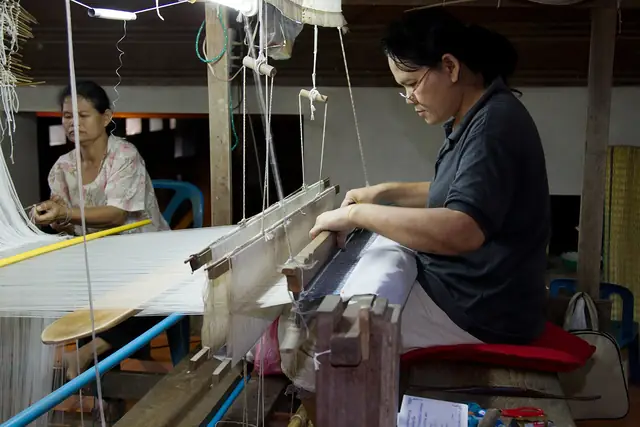
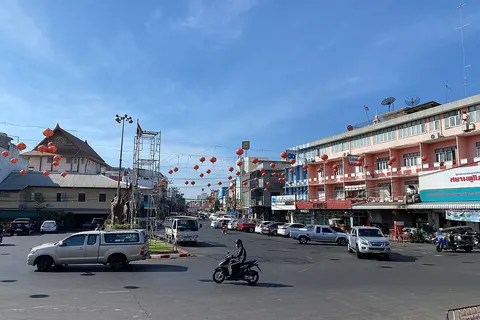
If you come to Surin for the elephants or the temples, the town and the craft villages round the trip out. The town has a red Khmer-style city pillar shrine, Wat Burapharam, a monument to the founder of the town, a museum that tells the story of four peoples, and a night market. Outside it are villages where gold-thread silk is still woven and silver is still worked. This page gives hours, distances, entry fees, buying tips, what to eat and a way to order the day so you see real weaving.
Hours and prices are as of 13 Nov 2026. Shops and workshops change their hours, so check before you go. To combine this with elephants and temples, see Surin in 1 to 2 days.
We earn a commission if you book through our links. The price you pay does not change. How we choose
Surin town and crafts at a glance
| Place | Hours | Entry | From town |
|---|---|---|---|
| City pillar shrine | 08:30 to 16:30 daily | Free | In town, Lak Mueang Road |
| Wat Burapharam | Morning to late afternoon, grounds open longer | Free | In town, Chit Bamrung Road |
| Phraya Surin Phakdi monument | Open at any time | Free | Roundabout on the south side of town |
| Surin National Museum | Wed to Sun 09:00 to 16:00 | 20 baht Thai, about 120 baht foreign | About 4 km south |
| Ban Tha Sawang | About 08:30 to 17:00 | Free or a small fee | About 8 to 10 km north |
| Ban Chan Rom | About 08:30 to 16:30 | Free | About 9 to 12 km east |
| Ban Sawai | About 08:30 to 17:30 | Free | About 25 to 30 minutes by car |
| Khwao Sinarin | 08:00 to 18:00 | Free to look around | About 15 to 18 km north-east |
With a free morning, go to Ban Tha Sawang first and come back to town in the afternoon, because the big loom is best seen before noon. If you want the museum, check the day first, because it is closed on Monday and Tuesday.
If you can only choose three things in one day, pick Tha Sawang, the museum (Wednesday to Sunday) and the night market. Together they tell the story of Surin best: the skill of the weavers, the history of four peoples, and the food people really eat. The shrine, Wat Burapharam and the monument take under an hour in total and sit close together, so they slot easily into the morning.
Surin city pillar shrine
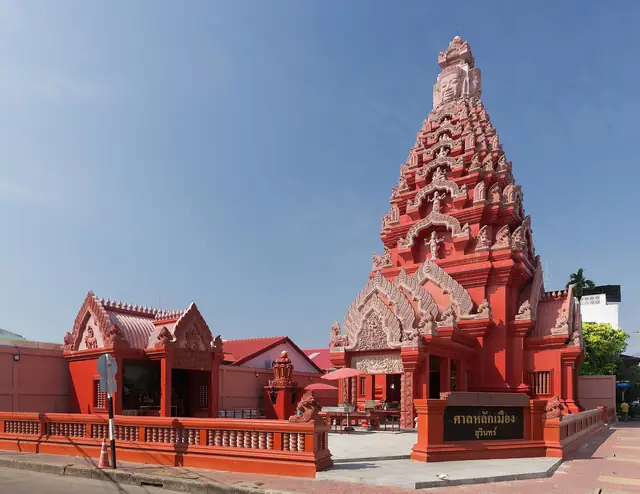
The shrine is on Lak Mueang Road, on Soi Poi Pring, about 500 m west of the provincial hall. It is a tiered red tower in Khmer style. Before 1968 the site was a shrine without a pillar. The Fine Arts Department then designed a new shrine and pillar. The pillar is a golden cassia log about 3 m tall and about 1 m around, brought from Sai Yok in Kanchanaburi, and the pillar-raising ceremony was held on 15 March 1974. It is open 08:30 to 16:30 daily and free.
- It is a place of worship, so dress modestly. Weekday mornings are quieter.
- The bright red against the sky makes it the best-known photo in town, and morning light is softer.
- A stop takes 15 to 20 minutes, and you can add Wat Burapharam and the monument in the same morning.
- The shrine closes at 16:30. If you stop on the way back from the villages, arrive before 16:00.
Wat Burapharam and Luang Pu Dun Atulo
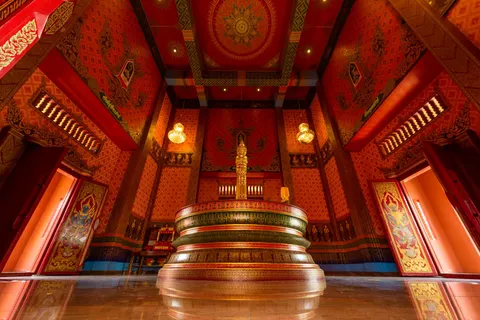
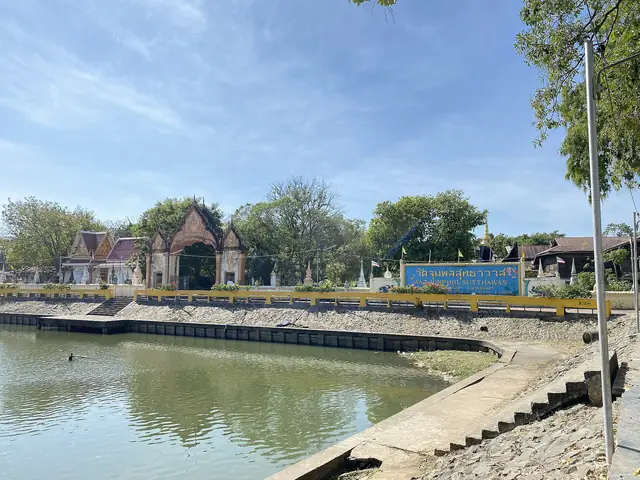
Wat Burapharam is in the middle of town at Moo 1, Chit Bamrung Road, opposite the provincial public prosecutor's office. It is a royal temple of the third class and about 200 years old. It is thought to have been built in the Thonburi or early Rattanakosin period by Phraya Surin Phakdi Si Narong Changwang (Pum). It has belonged to the Dhammayut order since 1933 and was raised to a royal temple in 1977.
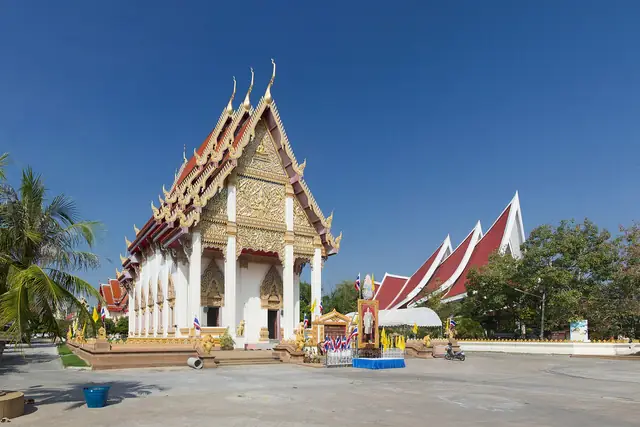
The principal Buddha is Luang Pho Phra Chi, in the Subduing Mara posture, four sok across the lap (a sok is about half a metre), made of compact terracotta in a style close to Khmer art. It sits in a four-sided brick-and-plaster hall on the west side of the ordination hall. In the past officials took their loyalty oath in front of it, and it later became a place where people make vows and ask for good fortune.
Luang Pu Dun Atulo, a forest-tradition meditation master born in 1887, lived here from 1934 until he died on 30 Oct 1983. There is a small museum on the grounds with his robes, alms bowl and belongings, and a likeness of him. No separate opening hours are published for it, so go in the morning and ask at the temple.
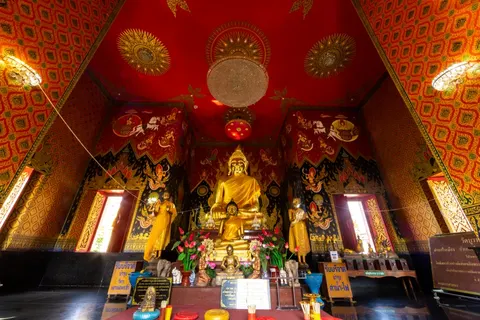
- Hours: visitor hours are about 08:30 to 16:30, and the grounds stay open longer from early morning. Free.
- Go before 08:00 to hear the monks chant, dress modestly and remove your shoes before entering any building, the museum included.
- There is parking at the temple. Check the walking distance from your hotel on a map.
Monument of Phraya Surin Phakdi Si Narong Changwang (Pum)
The monument is a dark bronze statue about 2.2 m tall, holding an elephant goad in the right hand, with a pair of swords on the back that point to his skill in war on elephant back. It honours the Kui leader who founded the town of Surin. It stands at the roundabout on the south side of town, near km 0 of the Surin to Prasat road, and is open around the clock and free. The annual ceremony is on 13 April.
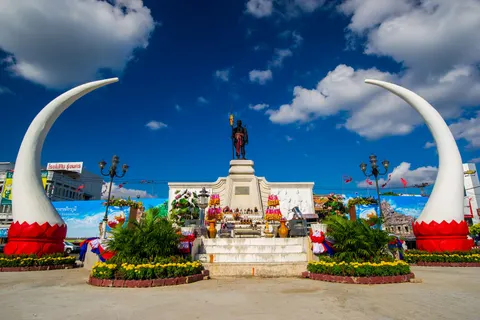
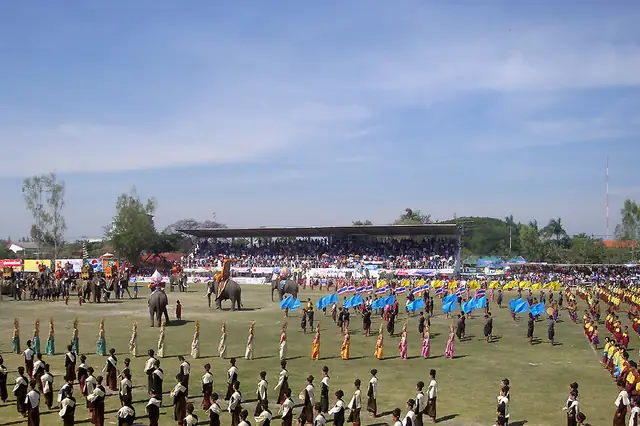
During the Round-up this is where the elephant welcome and feast starts on Friday morning, 20 Nov 2026. See elephants and the festival. On an ordinary day it is quiet, and a photo and a short respect take a few minutes.
Surin National Museum
The museum is at Moo 13, Chaniang subdistrict, on Highway 214, about 4 km south of town and about 10 minutes by vehicle. It is open Wednesday to Sunday 09:00 to 16:00 and closed on Monday, Tuesday and public holidays. Entry is 20 baht for Thais and about 120 baht for foreign visitors, so confirm at the door. Phone 0 4451 3274.
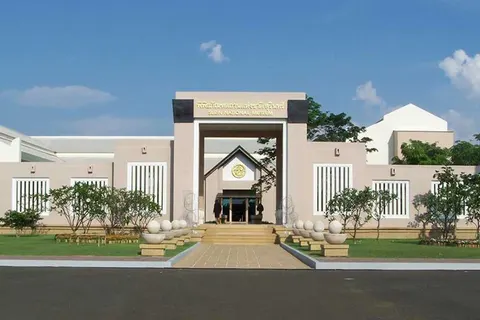
It has four connected buildings: an entrance hall, an education building with meeting and activity rooms and a library, an exhibition building with permanent and temporary displays, and a building for storage and a conservation lab. The permanent display has five themes: natural science (geography, soils, water, forests, wildlife, rice and farming); history and archaeology (prehistoric, Dvaravati, Khmer, Lan Xang and Ayutthaya periods); the history of Surin town (the story of Kui helping to catch the white elephant that escaped from Ayutthaya, a recreated capture scene, the arrival of the railway and the early market); ethnology; and outstanding local heritage such as handicrafts.
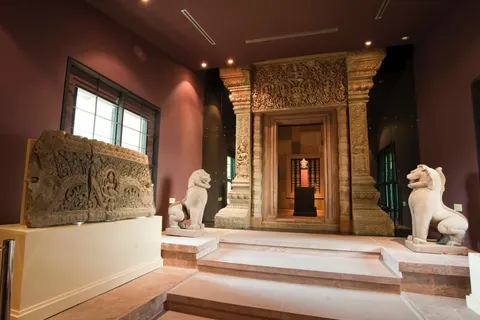
The room to spend longest in is the ethnology room, because it presents four peoples of Surin, the Kui, Khmer, Lao and Thai-Korat. That is the key to the languages, food, textiles and elephant culture you will meet all trip. Allow 45 to 90 minutes in total.
Visit before the temples so that you have seen the lintels and inscriptions from Phum Pon first. If you arrive on Monday or Tuesday, skip the museum and go to Tha Sawang instead. See Khmer temples.
The road to the museum has no comfortable footpath, so do not walk from town. Go by car, taxi or a lift from your hotel. A pink songthaew once ran this way for about 10 baht, but that may no longer be the case, so ask the driver or your hotel. In the rain, the museum is the best indoor choice in town.
Ban Tha Sawang, the gold-thread silk village
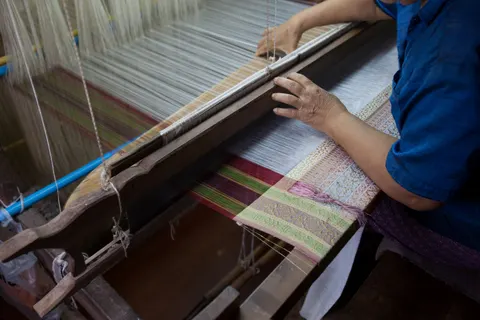
Ban Tha Sawang is in Chan Soma subdistrict, Mueang Surin, about 8 to 10 km north of town, 15 to 20 minutes by car. There is no direct public transport into the village. The village weaves yok thong, a fine silk brocade woven with gold-coloured metal thread twisted with silk. It has a large 1,416-heddle loom that needs four or five weavers at once, and it wove shirts and shawls for the APEC leaders in 2003.
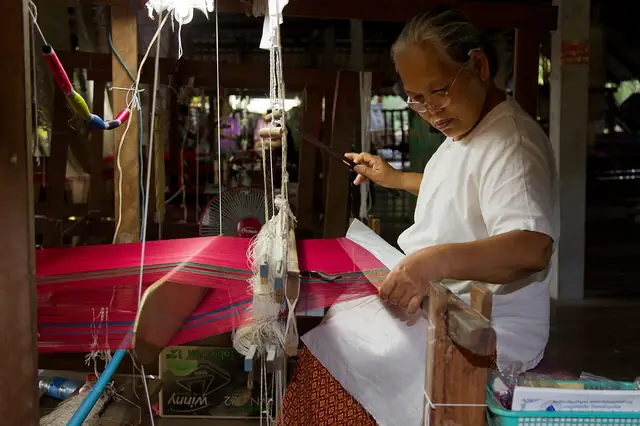
| Hours | About 08:30 to 17:00 daily. There is a weaving workshop, a traditional house, a silk display and a shop. Parking and toilets are available |
|---|---|
| Entry | Free or a small fee, usually tens of baht if charged. Carry small notes and check at the village entrance |
| Best months | November to June, when the weavers are not busy in the fields all day. Go before noon to see the weaving |
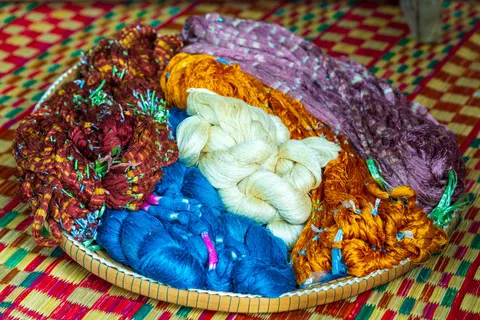
| What you see | Silk reeled and boiled, natural dyes such as red from lac, yellow from heartwood and blue from indigo, metal thread twisted with silk, and weaving on the big loom |
| Weaving speed | About 4 to 5 cm a day, so a long piece takes weeks |
| Phone | 0 4414 0015 |
| Buying | Everyday silk is priced within reach. Fine gold-thread pieces are priced one by one and are often made to order. Bring cash |
For a group or a short visit, phone the weaving group first. Demonstrations usually need notice, and some numbers online are old, so ask your hotel to call. Do not confuse it with another Ban Tha Sawang in Si Sa Ket province: type Ban Tha Sawang, Chan Soma, Mueang Surin into your map.
If you have time, see the silk display before you buy, and you will see which patterns and levels of fineness carry which prices. Then ask the weaver or the shop at the village directly.
Two more silk villages
- Ban Sawai, in Sawai subdistrict, open about 08:30 to 17:30 and free. It is about 25 to 30 minutes by car from town. It weaves mudmee ikat silk with elephant, naga, glass-bead and eggplant-flower patterns, with weaving under the houses, and has a natural-dye learning centre. Activities include a thousand-year-old clay Buddha, a boat trip on the Chi River, and picking and cooking organic vegetables. Phone 08 7962 3472. Weekday mornings are best, and some workshops may be closed on Sunday afternoon.
- Ban Chan Rom, in Ta Ong subdistrict, about 9 to 12 km east on Highway 2077. It is open about 08:30 to 16:30 and free. Many households raise mulberry and silkworms, reel the silk, dye it and weave mudmee, and some do silverwork. Looms usually need notice, and you can ask the Surin Provincial Commercial Office on 0 4451 4385 or 0 4451 2626. It is a village where people live, with no ticket booth, and 1 to 2 hours is enough.
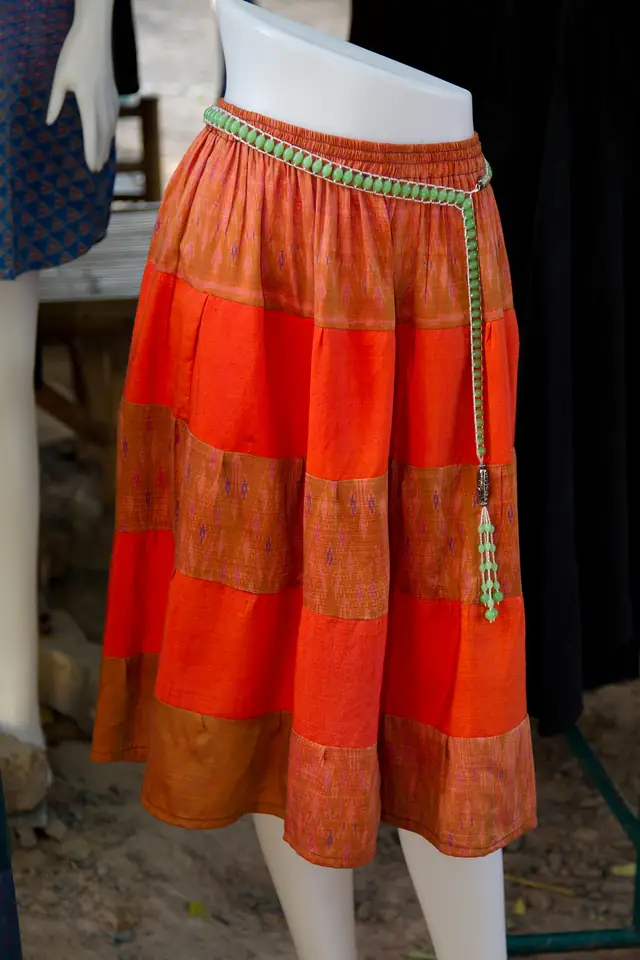
Both need a car. For a range of Surin silk in one day, try Tha Sawang in the morning and Ban Chan Rom late morning to noon. Ban Sawai lies south-west of town and is farther than the other two, so keep it for a half day of its own if you want the activities beside the Chi River.
Tha Sawang, Ban Sawai or Ban Chan Rom: which one
All three weave silk, but each visit feels different. This table helps you choose by the time you have and what you want to see.
| Village | Known for | Best for | Good to know |
|---|---|---|---|
| Tha Sawang | Gold-thread brocade on a 1,416-heddle loom | Seeing real weaving and the silk display | Go before noon, phone ahead for a group |
| Ban Sawai | Mudmee, elephant motifs, village activities | Activities and choosing mudmee cloth | Farthest, allow 25 to 30 minutes |
| Ban Chan Rom | Mulberry to mudmee in one village | Seeing every step from mulberry to cloth | Looms need notice, allow 1 to 2 hours |
If you have one day and can pick only one, go to Tha Sawang, because it is the one place with the big brocade loom to see. With an extra half day, add Chan Rom, which is a short stop east of town, or add Ban Sawai if you want a community activity.
Khwao Sinarin, the silver village
Khwao Sinarin, which is now a district of its own and no longer part of Mueang Surin, is about 15 to 18 km north-east of town, roughly 20 to 25 minutes by car. The craft is centred on Ban Chok, Moo 3, on the Surin to Roi Et road. Shops line both sides of the village road, open about 08:00 to 18:00 daily and free to enter, and silversmiths work at benches you can see from the street.
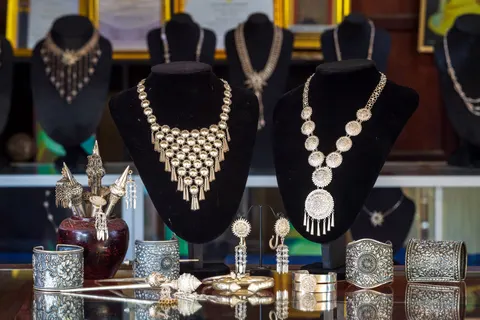
The best-known item is the pakuem (pakeuam) silver bead: silver sheet hammered into smooth round or oval beads, then enamelled and patterned. Patterns include the horseshoe-crab egg, the pikul flower and the money-bag. They are made into necklaces, bracelets, belts and earrings. Many households also make stone and bead necklaces, much of it for export, and some senior craftsmen make twisted silver-wire jewellery in the takao style. For a demonstration, contact the ancient silver craft group on 08 9043 6794 in advance.
- Price is by the weight of silver plus labour. Ask the weight and the price per gram before you buy, and bring cash.
- Some shops may be unstaffed on a given day. If you do not find the shop you want, ask at the next one.
- Walk past several shops to compare workmanship and prices before you decide.
- There is no common price list online, so compare the price per gram at the shop.
If you cannot reach the village, ask your hotel whether the Saturday morning green market at the provincial administration office still has silver stalls. That may no longer be the case, so treat it as a back-up and check first. It should not replace watching craftsmen work in the village itself.
Where to eat: the night market and town
The night market is at the eastern end of Krungsri Nai Road. It runs in the evening, about 17:00 to 21:30, and the road is closed to cars so it becomes a pedestrian street. There are food stalls with grilled items, noodles, pad thai, fried mussel pancakes, fruit, shakes and, in season, fried insects, and another part for clothes and toys. Hours can change from day to day, so go in the early evening to see everything.
- Isan sausage and Isan-style grilled chicken are easy to find at roadside stalls, though they are not a dish special to the province. Papaya salad is often hot, so say how hot you want it before you order.
- Breakfast at Thip Rot 1962 on Thanasan Road near the fountain roundabout, open about 06:00 to 14:00.
- There is no common price list in the market or at roadside stalls, so ask the price first, especially for seasonal items.
Opening hours change. Check on a map before you go.
Kui and Khmer dishes worth trying in Surin
If you want food that is really from Surin, look for the dishes of the Kui and Khmer people. These five are eaten by locals in the province. There is no standard price, so ask at the shop or at your hotel.
| Dish | What it is | Where to find it |
|---|---|---|
| Sanlo jek | Raw banana and chicken curry in coconut milk, found mainly in Surin | Community and merit-making events, ask your hotel who cooks it |
| Sloat rao (taro curry) | A Khmer-style sour curry with taro and field crab, snakehead fish or frog, soured with tamarind | Ask your hotel which shop or home kitchen cooks it |
| Ang kab bob (grilled frog) | Grilled frog, which the Michelin Guide Thailand featured in 2020 | Ask your hotel or driver |
| Ansom jruk | Sticky rice with peanuts and pork fat or banana, steamed in a coconut leaf parcel, a festival food | Merit-making events and festival markets |
| Khanom kroch | A fried sweet dumpling | Ask your hotel or driver |
Some of these are food for community events and are not sold every day at one shop. The method that works is to ask your hotel or driver which place is making them today, or to come during a festival when there are more stalls than usual. Do not order without asking what is in it, because some dishes use field crab or frog and a lot of coconut milk. If you avoid shellfish, nuts or pork, ask first.
If you do not eat spicy food, say so right from the start. Isan and Khmer food in Surin is often sour and hot.
Cafes in town for a break or a rainy day
Cafes are where you rest when the afternoon sun is strong or the rain comes. The hours below are approximate and can change, so check on a map before you go.
| Cafe | Area | Hours about |
|---|---|---|
| 361 THREE SIX ONE | Chaniang, south of town. Loft with a restaurant, coffee roastery and gallery | 07:30 to 23:00 |
| CHAROENSUK Cafe | Nok Mueang subdistrict. Minimalist, with a glass-walled area | 08:30 to 17:00 |
| For Foo Cafe | Lak Mueang Road. Dark loft that sells cakes | 08:30 to 17:30 |
| SATI Cafe | In town, roasts its own coffee | About 07:30 to 18:00, check first |
| Craft Cafe | Surinpakdi Road, with a bakery | Mon to Fri 07:30 to 16:30, Sat and Sun 09:30 to 16:30 |
| Light House Kafe | Thesaban 1 Road, opposite Phetkasem Plaza | About 09:00 to 22:00, check first |
If the afternoon is rainy, try this. Do Tha Sawang or the museum in the morning, because both are indoors, then rest at a cafe in town until the rain eases, before heading to the night market.
A one-day plan for the town and craft villages
This plan follows the real geography: the town and the museum to the south first, then north to Tha Sawang, back for lunch, then north-east to Khwao Sinarin, and the night market to finish.
| Time | Where | Note |
|---|---|---|
| 07:30 | Wat Burapharam | Go before 08:00 to hear the chanting |
| 08:30 | The city pillar shrine and the monument | 15 to 20 minutes each, the shrine opens at 08:30 |
| 09:30 | National Museum (closed Mon and Tue) | South of town, about 10 minutes by car. On Monday or Tuesday, go straight to Tha Sawang |
| 11:00 | Ban Tha Sawang | North, 15 to 20 minutes by car. Go before noon to see the weaving and buy silk |
| 13:00 | Lunch in town | Rest out of the midday heat |
| 14:30 | Khwao Sinarin | North-east, about 20 to 25 minutes by car. Watch the silversmiths and shop |
| 17:00 | Night market on Krungsri Nai Road | Stalls start about 17:00. End the day |
Without a car, hire a car for half a day through your hotel. See deals and transfers.
Other plans: silk first, Monday and Tuesday, and a half day
The plan above suits Wednesday to Sunday. If your day is different, or you do not want to cram too much in, pick from the versions below.
Silk first (be there while the weavers are at work)
| Time | Where | Note |
|---|---|---|
| 08:30 | Ban Tha Sawang | Opens about 08:30. Arrive when the weavers start |
| 10:30 | Khwao Sinarin | Silver shops open from 08:00 |
| 12:30 | Lunch in town | Rest out of the heat |
| 14:00 | Museum (Wed to Sun, closes 16:00) | Allow 45 to 90 minutes and leave before 15:45 |
| 15:45 | City pillar shrine and Wat Burapharam | The shrine closes at 16:30, so go early |
| 17:00 | Night market | End the day |
Monday or Tuesday (museum closed)
Drop the museum and visit all three villages instead: Tha Sawang in the morning, Ban Chan Rom late morning, Khwao Sinarin in the afternoon. Make up the culture with Wat Burapharam and the silk display at Tha Sawang.
Half day, morning only
If you only have the morning, go to Ban Tha Sawang when it opens, then return to town for the shrine, Wat Burapharam and the monument. That takes about 3 to 4 hours, not counting a meal.
Two hours on foot in town
If you are staying in town and do not want to use a car, the shrine, Wat Burapharam and the monument are three town stops of 15 to 30 minutes each. Walking time between them depends on your hotel, so check on a map, then finish with the night market. For a plan that adds elephants and temples, see Surin in 1 to 2 days.
Reaching the silk and silver villages without your own car
There is no direct public transport to Tha Sawang or Khwao Sinarin. A songthaew used to leave from the north side of the fresh market in the morning, but do not plan around it. The bus terminal is about 0.4 km from the railway station near Soi Nong Dume, and everything beyond that needs a vehicle.
If you do not drive, try this. Ask your hotel whether it can arrange a half-day car to Tha Sawang and Khwao Sinarin, and agree the price and waiting time before you set off. You can also try a ride-hailing app if a car is free that day, though in the villages there may be none. Arrange for the driver to wait for the return. See deals and transfers and getting to Surin.
 KKday
Private Transfer from Bangkok to Surin (or Surin to Bangkok)
From US$162.04 (Starting price per car, one way (sedan). SUV about US$180, van about US$234)
Price as of 6 Nov 2026A private transfer from Bangkok to a hotel in Surin. A sedan starts at about US$162 per car, one way, with free cancellation up to 3 days before. Price as of 6 Nov 2026. Use it if you are coming from Bangkok and do not want several changes.
Book on KKday Klook
Buriram Province Car Rental
From US$37.55 (Starting price per day, compact car, as of 13 Nov 2026)
Price as of 13 Nov 2026If you fly into Buriram or like to drive yourself, a rental car lets you reach the temples, the elephant village and the silk villages on your own timing. Pick up at Buriram Airport or in town, then drive about an hour to Surin. From about US$37.55 per day for a compact car as of 13 Nov 2026, depending on date and car. Check the driver age and deposit on the booking page.
See Buriram car rentalOther annual events besides the Round-up
Dates of many events change each year. The table uses 2026 dates where they are firm and the word around where they are not. There are no 2027 dates yet, so check before you go.
| Month | Event | Note |
|---|---|---|
| Around January | Surin Jasmine Rice and Silk Cloth Fair | Held regularly, check the date |
| 2 to 8 Feb 2026 | 4th Thailand Cultural Exchange Festival | At the 80th Anniversary Royal Park, free, with a fabric and costume show |
| Around March | Phanom Sawai mountain festival | Check the date, held at Phanom Sawai Forest Park |
| 10 to 12 Apr 2026 | Maha Songkran Surin Elephant | At the 80th Anniversary Royal Park |
| Around mid-May | Elephant ordination at Tha Tum | In the Ban Ta Klang area, check the date |
| Around August | Silk festival at Ban Tha Sawang | Date unconfirmed, check before you go |
| Around October | Long boat races on the Mun River | Check the date |
| 14 to 25 Nov 2026 | 66th Surin Elephant Round-up | See elephants and the festival |
| 20 and 21 Nov 2026 | Light and sound show at Prasat Sikhoraphum | Free, at 19:30 |
| Around December | Eel and new-rice festival at Chumphon Buri | Around the third week, check the date |
The Sikhoraphum event that comes with Loi Krathong does not fall on the same date each year. In 2026, rely on the light and sound show on 20 and 21 November. If you come during the Round-up, rooms fill fast, so book your stay early.
How gold-thread silk is made and what you can see in the village
Knowing the steps before you go helps you understand the workshop and choose what to buy. Silk at Tha Sawang is made in the stages below, and you can see several of them in the village.
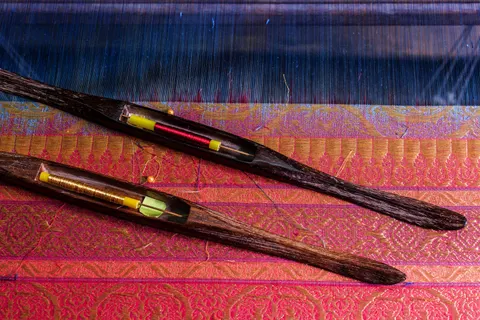
- The silk is reeled from the cocoons into thread and boiled to soften it.
- The thread is dyed with natural colours. The three base colours are red from lac, yellow from heartwood and blue from indigo seed.
- The gold-coloured thread is made by rolling thin metal and twisting it with silk. It is described as real gold or real silver, so ask the weaver on the spot.
- The warp is prepared on the big loom, which needs a pit about 2 to 3 m deep to hang the 1,416 heddles.
- It is woven row by row by four or five weavers: two or three lift the heddles, one inserts the sticks and one weaves. Gold-thread brocade is slow, about 4 to 5 cm a day.
Once you know how long brocade takes, the price of a piece makes sense. The mudmee silk at Ban Sawai and Ban Chan Rom uses another technique: the thread is tied and dyed into a pattern before weaving, which gives the elephant and naga motifs seen at Ban Sawai.
Peacock label, mudmee and hol: reading a silk tag before you buy
Thai silk has a quality mark called the Royal Peacock label, in four grades: Gold (Royal Thai Silk), Silver, Blue and Green. If a shop says the silk is genuine, ask to see the peacock tag and which colour it is. Silk without a tag can still be real, but the tag makes comparison easier.
- Yok thong: brocade with gold-coloured metal thread woven in a raised pattern, as at Tha Sawang. It takes the longest and is priced by the piece.
- Mudmee: ikat, where thread is tied and dyed into a pattern before weaving. The pattern comes from lining up the dyed threads. You find it at Ban Sawai and Ban Chan Rom.
- Hol: densely woven silk regarded as one of Surin's best-known cloths, often in grey, red, white, green and yellow, used at weddings and merit-making. Patterns and colours differ by weaver, so ask the shop before you buy.
If you are not used to judging cloth, start with three questions: hand-woven or machine, whole piece silk or a blend, and does it carry the peacock tag. A shop that can answer all three is usually familiar with what it sells.
Tips for buying silk and woven cloth
There is no fixed price for silk because every piece differs, so ask for the price of the piece and compare several shops. Useful questions:
| Ask | Why |
|---|---|
| Is it hand-woven or machine-woven? | Hand weaving takes much longer and prices vary a lot |
| Is the thread real silk, or a blend? | Ask whether the whole piece is silk, and feel the cloth |
| Is it dyed naturally or with chemical dyes? | It is hard to tell by eye, so ask the shop |
| Is the gold thread real metal or imitation? | At Tha Sawang the gold thread is metal twisted with silk, which is part of the price. Ask exactly what it is |
| What are the width and length? | Skirt cloths and shawls come in different sizes. Ask whether it can be tailored |
| How do I care for it? | Silk usually needs dry cleaning or gentle hand washing. Ask before you buy |
If your budget is small, start with a scarf or a small piece you can take home the same day. Fine gold-thread pieces are usually made to order, see the next section.
How much does gold-thread brocade cost, and how do I order it
There is no brocade price list online, because every piece differs and many are made to order. Royal-court style pieces made to order average about 30,000 baht per metre, and some large pieces take a year or more. Use it only as a sense of scale and check the real price with the weaver.
The figure makes sense once you watch the weaving. Weavers make about 4 to 5 cm a day, so one metre takes about 20 to 25 working days (100 divided by 5, and 100 divided by 4). At 30,000 baht a metre that is about 1,200 to 1,500 baht a day for a team of four or five weavers, before the cost of silk, dye and metal thread. That is not an inflated price.
- For a large piece, ask the weaver directly about size, pattern and time, and ask for a delivery date.
- If you want to take something home the same day, look at everyday silk, scarves and small pieces in the village shop.
- Keep a receipt or a note of the order, and the name and phone number of the weaving group.
Tips for buying silver and pakuem beads
At Khwao Sinarin the price is the weight of the silver plus the labour, so you can compare if you ask in full.
- Ask the weight in grams and the price per gram, and ask about the labour separately.
- Ask what grade of silver it is, and ask for a receipt or certificate if there is one.
- Check that the clasps and joins on necklaces and bracelets are firm.
- Walk past several shops first. The silversmiths work at street-side benches, so it is easy to compare workmanship.
- Bring cash. Many shops do not take cards.
Besides the silver pakuem beads, the village has stone and bead necklaces, which many households make for export. They suit anyone who wants a gift that costs less than silver. If you want a piece priced by weight, ask to see it on the shop's scale and note the figure in grams before you bargain over the labour.
The night market and gifts from Surin
Most gifts are best bought at the source, as in the table below. The night market (see the food section) suits dinner and small things. For a morning market, try the Rajamangala market on the Surin to Prasat road, about 3 km from town, which is busiest on Sunday morning, though its hours vary, so check first.
| Gift | Where to buy | Note |
|---|---|---|
| Silk and woven cloth | Ban Tha Sawang, Ban Sawai, Ban Chan Rom | Ask the price of the piece and compare shops |
| Silver and pakuem beads | Khwao Sinarin | Priced by silver weight plus labour |
| Surin jasmine rice | Gift shops and markets | Jasmine rice is a well-known product of the province |
| Sweet preserved radish | Markets and gift shops | Sweet pickled radish root |
| Other gifts | Shops in the market | Ask what it is and when it was made before you buy |
The royal park and Huai Saneng reservoir
If you want a break from temples and silk shops, there are two open spaces. The 80th Anniversary Royal Park, which locals call the new park or the elephant park, is open about 04:00 to 22:00 and free. It has a replica stone prasat, a playground, exercise areas, a running and cycling path and a small botanical garden. It is where the cultural festival in February and the Songkran elephant event in April are held.
The other is Huai Saneng reservoir in Chaniang, about 8 km south of the centre. A road runs along the dam crest for running and cycling, and it is a known sunrise spot. Part of the area holds a residence of Princess Mother Srinagarindra and an irrigation office, and there are shops and restaurants. It is open about 07:00 to 18:00 and free, the loop is about 5 km, and it has the nickname Surin sea. There are activities at Songkran.

Do not confuse the park with the health park beside Wirawat Yothin army camp on the Surin to Prasat road, which is another place, open about 05:00 to 19:00. If you navigate by map, type the full name of the one you want.
Nature near town for an extra half day
If you have a spare half day after the silk and temples, these three are reachable from town. Fees and hours are approximate, so check before you go.
| Place | Hours about | What to know |
|---|---|---|
| Phanom Sawai Forest Park | 08:30 to 16:30 | Three connected peaks. The first is about 220 m with a large white Buddha and the thousand bells. Entry about 100 baht per person, 30 baht a car and 10 baht a motorbike. There are steps |
| Nong Ta Heng (beach) | 08:00 to 18:00 | About 25 km from town, about 247 rai with floating platforms. Free, and good for children in the heat |
| Tung Kula Lake | 08:00 to 18:00 | In Chumphon Buri, about 750 rai, best from January to May |
Waterfalls near the border in Sangkha and Buachet are best in October and November, but access to areas near the border can change, so check with the district office first. See Khmer temples for the border and Ta Muen status.
Rainy days, with children, and with older travellers
Rainy days
The rainy season runs from about May to October, with rain usually in the afternoon or evening. August averages about 271 mm and September about 267 mm. Indoor options are the museum with its four buildings, the silk display and workshop at Tha Sawang, the Luang Pu Dun museum at Wat Burapharam, the covered city pillar shrine, and cafes in town. Minor roads to the villages and the border temples can get worse in August and September.
With children
Places children can use are the playground and paths at the royal park, the track round Huai Saneng in the evening, and Nong Ta Heng in the hot season. In Sangkha there is Janeena Park, with dinosaurs and robots, open about 09:00 to 19:00 and closed on Wednesday, adult 100 baht, child 60 baht, free under 100 cm. Check before you go. For the elephants and Ban Ta Klang, see elephants and the festival.
With older travellers
The shrine, Wat Burapharam, the museum, the silk display and the cafes are on flat ground and can be visited 15 to 20 minutes at a time. Use a car to reach each door, because the road to the museum has no footpath. Phanom Sawai has steps and is not suitable for anyone who finds walking hard. If you walk in town, choose the morning before 10:00.
When to go: a month-by-month table for the town and villages
Weather figures are long-term averages to show the pattern, not a forecast. Read it together with the events table above.
| Month | High/low C | Rain mm | For town and villages |
|---|---|---|---|
| Jan | 31/19 | 7 | Driest and coolest, best for walking |
| Feb | 33/20 | 10 | Dry, cultural festival at the park |
| Mar | 35/23 | 47 | Getting hot, go in the morning |
| Apr | 36/25 | 86 | Very hot, Songkran elephants, rest indoors in the afternoon |
| May | 35/25 | 186 | Rains begin, afternoon showers |
| Jun | 34/25 | 194 | Afternoon rain, go in the morning |
| Jul | 33/25 | 220 | Wet, use the indoor plans |
| Aug | 32/25 | 271 | Wettest, small roads can be poor |
| Sep | 32/24 | 267 | Wettest |
| Oct | 31/23 | 114 | Rain easing, long boat races |
| Nov | 31/21 | 30 | Dry and comfortable, Round-up and busy markets |
| Dec | 30/19 | 3 | Dry and cool, good for everything |
The best months are November to February, dry and cool. The hottest are March and April, with a record of 43.5 degrees in April. November is the month of the Round-up, dry and cool enough for an evening at the night market, but rooms fill fast.
Entry fees and budget for one day in town
Entry fees for the whole day add up to less than you might expect. Some cells are ranges, so check at the gate.
| Place | Foreign (baht) | Thai (baht) |
|---|---|---|
| City pillar shrine, Wat Burapharam, monument | 0 | 0 |
| National Museum | About 120 | 20 |
| Ban Tha Sawang | 0 to 50 | 0 to 10 |
| Ban Chan Rom, Ban Sawai, Khwao Sinarin | 0 | 0 |
| Total entry | 120 to 170 | 20 to 30 |
In total, entry for the whole day is about 120 to 170 baht for a foreign visitor (120 plus 0 to 50) and about 20 to 30 baht for a Thai visitor. Car hire, food and what you buy have no standard price. Ask the price of a half-day car from your hotel before you agree. Silk and silver are priced by the piece and by weight, so set a separate budget for gifts.
Carry coins and small notes. Silk villages and silver shops mostly take cash, and a foreign card at an ATM carries a fee of about 220 to 350 baht a time depending on the bank, so withdraw once and enough.
Phone numbers worth calling before you go
Numbers can change. If one does not connect, ask your hotel to call in Thai.
| Place | Phone |
|---|---|
| TAT Surin office | 044 514 447 and 044 514 448 |
| Surin National Museum | 0 4451 3274 |
| Ban Tha Sawang | 0 4414 0015 |
| Ban Sawai | 08 7962 3472 |
| Ancient silver craft group, Khwao Sinarin | 08 9043 6794 |
| Surin Provincial Commercial Office (for Ban Chan Rom) | 0 4451 4385 and 0 4451 2626 |
Where to stay in town for a crafts trip
Staying in town beats staying outside for this trip, because you can walk to the night market and the temple and reach the villages in a short drive. Here are three areas. Check distances on a map before you book.
Fortune Surin Hotel
Lak Mueang Road, Nai Mueang, Surin town
On Lak Mueang Road, the same road as the city pillar shrine. It suits anyone who wants to start the morning on foot to the shrine and the temple. Check the distance on a map.
See prices and availability on the booking page

Maneerote Hotel Surin
Soi Poy Tangko off Krungsri Nai Road, Surin town
On Soi Poy Tangko off Krungsri Nai Road, which is the road with the night market. It suits anyone who wants to walk to dinner after coming back from the villages.
See prices and availability on the booking page

Hotel Petchkasem Grand
Chit Bamrung Road, Surin town
On Chit Bamrung Road, the same road as Wat Burapharam. It suits anyone who wants to make an early-morning visit to the temple. Check the distance and the rooms on a map.
See prices and availability on the booking page
See all the options at where to stay in Surin.
Etiquette at temples, the shrine and villages
- Dress modestly, covering shoulders and knees, especially at the city pillar shrine and Wat Burapharam.
- Take your shoes off before entering any building, the Luang Pu Dun museum included.
- Ask before you photograph weavers and silversmiths.
- At a loom, do not touch the warp threads or the metal thread without asking, because the work is very fine.
- If you visit a temple in the morning, keep your voice down while monks are chanting.
Common mistakes
- Reaching Tha Sawang late in the afternoon or on a day without weavers. Go before noon.
- Arriving on Monday or Tuesday and expecting the museum to be open. It is closed both days.
- Thinking you can walk from the train station to Tha Sawang or Khwao Sinarin. You need a vehicle.
- Searching a map for just Ban Tha Sawang and going to the wrong one. There is another in Si Sa Ket province, so give the subdistrict, Chan Soma, Mueang Surin.
- Buying silver without asking the weight and the price per gram.
- Expecting price tags on gold-thread brocade. Fine pieces are priced one by one and often made to order.
- Reaching the city pillar shrine after 16:30, when it is closed.
- Not dressing modestly at the temple and the shrine.
Keep reading
 Plan your Surin tripElephants, Khmer temples, silk, stays, getting there
 Surin in 1 to 2 daysTimed plans for the town, silk villages and temples
 Elephants and the Round-upRound-up 2026 dates, tickets and Ban Ta Klang
 Khmer temples in SurinSikhoraphum, Ban Phluang, Phum Pon, fees and Ta Muen status
 Getting to SurinTrain, bus, flight via Buriram and driving
 Where to stay in SurinWhich area to choose, especially for the Round-up
 Surin deals and transfersPrivate transfer, train and bus tickets with prices
Frequently asked questions
How many days do I need for Surin town?
One day covers the town and the silk and silver villages. Add Ban Ta Klang or Prasat Sikhoraphum for a second day. Ban Sawai is the farthest village, so make it a half day of its own if you want its activities.
What time does the Surin city pillar shrine open, and is it free?
It is open 08:30 to 16:30 daily and free. It is on Lak Mueang Road, about 500 m west of the provincial hall, and its pillar was raised on 15 March 1974.
Does Wat Burapharam charge an entry fee, and who was Luang Pu Dun Atulo?
No, it is free. Visitor hours are about 08:30 to 16:30 and the grounds stay open longer. The Luang Pu Dun museum has no separate hours published, so go in the morning. He was a forest-tradition meditation master who lived at the temple from 1934 until he died on 30 Oct 1983.
What are the hours at Ban Tha Sawang, is it free, and how far is it?
About 08:30 to 17:00, free or a small fee, so check at the entrance. It is about 8 to 10 km north of town, 15 to 20 minutes by car. Go before noon to see the weaving, and type Chan Soma, Mueang Surin into your map so that you do not go to the wrong village.
Can I reach Tha Sawang and Khwao Sinarin without a car?
There is no direct public transport into the villages. Ask your hotel to arrange a half-day car, and agree the price and the waiting time before you go. See deals and transfers.
How much does Tha Sawang gold-thread brocade cost?
There is no confirmed price list. Fine pieces are priced one by one and often made to order. Made-to-order royal-court patterns run about 30,000 baht a metre, so check with the weaver. Everyday silk, scarves and small pieces cost much less. Ask the weaver directly.
Where can I buy silver, and how far is it?
At Khwao Sinarin, about 15 to 18 km north-east of town. Shops line the village road, open about 08:00 to 18:00. Price is silver weight plus labour. Bring cash.
When is Surin National Museum open and how much is it?
Wednesday to Sunday 09:00 to 16:00, closed Monday, Tuesday and public holidays. 20 baht for Thais and about 120 baht for foreign visitors, so confirm at the door. Phone 0 4451 3274. It presents four peoples: Kui, Khmer, Lao and Thai-Korat.
Where is the Surin night market and what should I eat?
At the eastern end of Krungsri Nai Road, about 17:00 to 21:30, with the road closed to traffic. There is pad thai, fried mussel pancakes and grilled food. For Kui and Khmer dishes such as sanlo jek, sloat rao and grilled frog, ask your hotel where they are being cooked.
When is the best time to visit Surin?
November to February is drier and cooler. April is very hot, with a record of 43.5 degrees. August and September are the wettest months. Rooms fill fast during the Round-up.
Where the facts come from
- Thai Holiday Guide: Surin city pillar shrine
- Thai Holiday Guide: Wat Burapharam
- Thai Holiday Guide: Phraya Surin Phakdi monument
- Thai Holiday Guide: Surin National Museum
- Thai Holiday Guide: Ban Tha Sawang
- Thai Holiday Guide: Khwao Sinarin
- Thai Holiday Guide: Ban Sawai
- Thai Holiday Guide: Ban Chan Rom
- Thai Holiday Guide: Surin province
- KTC: 20 places to visit in Surin
- BucketListly: Surin best things to do
- PPTV: Tha Sawang gold-thread silk
- Wikipedia: Surin, Thailand (climate)
- Rough Guides: Surin and around
- Wikivoyage: Surin
- Thailandee: What to do in Surin
- Daily News: Luang Pu Dun Atulo
- Daily News: Maha Songkran Surin Elephant