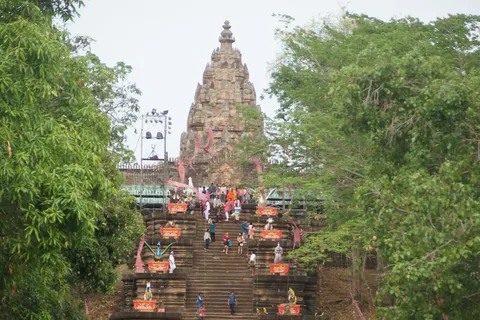
Visitors to Korat often ask whether they can do Phanom Rung in a day. They can, by car, but Phanom Rung is in Buriram, so it is a separate day, not part of the Phimai trip. Without a car you need a hired driver or a night in Nang Rong.
This page answers what people ask before they go: whether it is realistic, how to get there, when to leave, what it costs, what to see, which month is best and whether to combine it with Phimai. Fees and times are as of 11 Nov 2026. Drive times, fees and sun dates change, so check before you go.
We earn a commission if you book through our links. The price you pay does not change. How we choose
Quick facts before you go to Phanom Rung
| Where | Ban Ta Pek, Chaloem Phra Kiat district, Buriram 31110. The nearest town is Nang Rong |
|---|---|
| From Korat | About 125 to 135 km, about 2 hours or a little more each way by car |
| Day trip | Yes, if you have a car or a hired driver and leave Korat before 06:00. You are back in Korat at about 15:30 to 16:30 |
| How to go | Your own car, a rental car or a hired car with driver. No public bus reaches the gate |
| Hours | Daily 06:00 to 18:00, including public holidays. Phone 0 4466 6251 |
| Phanom Rung ticket | Thai 20 baht, foreigner 200 baht |
| Combined with Muang Tam | Thai 30 baht, foreigner 250 baht. The Muang Tam single ticket: ask at the gate |
| Rear-gate vehicle fee | Car 50 baht, motorbike 20 baht, bicycle 10 baht, per vehicle |
| Walk in | About 400 m from the front car park, or about 100 m from the rear gate |
| Muang Tam | About 6 to 8 km from Phanom Rung, 10 to 15 minutes by car |
| Time needed | Phanom Rung about 1.5 to 2 hours, Muang Tam about 45 to 60 minutes |
| Best months | November to February. March to May is very hot, so go at opening time or late in the day |
Not everything is Korat. Phanom Rung and Muang Tam are in Buriram, while Phimai is in Korat. See Phimai.
Short answers for people still deciding
- Can I do it in a day from Korat? Yes, by car or hired driver, leaving early. Plan for about 8 to 9 hours door to door.
- No car? It is possible but slow, with several changes. A hired car through your hotel is easier, or sleep in Nang Rong the night before.
- Should I add Muang Tam? Yes if you have time. The combined ticket costs less than two singles, and Muang Tam is flat and shadier.
- Phimai on the same day? Not recommended. They lie in opposite directions. See the Phimai section below.
- Want the sun through the 15 doorways? Sleep in Nang Rong. Leaving Korat in the middle of the night does not pay off.
Is a day trip realistic, and why it needs its own day
Visitors to Korat often ask whether Phanom Rung is close enough for a day. It is, but it is a long day that needs a sensible schedule. Do the sums: 2 hours there and 2 hours back is 4 hours on the road. Phanom Rung takes 1.5 to 2 hours, Muang Tam 45 to 60 minutes, the drive between them 10 to 15 minutes, and lunch about 45 to 60 minutes. That comes to about 8 to 9 hours. Leave Korat at 05:45 and you are back at about 15:30 to 16:30, with daylight to spare.
Who the day suits, and who should think again
- Driving yourself or renting a car: the best fit. You choose when to leave and when to turn back.
- A hired car with driver through your hotel: fine for anyone who does not drive. Agree the waiting time and the all-in price first.
- Families with older relatives or small children: possible. Use the rear gate and drop Muang Tam if people tire.
- No car and no wish to hire one: you would take a bus to Nang Rong and then charter a songthaew up the hill. That takes many hours, so sleeping in Nang Rong makes more sense than a day return.
- Sunrise photographers and doorway-alignment visitors: a day return from Korat does not work. You would have to leave in the middle of the night.
Why not combine it with Phimai
Phimai lies north-east of Korat city, about 60 km and about an hour by car. Phanom Rung lies far to the south-east in Buriram, about 125 to 135 km away. They are not on the same road, so trying to see both in one day means hours in the car and little time on foot. Choose one per day. The comparison table and a two-day plan are in the Phimai section below.
The KKday private tour from Bangkok (the Nakhon Ratchasima package of 2 days 1 night or 3 days 2 nights) does not go to Phanom Rung. To go, arrange a car yourself or hire one from Korat.
What you actually see when you arrive
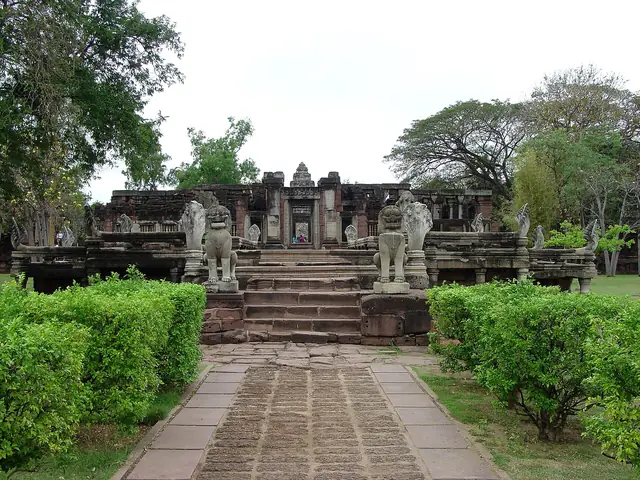
Phanom Rung is a pink-orange sandstone temple on the top of an extinct volcano, about 350 to 400 m above sea level. The layout runs in one straight line: a laterite-paved walkway with lotus-bud posts on both sides, a naga bridge, a long stairway, and then the main tower at the top. Pilgrims once approached it the same way. It was built as a temple to Shiva and is one of the best-restored Khmer temples in Thailand.
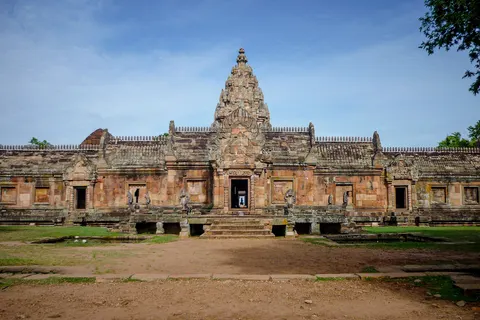
The picture above shows the main tower from the front, rising behind the gallery walls. A little cloud actually helps: the stone looks softer than under a bare sky, and the colour changes with the light, orange-pink in the early and late hours and paler at noon.
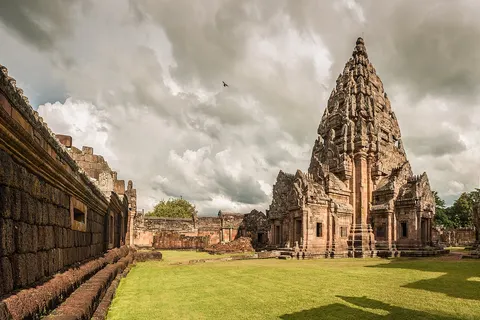
From the inner courtyard the tower and gallery stand above a green lawn. There is space to walk around and sit, but almost no shade, so carry a hat and water. If you arrive mid-morning the sun gets strong faster than you expect.
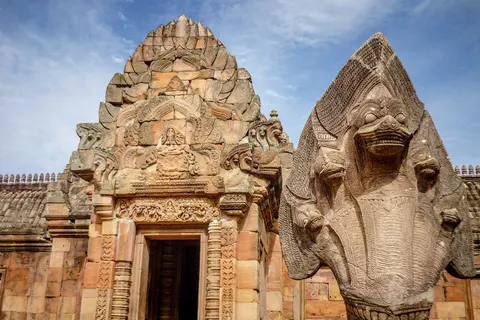
This one shows a carved pediment above a doorway beside a five-headed naga on the balustrade. The lintels and pediments of the main tower tell stories of Shiva, Vishnu and the Ramayana. The section on what to look for gives them one by one.
A one-day plan from Korat, hour by hour
This plan suits November to February, when it is not too hot. It assumes you drive or hire a car with driver and leave Korat before 06:00.
| Time | What to do | Note |
|---|---|---|
| About 05:45 | Leave your hotel in Korat | Fill the tank and buy drinking water before you leave the city |
| About 07:45 | Arrive at the front car park of Phanom Rung and buy the combined ticket | The park opens at 06:00, so it is still cool and the car park is empty |
| About 07:50 to 09:50 | Walk the stone walkway, the naga bridges, the stairs and the main sanctuary | About 1.5 to 2 hours. Wear trainers with tread |
| About 10:00 | Drive to Prasat Muang Tam | About 6 to 8 km, 10 to 15 minutes |
| About 10:15 to 11:15 | Walk around Muang Tam and its naga ponds | Flat and shadier, good for the hotter late morning |
| About 11:30 | Lunch near Prakhon Chai or Nang Rong | A som tam restaurant with branches in the area opens about 10:00 to 17:30. Check before you go |
| About 12:30 | An extra stop if you have energy left, such as the Ban Khok Mueang village or the kuti rishi | Normally no extra ticket. Check before you go |
| About 13:30 | Drive back to Korat | Back in Korat at about 15:30 to 16:00 |
The times are a suggested plan, not official hours. If you walk slowly or the traffic is bad, drop Muang Tam or the extra stops, never the time at Phanom Rung.
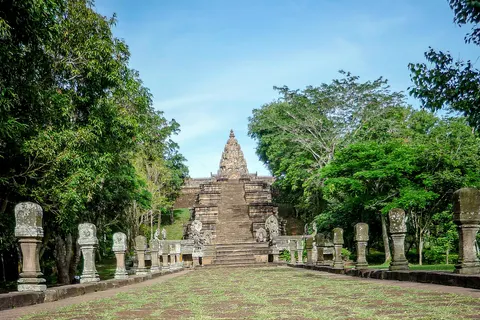
The picture shows the stone avenue lined with lotus-bud posts, the first thing you meet when you walk up from the front car park. It has no shade, which is why the plan has you arrive in the morning.
If you go from March to May
In Korat the April mean maximum is about 36.6 C and the record is 44.0 C. Sandstone and laterite hold the heat. Shift everything one hour earlier: leave Korat at about 05:00, arrive at about 07:00, and finish walking on stone by about 10:00 to 11:00. Then go to Muang Tam, which is flat and has big trees at the front gate. Drop the extra stops, and never plan to walk Phanom Rung at midday in April.
If you start late, reverse the order
If you leave Korat at about 08:00, see Muang Tam first at about 10:00, have lunch and a rest in the shade, then climb Phanom Rung at about 14:30 when the sun is softer. The park closes at 18:00 and no last-entry time has been announced, so arrive at least an hour and a half before closing. This plan gets you back to Korat at about 19:00 and works only from November to February.
On sun-alignment days, from Korat
On a sunrise day the light comes through at about 05:50 to 06:10 and you need to be parked before 05:00. From Korat you would have to leave at about 02:15 to 02:30, which is not worth it. Sleep in Nang Rong instead, about 30 minutes from the temple. The sunset days (March and October) do work as a day return: be at Muang Tam at about 14:30 and up at Phanom Rung before 16:30. You then drive back in the dark and reach Korat at about 20:30 to 21:00. See the sun section below.
How to get there from Korat: car, driver, bus and train
| Option | Suits | Good to know |
|---|---|---|
| Your own car or a rental | Anyone who drives | No waiting for others. Parking at the front of the park is free. Check the route on a map app before you leave |
| A hired car with driver through your Korat hotel | Anyone who does not drive, families, older travellers | Ask for a price that covers fuel, driver and a full day of waiting. Ask them to take you to both Phanom Rung and Muang Tam |
| A group tour from Korat | Not available to book here | The KKday private tour from Bangkok does not go to Phanom Rung. Ask your hotel or an agent in Korat whether they run a trip you can join |
| Bus to Nang Rong, then a chartered songthaew up the hill | Travellers with no car and plenty of time | No public bus reaches the gate. A chartered songthaew costs about 200 to 300 baht per vehicle. Agree the price and the waiting time before you set off |
| Train from Korat to Buriram, then a taxi | Not recommended for a day trip | The train takes about 1 h 34 min to 2 h 5 min, and then you still have about 65 to 76 km by road from Buriram city. The total is longer than driving direct |
| Motorbike | Not recommended from Korat | The distance is long. If you ride at all, rent in Nang Rong and go up through the rear gate (vehicle fee 20 baht) |
Driving yourself: the route and what to know
From Korat head toward Nang Rong. The last part is the usual approach: Highway 24 (Sikhio to Ubon Ratchathani) past the Nang Rong area to Ban Tako, about 14 km, then right onto Highway 2117 through Ban Ta Pek for about 12 km to the park. Let a map app choose the exact route on the day, because road works and traffic change. Set the pin to Phanom Rung Historical Park, not to Buriram city.
- The total is about 125 to 135 km, about 2 hours or a little more, depending on the road and the traffic leaving Korat.
- The front car park is free. The rear gate charges per vehicle: car 50 baht, motorbike 20 baht.
- Fuel stations and shops are on the main towns along the way. Near the foot of the hill there are fewer, so fill up before you leave Nang Rong or before you turn onto the small road.
- If you do not know the road, do not drive back to Korat in the dark. Some stretches of the minor roads are unlit. Plan to leave the park before 15:00 on an ordinary weekday.
- On festival days and alignment days the roads are busy and the car park can fill before dawn. Arrive before the time the park announces.
Hired car with driver: what to ask before you agree
If you do not drive, the easiest way is to ask your Korat hotel to find a car. The drive from Korat is much longer than a hire from Nang Rong, which is about 1,000 baht or more for a day, so expect the quote from Korat to be higher. Ask for the price before you commit, and ask all of the following.
- Does the price include fuel, driver and waiting all day? Is there an overtime charge?
- What time do you leave, and does the driver wait at the front car park or the rear gate? If you want to go up through the rear gate, say so, because it has a vehicle fee.
- Does the price cover both Phanom Rung and Muang Tam, and any extra stops? What would extra stops cost?
- How many people does the car take, is there luggage space and air conditioning, and does the driver speak English?
- What happens if rain or heat means you want to change the day?
Entry tickets are paid separately from the car. Carry small notes, because the ticket window may not take cards. For other tours and transfers in Korat see Korat tours and tickets.
No car: work out the time first
Taking a bus from Korat Bus Terminal 2 to Nang Rong and then chartering a songthaew up the hill can be done, but it takes several hours longer than driving direct. Add waiting for the bus and the change of vehicle, and you will have little time left at the park. Ask for timetables and fares at the Terminal 2 counter before you go. The better value is to sleep one night in Nang Rong, then take a songthaew or a car from your hotel in the morning, about 30 minutes to the temple. See the stay section below, and the no-car options on the Buriram page for Phanom Rung and Muang Tam.
If you are coming from Bangkok and want to sleep in Korat the night before, you have to get to Korat first. There are several ways, see getting to Korat.
 12Go
Bangkok to Nakhon Ratchasima on 12Go
From US$4 (Cheapest for Sun 8 Nov 2026, searched for 2 travellers: train US$4, bus US$9, taxi from about US$78)
Price as of 5 Nov 2026Compare train, bus and taxi from Bangkok to Korat Bus Terminal 2 or Korat station. Suits travellers who sleep in Korat the night before and go up to Phanom Rung the next morning. Limit: this takes you from Bangkok to Korat, not to Phanom Rung.
Book on 12GoTickets, the combined ticket, the rear gate and opening hours
The Fine Arts Department runs Phanom Rung Historical Park and opens it every day from 06:00 to 18:00, including public holidays. If you want to arrive exactly when the gate opens, phone the park on 0 4466 6251 first. No last-entry time has been announced, so arrive at least an hour and a half before closing.
| Ticket | Thai | Foreigner |
|---|---|---|
| Phanom Rung, single | 20 baht | 200 baht |
| Prasat Muang Tam, single | Ask at the gate | Ask at the gate |
| Combined, Phanom Rung and Muang Tam | 30 baht | 250 baht |
If you plan to see both, the combined ticket is the better buy. Buy it at the Phanom Rung ticket window when you start and keep it. If you plan to begin at Muang Tam, ask at the window there whether the combined ticket is sold, and if in doubt buy it at Phanom Rung first.
Worked examples
| Group | Way in | Sum | Total |
|---|---|---|---|
| 2 foreign adults | Combined ticket, walk from the front car park | 250 x 2 | 500 baht |
| 2 foreign adults | Combined ticket, drive up the rear gate | (250 x 2) + 50 | 550 baht |
| 4 foreign adults in one car | Combined ticket, rear gate | (250 x 4) + 50 | 1,050 baht |
| 2 Thai adults | Combined ticket, rear gate | (30 x 2) + 50 | 110 baht |
Rear-gate vehicle fee
If you drive through the gate behind the temple and park near the top, a vehicle fee is charged on top of the entry ticket: 10 baht for a bicycle, 20 baht for a motorbike and 50 baht for a car. It is charged per vehicle, not per person. The big car park at the front of the park is free.
Who enters free
- Monks, novices and clergy of other religions
- Students in uniform or showing a student card, and school groups with their teachers
- People with disabilities and disadvantaged people
- Thai citizens over 60 showing the Thai ID card
- Thai war veterans with an official card
- Members of ICOMOS and ICOM with a membership card
No separate child price is listed. A foreign child who is a student with a school card is covered by the student rule; otherwise ask at the window. Carry small notes in cash rather than counting on a card terminal at the ticket window.
Free services
The park information centre offers free guiding of the monuments, free toilets and Wi-Fi. Whether a guide is on duty, and in which language, depends on the day, so ask at the centre when you start. Food and drink are sold near the entrance, but there is no proper restaurant on the hilltop, so carry water.
On festival days and sun-alignment days the park may announce special hours and entry arrangements. Fees and hours on this page are as of 11 Nov 2026. Check before you go.
What to see at Phanom Rung, in walking order
Phanom Rung is not a sprawling ruined city. It is a pilgrimage route laid out in stages, lifting the visitor from the ground toward the tower on the summit. If you drive up the rear gate and walk straight to the top you skip that experience, so the best plan is to follow the order below. If you start at the rear gate, read it backwards.
1. The walkway and the lotus-bud posts (about 5 to 10 minutes)
The walkway is paved in laterite, with sandstone posts topped with lotus buds on both sides, roughly 70 in all. There is no shade, so on a summer morning you feel the heat from the first steps.
2. The first naga bridge and the stairs (about 20 to 30 minutes)
At the end of the walkway is the first naga bridge, a cross-shaped platform with five-headed nagas facing the four directions and an eight-petal lotus carved in the middle. It stands for the link between earth and heaven. Most people take their best photo here, looking up toward the stairs and the tower. From here a laterite stairway rises in five flights with terraces between them. Some steps are high and the stones are uneven, so go slowly, and if your knees are bad use the rear gate.
3. The cross-shaped terrace, the ponds and the second bridge (about 10 minutes)
The terrace has four small ponds, which at some times of year have lotus growing and reflect the tower. Beyond is a smaller second naga bridge, then the outer gallery (only the raised laterite floor survives), the inner gallery with gateways on all four sides, and the third naga bridge leading to the front hall of the main tower.
4. The main tower and its carvings (about 30 to 40 minutes)
The main tower is built of pink sandstone on a recessed square plan, with three porches. Inside the sanctum you can still see the base for a lingam and the drain that carried holy water away. Around the tower are two small brick sanctuaries, the oldest buildings on the hill (mostly just bases), a small sandstone sanctuary called Prang Noi in the south-west whose gable shows Krishna lifting Mount Govardhana, two library buildings, and a laterite building with a single door. Give yourself at least half an hour around the tower alone.
Three things to find
- The dancing Shiva pediment above one porch: Shiva Nataraja with many arms, surrounded by attendants and scrolling foliage. It is the most photographed piece on the site, and a zoom lens helps with the hands and jewellery.
- The reclining Vishnu lintel above the east doorway of the main tower: Vishnu lying on the serpent Ananta in the cosmic ocean, with a lotus rising from his navel and Brahma seated on it. In Thai it is called Phra Narai Banthomsin.
- Hermits, deities and scenes from the Ramayana on the pillars, door frames and walls.
The easiest way to tell the gods apart on a lintel is to look for three things: the pose of the god, the animal beneath him, and the kala face above the frame. With those you can tell Shiva, Vishnu and Brahma apart in a single round.
The stolen lintel that came home
The reclining Vishnu lintel was stolen from the temple in the 1960s and bought by the Art Institute of Chicago in 1967, which displayed it for more than twenty years. In early 1988, as the restoration neared its end, calls in Thailand for its return grew into heavy press coverage. The museum at first refused to hand it back without conditions, then agreed in October 1988 to send it home. It reached Thailand on 10 November 1988 and was set back in its original place on 7 December 1988, completing the restoration. Look up at it for a minute before you walk on.
A short history that makes the visit richer
The name comes from the Khmer Phnom Rung, meaning great mountain. The main sanctuary dates to about the 12th century CE, the era when Angkor Wat was being built, and as Khmer power faded the temple became a Buddhist site. The ruins lay broken for centuries. The site was registered as an ancient monument in 1935, and between 1971 and 1988 it was rebuilt by anastylosis: every stone was numbered, taken down, the foundations strengthened, and the pieces put back in their original places. Princess Maha Chakri Sirindhorn opened the restored park on 21 May 1988. Phanom Rung, Muang Tam and Plai Bat are on Thailand's tentative list for World Heritage status, but they are not yet inscribed.
If you have less than an hour and a half
Drive up the rear gate and walk about 100 m straight to the main tower. See the lintel and pediments, walk around the gallery, then walk down the front approach as far as the first naga bridge for the photo looking up. Have your driver or friend meet you at the front car park. This gives you both the overview and the approach in 60 to 75 minutes.
The sun through the 15 doorways
A few days a year the sun rises or sets exactly along the east-west axis of the temple, so its light passes in a straight line through the 15 doorways of the main sanctuary, through the porches and the inner room, and out the other side. The windows people usually talk about are:
| Period (about) | Dates (about) | Time of day | Useful details |
|---|---|---|---|
| Early March | 5 to 7 March | Sunset | The setting sun through the doorways. Evening entry follows the park's notice |
| Early April | 3 to 5 April | Sunrise | Light at about 05:50 to 06:10. Coincides with the Phanom Rung festival |
| Mid September | 8 to 10 September | Sunrise | Light at about 05:57. Rainy season, so clouds often hide it |
| Early October | 5 to 7 October | Sunset | The sun sets at about 17:55 early in the month |
The dates can shift by about a day from year to year, so do not rely on this table. The exact days and times are announced by the park and the Buriram provincial office; phone 0 4466 6251 before you go. The 2026 Phanom Rung festival ran from 3 to 5 April 2026 and has finished. The dates and programme for 2027 have not been announced, so the windows above are the likely period. Wait for the official notice.
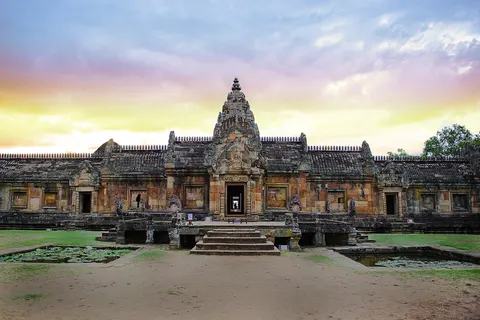
The photo shows the sanctuary under an evening sky. It is not a picture of the light passing through the 15 doorways, but it gives a feel for the colour of the stone at the ends of the day when people come to take pictures.
What you will really see
When the light lines up through all 15 openings it lasts only a few minutes, and the beam moves slowly, so people shift from door to door to follow it. On a clear morning you see a straight orange line cut through the building. If there is cloud or rain on the horizon you may see nothing at all. That is why you should plan two mornings in a row within the announced window, not one.
What time to go and where to be
- Sunrise: leave Nang Rong or Buriram at about 04:00 to 04:30 and be in the car park before 05:00, because the front car park fills fast. On a crowded morning it can be full by about 05:45.
- Viewers usually stand in the courtyard behind the temple on the west side and look east through the line of doorways. That area can be packed by about 06:00, so be there before then for a good spot.
- Sunset: be in the car park before 16:30 and walk up early. Do not walk down in the dark without a torch, because the lighting on the walkway is limited.
- The April festival has an evening programme with a procession, Apsara dance and a light-and-sound show that can run until about 19:30. Check the programme for your year.
Entry procedure and fees on these days follow that year's notice from the park, so do not assume last year's. Tripods and selfie sticks cause crowding at the viewing spots, so a small handheld camera is safer.
If the weather does not help
Phanom Rung is still worth the trip without a perfect alignment. A thin layer of cloud gives softer, warmer light on the sandstone than a bare sky. If you have come a long way, build a spare morning into the plan, and if you must leave early you can still enjoy Muang Tam in the late morning.
Plans from Korat for alignment days
| Case | Plan | Note |
|---|---|---|
| Sunrise (April, September) | Sleep in Nang Rong the night before, leave at 04:00 to 04:30 and be parked before 05:00 | Leaving Korat at about 02:15 to 02:30 is not recommended |
| Sunset (March, October) | Leave Korat at about 11:00, reach Muang Tam at about 14:30 and go up Phanom Rung before 16:30 | Back in Korat at about 20:30 to 21:00. Take a torch |
| Any other day | Use the one-day plan above | No timing worries |
Muang Tam and nearby stops
Prasat Muang Tam is at Chorakhe Mak in Prakhon Chai district, about 6 to 8 km from Phanom Rung, a drive of about 10 to 15 minutes. It is older than the main tower at Phanom Rung, built in the latter half of the 16th Buddhist century (roughly the 11th century CE) as a Hindu temple to Shiva, mixing the Khleang and Baphuon styles in sandstone, brick and laterite. The enclosure is about 120 by 127 m. A combined ticket with Phanom Rung is 250 baht for foreigners.
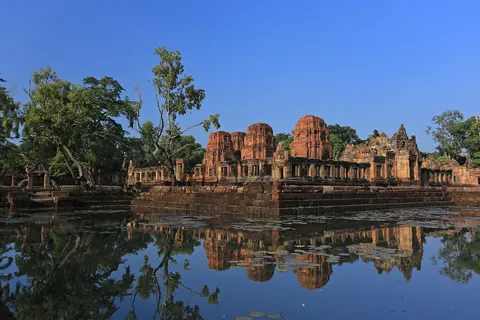
The picture shows the sanctuary and its gallery reflected in a pond. Where Phanom Rung climbs a line up a hill, Muang Tam is flat and you walk around it. A laterite outer wall encloses the site, there are gateways on four sides, and a sandstone gallery surrounds five brick towers standing on one laterite base: three in front and two behind. The main tower in the middle of the front row survives only as a base. Two brick library buildings stand in front.
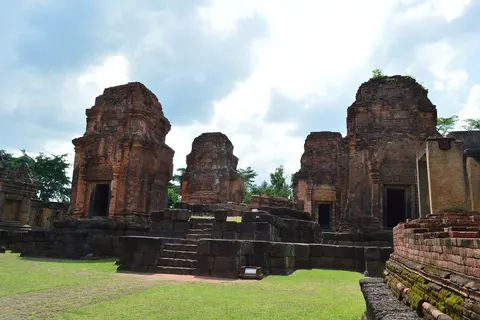
The row of towers on low platforms is the brick-and-sandstone group in question. Its red colour is different from the pink-orange of Phanom Rung, and the north side of the gallery has had less restoration, so you see the original surface of the stone.
The four naga ponds
The feature that sets Muang Tam apart is four L-shaped ponds at the corners of the gallery, lined with stepped laterite and edged by the bodies of five-headed nagas, necks raised at the corners. When the ponds hold water they reflect the orange brick towers, and in the afternoon the warm light on the pond at the west corner makes the best picture. The water level changes with the season, so check if you are going for that picture.
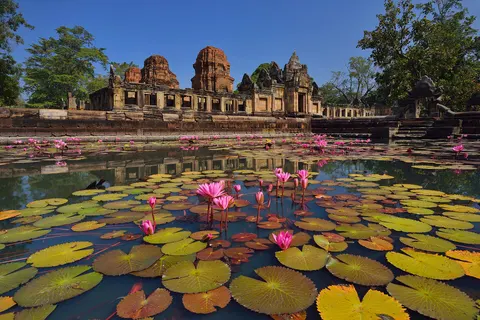
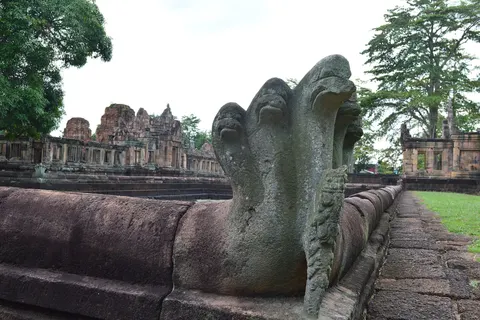
The first of these pictures is the lotus pond in front of the temple, and the second a multi-headed stone naga on the pond balustrade. The ponds look best when the lotus is in flower, and the nagas at the pond corners are where most people stop for photographs.
Carvings to find
On the small towers the lintels show Shiva and Uma on the bull Nandi, and Varuna on a swan. A pediment shows Indra on the elephant Airavata. The stone at Muang Tam has a pink-red colour unlike the stone at Phanom Rung.
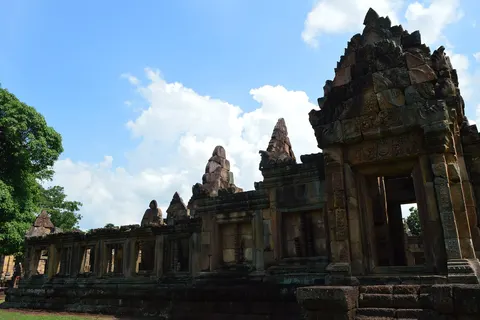
The side gallery and carved gateway in the picture are worth a pause for the carving. Walk anticlockwise from the front gateway, which brings you to the older north gallery and ends at the west corner pond. It takes about 45 to 60 minutes. Large trees near the front gate give shade for a rest, and older visitors and small children manage it far more easily than the hilltop. If you can see only one place and dislike stairs, Muang Tam still gives a full picture of a Khmer temple. Check the opening hours of Muang Tam at the ticket window or by phoning 0 4466 6251, and do not arrive close to closing time.
Outside the Muang Tam walls
To the north is the Muang Tam baray, a large reservoir about 510 by 1,090 m, and to the north-west the Khok Mueang kuti rishi, a hospital chapel from the time of Jayavarman VII. Nearby is the Ban Khok Mueang tourism village, with ox-cart rides, silk woven with a fern pattern inspired by the Muang Tam gate posts, and reed mats. It is open about 08:00 to 17:00. Check before you go.
Phanom Rung or Muang Tam: which if you can only choose one
Phanom Rung is more spectacular, with its hilltop position, its staged approach and its carvings. Muang Tam is quieter, shadier and easier on the legs. If you have half a day and must choose, choose Phanom Rung. If you have a full day, see both, because the combined ticket costs less than two singles and the two tell the story of different periods.
Extra stops on the same roads
- Prasat Khao Plai Bat sits on another extinct volcano about 2 km from Muang Tam and about 6 km from Phanom Rung. The way up is a walk of about 1 km uphill from the Wiwek Asom Khao Plai Bat meditation retreat. Allow 1 to 2 hours including the walk. It is open about 09:00 to 16:00 and normally has no entry fee. Do not go in the rain. There is no food on the hill.
- Kuti rishi at Nong Bua Rai, about 2.3 km from Phanom Rung: a dark laterite building, one of the 102 hospital chapels built under Jayavarman VII. A stop of 15 to 20 minutes.
- Prasat Ban Bu, about 4.2 km away: a laterite rest-house inside the grounds of a school. Ask a teacher or staff member before entering, and do not walk in during lessons.
- Wat Khao Angkhan, about 20 km further along the same road from Phanom Rung: a brick-red ordination hall on another extinct volcano. Open about 08:00 to 17:00.
- Ban Charoen Suk, about 15 km from Phanom Rung: a community that dyes cotton with volcanic soil from Khao Angkhan, soft light to reddish brown, with a demonstration centre open about 08:00 to 17:00.
For the basalt columns at Ban Khok Ma Kha Ron in Nang Rong district see lakes and Nang Rong. For other Khmer sites in Buriram see Khmer sanctuaries and kilns. For the fuller Buriram-side description of both temples, with more detail on each stop, see Phanom Rung and Muang Tam in Buriram.
When to go: how hot it gets and when it rains
There is almost no shade at Phanom Rung, and the sandstone and laterite hold the heat, so the season matters more than you might think. The table uses the normal figures for the Korat weather station. Conditions in Buriram may differ slightly, but nothing on the hilltop shields you from the sun.
| Month | Mean maximum | Average rain | Advice |
|---|---|---|---|
| January | 31.0 C | 8.6 mm | Very good. Clear skies, walk morning or late morning |
| February | 33.5 C | 12.7 mm | Good. It heats up by mid-morning, so be at the park before 09:00 |
| March | 35.7 C | 46.3 mm | Hot. Go very early. Sunset alignment about 5 to 7 March |
| April | 36.6 C | 79.5 mm | The hottest month, with a record of 44.0 C. Finish walking on stone by about 10:00 to 11:00. The festival is in early April |
| May | 35.4 C | 151.7 mm | Hot and the rains begin. Go early and carry an umbrella |
| June | 34.7 C | 120.0 mm | Showers on and off, slippery stone, green fields, few visitors |
| July | 34.0 C | 130.1 mm | Much the same as June. Choose a clear day and go in the morning |
| August | 33.3 C | 178.0 mm | Heavier rain. Wear shoes with tread |
| September | 32.4 C | 238.8 mm (about 14 days) | The wettest month. Cloud often hides the sunrise alignment of about 8 to 10 September |
| October | 31.3 C | 135.0 mm | The rain eases. Sunset alignment about 5 to 7 October |
| November | 30.9 C | 19.6 mm | Dry and clearing. Very good |
| December | 29.9 C | 2.6 mm | The best of the year, cool and pleasant, but busier around New Year |
In short, November to February is best. If you must go from March to May, be at the park when it opens and finish walking on stone before noon. In the rainy season come early and allow a spare day, because rain tends to arrive in the afternoon.
Heat, dress code, older visitors and small children
What to wear
No official dress code has been announced, but for local people this is a sacred place. Cover your shoulders and knees, take shoes off only at buildings that hold a Buddha image, do not climb on or sit on carved stones, and do not touch the carvings. Wear closed shoes with a tread, because the stones are uneven and some steps are high.
Sun and water
UV is very high from April to August. Carry at least a large bottle of water per person, a hat, sunglasses and sunscreen. There is no proper restaurant on the hilltop, only drink stalls near the entrance.
Older visitors, small children and wheelchairs
The front approach has several flights of steps and uneven stone, which is slow going for older visitors and unsuitable for strollers or wheelchairs on the stairs. The rear gate helps a great deal because the walk is about 100 m, but the temple itself still has stone steps and rough ground, so it is not suitable for wheelchairs beyond the upper courtyard. For specific access questions, phone the park on 0 4466 6251 before you go. Muang Tam is flatter and has shade, so older visitors and small children cope with it far better.
- With older relatives: drive up the rear gate, see the main tower, and walk down the front approach only if they feel up to it. Have the car wait at the front car park.
- With small children: use a carrier rather than a stroller, bring hats, water and snacks, because there is no shop on the hill.
- If anyone tires, drop Muang Tam or the extra stops first, never the time at Phanom Rung.
Photo tips
- Shoot the walkway from the first naga bridge, looking up.
- Inside the galleries use the doorways as frames and shoot the main tower through them.
- The first hour after opening and the last hour before closing give warm light and fewer people.
- Ask the park before flying a drone.
- On alignment days avoid tripods and selfie sticks in the crowded spots.
Phanom Rung and Muang Tam are inside Buriram province. Land border crossings are suspended and travel advisories advise against going close to the border, so check before you go and follow official instructions at the time of your trip. The hours and fees on this page are the normal ones. If the park announces a closure or different hours, follow that notice.
Combining it with Phimai or Prasat Phanom Wan
If you are in Korat for several days, the next question is which Khmer temples to pick. This table compares the four that visitors most often reach from Korat.
| Place | Direction and distance from Korat | Open | Foreigner fee | Time |
|---|---|---|---|---|
| Phanom Rung | South-east, about 125 to 135 km, about 2 hours by car | Daily 06:00 to 18:00 | 200 baht (250 baht with Muang Tam) | 1.5 to 2 hours |
| Muang Tam | 6 to 8 km from Phanom Rung | Check at the ticket window | Included in the 250 baht combined ticket | 45 to 60 minutes |
| Phimai | North-east, about 60 km, about 1 hour by car | Daily 07:00 to 18:00 | 200 baht | 1.5 to 2 hours |
| Prasat Phanom Wan | On Highway 2, about 15 km north-east of the city | About 07:00 to 17:00 | About 80 baht | 30 to 45 minutes |
The verdict is not to combine Phanom Rung with Phimai in a day. They lie in opposite directions, and doing both leaves you more than half the day in the car. Prasat Phanom Wan is on the Phimai side, not on the road to Phanom Rung, so it is not a stop on the way.
If you have only one day and can pick one
- Choose Phanom Rung if you want a hilltop Khmer temple, fine carving and a processional approach, and you have the whole day.
- Choose Phimai if time is short, you do not want a long drive, you are with older relatives or small children, it is hot, or you want lunch in a small town near the temple. See Phimai.
- To do both, split them over two days.
A two-day Khmer plan from Korat
| Day | Plan | Note |
|---|---|---|
| Day 1 | Phimai in the morning, about 07:30 to 11:30, then Prasat Phanom Wan on the way back, about 30 to 45 minutes | Sleep in Korat and have the night market at Wat Burapha in the evening, about 17:00 to 22:00, check before you go |
| Day 2 | Phanom Rung and Muang Tam, using the one-day plan above | If you do not want to drive back to Korat, sleep in Nang Rong and return the next day |
With three days in Korat, give one day to the city (see Korat city), one to Phimai and one to Phanom Rung. A ready-made schedule is in Korat in 2 days and 1 night. For the pottery village that sells ceramics, see Dan Kwian, which is a separate trip from the one to Phanom Rung.
Phimai and Phanom Rung belong to the same Khmer road network. The old road from Angkor to Phimai ran for about 225 km. Phimai faces south because the road arrived from that side, and Phanom Rung and Muang Tam sit on a branch of it. That is why the two feel so different: Phimai is a temple on flat ground inside a town, while Phanom Rung stands on a hill.
Where to eat before and after the temples
Food and drink are sold at the park entrance, but there is no proper restaurant on the hilltop, so eat breakfast before you go up and have brunch or lunch at the foot of the hill. If you leave Korat at 05:45, ask your hotel the night before to pack breakfast, or buy something to eat in the car. For Korat's best-known dishes see what to eat in Korat.
- Nang Rong: the local speciality is kha moo, stewed pork leg, along with pork-skillet barbecue and grilled chicken on the road toward Buriram. A good place for dinner if you stay in town.
- Prakhon Chai and Ban Khok Mueang: a som tam restaurant with branches at Prakhon Chai, Nang Rong and Ban Kruat opens about 10:00 to 17:30. Check before you go.
- Ta Pek, near the way up to Phanom Rung: a sausage shop and local eateries, handy for snacks to take home. Check the hours.
- Ban Khok Mueang village: food and souvenirs while you visit the silk and ox-cart village, about 08:00 to 17:00.
- Nang Rong walking street: an afternoon-to-evening market on Fridays and Saturdays. Check the days before you go.
If you are back in Korat in the evening, the night market at Wat Burapha on Chumphon Road is open about 17:00 to 22:00 and sells both food and clothes. Check before you go. See Korat city. If you sleep in Buriram city, see Buriram city and sports.
What the day costs
The figures below are for two foreign visitors using the combined ticket for Phanom Rung and Muang Tam. Car hire is a rough range for a small car per day (about US$25 to 45). Check the real price before you book. Fuel for about 260 km there and back is not included.
| Item | Sum | Low | High |
|---|---|---|---|
| Small rental car for one day | Price per day | 840 baht | 1,500 baht |
| Combined tickets for 2 foreigners | 250 x 2 | 500 baht | 500 baht |
| Rear-gate vehicle fee | One car | 50 baht | 50 baht |
| Lunch for 2 | About 60 to 80 baht a dish x 2 | 120 baht | 160 baht |
| Total before fuel | 1,510 baht | 2,210 baht |
That is about 755 to 1,105 baht per person before fuel. With four people in one car, the car and fuel are shared, and the combined tickets for four come to 1,000 baht plus the 50 baht rear-gate fee.
By bus to Nang Rong and a chartered songthaew up the hill, two people pay 500 baht for combined tickets, plus the songthaew at about 200 to 300 baht per vehicle (shared between two), plus the bus fare both ways, which you should check at the counter. It saves less than you might expect, because it costs time and leaves less of it at the park. For a hired car with driver, ask for a quote first and compare it with the sum above.
Common mistakes
- Leaving Korat late, for example at 08:30, and arriving at the hottest time in March to May. Leave before 06:00.
- Thinking Phanom Rung is in Korat. It is in Buriram, so the journey is longer than people expect, and it does not belong in a Phimai day.
- Assuming a public bus goes to the gate. It does not. You get off at Nang Rong and charter a songthaew.
- Buying two single tickets when the combined ticket is cheaper. For foreigners it is 250 baht.
- Wearing sandals with no grip on wet stone or high steps.
- Driving up the rear gate and skipping the processional walkway entirely. You get the view but lose the approach the builders designed.
- Turning up on an alignment day with no parking plan. The car park is full before 06:00.
- Planning so that you drive back to Korat in the dark. Some stretches of the minor roads are unlit, so leave the park before 15:00 on an ordinary weekday.
- Carrying only a credit card. The ticket window and small shops on the way may take cash only.
- Not filling the tank or buying water before the small roads. There are fewer shops near the foot of the hill than in the towns.
To avoid crowds and heat
Go on a weekday, arrive at opening time and avoid festival weekends and alignment days. Outside those days the crowds are much thinner.
Where to sleep before an early start: Korat, Nang Rong or Buriram
For a day return, sleep in Korat city the night before so you can set off early. If you want the sunrise light through the doorways, or you do not want to drive back in the evening, sleep near Phanom Rung instead.
| Base | Best for | Good to know |
|---|---|---|
| Korat | A day return, or if you have other days for Phimai and the city | About 2 hours each way, so leave before 06:00. The most choice of hotels and restaurants |
| Nang Rong | Sunrise alignment, travellers with no car, relaxed days with Muang Tam and extra stops | About 30 minutes and about 26 km to Phanom Rung. Fewer hotels, and they fill early at festival times |
| Buriram city | Temples plus the circuit or football | About 1 hour to 1 h 15 min to Phanom Rung |
In Korat, pick a hotel that is easy to leave by car and has no traffic jam in the dark early hours. The three below are in the city centre and by the malls.
 Mid-range
Centre Point Hotel Terminal21 Korat
Terminal 21 Korat, Mittraphap Road, 0.3 km from the city centre
Mid-range hotel at Terminal 21 Korat, about 1.5 km from the Ya Mo monument. Suits travellers who want to leave early and come back to the mall and restaurants in the evening. Limit: check room types and rates on the booking page.
See prices and availability on the booking page
 Mid-range
AisanA Hotel Korat
In the city, 1.4 km from the city centre
Mid-range hotel in the city, 1.4 km from the city centre. Suits travellers who want to sleep in town and leave early. Limit: check room types and rates on the booking page.
See prices and availability on the booking page
 Budget
Sabai Hotel Korat
In the city, 1.8 km from the city centre
Budget hotel in the city, 1.8 km from the city centre. Suits travellers who only need a bed for the night before an early start. Limit: read the reviews and check room types on the booking page first.
See prices and availability on the booking page
If you sleep in Nang Rong
In Nang Rong, the Phanomrungpuri Hotel has a pool, a restaurant and free parking, which makes it a practical base for an early start. The Park Nangrong Resort is a garden resort with free parking and breakfast, suited to drivers who want somewhere quiet after a day at the temples. Goodview Nangrong Guesthouse is a budget place on the edge of Nang Rong with parking and family rooms, about 1 km from Nang Rong bus station. See all hotels on where to stay in Buriram.
During the Phanom Rung festival, on alignment days and on race weekends at Buriram, rooms in Nang Rong and Buriram city go quickly. Book several weeks ahead and choose free cancellation where you can.
Frequently asked questions
Is Phanom Rung in Korat?
No. It is in Buriram province, in Chaloem Phra Kiat district. The nearest town is Nang Rong. The road from Bangkok passes through Korat, but the temple itself is not in Korat.
How long does it take to get from Korat to Phanom Rung?
It is about 125 to 135 km, about 2 hours or a little more each way by car. Check the route and time on a map app before you leave.
Can I do Phanom Rung as a day trip from Korat?
Yes, by car or hired driver, leaving Korat before 06:00. Allow about 2 hours at Phanom Rung and 1 hour at Muang Tam. You are back in Korat at about 15:30 to 16:30, about 8 to 9 hours in all.
Can I get to Phanom Rung by bus from Korat?
No public bus goes to the gate. You would take a bus to Nang Rong and charter a songthaew or pickup up the hill, about 200 to 300 baht per vehicle. That takes many hours, so it is not recommended for a day return. Use a car or a hired driver, or sleep in Nang Rong first.
How much is Phanom Rung for foreigners?
Phanom Rung costs 200 baht for foreigners and 20 baht for Thais. A combined ticket with Muang Tam is 250 baht for foreigners and 30 baht for Thais. If you drive up the rear gate there is a vehicle fee of 50 baht for a car and 20 baht for a motorbike. Check at the ticket window.
What time does Phanom Rung open?
Daily 06:00 to 18:00, including public holidays. Phone 0 4466 6251 to confirm on the day you go. Festival days may have special hours.
When does the sun shine through the 15 doorways?
Four times a year: sunrise at about 3 to 5 April and 8 to 10 September, and sunset at about 5 to 7 March and 5 to 7 October. The dates can shift by a day. The 2027 dates have not been announced, so check before you go.
Does the KKday Korat private tour go to Phanom Rung?
No. The 2 days 1 night Nakhon Ratchasima package includes Phimai but not Phanom Rung.
How far is Muang Tam from Phanom Rung, and should I go?
About 6 to 8 km, 10 to 15 minutes by car. Plan 45 to 60 minutes at Muang Tam. Go if you have time, because the combined ticket costs less than two singles, and Muang Tam is flat and shadier.
Where should I sleep before Phanom Rung, and can older people go?
For a day return, sleep in Korat city and leave before 06:00. For the sunrise alignment, sleep in Nang Rong. See where to stay in Korat and Phimai. Older visitors can go if they drive up the rear gate, which is only about a 100 m walk, but the temple has stone steps and is not suitable for wheelchairs.
Where the facts come from
- Fine Arts Department, Phanom Rung Historical Park: services, hours and fees (Thai)
- Fine Arts Department, Phanom Rung Historical Park: contact and routes (Thai)
- Thailand.go.th, Phanom Rung 15 doorway sunrise
- Thai Post, Phanom Rung festival 2026 (Thai)
- Bangkok Biz News, Phanom Rung sunrise and sunset alignment timetable (Thai)
- Bangkok Post, Phanom Rung light phenomenon
- Thai Holiday Guide, Phanom Rung Historical Park
- Thai Holiday Guide, Prasat Hin Mueang Tam
Keep planning
 Korat trip plannerHow many days, where to go, getting around, budget
 Korat in 2 days, 1 nightA timed plan: Dan Kwian, the city, Phimai
 Korat tours and ticketsPrivate tour, transfer, train and bus tickets, Muay Thai
 Where to stay in KoratAreas compared, with 16 hotels
 Getting to KoratTrain, bus, private car and from Khao Yai
 PhimaiFees, hours, how to get there and the festival
 Korat city sightsYa Mo, temples, night markets and malls
 Dan KwianThe pottery village and how to go
 Korat foodPad mi, shops to try, night markets