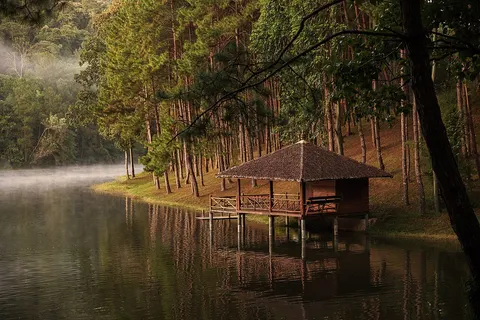
This page covers the places north of Mae Hong Son town that most visitors fit into one day: the pine-ringed lake at Pang Ung, the Yunnan Chinese tea village of Ban Rak Thai, Pha Suea waterfall and the fish cave in the same national park, the Su Tong Pae bamboo bridge, and Ban Jabo further up the road toward Pai. You get fees, hours, distances from town, how to get around by own vehicle, songthaew or tour, and timed plans from Mae Hong Son town and from Pai.
Today is 6 Nov 2026, the start of the cool season. Nights in the hills are turning chilly and mist is starting to form over Pang Ung at dawn, though the real cold arrives from mid December to January. Fees and hours below are approximate, so check them before you go. Tour prices on the booking cards are as of 6 Nov 2026.
We earn a commission if you book through our links. The price you pay does not change. How we choose
Pang Ung: a pine-ringed lake, morning mist and camping
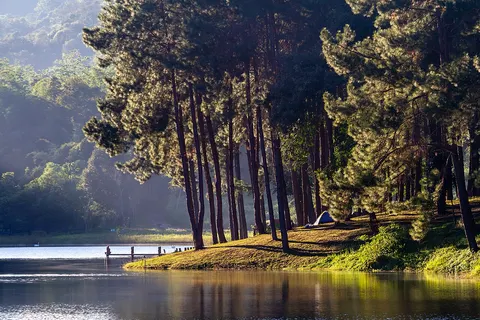
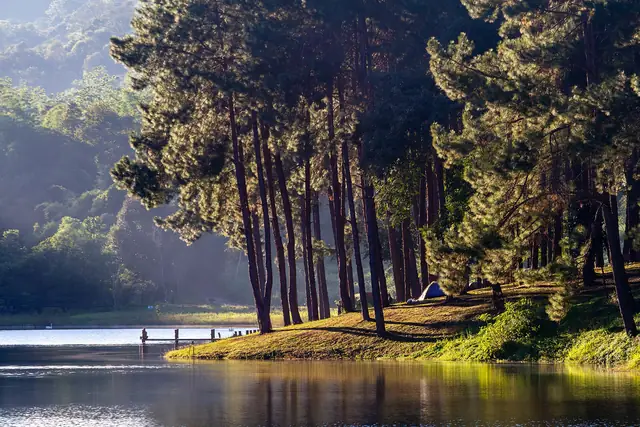
Pang Ung, also called Doi Pang Ung or Pang Tong Royal Project 2, is a reservoir at about 1,127 m ringed by two-needle and three-needle pines. It is about 44 km from Mae Hong Son town and takes roughly 45 minutes to an hour to drive, with a narrow, switchbacked last stretch. Thais call it the Switzerland of Thailand: still water, rows of pines and thin mist drifting over the surface at sunrise.
A short history
The land was once used to grow opium. It was developed into a model forest project from 1984 under Queen Sirikit and later took the name Pang Ung. Today it lies within Tham Pla-Pha Suea National Park and has flower gardens, tent camping, small cottages, a restaurant or two and bamboo rafts on the lake. After the area reopened on 1 Oct 2022, the park reorganised parking, cut the number of tents and added staff to cope with the crowds.
Fees, hours and prices
| Entry | About 100 baht for a foreign adult, about 50 baht for a foreign child, about 20 baht for a Thai adult, about 10 baht for a Thai child. Check before you go. |
|---|---|
| Hours | Open from first light, about 06:00, to early evening. Opening and closing times change, so check before you go. |
| Bamboo raft | About 150 baht for 30 minutes, up to about 2 people, from about 07:00 |
| Tent | About 300 to 500 baht a night depending on size, bedding included, shared toilets and showers. Book directly with the park. |
| Distance | About 44 km from Mae Hong Son town, roughly 45 minutes to an hour |
| Bring | Cash, a warm layer, a full tank from town. Do not count on an ATM at the lake. |
Camping between late November and January needs a booking weeks ahead, because Pang Ung fills in the cool season.
Mist and cold
Mist is most reliable from November to February and thickest in the first hour or two after sunrise. Once the sun rises, vapour lifts off the water and fades fast, so after about 09:00 you usually get nice light but no thick mist. Right now, in early November, nights are cool rather than cold. In earlier years dawn lows in the hills from October to December were about 17 to 19 degrees Celsius, but the real cold comes from mid December to January.
The figure still talked about is 3 degrees Celsius at Pang Ung on 22 Dec 2017, when Mae Hong Son town read about 8.5, Khun Yuam about 5 and Pai about 12. The town itself has dropped to 3.3 degrees in December, its record since measurements began in 1951. On a long December weekend in 2022 the lake was about 17 degrees, rooms were sold out and some visitors slept in their cars. If you come in late December or January, pack for single-digit mornings, not just a thin layer for a stroll by the water.
What else is in the project
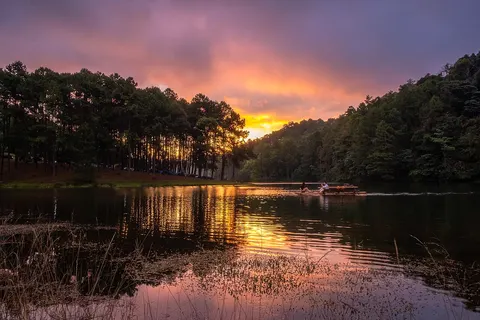
The project also has the Pang Tong palace buildings, flower gardens, sheep and horses and a wildlife breeding station. Opening times change, so ask at the gate.
If you are not camping, leave town at about 05:15 to reach Pang Ung at first light, about 06:15 to 06:30. The first stretch of highway is still dark, so drive slowly and watch for mist and animals; the narrow last stretch comes as the sky lightens. On weekends and holidays in December and January the car park fills early.
Ban Ruam Thai is a village near Pang Ung. It is not Ban Rak Thai. When you book a room or drop a map pin, check the name, because the two are often confused.
Ban Rak Thai: a Yunnan Chinese tea village on a lake
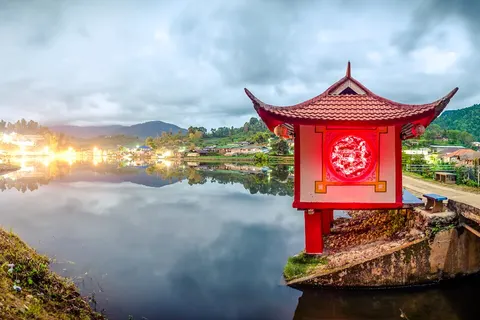
Ban Rak Thai, also known as Ban Mae Aw, is in Mok Champae subdistrict, Mueang district, about 45 km from Mae Hong Son town. Allow about 1.5 to 2 hours by road. The way is a narrow, winding paved road with hairpin bends, and cow dung on the surface is common. About a thousand people live in the village, most of them of Yunnan Chinese descent.
A short history
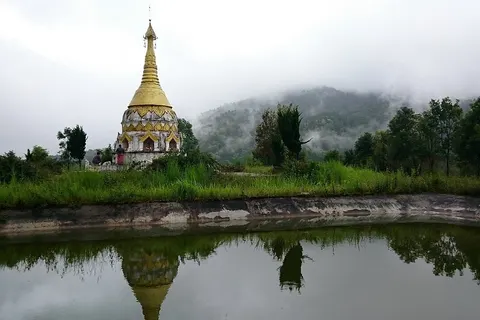
After the Communist takeover of China in 1949, units of the Kuomintang army from Yunnan retreated south and settled along the Thai and Burmese border. They later gained Thai citizenship in return for fighting communist insurgents and curbing the heroin trade. Around 1983 to 1984 the village was renamed Rak Thai, meaning love Thailand, and a royal project introduced tea in place of opium. Today you still see tea shops, Chinese signs and Yunnan food all over the village.
What to do here
The main activity is sitting in a lakeside tea house. Oolong and jin xuan, a milky, floral oolong, are about 40 to 60 baht a small pot, while aged pu-erh costs more and makes a popular gift. Many shops let you taste before buying. Ask whether the leaf is grown in the village or brought in, because prices differ a lot.
For food, try Yunnan dishes such as thousand-year pork, slow-braised pork belly laid on pickled mustard greens, which Gee Lee, one of the village's old restaurants, has long made. Village cooking uses a fair amount of oil and pork fat, so say so before ordering if you eat light. Check opening hours and the menu on arrival.
What to buy
Oolong, jin xuan, pu-erh and hill-grown coffee are what most people take home, priced by grade and weight. Taste first, ask for the cup to be brewed from the bag you are buying, and look at the date on the packet.
Crowds and timing
There is no known entry fee for the lake or village. Weekday mornings before about 09:00 are quiet; tour vans arrive after that, especially at year end and on public holidays. Mornings are cool and misty. From late January to February you may catch wild cherry blossom in the village, and a tea festival is held around February, when rooms go quickly.
Staying overnight
Simple guesthouses and homestays circle the lake. Basic rooms run about 500 to 800 baht and can double on holidays. Some of the simpler places may have no heater, so ask about blankets before booking in the cool season. A night here lets you see the village once the tour vans have gone. For lodging in town, see where to stay in Mae Hong Son.
Do not count on a fuel station between town and the village or an ATM at the lake. Fill up and withdraw cash in town.
Pha Suea waterfall: a tiered fall beside the highway
Pha Suea waterfall is inside Tham Pla-Pha Suea National Park, about 26 km from Mae Hong Son town, at about km 191 on Highway 1095, where the road to Pang Tong also branches off. You walk about 100 m from the road, so a stop takes roughly 30 minutes to an hour.
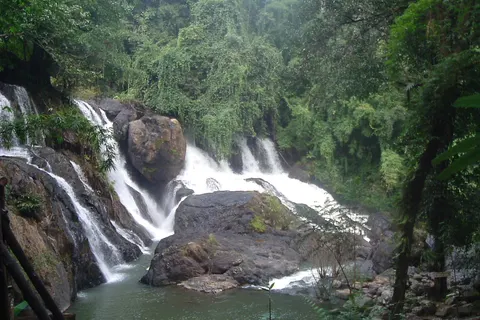
The water runs over several tiers of big boulders in the forest. The fall is about 10 m high and 15 m wide, so do not expect a towering drop. What it has is easy access and water all year; it runs fullest across the cliff in the rainy season, and the best time to come is about July to September. In the dry season the flow drops a lot, and from February to April the fall can shrink to a trickle, with smoke across the view.
Tham Pha Daeng cave, about 1 km away, and the Mae Sa-nga Klang waterfall are also in the park, but most people stop only at Pha Suea and the fish cave. One park ticket covers the waterfall and the fish cave: about 100 baht for a foreign adult and about 20 baht for a Thai adult, hours about 08:00 to 16:30 or 17:00. Check before you go and keep the ticket to show at the second stop.
Wear shoes with grip. Rocks by the water stay wet through the rains and after showers.
Tham Pla: a clear spring pool and sacred fish
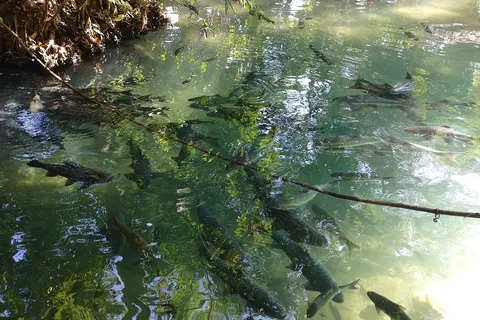
Tham Pla, the fish cave, is about 17 km from Mae Hong Son town on Highway 1095, on the town side of Pha Suea. From the car park a path of about 450 m, with a suspension bridge, leads to a pool that flows out from the foot of a cliff. The spring runs all year, so the water stays clear even in the dry season.
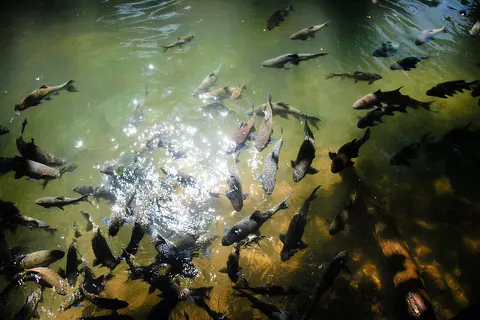
The fish are a kind of mahseer that locals call pla mung, growing up to about a metre. Villagers treat them as sacred and do not catch them, and a hermit statue stands by the pool. Bags of vegetables and fruit are sold at the entrance to throw to the fish from wooden platforms, which children and groups enjoy. Buy the bags sold there and do not bring other food.
You can walk it on your own without a guide and should allow about 40 minutes to an hour. The park was declared on 23 Dec 2010 and covers several hundred square kilometres across Mueang and Pang Mapha districts, with its highest point at Doi Lan, about 1,918 m, on the border with Shan and Kayah states in Myanmar.
The fish cave and the waterfall share one park ticket, about 100 baht for a foreign adult and about 20 baht for a Thai adult. Check current prices and hours before you go.
Su Tong Pae bamboo bridge: repaired, best at dawn or dusk
The Su Tong Pae bridge is at Ban Kung Mai Sak in Pang Mu subdistrict, about 8 to 10 km from Mae Hong Son town. It is a bamboo footbridge crossing rice fields and the Mae Sa-nga river to a temple on the far side, built by villagers and monks. Length is usually given as about 500 to 800 m depending on how it is measured, and it is about 2 to 3 m wide. It is free, with a donation box near the entrance, and open about 06:00 to 18:00.
In August 2026 flash floods on the Mae Sa-nga damaged the bridge: the head tilted, a section was removed, and it could not be crossed. Monks, soldiers and villagers repaired it with steel beams and bamboo flooring, and it was open again in late October 2026, when it was even used for a 59-monk alms-giving at the end of Buddhist Lent. The bridge has flooded several times this year, so heavy rain can close it again. Check its status with the temple or community before you go.
The paddy around the bridge changes colour with planting and harvest, so do not plan on green or golden fields. Go for the bridge, the morning mist and the monks on their alms round.
Best light
About 06:30 is when monks walk the bridge on their alms round, so arrive by about 06:15. Mist over the water is common from November to February. The late afternoon before sunset, about 17:30, is just as pretty. Do not overtake monks or push a camera into their path, leave room for them to walk, and dress modestly. After rain the bamboo is slippery and the floor still flexes underfoot, so walk slowly and give way to people coming the other way.
Make Su Tong Pae the first stop of the morning or the last of the evening. It is close to town and does not overlap with the Pang Ung road.
Ban Jabo: a Black Lahu village and hanging-leg noodles
Ban Jabo is a Black Lahu village in Pang Mapha district, founded in 1989 and home to a little over two hundred people. It is about 57 to 60 km from Mae Hong Son town and about 55 km from Pai, roughly 1 hour 20 minutes by car from Pai. It lies farther out than the other stops on this page, so it fits better on a drive between Pai and Mae Hong Son town. See Pang Mapha and the caves for that side of the road.
What people come for is the hanging-leg noodle shop, a wooden platform that juts out over a cliff so you sit with your legs dangling, about 300 m from the village centre. Check prices and hours with the shop and bring cash. The Ban Jabo viewpoint lies about 300 m from the village. The sea of mist is best from November to February, shortly before or after sunrise, and usually thins within one to two hours. For another viewpoint, Kiko Kho at Ban Huai Hia is about 12 km away.
A guided walk into Tham Jabo cave costs about 150 to 400 baht a person, so check before you go. Accommodation is in homestays arranged with the community directly. There is no known village entry fee, but always ask before photographing people and do not walk into homes uninvited.
Phu Pha Mok: ask locally before you go
Phu Pha Mok is a name people use for a viewpoint on the way to Ban Jabo, said to give an all-round view of the mist and sunrise after a steep climb, where a guide helps in the dark. Ask your homestay host or someone local for the exact position, any fee and the route up before you go.
If you want a reliable sea of mist, use the Ban Jabo viewpoint described in the section above, or ask your homestay host the day before, since they know where the mist sits that morning and whether the path is open. Take what any pre-dawn viewpoint needs: a torch or headlamp, proper shoes and a warm layer.
A day plan from Mae Hong Son town and from Pai
All the stops lie on or just off Highway 1095. Doing them in a single day means leaving early and leaving something for another day. The times below are approximate, so add time for photos, meals and parking.
From Mae Hong Son town (own vehicle)
| About | Where | What to do |
|---|---|---|
| 05:15 | Leave town | Fill the tank, carry cash and a warm layer |
| 06:15 | Pang Ung | Morning mist, walk the lake, maybe a raft |
| 08:30 | Leave Pang Ung | Drive on to Ban Rak Thai, leaving time for the narrow road |
| 10:00 | Ban Rak Thai | Tea, coffee, a lake walk and lunch |
| 12:45 | Leave Ban Rak Thai | Drive back down while there is daylight |
| 14:30 | Pha Suea waterfall | Buy the park ticket, walk to the falls |
| 15:15 | Tham Pla | Show the same ticket, cross the suspension bridge, feed the fish |
| 16:45 | Su Tong Pae bridge | Evening light before sunset at about 17:30 |
| 18:00 | Back in town | Night market or rest |
This plan is full and involves roughly 5 to 6 hours of driving. If you are tired or have children, move Su Tong Pae to a short stop the next morning. Do not drive Highway 1095 at night: lighting is poor, the road bends constantly, and there can be fog or animals on the road.
From Pai
Pai is about 110 km from Mae Hong Son town, roughly 2 to 2.5 hours by direct drive. Going both ways in one day leaves very little time on the ground. A better way is to split it over two days with a night in Mae Hong Son. If you really must do it in a day, use a private tour with a driver.
| About | Where | What to do |
|---|---|---|
| 06:00 | Leave Pai | Fill the tank, wear a warm layer |
| 07:20 | Ban Jabo | Noodles and the mist viewpoint, if the shop is open |
| 09:45 | Pha Suea waterfall | Buy the park ticket, walk to the falls |
| 10:45 | Tham Pla | Same ticket, feed the fish |
| 12:00 | Mae Hong Son town | Lunch, a rest and fuel |
| 14:00 | Su Tong Pae bridge and Doi Kong Mu | Afternoon and evening light. Doi Kong Mu is covered on town and temples |
| Next day | Pang Ung and Ban Rak Thai | Pang Ung at dawn, Ban Rak Thai mid-morning, then back to Pai or onward |
To continue around the Mae Hong Son Loop, see the route and day options on the loop and plans. Pai itself is on the Pai guide.
Day tour from Mae Hong Son town
If you would rather not drive, the shared day tour from Mae Hong Son town covers the main sights in one day. The programme stops at Ban Mok Champae, where noodles are made by hand, a hill-tribe village, lunch at Ban Rak Thai with a tea and coffee plantation visit and a jasmine tea tasting, Pha Suea waterfall, and finally Pang Ung. It takes about 7.5 hours with hotel pickup in Mae Hong Son town and needs a minimum of two adults. A solo traveller pays the guide an extra fee for a private run or can cancel for a refund.
 KKday
Day Tour from Mae Hong Son: KMT Village (Ban Rak Thai), Pha Sua Waterfall, Pang Oung
From US$118.26 (Starting price per person)
Price as of 5 Nov 2026Shared day tour from Mae Hong Son town to Ban Rak Thai, Pha Suea waterfall and Pang Ung, with lunch at Ban Rak Thai and hotel pickup in town, about 7.5 hours. This tour cannot be cancelled.
See the KKday tourPhotos, prices and reviews from Klook
The same programme from Mae Hong Son town: Ban Rak Thai, Pha Suea waterfall, Pang Ung, about 7.5 hours, English and Thai guide.
See the Klook tourPrivate full-day tour from Pai
For people based in Pai who want a full day by private car, there is a private tour from Pai. Pickup is at about 08:00 at your Pai hotel, with a drive of about 2.5 hours to the first stop. It then visits Ban Rak Thai, Pang Ung, Su Tong Pae bridge, a Karen village, Wat Phra That Doi Kong Mu, Pha Suea waterfall and Tham Pla, and returns to Pai at about 17:00. It is a long day of about 9 hours and not suited to anyone who gets carsick easily.
 KKday
Pai: Discover Mae Hong Son's Highlights Full-Day Private Car Tour
From US$152.08 (Starting price. Options by group size are on the booking page)
Price as of 5 Nov 2026Private full-day car tour from Pai to Ban Rak Thai, Pang Ung, Su Tong Pae, Doi Kong Mu, Pha Suea and Tham Pla, pickup about 08:00 in Pai, about 9 hours, free cancellation up to 2 days ahead.
See KKday private tourPhotos, prices and reviews from Klook
Private full-day Mae Hong Son highlights tour by car from Pai, hotel pickup in Pai, about 9 hours.
See Klook private tourIf your tour stops at a Karen village, ask whether it is community-run, whether the fee reaches the villagers, and always ask before photographing people. If it feels like watching a show, you can skip it.
Getting there: own vehicle, songthaew or tour
| Option | Best for | Notes |
|---|---|---|
| Rented car or pickup | Your own schedule and every stop | The roads to Pang Ung and Ban Rak Thai are narrow and steep. Drive only when it is light. |
| Motorbike | Confident riders on mountain roads | Needs a licence that covers motorcycles. Sharp bends and cow dung on the road. |
| Yellow songthaew | No vehicle and no rush | Ban Rak Thai has only a few morning runs, about 130 to 150 baht a person, and fares and times change. Ask the day before and confirm with the driver. |
| Chartered taxi or van | Small groups who do not want to drive | About 2,000 to 3,000 baht a vehicle to Ban Rak Thai by SUV or van, with 3 to 4 hours of driving there and back before any sightseeing. There are no meters, so agree the price first. |
| Day tour | All of it in one day without driving | See the options in the day plan section |
The songthaew to Ban Rak Thai leaves from behind the main market in town in the morning. Runs and times change, so ask your hotel or someone in the market a day ahead and do not plan around a fixed return time. Ordinary tuk-tuks in town cannot manage the hill.
If you drive, fuel is in town before you climb, so fill up there. Foreigners renting a motorbike should carry an International Driving Permit that includes the motorcycle category (A) together with their home licence. A car-only permit does not cover a motorbike, and riding without the right category can void insurance. Helmets are compulsory for rider and passenger, and fines run about 500 to 2,000 baht, so check before you travel.
Is now a good time, and what to pack
November to January is the best season on this route: cool, clear and misty at dawn, but busy. Book rooms in town, at Ban Rak Thai and tents at Pang Ung ahead, particularly for weekends, Loy Krathong on 24 Nov 2026 and New Year. For lodging in town see where to stay in Mae Hong Son.
- February to April is burning and haze season. In 2026 it was severe enough that some reserved forests were closed to visitors in April. Avoid mid February to the end of April.
- The rainy season from June to October is green and quiet, but brings landslides and flash floods, which is what damaged the Su Tong Pae bridge in August 2026.
- A light jacket or fleece, scarf and beanie for early mornings and nights, and an extra blanket or sleeping bag if you camp late in the year.
- Shoes with grip, a light rain layer and drinking water.
- Enough cash for fees, tea, food and rafts, since you should not count on an ATM at the lake.
- A torch or headlamp for pre-dawn starts.
- Travel-sickness tablets, because the mountain roads bend constantly.
If you plan to see the Mexican sunflowers at Doi Mae U Kho on the Khun Yuam side, this year's bloom started gradually on 1 November with an official opening on 11 November. See Khun Yuam and Mae Sariang.
Frequently asked questions
How far is Pang Ung from Mae Hong Son town?
About 44 km, roughly 45 minutes to an hour by car. The last stretch is narrow with hairpins, so drive when it is light. Do not count on an ATM at the lake, so fill the tank and carry cash from town.
Can you do Pang Ung and Ban Rak Thai in one day?
Yes, if you leave Mae Hong Son town at about 05:15, reach Pang Ung for the mist at about 06:15 and get to Ban Rak Thai at about 10:00. The shared day tour from town also covers both in about 7.5 hours. Adding Pha Suea, Tham Pla and Su Tong Pae makes the day very full.
What is the difference between Ban Rak Thai and Ban Ruam Thai?
They are different places. Ban Rak Thai, or Ban Mae Aw, is the Yunnan Chinese village on a lake. Ban Ruam Thai is a village near Pang Ung. Check the name when booking or searching a map.
How much does it cost to enter Tham Pla and Pha Suea waterfall?
One park ticket covers both, about 100 baht for a foreign adult and about 20 baht for a Thai adult, hours about 08:00 to 16:30 or 17:00. Check current prices and hours, and keep the ticket to show at the second stop.
Is the Su Tong Pae bamboo bridge open after the floods?
It was repaired and was open again in late October 2026, but heavy rain can close it again, so check with the temple or community before you go. The colour of the rice fields around it changes with planting and harvest, so do not go expecting golden paddy.
How cold does Pang Ung get in November and December?
Early November is cool, not cold; dawn lows from October to December in earlier years were about 17 to 19 degrees Celsius. The real cold comes from mid December to January, and Pang Ung hit 3 degrees on 22 Dec 2017. Bring a warm layer, and an extra blanket or sleeping bag if you camp.
Can you visit Pang Ung and Ban Rak Thai without your own car?
Yes. Take the day tour from town, charter a taxi or van, or ask about the yellow songthaew that makes a few morning runs to Ban Rak Thai. The songthaew is unreliable and you may not be able to return at the hour you want.
When should you avoid visiting?
Avoid mid February to the end of April because of burning and haze, and be careful in the heavy rains from June to October if landslides worry you. November to January is best but needs advance booking.
Where the facts come from
Keep planning
 Plan Mae Hong SonThe loop, sunflowers, Pang Ung, Tham Lod, where to stay, getting there
 Mae Hong Son Loop and 3, 4, 5 day plansRoute, direction, driving, vans, safety, season
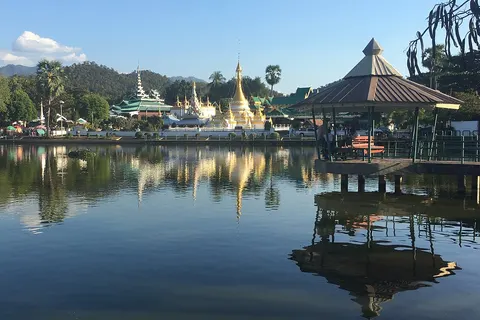 Mae Hong Son town and templesChong Kham lake, twin temples, Doi Kong Mu, night market, Tai Yai food
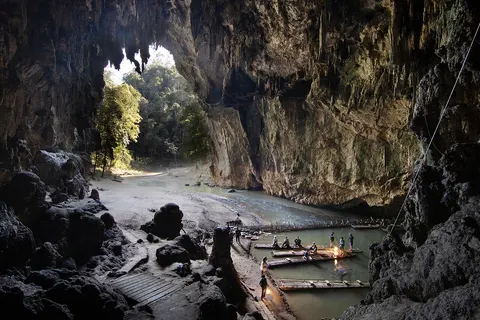 Pang Mapha and Tham LodRaft tour, costs, Ban Luk Khao Lam, viewpoints
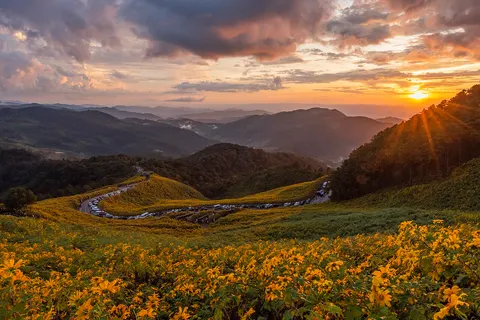 Khun Yuam, Mae Sariang and the sunflowersDoi Mae U Kho sunflowers, Mae Surin, Wat To Phae, Mae Sariang, Salween
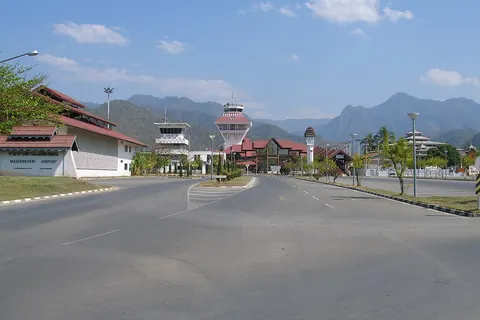 Getting to Mae Hong SonVans, buses, private cars, airport, from Chiang Mai, Pai and Bangkok
 Where to stay in Mae Hong SonTown, Ban Rak Thai, Pang Mapha, Khun Yuam, Mae Sariang
 Mae Hong Son deals this monthTours, transfers, vans and hotels worth booking ahead