Lopburi was once the centre of the Lavo kingdom, later a Khmer outpost, and under the Ayutthaya king Narai the Great a royal residence where he stayed 8 to 9 months a year. Traces of all three eras sit side by side in one walkable district: laterite prangs, a temple hall with French-style windows, and the brick walls of a palace. That mix is what sets the town apart from other old cities in central Thailand. Add the macaques strolling over roofs, wires and walls, and you have the picture most people remember.
This page orders the sights so they are easy to walk in sequence from Lopburi railway station, with opening hours, fees, how to keep your belongings away from the monkeys, the yearly monkey festival and which days things are closed. Information as of 13 Nov 2026. Hours and fees can change on holidays and with Fine Arts Department notices, so check again before you go. If you have not planned your transport yet, read getting to Lopburi and the 1 to 2 day plan.
We earn a commission if you book through our links. The price you pay does not change. How we choose
The old town sights at a glance
| Place | Highlight | Approx. hours | Entry (foreigners) |
|---|---|---|---|
| Wat Phra Si Rattana Mahathat | Large laterite prang, naga-sheltered Buddha in the royal viharn | 08:00 to 17:00 daily | About 50 to 80 baht or the combined ticket |
| Phra Prang Sam Yot | Three Khmer prangs side by side, many monkeys | 08:30 to 18:00 daily | About 50 to 80 baht or the combined ticket |
| San Phra Kan | Old Khmer shrine, the town's guardian shrine | 05:30 to 17:30 daily | Free, donations optional |
| Narai Ratchaniwet Palace | Palace and national museum, brick walls with 11 gates | Museum halls 09:00 to 16:00, Wednesday to Sunday | About 150 to 200 baht |
| Ban Wichayen | House for foreign envoys and Constantine Phaulkon's residence | About 08:30 to 16:30, probably Wednesday to Sunday, check | About 50 to 80 baht or the combined ticket |
| Wat Sao Thong Thong | Luang Pho To Buddha, hall from King Narai's time | 08:00 to 16:30 | Free |
| Wat Kawitsararam | Old ubosot in the maha ut style, wall paintings | Check before you go | Free |
| Wat Nakhon Kosa | Dvaravati brick chedi and a Lopburi-period prang | Open all hours | Free |
The Fine Arts Department combined ticket for foreigners is about 150 to 200 baht (30 baht for Thais). It covers Phra Prang Sam Yot, Wat Phra Si Rattana Mahathat, Ban Wichayen and Phra Thinang Kraisorn Sihraj, so ask at the ticket desk exactly which sites it covers before you buy. Narai Ratchaniwet Palace sells its own ticket. Foreigner rates follow the department's fee schedule, so treat them as a range and confirm at the gate. Hours and fees are approximate as of 13 Nov 2026.
A walking order that does not wear you out
The old town is small, but the sun is strong and the monkeys snatch things along the way. The easiest order is to start on the railway station side and work toward the palace. Phra Prang Sam Yot and San Phra Kan sit next to each other and hold the most monkeys, so pass through them in the morning while it is still cool. The palace and Ban Wichayen have more roofs and shade and suit late morning and the afternoon.
| Order | Place | Time to allow | Why this order |
|---|---|---|---|
| 1 | Wat Phra Si Rattana Mahathat | About 45 minutes | Opposite the station, so you can start as soon as you arrive |
| 2 | Phra Prang Sam Yot and San Phra Kan | About 1 hour 30 minutes | Next to each other, most monkeys, best in the morning |
| 3 | Wat Nakhon Kosa | About 20 minutes | North of the station, near San Phra Kan |
| 4 | Lunch break | About 1 hour | Avoid the strongest sun |
| 5 | Narai Ratchaniwet Palace | About 1 hour 30 minutes | Large grounds with some shade, open Wednesday to Sunday |
| 6 | Wat Kawitsararam and Wat Sao Thong Thong | About 45 minutes | Close to the palace |
| 7 | Ban Wichayen | About 40 minutes | North of the palace and closes a little before the prangs and Wat Phra Si Rattana Mahathat |
On Monday and Tuesday the palace museum halls and Ban Wichayen are closed (the palace grounds stay open daily from about 09:00 to 16:30, so you can still walk the walls and lawns). Use those days for the wat, the prangs, San Phra Kan, Wat Sao Thong Thong and Wat Kawitsararam, and keep the palace for Wednesday to Sunday.
If you have not sorted out how to get to Lopburi yet, see getting to Lopburi for the full options.
 12Go
Bangkok to Lopburi on 12Go
From US$5 (As of 6 Nov 2026: buses from about US$5, vans from about US$5 to US$7. Prices change by date)
Price as of 6 Nov 2026Vans and buses from Bangkok to Lopburi. The van leaves from Mo Chit new van terminal and takes about 2 hours 30 minutes.
Book on 12GoPhotos, prices and reviews from Klook
A full-day train tour from Bangkok. You meet the guide at Krung Thep Aphiwat Central Terminal and the ticket includes return train tickets. The programme covers Phra Prang Sam Yot, Wat Phra Si Rattana Mahathat and Narai Ratchaniwet Palace.
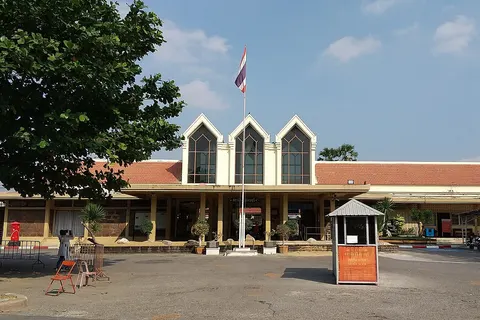
Book on KlookWat Phra Si Rattana Mahathat, the Khmer prang opposite the station
Wat Phra Si Rattana Mahathat stands opposite Lopburi railway station, so almost everyone who arrives by train starts here. Nothing firmly dates the temple, but the large prang on the west side is laterite covered in plaster, and its gopura gateway is Lavo-style work with fine stucco. The gable carvings show Buddha images and scenes from his life, which shows Mahayana Buddhist influence. The prang was repaired in several reigns, from King Ramesuan and King Maha Chakkraphat to King Narai, so the decoration mixes periods.
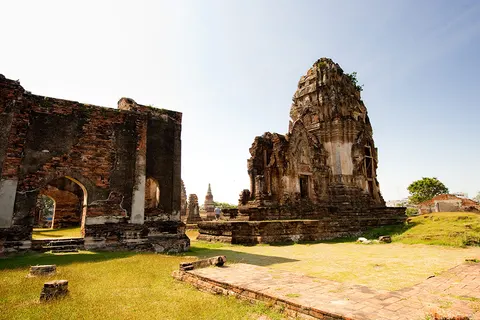
As you walk in you reach the ruin of the changing pavilion, where the king changed out of his regalia before ceremonies in the viharn or ubosot. Only leaning posts remain. Next is the royal viharn built in King Narai's time. Its doors are square in the Thai way, but its windows are cut as French Gothic openings. Inside is a sandstone naga-sheltered Buddha with a lap width of 1.5 metres and a height of 3 metres. The Supreme Patriarch named it Phra Phuttha Lawaburarak, meaning the Buddha who protects Lopburi. South of the viharn is a small ubosot whose doors and windows are entirely French in style.
- Hours: about 08:00 to 17:00 daily. Foreigners pay about 50 to 80 baht, or use the combined ticket at about 150 to 200 baht.
- What to look at: the large west prang, the gopura gateway, the royal viharn with its French-style windows, and the small corner prangs with praying deity figures facing outward.
- Photos: morning and late afternoon give soft light, so the prang does not wash out.
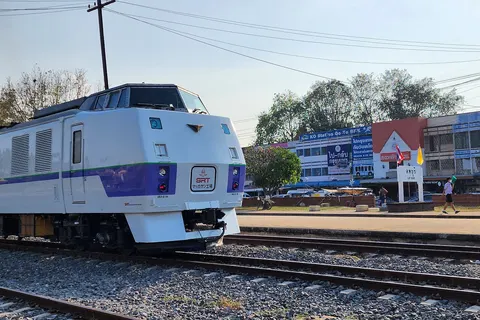
- Trains: the temple sits beside the railway, so a passing train gives you a photo with the ruins and the train in one frame.
Phra Prang Sam Yot, the symbol of Lopburi
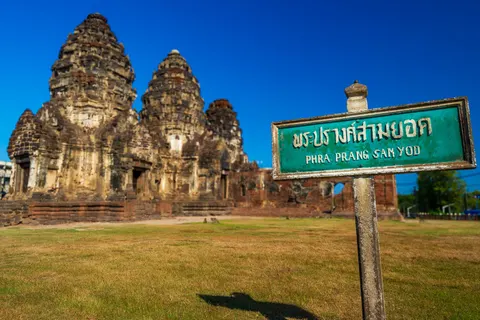
Phra Prang Sam Yot stands on a mound west of the railway about 200 metres north of the station. It is a row of three prangs linked by a passage, built of laterite and decorated with stucco, in the Khmer Bayon style from around the 12th to 13th century. The door-frame columns carry carved seated hermits inside gabled niches, a detail typical of Bayon art. The central prang has a base that once held a Buddha image, and the original wooden ceiling was painted with red flower patterns.
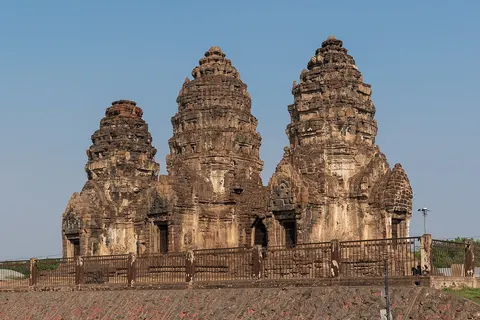
The prang began as a Khmer Mahayana Buddhist shrine, was later turned into a Hindu shrine with linga bases inside all three towers, and was converted into a Buddhist temple again under King Narai. He also had a brick viharn built that mixes Ayutthaya and European touches around the doors and windows. In front, to the east, a viharn holds a large stone Buddha in meditation, in early Ayutthaya style. It is still a place of worship. The monkeys are kept out of the inner prang, but the area around the mound is where they are thickest.
- Hours: 08:30 to 18:00 daily.
- Entry: about 50 to 80 baht for foreigners and 10 baht for Thais, or the combined ticket at about 150 to 200 baht for foreigners and 30 baht for Thais. Thais over 60 enter free. Confirm the rate at the ticket desk.
- Contact: Fine Arts Office 4 Lopburi, tel. 0 3641 2510.
- Dress: cover shoulders and knees, because it is still a place of worship.
- Light: about 08:30 to 10:00 or just before closing, when side light brings out the stucco on the laterite.
The prangs stand right beside the railway line. When a train passes the monkeys scatter. Do not stand on the track and do not climb over the fence to photograph the train.
The Lopburi monkeys: how to keep it relaxed
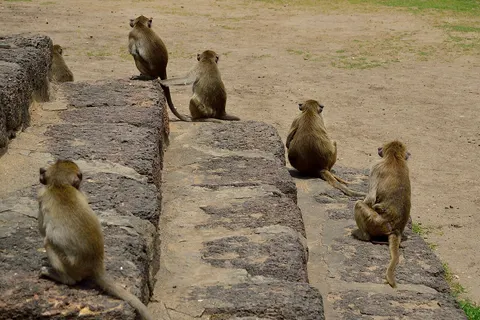
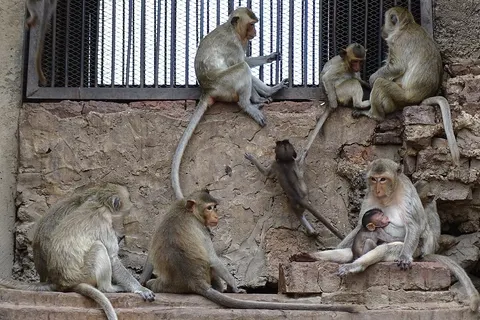
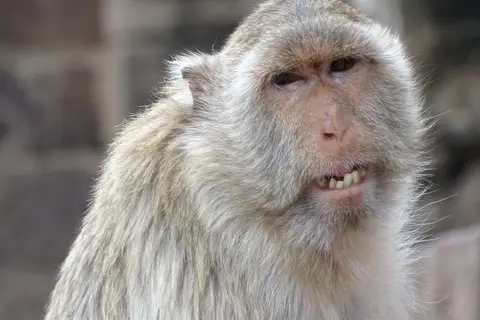
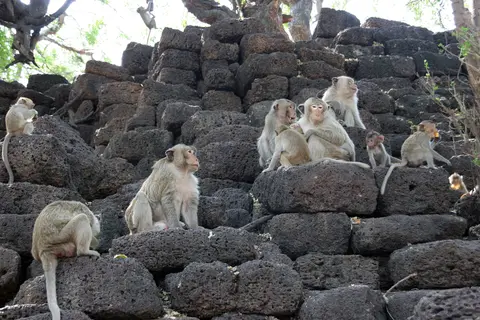
The monkeys are long-tailed macaques living around Phra Prang Sam Yot and San Phra Kan. Local people believe they are followers of the guardian spirit Jao Pho Phra Kan, so feeding them has long been part of the town's customs, and the population grew a lot after the Monkey Banquet began in 1989. Since 2024 the municipality and other agencies have trapped, sterilised and moved large numbers of monkeys to a shelter, so there are far fewer in the old town than a few years ago. The ones that remain are mostly around San Phra Kan and Phra Prang Sam Yot, on roofs, wires, wall tops and the streets around the prangs, so prepare as you always would. The next section has the details.
What the monkeys like to grab
- Plastic and cloth bags, because they know bags usually hold food, even when yours is empty.
- Water bottles and cups held in the hand.
- Sunglasses, hats, phones and open shoulder bags.
- Anything that dangles, such as key rings, lanyards and jewellery.
Habits that actually work
- Put food, water and valuables in a fully zipped bag before you enter the prang area, and carry it on your front.
- Do not feed the monkeys yourself, because they crowd and jump on people.
- Do not stare at the big monkeys for long, and do not poke at or reach for a baby monkey.
- If a monkey grabs something, let go. What a monkey takes is rarely returned.
- Hold small children by the hand or carry them, and do not show snacks.
- If you are bitten or scratched, wash the wound at once with clean water and soap, then see a doctor to discuss rabies vaccination.
Some hotels in the monkey zone have wire cages on balconies or windows. If you leave a balcony door open when you go out, a monkey can enter the room. See where to stay in Lopburi for areas with fewer monkeys.
How many monkeys are left: the 2024 to 2026 control programme
Since 2024 Lopburi municipality and the Department of National Parks, Wildlife and Plant Conservation have been trapping monkeys, sterilising them and moving some to the Pho Kao Ton shelter. In short:
- Late March to early April 2024: a control centre opened, the first round caught 23 monkeys, and a second round began on 1 April, with sterilisation alongside relocation.
- March 2025: more than 2,500 monkeys had been caught, and the plan was for the remaining monkeys to stay only at San Phra Kan and Phra Prang Sam Yot as the town's symbol.
- October 2025: a further 250 monkeys were sterilised between 14 and 20 October. Officials estimated that the population in the original area had fallen by more than 95% and that no more than about 150 remained in the old town.
What visitors see in 2026 is far fewer monkeys, mostly around San Phra Kan and Phra Prang Sam Yot. The figures above are officials' estimates and keep changing.
What this means for your plan
- If you want to see monkeys up close, go to San Phra Kan and Phra Prang Sam Yot in the morning. Do not expect big troops on every street, as in older photos.
- If you dislike monkeys, the palace, Wat Sao Thong Thong, Wat Kawitsararam and Wat Choeng Tha are much more relaxed.
If a monkey bites or scratches you
Most monkeys snatch rather than attack, but a bite or scratch carries a risk of rabies and other infections, so act at once and do not wait to see how it looks. These are general steps, not personal medical advice.
- Wash the wound straight away with soap and clean running water for about 15 minutes, the usual advice.
- Apply an antiseptic such as povidone-iodine, or alcohol, after washing.
- Go to a hospital the same day so a doctor can assess you for rabies and tetanus vaccination.
- The standard rabies course is 5 doses, on day 0, 3, 7, 14 and 28. The doctor will set yours based on your history.
- Do not treat it yourself in your room, and do not wait until you are back in Bangkok.
If a monkey comes close, stay calm and still. Do not scream, run or hit out. Give mothers carrying babies space and never reach for a baby monkey.
San Phra Kan, the town's guardian shrine
San Phra Kan stands beside the railway on the east side of Phra Prang Sam Yot, in Tha Hin subdistrict. It is an old Khmer shrine built of laterite stacked into a tall base, which is why older residents also call it the high shrine. Inside is Jao Pho Phra Kan, thought to be a standing stone figure of Narayana (Vishnu). There are two, a small one in the old Thai style and a larger one in Lopburi style.
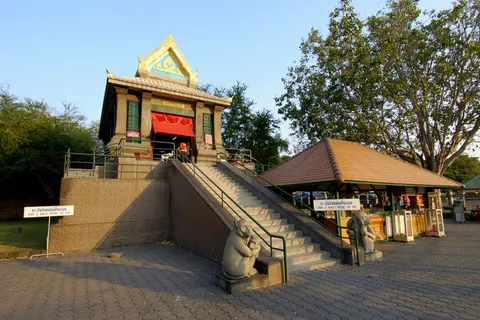
A small upper viharn holds a sandstone lintel carved with Narayana reclining on the serpent, from about the 10th to 11th century, and an octagonal inscribed stone pillar written in old Mon script was found here. From the top you can see the three prangs of Phra Prang Sam Yot. Big shade trees surround the shrine, which makes a good rest stop after walking in the sun, but also a place with many monkeys, because they are seen as the deity's followers.
- Hours: 05:30 to 17:30 daily.
- Entry: free. Offerings and donations are optional.
- Contact: tel. 0 3677 0096.
- Worship: local people come to make wishes and give thanks, and flowers and incense are sold at the front. Dress modestly.
- Care: monkeys climb the stairs and the roof of the shrine, so zip your things away before going up.
Narai Ratchaniwet Palace and museum
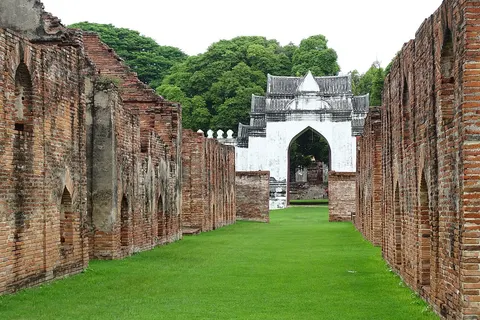
Narai Ratchaniwet Palace is in Tha Hin subdistrict. King Narai the Great ordered it built in 1666 as his residence in Lopburi, and he stayed here 8 to 9 months of each year. The plan has outer, middle and inner royal zones. The brick walls are plastered and topped with merlons, and there are 11 gateways in all. The middle and inner zone walls and gates are pierced with small pointed arches shaped like lotus petals in a row, used to hold lamps, about 2,000 niches in total.
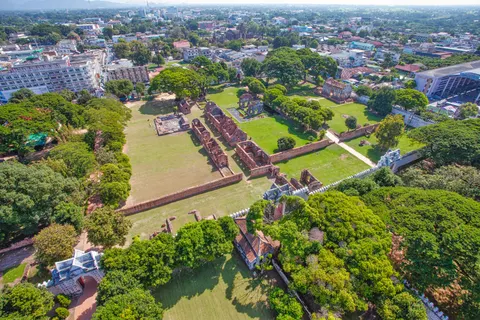
The key buildings from King Narai's reign include Phra Thinang Dusit Sawan Thanya Maha Prasat, which blends Thai and French styles and was originally the audience hall. In its centre is a window where the king appeared to those waiting. The front doors and windows have pointed arches, while the rear pavilion has Thai-style niches. The French envoys' records say the walls were decorated with mirrors brought from France, and King Narai received the French ambassador, the Chevalier de Chaumont, in this hall in 1685. In the reign of King Rama IV the palace was restored and named Phra Narai Ratchaniwet. Several buildings now form the Somdet Phra Narai National Museum.
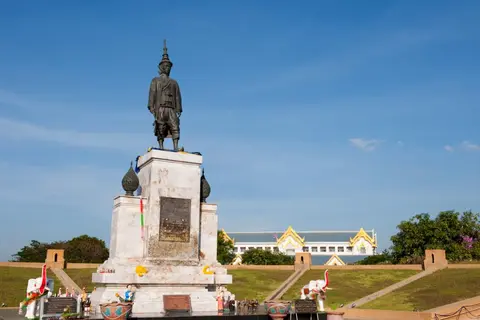
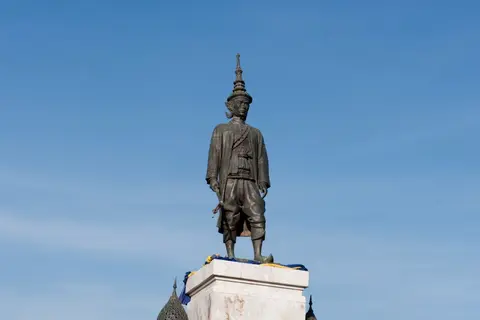
Near Phra Narai Ratchaniwet stands the monument to King Narai the Great, a bronze statue on a marble base with an elephant figure left as an offering. It makes a good photo stop before or after the palace.
- Hours: the museum halls open 09:00 to 16:00, Wednesday to Sunday, and close on Monday, Tuesday and public holidays. The palace grounds are open daily from about 09:00 to 16:30.
- Entry: about 150 to 200 baht for foreigners and 30 baht for Thais. Monks, students in uniform and people over 60 enter free.
- Contact: tel. 0 3641 1458.
- Time needed: about 1.5 to 2 hours if you walk the outer walls and the museum.
- Bring: a hat, drinking water and shoes that can handle grass, because the grounds are wide and parts have little shade.
- Galleries: the exhibition halls are air-conditioned, which helps on hot or rainy days. They include Chantara Phisan Hall (built 1665) and Phiman Mongkut Pavilion, home to the museum's main collection.
The palace is much quieter than the prang area and has few monkeys. If you want a break from them, spend late morning to early afternoon here.
Ban Wichayen, the house for foreign envoys
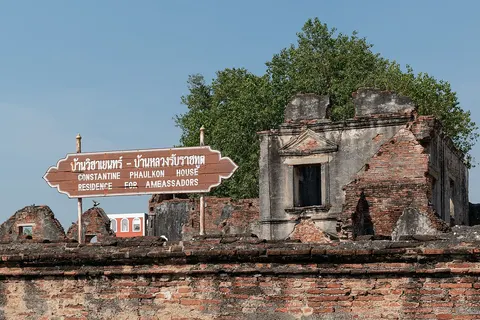
Ban Luang Rap Ratchathut, or Ban Wichayen, is on Wichayen Road north of Narai Ratchaniwet Palace, about 300 metres from Prang Khaek. It was used to receive envoys who came to see King Narai. The first French embassy, in 1685, stayed here. Later Constantine Phaulkon, a Greek who entered Thai royal service and was made Chao Phraya Wichayen, was given a residence on the west side of the envoys' house. The site has three parts: lodgings for the embassy, a middle section with bases that are thought to be a bell tower and a Christian church, and a group of large two-storey buildings on the east.
Some buildings are truly European in style, especially the two-storey brick-and-plaster building on the east side, whose windows and gateways show Renaissance design. It is one of the clearest remains of Ayutthaya's relations with France under King Narai, and it is where visitors hear the story of Phaulkon, who was executed in 1688.
- Hours: about 08:30 to 16:30, probably Wednesday to Sunday. Check before you go, since it may close on public holidays.
- Entry: about 50 to 80 baht for foreigners, or the combined ticket at about 150 to 200 baht.
- Getting there: walk north from the palace, or take a songthaew if the sun is strong.
- Time needed: about 30 to 45 minutes.
Wat Sao Thong Thong, a King Narai era temple with Luang Pho To
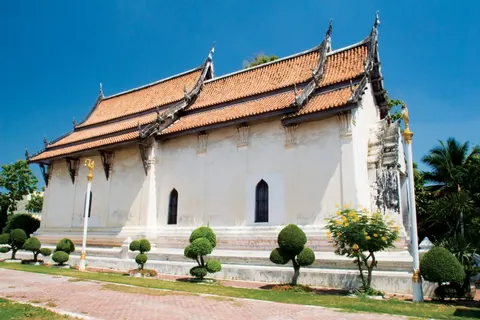
Wat Sao Thong Thong is on Francais Road, which links the palace and Ban Wichayen. It was once two temples, Wat Ruak and Wat Sao Thong Thong, which were later merged under one name. The viharn dates to King Narai's time and was first built for another religion, because a map drawn by a European craftsman shows the area as a Persian residence that may have been used for Islamic worship. Today it houses Luang Pho To, a Buddha in the Subduing Mara posture, which Lopburi people regard as the town's sacred protector.
- Hours: 08:00 to 16:30 daily.
- Entry: free, with a donation box.
- Highlights: the viharn wall cut into arched niches holding various Buddha images, the crowned main Buddha in the Forbidding the Ocean posture in the ubosot, and an old building thought to have housed envoys and guests from Persia.
- Contact: tel. 0 3642 0535.
Wat Kawitsararam, a royal temple beside the palace
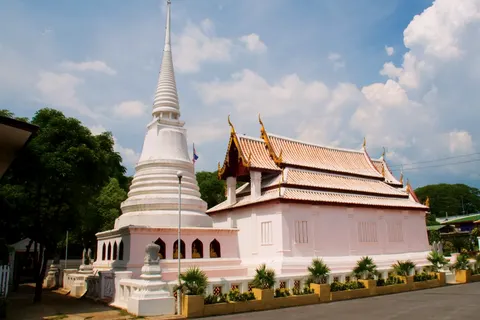
Wat Kawitsararam Ratchaworawihan is on Phet Racha Road, beside the south side of Narai Ratchaniwet Palace. It is a third-class royal temple of the worawihan type. Tradition says it was first called Wat Khawit and later renamed Wat Kawitsararam, meaning the king's temple. King Narai built it and granted it as a consecrated boundary for ordaining royal attendants. The original ubosot is small, in the maha ut style, with only one door and wall openings instead of windows. The principal Buddha is an early Subduing Mara image in the U Thong style, and the walls and every column carry painted decoration.
- Highlights: the old maha ut ubosot, the original roof of Chinese-style tiles, and the sacred well once used for the loyalty oath water.
- Entry: free. Check the opening hours before you go.
- Contact: tel. 0 3661 8593.
- Time needed: about 20 to 30 minutes.
The Sa Kaeo roundabout, Prang Khaek and Wat Nakhon Kosa
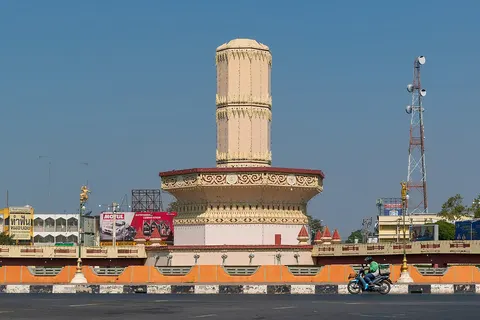
The Sa Kaeo roundabout is a major junction in the middle of Lopburi town, with a candle-shaped monument at its centre. Construction began in 1938 under Field Marshal Plaek Phibunsongkhram, who expanded Lopburi and made it a military centre, which helps explain why the province still has so many army camps and military areas. Use it as a landmark when you give directions or call a ride.
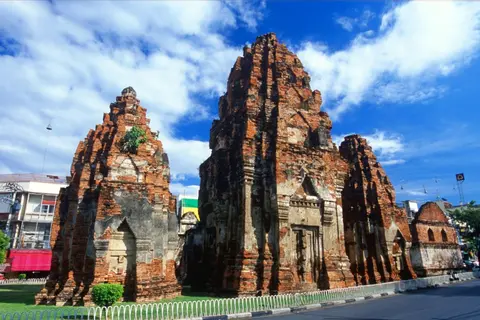
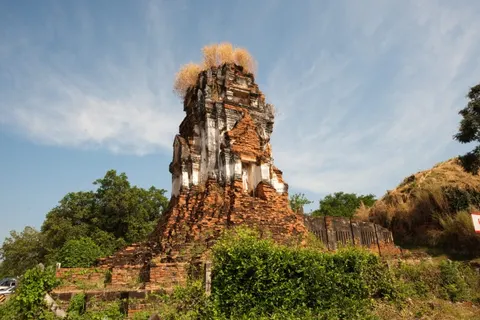
Prang Khaek is a ruined Khmer-style prang standing on a road median, open all day and quick to see, a good stop on the way to Ban Wichayen. Wat Nakhon Kosa is north of the railway station near San Phra Kan. It has a large brick chedi thought to be Dvaravati, judging from the large bricks with a lot of rice husk, and a Lopburi-period prang from about the 11th to 12th century. It was registered as a national monument in 1935. The ubosot and viharn date to King Narai.
The Monkey Banquet and the King Narai fair
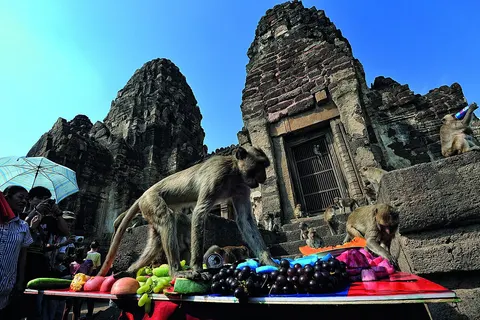
The Monkey Banquet is held every year on the lawn in front of Phra Prang Sam Yot. It began in 1989, started by the owner of Lopburi Inn hotel (Yongyuth Kitwattananusont) to thank the monkeys, and it is free to attend. It is usually held on the last Sunday of November, which would be Sunday 29 November in 2026. Check the day and feeding rounds with Lopburi Inn or TAT Lopburi before you book tickets or a room.
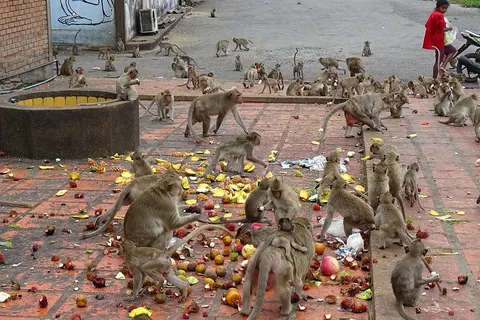
- Upside: you see many monkeys eating at once, the photos are easy, and there is an opening show.
- Care: the crowds are dense and the monkeys excited, so belongings go missing more easily than on a normal day. Zip everything away.
- Stay: old town rooms fill early in the festival week, so book ahead.
- King Narai the Great fair: held in mid-February for about 10 days at Narai Ratchaniwet Palace, with retro markets and light shows, and free to enter. The 2026 fair ran 13 to 22 February. Dates for 2027 are not announced, so check before you plan.
The 2026 banquet at a glance
| Date | Expected Sunday 29 Nov 2026, check before you go |
|---|---|
| Entry | Free |
| Feeding rounds in past years | 4 rounds, about 10:00, 12:00, 14:00 and 16:00 |
| Arrive | About 09:00, before the opening ceremony and show |
| Where | Fruit and vegetable tables in front of Phra Prang Sam Yot |
The 2024 edition was the 36th. With far fewer monkeys in the old town, recent banquets may be smaller than the old photos suggest, so do not expect hundreds of monkeys eating at once.
Where to sleep in banquet week
Old town rooms fill early in banquet week. Staying the night before helps you reach the lawn in good time. Check prices for your dates on the booking page.
Noom Guesthouse
15-17 Phayakamjad Road, Tha Hin, old town
A budget guesthouse in Tha Hin, the old town area, handy for the prangs and the railway station.
See prices and availability on the booking page
Nett Hotel
5/5 Radchadumnoen Road, Lopburi town
A hotel on Radchadumnoen Road in Lopburi town, a base for walking the old town.
See prices and availability on the booking page
Where to eat and where to sleep in the old town
Restaurants serving rice dishes, noodles and coffee are scattered along the road in front of the station and around the Sa Kaeo roundabout, and food stalls and markets often set up near the station in the evening (check the days). Lopburi also has Thai Phuan and Thai Beung communities, so local snacks and dishes appear in restaurants and markets. Ask the staff which dishes are local, and you will get a better answer than from reading the menu.
Places to stay in the old town range from budget guesthouses to mid-range hotels. Areas with fewer monkeys suit people who do not want to meet them in the morning. See where to stay in Lopburi for the list, and compare tours and tickets on the deals page.
Read next
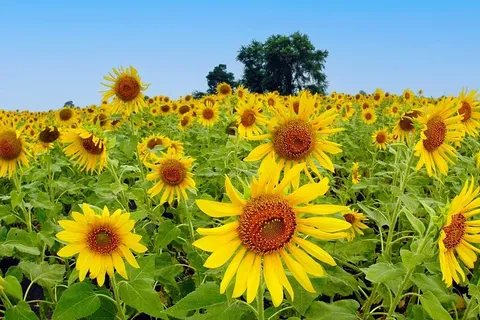
 Lopburi: monkeys, Khmer prangs and sunflowersOld town, temples, Pa Sak Dam, sunflower fields and how to get there from Bangkok
 Lopburi in 1 to 2 daysTimed plans, the train from Bangkok and an overnight option
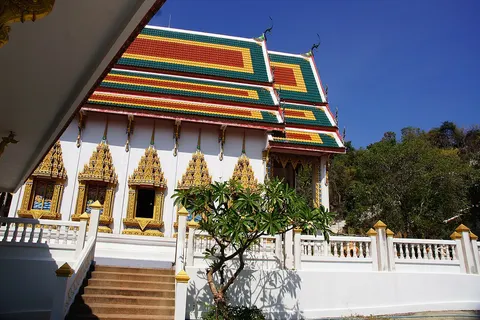 Temples around LopburiWat Choeng Tha, Wat Mani Chonlakhan and Wat Phra Bat Nam Phu
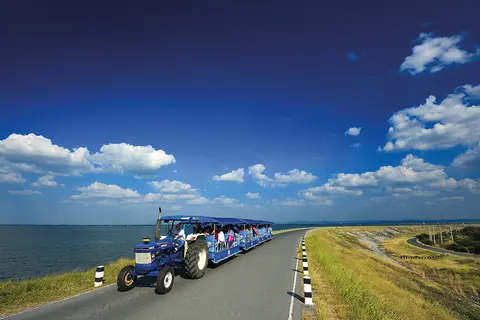 Pa Sak Dam, sunflowers and natureThe floating train, Khao Chin Lae sunflowers, Khao Wong Phra Chan and waterfalls
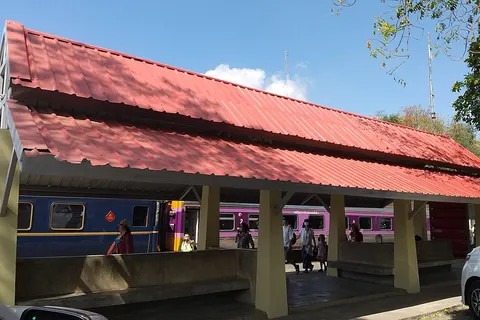 Getting to LopburiNorthern line trains, vans, buses, driving and getting around town
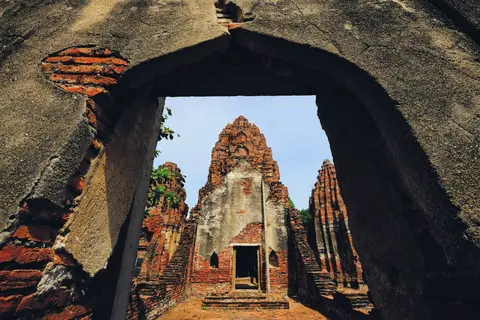 Where to stay in LopburiOld town, Tha Sala, the sunflower area and Chai Badan
Frequently asked questions
How long does Lopburi old town take?
If you start at the railway station and walk Wat Phra Si Rattana Mahathat, Phra Prang Sam Yot, San Phra Kan, Narai Ratchaniwet Palace and Ban Wichayen, plan about 5 to 6 hours including lunch. A rushed version with only Phra Prang Sam Yot and the palace takes about 3 hours.
What does the Fine Arts Department combined ticket cover?
For foreigners it costs about 150 to 200 baht (30 baht for Thais) and covers Phra Prang Sam Yot, Wat Phra Si Rattana Mahathat, Ban Wichayen and Phra Thinang Kraisorn Sihraj. Ask at the ticket desk exactly which sites it covers. Narai Ratchaniwet Palace sells a separate ticket.
Which days is Narai Ratchaniwet Palace closed?
The museum halls are closed on Monday, Tuesday and public holidays, and open Wednesday to Sunday, 09:00 to 16:00. The palace grounds are open daily from about 09:00 to 16:30. Ban Wichayen is probably open Wednesday to Sunday too, so check before you go. On a Monday or Tuesday, see the temples and prangs instead.
Are the Lopburi monkeys dangerous? What about children?
They mostly snatch things rather than attack, but they can bite or scratch if provoked or if you go near a baby. Hold children by the hand or carry them, do not show open snacks, and if you are scratched or bitten wash the wound and see a doctor.
Are there still many monkeys in 2026?
Far fewer than a few years ago. Since 2024 many monkeys have been trapped, sterilised and moved to a shelter, and officials estimated in October 2025 that the old-town population had fallen by more than 95%. The ones left are mostly around Phra Prang Sam Yot and San Phra Kan, so still zip your bags and do not feed them.
When is the Monkey Banquet in 2026?
It is usually held on the last Sunday of November, which would be Sunday 29 November 2026. Entry is free. Past editions had 4 feeding rounds, about 10:00, 12:00, 14:00 and 16:00, and it is best to arrive about 09:00. Confirm the date with Lopburi Inn or TAT Lopburi before you go.
What should I wear at the temples and prangs?
Cover shoulders and knees, because Phra Prang Sam Yot, San Phra Kan and the temples are still places of worship. Wear comfortable shoes and a hat, because you walk outdoors for hours.
Can I do Lopburi as a day trip from Bangkok?
Yes, if you leave early. The van from Mo Chit takes about 2.5 hours and the old town takes half a day to a full day on foot. See getting to Lopburi for options and times.
How much does Phra Prang Sam Yot cost for foreigners?
About 50 to 80 baht, against 10 baht for Thais. The Fine Arts Department combined ticket is about 150 to 200 baht for foreigners and 30 baht for Thais. Rates follow the department's schedule, so confirm at the ticket desk. Thais over 60 enter free. It is open daily from 08:30 to 18:00.
What should I do if a Lopburi monkey bites me?
Wash the wound at once with soap and clean water for about 15 minutes, apply antiseptic, and go to a hospital the same day for rabies and tetanus assessment. The standard rabies course is 5 doses, on day 0, 3, 7, 14 and 28. Do not treat it yourself or wait until you are back in Bangkok.
Why are there fewer monkeys in Lopburi now?
Since 2024 Lopburi municipality and the Department of National Parks, Wildlife and Plant Conservation have trapped monkeys, sterilised them and moved some to the Pho Kao Ton shelter. By March 2025 more than 2,500 had been caught, and the plan is for the rest to stay only at San Phra Kan and Phra Prang Sam Yot.
Is Lopburi still worth visiting if I am afraid of monkeys?
Yes. There are far fewer monkeys, and the palace, Wat Sao Thong Thong, Wat Kawitsararam and Wat Choeng Tha have fewer than the prang area. Pass San Phra Kan and Phra Prang Sam Yot quickly in the morning, or view the prangs from the street without walking close to the monkeys.
When is the King Narai Reign Fair in 2027?
The dates are not announced yet. It is usually held for 10 days in mid-February at Narai Ratchaniwet Palace and is free to enter. The 2026 fair ran 13 to 22 February. Check Lopburi province and TAT announcements before you book a room.
Where the facts come from
- Wikivoyage: Lopburi (getting there and sights)
- Wikipedia: Phra Prang Sam Yot
- Wikimedia Commons: Sa Kaeo roundabout, Lopburi
- The Thaiger: Exploring the ancient city of Lop Buri in a day
- Thai PBS: Lopburi monkeys, final round 2025 (Thai)
- Thai PBS: Lopburi monkey control centre, April 2024 (Thai)
- The Thaiger: Lopburi monkey survival guide
- Thai Holiday Guide: Monkey Buffet Festival
- Thai Holiday Guide: Phra Prang Sam Yot
- Thai Holiday Guide: Phra Narai Ratchaniwet
- Thai Holiday Guide: King Narai Reign Fair
- Fine Arts Office 4 Lopburi: contact