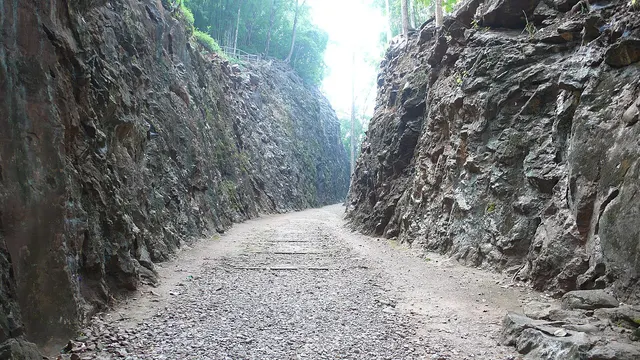
Hellfire Pass is the best-preserved cutting on the Thailand-Burma Railway, a deep notch hacked through solid rock in 1943 with hammers, chisels and explosives by Allied prisoners of war and Asian labourers. It is named for the sight of the night work by torchlight, which one prisoner compared to Dante's Inferno. The museum next to it, opened by the Australian Government in 1998, is free, well run and one of the most useful stops on the whole Death Railway route.
This page answers what visitors search for most: entry, opening hours, closure days, the two walks, the audio guide, how to get there from Kanchanaburi and from Nam Tok, whether to go independently or with a tour, how to combine it with Sai Yok Noi and Tham Krasae in one day, which months suit, how to handle the heat, and the etiquette that suits a memorial rather than a photo stop.
Heavy rain in late September 2026 closed several places along this road, so there is also a clear section on how to check the situation before you travel.
We earn a commission if you book through our links. The price you pay does not change. How we choose
Quick facts before you go
| Entry | Free for everyone; donations welcome (boxes in the museum). Groups over 20 must book in advance |
|---|---|
| Opening hours | Daily 09:00 to 16:00. The trail opens at 09:00 after morning cleaning. Allow at least an hour before closing |
| Annual closures | 1 January; 13 to 15 April (Songkran); about weeks 1 to 3 of May (annual maintenance, dates vary); 5 December; 24 to 27 December; 31 December |
| Status after the rain | As of 7 Nov 2026 the museum shows normal hours and no closure notice. Since 27 Sep 2026 a Death Railway day tour from Bangkok has gone to Captive Cave instead of the Pass (as of 5 Nov 2026). Check before you go: phone or message the museum the day before |
| Blue Walk | About 500 m from the museum to the Pass, 45 to 60 minutes |
| Green Walk | 2.6 km to Hintok Road, about 1.5 hours one way, safety radio provided, no pick-up at the end |
| Audio guide | Free, in Thai, English and Dutch, until 15:00. One ID card as deposit. First come, first served |
| Where | 207 Moo 11, Tha Sao, Sai Yok district, Kanchanaburi 71150, on Highway 323 at about kilometre 64 to 65, about 80 km from Kanchanaburi town |
| Facilities | Car park, toilets, vending machines for drinks and snacks, outdoor seating |
| Getting there | About 1 hour by car, 1.5 to 2 hours by bus, or on a day tour |
| Official information | hellfirepass.dva.gov.au (Australian Department of Veterans' Affairs) |
Allow two hours or more. The museum and the audio guide are worth the time, and the Blue Walk on its own takes most of an hour. Come by 14:30 if you want the audio guide and the full walk.
Closure dates and the situation after the 2026 rain
Annual closure days
The museum closes only a few days a year: 1 January, 13 to 15 April (Songkran), about the first three weeks of May for annual maintenance (exact dates change every year, so check before you book a trip in early May), 5 December, 24 to 27 December and 31 December. On every other day it is open from 09:00 to 16:00, weekends and public holidays included.
After the heavy rain of late September 2026
Heavy rain in late September 2026 flooded the Khwae Noi valley and closed several sights in the area. Since 27 September 2026 a Death Railway day tour from Bangkok that used to stop at Hellfire Pass has gone to Captive Cave instead (as of 5 Nov 2026). The museum itself shows opening hours of 09:00 to 16:00 and no temporary closure notice (as of 7 Nov 2026). Check before you go.
In short, the building, the trail and the stop a tour operator chooses can be in different states. If Hellfire Pass is the main reason for your trip, phone the museum or message its Facebook page (HellfirePassThailand) the day before and ask three things: is the building open, is the short trail open, and is the long trail open. Trails like these are often shut for safety when the ground is wet, while the museum building may stay open.
- If you drive yourself, check again on the morning you travel. Arriving to a closed trail wastes about an hour each way.
- If you buy a tour, ask what the operator does if the Pass is closed and whether you get a refund.
- If you travel in the heavy rain months, roughly May to October, keep a spare day in Kanchanaburi, for example the war cemetery and the town museums.
What is inside the museum
The building, called the Interpretive Centre, is the start of every route. Walk through it before you go down to the cutting: once you know who built the railway and how, the rock below means much more. It tells the story with text panels, black-and-white photographs, artworks and the accounts of former prisoners of war.
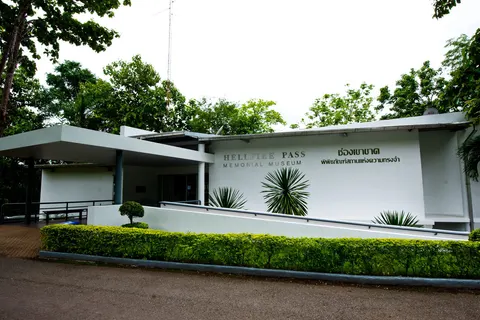
- Backlit text panels with personal stories of prisoners and labourers, alongside photographs and sketches.
- Photographs from the Australian War Memorial and the drawings of Jack Chalker, a former prisoner who recorded camp conditions.
- A short film of about 10 minutes on a loop that gives an overview of the railway before you walk.
- The Peace Vessel sculpture, placed at a corner with a view over forest and hills, a quiet place to sit before or after the walk.
- Toilets, parking, vending machines for drinks and snacks, and an information counter that helps with the audio guide. Eat before you come or after you leave.
The exhibits are serious and direct, with death, disease and violence in them. Reading quickly takes about 30 to 45 minutes; reading carefully and listening to the audio guide takes longer. Parents of young children should decide for themselves which parts the children see.
The Blue Walk and the Green Walk
Blue Walk, about 500 m
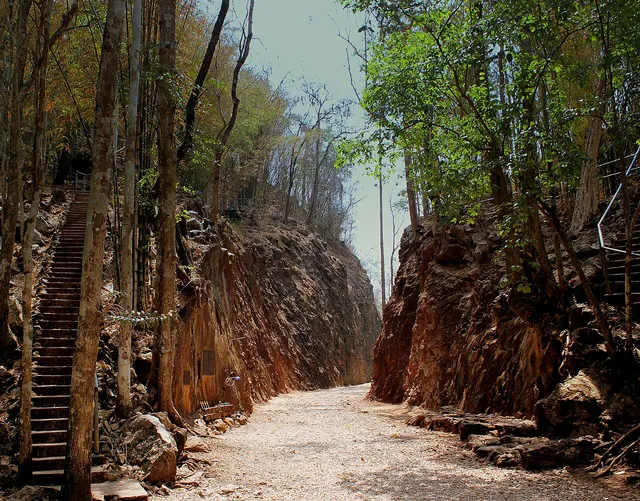
The short walk goes from the museum down to the Pass, the Konyu Cutting where the railway ran through the rock. It takes 45 to 60 minutes, including time to read the signs and stand in the cutting. It starts with steps down from the building and the surface is uneven gravel, so wear closed shoes with grip. The way back is uphill, so it feels harder than the way down. Many visitors find it moving: the tall rock walls and the preserved rails make the labour plain.
Green Walk, 2.6 km
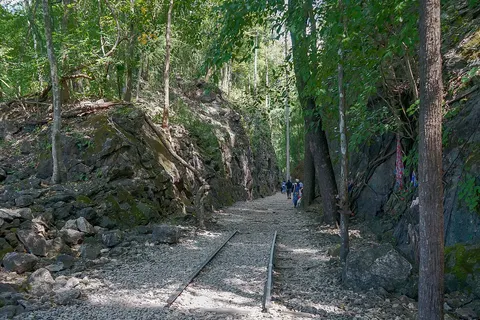
The long walk follows the old railway bed through the forest to Hintok Road, about 1.5 hours one way or about 3 hours there and back (about 5.2 km in total). It has steep ups and downs and a gravel surface, so it is for fit walkers only. You collect a free safety radio from the service counter or the lower floor before you start. Beyond the cutting the trail runs about another 2 km past traces of the railway's engineering: smaller cuttings, a large embankment and the sites of timber trestle bridges, with audio stops along the way.
There is no pick-up at the end on Hintok Road, which is 3 to 4 km of narrow, steep, winding local road. If you do not want to walk back, arrange a driver or taxi to wait there in advance and do not count on finding one. With little shade, start early and carry at least 1 litre of water per person.
Buggy for limited mobility
A free buggy carries elderly visitors, people with physical limits and people with health problems to the Pass and back, taking about 30 to 40 minutes. Ask at reception. It carries the person who needs it plus one helper, and other family and friends walk alongside. Small-wheeled pushchairs struggle on the gravel, so ask at the counter before you decide.
| Topic | Blue Walk | Green Walk |
|---|---|---|
| Distance | About 500 m one way | 2.6 km one way (about 5.2 km round trip) |
| Time | 45 to 60 minutes including time to look around | About 1.5 hours one way, about 3 hours round trip |
| Effort | Moderate, with steps and gravel | Hard, steep ups and downs, little shade |
| Bring | Water, shoes with grip, repellent | At least 1 litre of water, hat, sunscreen, safety radio from the counter |
| Suits | Most visitors, including older children who can walk | Fit adults with half a day |
- Bring water. It is hot and shaded only in parts.
- Respect the memorial. Keep your voice down, and do not climb or carry anything away from the cutting.
- Wear long sleeves or repellent in the early morning or after rain; the forest has mosquitoes.
What you will see on the walk
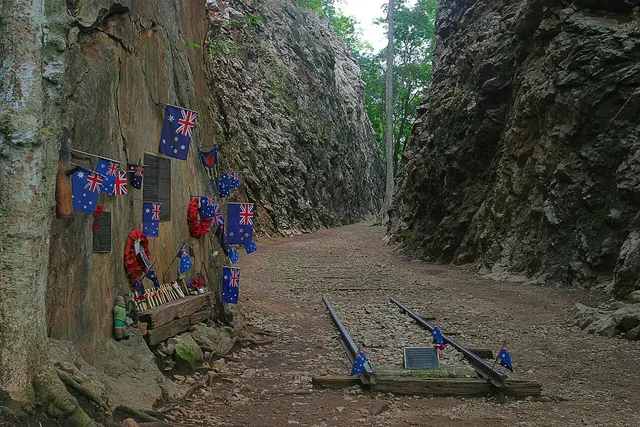
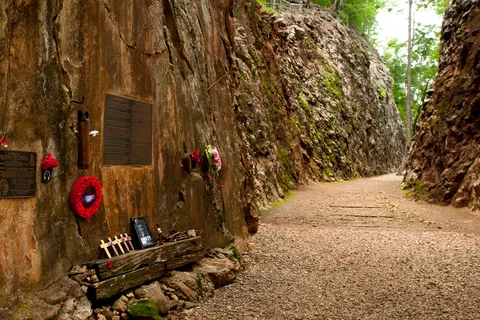
Most visitors walk only the Blue Walk, which takes you into the heart of the cutting: tall rock walls on both sides and a floor that follows the old railbed. On one wall are plaques, wreaths, small Australian flags and small wooden crosses that visitors have left, and a short length of rail lies on the ground. It makes clear that this is a memorial, not just a viewpoint.
The cutting is about 75 m long. Engineers chose an open cut over a tunnel because work could go on at many points at once, while a tunnel can only be driven from its two ends. Most of the work was done by hand, chipping with hammers and hand drills and using explosives. Stand still in the middle, look up at the walls and remember that every metre of it was cut by hand.
If you carry on along the Green Walk you pass traces of the railway embankment, places where timber trestle bridges once crossed the gullies, and cuttings smaller than Hellfire Pass. There were six trestle bridges between the Pass and Hintok. No trains run on this stretch today, so it is quiet and the forest is all around. If you listen to the audio guide as you walk, former prisoners describe the work at the places you pass.
With only 1.5 hours, spend about 30 minutes in the exhibits, then walk the Blue Walk with the audio guide. Do not push for the long trail; the Green Walk suits people who will give the museum a whole morning.
The free audio guide and the museum
The museum tells the story of the railway through objects, film and personal accounts, and the free audio guide plays on the trail. Collect it from the lower floor with a disposable earbud, leaving one ID card (driving licence or passport) as a deposit that you get back when you return the device. One ID covers a family or group.
- Languages: Thai, English and Dutch.
- No advance booking. First come, first served.
- Available until 15:00, so come before then.
- The commentary uses the voices of former prisoners and explains the history of each stop along the route.
- The audio files and transcripts are also online on the Department of Veterans' Affairs audio guide page, so you can listen at home beforehand in the language you prefer.
Start the audio guide before you go down the steps, because each stop speaks about the place where you stand. If the devices have run out by late morning, ask at the counter and use the online files instead.
How long to allow and sample plans
The time you need depends on how much you walk. This table is a rough guide.
| Style | Time to allow | What it covers |
|---|---|---|
| Rushed | About 1.5 hours | A quick look at the exhibits and the Blue Walk |
| Recommended | About 2 to 2.5 hours | Exhibits, audio guide and an unhurried Blue Walk |
| Full | About 4 to 5 hours | All of the above plus the Green Walk round trip, or a driver waiting at Hintok Road |
Half day from Kanchanaburi by car
| Time | What to do |
|---|---|
| 07:30 | Leave Kanchanaburi town and drive Highway 323, about 1 hour plus a margin for traffic and a fuel stop |
| 09:00 | Arrive when the museum opens and collect the audio guide on the lower floor |
| 09:15-10:00 | Exhibits and the short film |
| 10:00-11:15 | Blue Walk with the audio guide |
| 11:30 | Drive on for lunch near Tha Sao or Nam Tok station |
| Afternoon | Continue to Sai Yok Noi or Tham Krasae, see the combining section below |
By public bus
Take the Kanchanaburi to Thong Pha Phum or Kanchanaburi to Sangkhla Buri bus from Kanchanaburi bus terminal as early as you can, so that you reach the museum between about nine and ten. Tell the conductor you want Hellfire Pass (Chong Khao Khat in Thai). Plan two to three hours in the museum, then be at the stop opposite the entrance before 17:00. Do not plan to the last minute, because the buses do not keep exact times.
How to get to Hellfire Pass
| Option | Best for | Notes |
|---|---|---|
| Car or driver | The easiest way | About 80 km and 1 hour from Kanchanaburi. Agree the waiting time with the driver |
| Bus from Kanchanaburi | Budget and time to spare | 1.5 to 2 hours. The return bus stop is on Highway 323 opposite the main entrance, with buses about hourly at around 60 baht. Times are not exact; be at the stop by 17:00 |
| Minivan from Kanchanaburi bus terminal | One way only | Around 120 baht. Minivans do not pick up passengers along the way, so you cannot ride one back from the museum; use the bus |
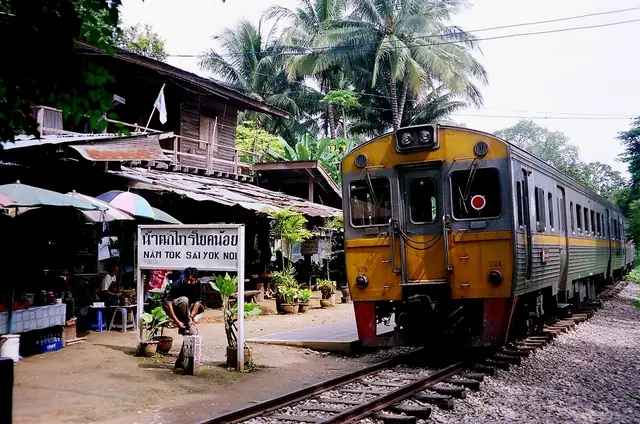
| Train to Nam Tok | Combining with the Death Railway | Nam Tok station is about 20 km away and no taxis wait at the museum. Take the bus to Tha Sao, then walk about 5 minutes to Nam Tok station. Trains are few; confirm times with the State Railway of Thailand. Floods closed the line past Tha Kilen in late September 2026 and it reopened to Nam Tok on 3 October 2026, so check the line is open |
| Day tour | No logistics | Day tours from Bangkok that include the area are in the box below |
If you drive
From Kanchanaburi town take Highway 323 toward Sai Yok and Thong Pha Phum. It takes about 1 hour on a winding, hilly road, and petrol stations are not frequent, so fill up before you leave town. Type the full name Hellfire Pass Interpretive Centre into your map app. The museum is at about kilometre 64 to 65 of the highway and the car park has space for buses as well. Switch the engine off while parked.
If you take the bus
Go to Kanchanaburi bus terminal and find the counter for buses to Thong Pha Phum or Sangkhla Buri, which pass Hellfire Pass. Tell the conductor to drop you at Hellfire Pass. The bus stops at the gate of the Thai military base beside the museum. For the return, cross the road to the stop opposite and take a red bus back to Kanchanaburi bus terminal, about 1.5 hours and around 60 baht.
If you start in Bangkok
Bangkok to Kanchanaburi takes about 2 hours, then another 1.5 to 2 hours on to Hellfire Pass, so about 3.5 to 4 hours each way. A same-day round trip on public transport leaves very little time at the museum before the 16:00 closing, so it is not recommended. Better options are to sleep one night in Kanchanaburi and go the next morning, or to take a tour that includes the Pass.
 12Go
Bangkok to Kanchanaburi on 12Go
From US$4
Price as of 5 Nov 2026Bus, van and taxi from Bangkok to Kanchanaburi. Pick a morning departure so you can continue to Hellfire Pass before the museum closes.
Book on 12GoBangkok to Kanchanaburi: bus, van, train and taxi
The Death Railway ride: Kanchanaburi to Nam Tok, fares and timetable
Combining Hellfire Pass with nearby sights
Hellfire Pass sits on Highway 323, the same road as Sai Yok Noi waterfall, Tham Krasae and Sai Yok National Park, so a car makes a single day possible. The museum opens at 09:00, so make it the first stop.
| Sight | Where | Time | Notes |
|---|---|---|---|
| Nam Tok station and Sai Yok Noi waterfall | About 20 km from Hellfire Pass | About 1 to 1.5 hours | The end of the Death Railway line. Check the waterfall's status before you go |
| Tham Krasae cave and the wooden walkway above the Khwae Noi | On the way back to Kanchanaburi | About 30 minutes | See the Sai Yok Noi page for the combined plan |
| Kanchanaburi War Cemetery (Don Rak) | In Kanchanaburi town | About 45 to 60 minutes | Go the day before for context |
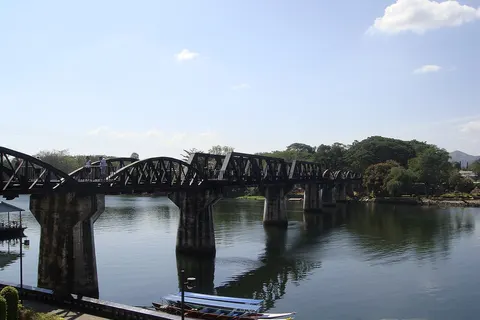
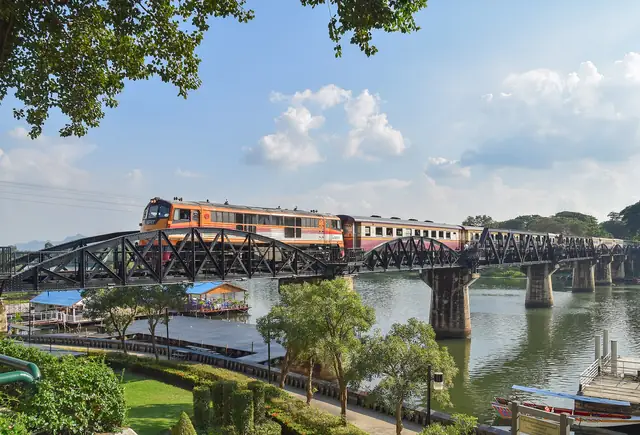
| Bridge over the River Kwai | In Kanchanaburi town | About 1 hour | Best early morning or late afternoon |
A sensible order is Hellfire Pass in the morning, lunch near Nam Tok station, Sai Yok Noi in the afternoon and Tham Krasae on the way back. If you also want to ride the Death Railway, make that a separate day: the ordinary train that reaches Nam Tok around noon does not leave enough time to visit the Pass and get back.
Sai Yok Noi waterfall: status, hours and a plan with Hellfire Pass and Tham Krasae
War cemetery and museums in Kanchanaburi town, including Anzac Day
Kanchanaburi in 3 days and 2 nights, with a day that includes Hellfire Pass
Why this cutting matters
In the Second World War the Japanese army wanted a supply route to Burma and built the Thailand-Burma Railway, about 415 km long. Work began in October 1942 and finished in about 12 months. It used about 61,700 Allied prisoners of war, British, Australian, Dutch, American and New Zealand, together with a large number of Asian labourers from China, Vietnam, Java, Malaya, Burma and India.
Work on the cutting began on 25 April 1943, which is Anzac Day. In July and August 1943 prisoners worked shifts of 12 to 18 hours with no rest day, a period they called speedo, until the Hellfire Pass section was finished in August. The death rate here was higher than on other parts of the railway, from hunger, cholera, tropical ulcers and violence. The name Hellfire comes from the sight of emaciated men working at night by torchlight.
The memorial is a joint effort of the Thai and Australian governments. The museum opened in 1998 at a ceremony attended by the Australian prime minister of the time, and it is now run by the Australian Department of Veterans' Affairs. A dawn service is held on Anzac Day, 25 April, and members of the public can register in advance for free. In 2026 the site opened at 03:00, visitors were asked to be seated by 05:00 and the service began at 05:30; check the times and registration for later years on the official site.
A visit to Hellfire Pass means more if you pair it with the cemetery in town and the River Kwai Bridge, so that you see the wider picture of the people this railway took.
War cemetery and museums in Kanchanaburi town
The Bridge over the River Kwai: walking, the train and when to go
Etiquette and site rules
Hellfire Pass is a memorial to a very large number of dead, and the families of victims and veterans visit regularly, so behave as you would in a cemetery.
- Keep your voice low in the cutting and along the trail, and silence your phone.
- Do not climb the rock walls, step on or take anything from the cutting, and do not touch or move the flags, wreaths, crosses and plaques that visitors have left.
- Photographs are fine, but do not pose playfully or take jokey selfies at the memorial spots.
- Dress modestly. Covered shoulders and knees are a courtesy rather than a rule here, and clothes you can hike in suit the trail anyway.
- Stay on the marked paths and do not cut into the forest.
- Do not feed animals and keep your distance from wildlife.
- Switch off your engine when you park.
- Take your bottles and snack wrappers to the bins near the building.
Pets are allowed in the building and on the trail, but they must be on a lead and you must carry waste bags and cleaning supplies. Bring water and treats for the animal, and think about the heat and the gravel under its paws.
Heat, rain and what to bring
Much of the trail has tree shade, but the cutting and parts of the long trail are open and the sun is strong. It can be hot and humid all year, and hottest from about March to May. In the rainy season the gravel is slippery and water runs along the gullies; running water in the wet season can be hazardous on the long trail.
- Closed shoes with grip, not sandals.
- At least 1 litre of drinking water per person, more for the Green Walk.
- A wide-brimmed hat, sunscreen and sunglasses.
- Insect repellent, reapplied every couple of hours, especially in the morning and after rain.
- A light rain jacket from May to October.
- A little cash for the vending machines and donations.
- A power bank, because photos and maps drain a phone quickly.
In the hot season arrive at 09:00 and walk first, while it is cooler and quieter than late morning, then spend the middle of the day in the shaded exhibition rooms.
The best time to visit
Hellfire Pass is open every day apart from a few closure days, so weather and annual closures matter most. This table gives the picture period by period.
| Period | Conditions | Good to know |
|---|---|---|
| November to February | Cool season, little rain, the most comfortable time of year | Best period. Dry trail but more visitors. Closed 5 Dec, 24 to 27 Dec, 31 Dec and 1 Jan |
| March to April | Very hot | Go early and carry plenty of water. Closed 13 to 15 April for Songkran. Some years bring forest-fire smoke |
| May | Hot, with rain starting | Annual maintenance closure at about weeks 1 to 3. Check the dates before booking hotels |
| June to August | Rainy season, lush forest | Slippery paths and frequent afternoon rain. Go in the morning. The long trail is riskier than the short one |
| September to October | Heaviest rain | Heavy rain in late September 2026 flooded the Khwae Noi valley and closed some places. Check the status every time and keep a spare day |
If you can choose, go between about November and February on a weekday, and avoid the closure dates and long public holidays when tours are busy. If you want to attend the Anzac Day dawn service, plan your stay well ahead, because accommodation near the Pass is limited.
Tours that go to the Hellfire Pass area
One day tour from Bangkok carries Hellfire Pass in its title, but its programme has changed since late September 2026. Read the details on the booking page before you buy.
Photos, prices and reviews from Klook
A 12-hour join-in tour from Bangkok (hotel pickup in Bangkok) with the Death Railway train ride, the bridge, the war cemetery and lunch, with an English-speaking guide. Since 27 September 2026 it has gone to Captive Cave instead of Hellfire Pass because of heavy rain (as of 5 Nov 2026). If the Pass itself is why you want this tour, check with the operator and the museum first.
Book on KlookWhat to ask before you buy a tour to the Pass
- Is Hellfire Pass really in the programme, and is there time to walk the trail or only a stop outside the museum?
- How many minutes do you get at the Pass? The Blue Walk alone takes 45 to 60 minutes and the audio guide ends at 15:00.
- Does the tour arrive before or after 09:00? The trail opens at 09:00.
- If the Pass is closed, where does the tour go instead, and is any difference refunded?
- Are entry fees for other stops included? Hellfire Pass itself has no entry fee.
If you want to set your own route, this private tour from Bangkok takes 13 hours. The routes listed are the bridge, the Death Railway, Mallika City, Erawan Falls and Meena cafe. If you want to add Hellfire Pass, ask the operator before you book.
Photos, prices and reviews from Klook
A 13-hour private tour from Bangkok with a choice of route from the listed stops. Ask the operator whether Hellfire Pass can be added and what it would cost.
Book on KlookKanchanaburi day tours from Bangkok on KKday (check the programme for Hellfire Pass before you book)
Photos, prices and reviews from KKday
Tour prices, inclusions and times are set by the operator and can change. Read the current details on the booking page. Booking through this button does not change your price.
Where to stay for an early start at Hellfire Pass
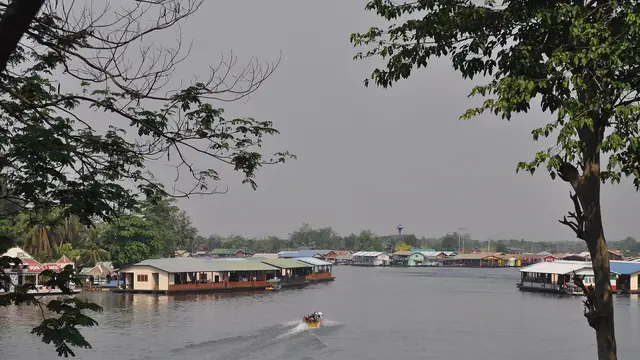
There is not much accommodation near Hellfire Pass, and most of it is around Tha Sao and Sai Yok on the river, which is peaceful but reached by boat. To be at the gate for the 09:00 opening, either sleep in Kanchanaburi town, about 1 hour away by car, or stay near Tha Sao and Sai Yok.
Kanchanaburi town suits you if you have a car and want dinner along Mae Nam Khwae Road when you get back. If you would rather not get up very early, a night near Tha Sao shortens the journey.
 Mid-range
Good Times Resort Kanchanaburi
Mae Nam Khwae Road, town centre
Mae Nam Khwae Road in the town centre, a practical base if you drive to Hellfire Pass in the morning. Check dates and rooms on the booking page.
See prices and availability on the booking page
 Budget
River Kwai Jungle Rafts
Tha Sao, Sai Yok, simple raft rooms reached by boat
Tha Sao, Sai Yok, the closest option here to Hellfire Pass. Very simple raft rooms reached by boat, for travellers who do not need comforts. Check the room details on the booking page first.
See prices and availability on the booking page
 Upscale
The Float House River Kwai
Wang Krachae, Sai Yok, floating villas reached by boat
Wang Krachae, Sai Yok, floating villas reached by boat, a riverside night before an early start at the Pass. Check dates on the booking page.
See prices and availability on the booking page
Where to stay in Kanchanaburi: town, River Kwai, rafts and the Erawan area
Common mistakes
- Arriving late in the afternoon. The museum closes at 16:00, the audio guide ends at 15:00 and the Blue Walk takes close to an hour, so be there by 14:30 at the latest.
- Thinking you can ride to Nam Tok and hop over to Hellfire Pass. No taxis wait at the museum and trains are few.
- Not allowing time for the return. The last buses do not keep exact times, so be at the stop before 17:00.
- Wearing sandals on the steps and gravel.
- Starting the Green Walk without enough water and without a driver booked for the far end.
- Not checking the annual closure dates and the status after the rain before leaving Kanchanaburi.
- Joining a tour that stops only briefly and assuming you have seen it all, when there is too little time for the exhibits.
- Bringing young children without preparing them for the content. The exhibits deal with death and disease.
Frequently asked questions
Is Hellfire Pass free?
Yes. Entry to the museum and the trail is free for everyone, and donation boxes are inside the museum. Groups of more than 20 people must book in advance. The audio guide and the safety radio for the Green Walk are free too.
What time does Hellfire Pass open and close?
Daily 09:00 to 16:00. The trail opens at 09:00 after cleaning, and the audio guide is available until 15:00. Allow at least an hour before closing.
Is Hellfire Pass open now?
As of 7 Nov 2026 the museum shows 09:00 to 16:00 and no closure notice. Since 27 Sep 2026 a Death Railway day tour from Bangkok has gone to Captive Cave instead because of heavy rain (as of 5 Nov 2026). Check before you go: phone the museum or message its Facebook page, HellfirePassThailand, the day before.
On which days is Hellfire Pass closed?
1 January, 13 to 15 April, about weeks 1 to 3 of May for maintenance, 5 December, 24 to 27 December and 31 December.
How long are the Blue and Green walks?
The Blue Walk is about 500 m to the Pass and takes 45 to 60 minutes. The Green Walk is 2.6 km one way to Hintok Road, about 1.5 hours each way, and is for fit walkers with a safety radio.
How do I get to Hellfire Pass from Kanchanaburi?
About 80 km on Highway 323. By car it is about 1 hour; by bus 1.5 to 2 hours, asking for Hellfire Pass, with a return bus stop opposite the entrance running about hourly at around 60 baht. Be at the stop by 17:00. A minivan costs around 120 baht but you cannot ride one back from the museum.
Can I reach Hellfire Pass by train?
Only part of the way. Nam Tok station is about 20 km away and no taxis wait at the museum. Take the bus to Tha Sao and walk about 5 minutes to the station. Train times are limited, so confirm them with the State Railway. Floods closed the line past Tha Kilen in late September 2026 and it reopened to Nam Tok on 3 October 2026, but heavy rain can close it again.
Is there an audio guide?
Yes, it is free, in Thai, English and Dutch. Collect it from the lower floor and leave one ID card as a deposit. It is first come, first served and available until 15:00. The audio files are also online.
Is Hellfire Pass suitable for children and older visitors?
The Blue Walk is manageable for most people with decent shoes. A free buggy is available for those with limited mobility. The Green Walk is for fit adults only. The subject matter is serious, so judge it for younger children.
How long should I spend at Hellfire Pass?
About 2 to 2.5 hours for the exhibits, the audio guide and an unhurried Blue Walk. If you also walk the Green Walk there and back, allow 4 to 5 hours.
Can I bring a dog?
Yes, in the building and on the trail, but the dog must be on a lead and you must carry waste bags and cleaning supplies. Bring water for it and watch the heat and the gravel.
Is it better to go independently or on a tour?
If you have a car or can hire a driver, go independently: you control the walking time and arrive at 09:00. Without a car a tour saves the logistics, but ask whether the Pass is really in the programme and how long the stop is.
Where the facts come from
- Hellfire Pass Memorial Museum FAQ, Australian Department of Veterans' Affairs
- Hellfire Pass Memorial Museum, Australian Department of Veterans' Affairs
- History of the Thailand-Burma Railway at Hellfire Pass
- Planning your trip to Hellfire Pass
- State Railway of Thailand
- Anzac Day dawn service at Hellfire Pass
Keep planning
 Plan your Kanchanaburi tripHow many days, what to see, fees and where to stay
 Kanchanaburi in one dayAn hour-by-hour plan from Bangkok
 Kanchanaburi in 2 days and 1 nightHistory, the train, a night by the river, then Erawan
 Kanchanaburi in 3 days and 2 nightsAdd Hellfire Pass and Sai Yok Noi
 Kanchanaburi tours and dealsDay tours and train options with prices
 Where to stay in KanchanaburiTown, riverside, raft houses and the Erawan side
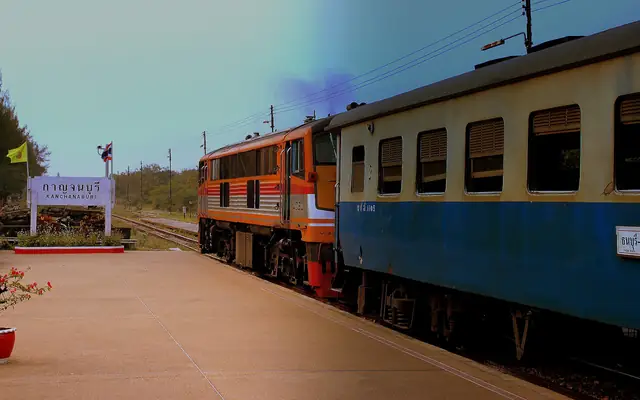 Bangkok to KanchanaburiBus, van, train and taxi compared
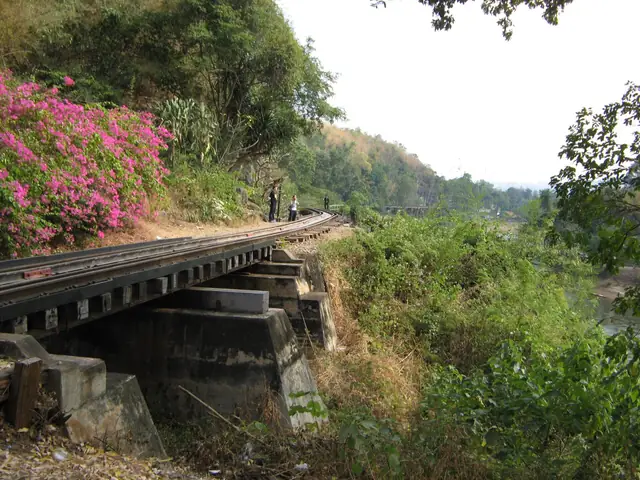 Getting around KanchanaburiScooter, taxi, songthaew and train
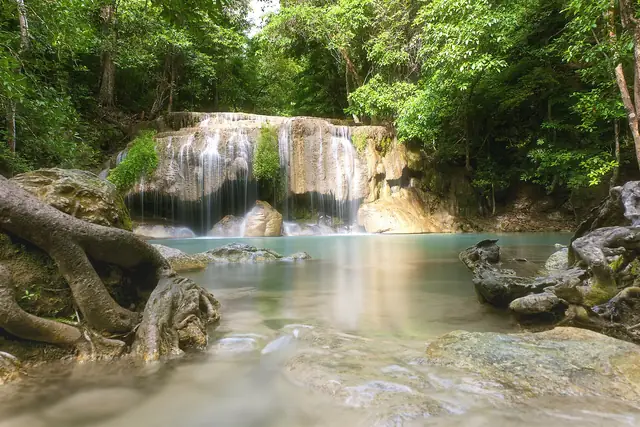 Erawan FallsFees, hours, the 7 tiers and how to go
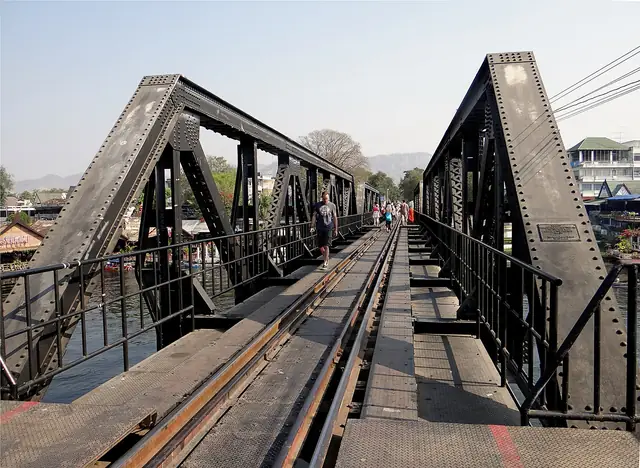 River Kwai BridgeHow to walk it, ride it and when to go
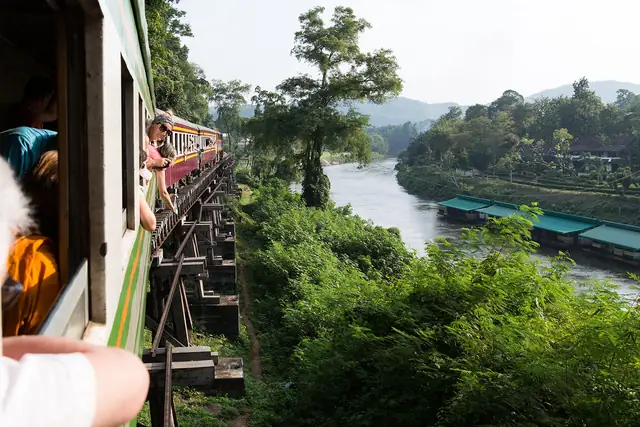 The Death RailwayTimetable, fares and Tham Krasae
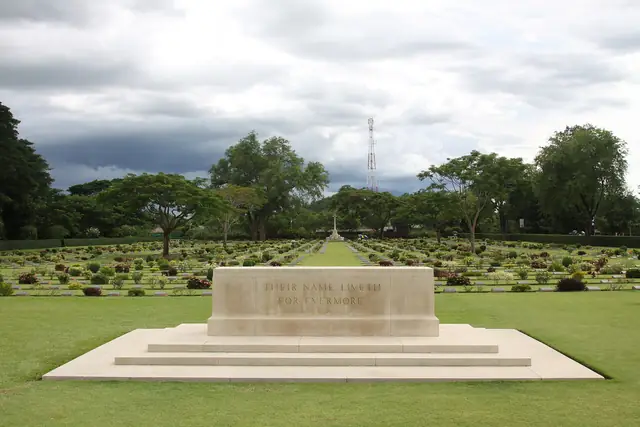 War cemetery and museumsDon Rak, JEATH and the Railway Centre
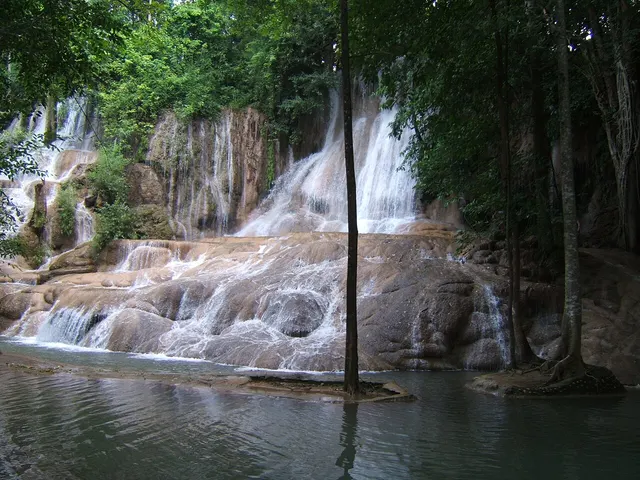 Sai Yok Noi waterfallBy Nam Tok station, not the same as Sai Yok Yai
 Elephant sanctuariesHow to choose one and what to ask