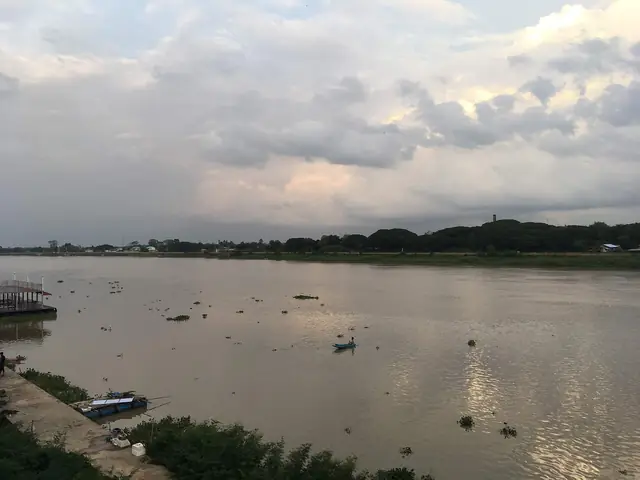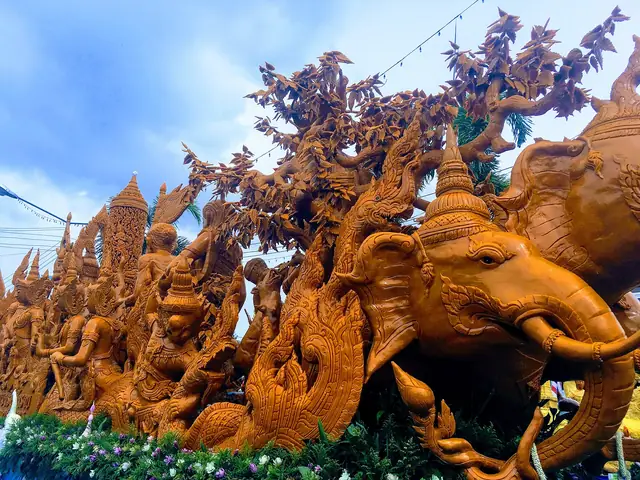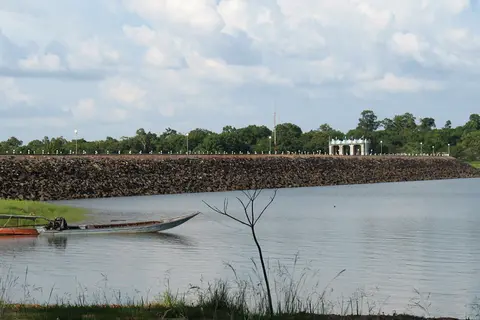
This page covers the sights outside the Khong Chiam and city routes that are worth a spare day or two. They include the reservoir and floating solar plant at Sirindhorn Dam, a temple that glows after dark, the Chong Mek crossing on the way to Pakse, natural sights such as Huai Luang waterfall and the Kaeng Saphue rapids, and an ancient Khmer ruin, Prasat Ban Ben.
If you have not chosen your trip yet, read Ubon Ratchathani in 2 days and 1 night, and for the eastern side see Khong Chiam and Pha Taem. Distances, hours and fees on this page are approximate, so confirm them with the site before you set out.
We earn a commission if you book through our links. The price you pay does not change. How we choose
Sirindhorn and the south in one minute
| Best for | Travellers with a car who like reservoir views, waterfalls, a temple that glows after dark, or a side trip into Laos at Pakse, and who have one or two spare days outside Ubon city. |
|---|---|
| Main sights | Sirindhorn Dam, Wat Sirindhorn Wararam Phu Phrao, Chong Mek, Phu Chong Na Yoi National Park and Huai Luang waterfall, Prasat Ban Ben, Kaeng Saphue. |
| Distances from the city | Kaeng Saphue about 45 km, Prasat Ban Ben about 63 km, Sirindhorn Dam about 70 km, the glowing temple and Chong Mek about 90 km, Phu Chong Na Yoi about 120 km, which is about 2 hours of driving. |
| Best season | The temple works all year and glows best in full dark. Huai Luang from about August to February, Kaeng Saphue from about January to May, Prasat Ban Ben all year but early or late in the day. |
| Fees | Phu Chong Na Yoi about 40 baht for a Thai adult and about 200 baht for a foreign adult (children about 20 and 100 baht). The glowing temple, Prasat Ban Ben and Kaeng Saphue are free. |
| How to get there | No direct public bus to Phu Chong Na Yoi or Prasat Ban Ben. Rent a car or hire a driver. The cross-border bus to Pakse passes through Chong Mek. |
| Time to allow | Half an afternoon and evening for the Sirindhorn side, a full day for Phu Chong Na Yoi, half a day each for Kaeng Saphue and Prasat Ban Ben, and one night in Pakse. |
| Where to base yourself | Near Sirindhorn for the dam and the temple, Phibun Mangsahan for Kaeng Saphue. Phu Chong Na Yoi is a return trip from Sirindhorn or the city. |
Do not combine Phu Chong Na Yoi and Kaeng Saphue in one day. They lie in different directions, and Huai Luang needs time for about 273 steps down and the climb back.
Six sights compared: distance, hours and best months
Use this table to choose a side before you plan the day. Figures are approximate, so confirm hours and fees with the site before you set out.
| Sight | From the city | Hours and fee | Best months |
|---|---|---|---|
| Sirindhorn Dam | About 70 km, about 1 hour 15 to 1 hour 30 minutes | About 06:00 to 18:00; confirm fees at each viewpoint | All year, best late afternoon to dusk |
| Glowing temple | About 90 km, about 1 hour 30 minutes, near Chong Mek | About 06:00 to 20:00 or 21:00; free | All year, glows after about 18:30 |
| Chong Mek | About 90 km | Thai side closes about 20:00 | All year, crossing is easiest in the morning |
| Phu Chong Na Yoi, Huai Luang | About 120 km, about 2 hours | 08:30 to 16:30; about 40 baht Thai, about 200 baht foreign | About August to February |
| Prasat Ban Ben | About 63 km, about 1 hour 15 minutes | Normally free | All year, early or late |
| Kaeng Saphue | About 45 km, about 1 hour | Free, no fixed hours | About January to May |
The Sirindhorn side (dam, temple, Chong Mek) lies on one road, so it fits an afternoon and evening. Phu Chong Na Yoi, Prasat Ban Ben and Kaeng Saphue lie in different directions, so each deserves its own trip.
A car helps more here than anywhere else around Ubon. Distances are long, the sights are scattered, and do not count on a public bus back to the city from the temple in the evening. You can collect a rental car at Ubon airport and head south straight away.
 Klook
Ubon Ratchathani Province Car Rental
From US$37.09 (Starting price per day, compact car, as of 13 Nov 2026)
Price as of 13 Nov 2026Rent a car at Ubon airport or another pick-up point of your choice. It suits the dam and the glowing temple at dusk. The price starts at about US$37.09 a day for a compact car for pick-up on 18 to 21 Nov 2026, as of 13 Nov 2026, and changes with the date and the car. Check the driver age and the deposit on the booking page.
Book on KlookSirindhorn Dam and the floating solar plant
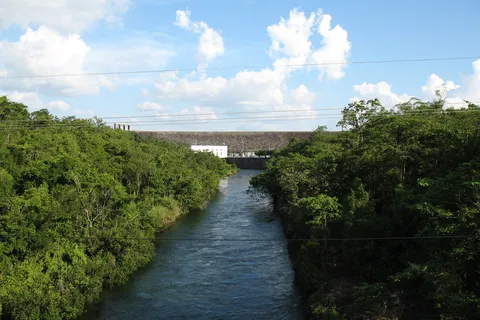
Sirindhorn Dam is in Sirindhorn district, about 70 km from Ubon city. It was built across the Lam Dom Noi, a tributary of the Mun River. It is a rock-fill dam with a clay core, 42 m high and 940 m long, and the reservoir covers about 288 square kilometres. It serves power, irrigation, fishing and tourism.
Construction began in June 1968, the foundation stone was laid on 2 February 1969 and the dam opened on 27 November 1971. EGAT, the operator, can be reached on 0 4536 6081 to 3. The site is open daily about 06:00 to 18:00.
The 45 MW floating solar plant
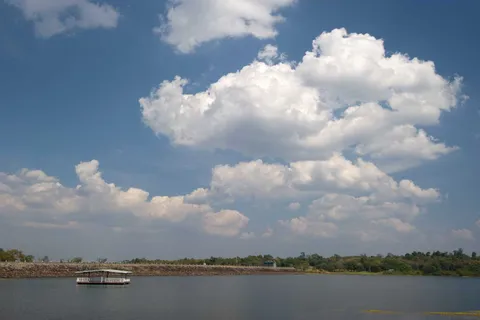
What sets the dam apart is a floating solar plant combined with hydropower. It is about 45 MW and began feeding the grid commercially on 31 October 2021. The panels make power from daylight, and at night or when the sun is not out the dam's own hydropower can fill in, so the floating panels pair with the plant that is already there.
You do not need to care about energy to enjoy it. The reservoir is wide, the dam crest and hills fill the far side, and floating raft restaurants on the reservoir serve fish.
The glass walkway on the dam
A glass walkway of more than 415 m runs along the dam bank through a garden of native Ubon plants with the floating solar panels in view. Near the dam crest there is also Sirindhorn Park, a public park open since 1991. Hours and the open or closed status of the walkway and each viewpoint can change, so phone EGAT before a long drive, especially on weekdays and after heavy rain.
- Go in late afternoon to dusk. The light is good and it is cooler. Midday in the hot season is harsh on the open reservoir.
- If you eat at a raft restaurant, ask the menu prices and how the bill is worked out before you order, and leave time to drive back before dark. Roads outside the city have few lights.
- Bring a hat, sunscreen and water. The crest is open and the wind is strong at times.
- The dam is on the same road as Chong Mek and the glowing temple. Spend 1 to 2 hours here, then reach the temple before dusk.
Stay near the dam
The dam has bungalows, a restaurant, a cafe and a community goods shop. Private places around Sirindhorn also save you the dark drive back to the city. If you plan to see the reservoir in the evening and then go on to the glowing temple, one night here is easier than a same-day round trip. Check rooms and breakfast terms on the booking page before you decide.
Kaysorn Siri
Sirindhorn, near Sirindhorn Dam
A stay in Sirindhorn near the dam. It suits travellers who want an evening at the reservoir and the glowing temple at night without driving back to Ubon in the dark. Check rooms and prices on Agoda.
See prices and availability on the booking page
Suan Rim Khuean Resort
Sirindhorn, near Sirindhorn Dam
A second option near Sirindhorn Dam, useful if you want to compare prices and cancellation terms before booking. Check rooms on Agoda.
See prices and availability on the booking page
The glowing temple, Wat Phu Phrao, is on the same road
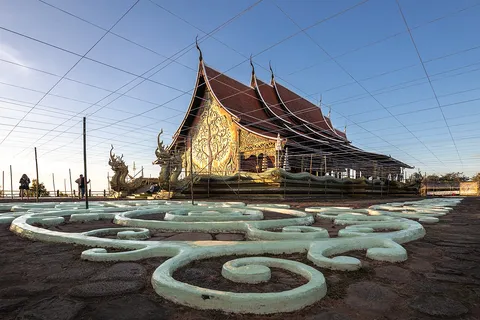
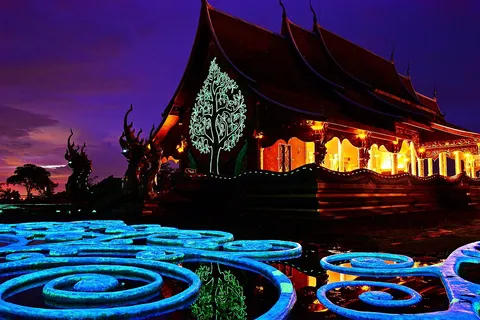
Wat Sirindhorn Wararam Phu Phrao, the glowing temple, stands on the top of Phu Phrao hill in Chong Mek subdistrict, Sirindhorn district, near the Chong Mek checkpoint and on the same side as the dam. By car it is about 1 hour 30 minutes from Ubon city. For photography tips and how to get back to town at night, see the glowing temple, Wat Phu Phrao on the city and temples page. This page covers the history, the temple itself and how to fit it into a day with the dam.
A temple that was abandoned and came back
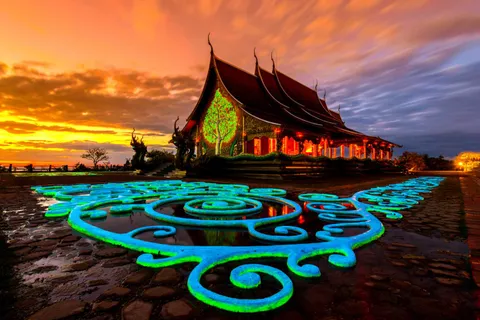
The temple was founded around 1973 by Phra Ajarn Bunmak, a monk from Champasak in Laos. It was later abandoned and stood empty for decades. In 1999 Phra Khru Kamon found it again and restored it as a meditation place. After Phra Khru Kamon died in 2006, Phra Khru Panya continued the work, including the glowing tree painting and the decoration of the ordination hall.
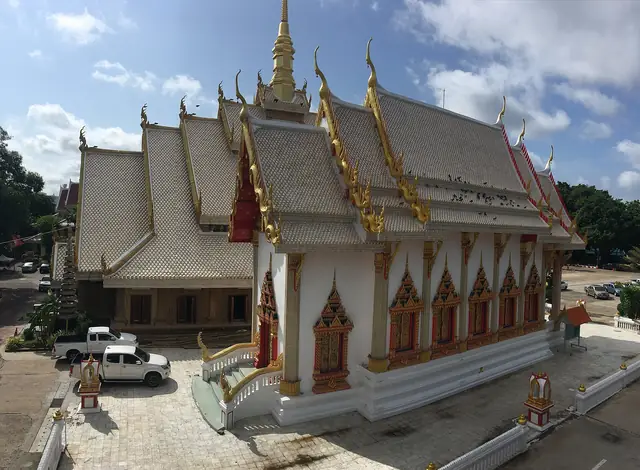
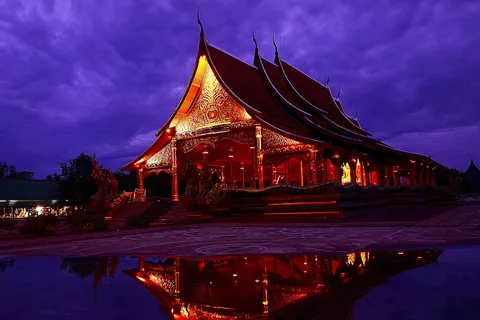
The ordination hall is Lan Xang in style and copies Wat Xieng Thong in Luang Prabang, Laos, but is larger, about twice as long. It mixes Khmer touches with Isan craftsmanship, with nagas along the stairs and a golden tree on the gable.
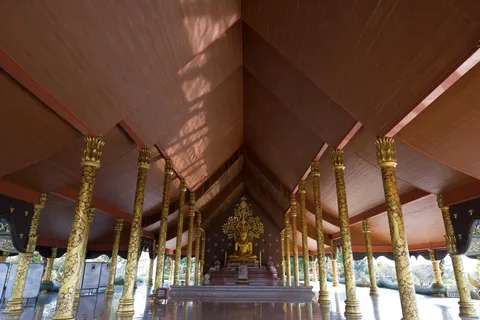
If you arrive in daylight, do not be disappointed that nothing glows yet. Walk round the hall, look at the gilded pillars and timber roof, and enjoy the view from the hilltop, which takes in the Chong Mek checkpoint, the Sirindhorn reservoir and ranges of hills beyond. This is still a working meditation temple, so dress modestly, speak quietly and stay out of areas that are closed off.
What glows, and when
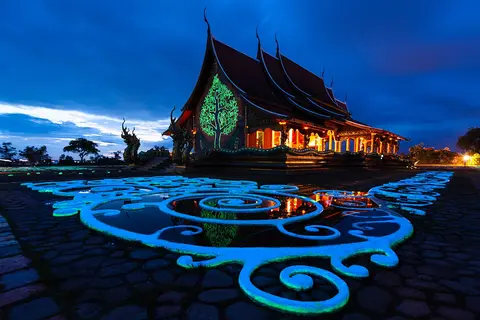
The glow comes from the carved tree in relief on the back wall of the hall, a kalpaphruk or wishing tree, and from patterns on the courtyard around it. Both are painted with a phosphor paint that soaks up daylight and releases it in the dark. The tree glows green and the courtyard patterns glow green to blue. How strong it looks depends on how dark it is, so a clear night beats a thick cloudy one.
- The usual viewing window is about 18:00 to 20:00, and the glow becomes clear from about 18:30 as the sky darkens.
- Turn off flash and do not shine a torch on the paint. Use night mode on your phone and rest it on a tripod or railing.
- For the strongest effect, wait until the sky is fully dark. Do not leave while it is still twilight.
- On rainy or heavily clouded evenings the glow can be fainter. If the sky does not help, photograph the hall and the sunset view instead.
Fitting the dam and the temple into one day
| Approximate time | What to do | Notes |
|---|---|---|
| 12:30 to 13:00 | Leave Ubon city | Highway 217 is the main road to Chong Mek |
| 14:00 to 14:30 | Arrive at Sirindhorn Dam, walk the crest and look at the reservoir | Phone EGAT first to ask whether the glass walkway is open |
| 16:30 to 17:00 | A snack or light dinner by the reservoir | Ask prices before you order |
| 17:15 to 17:30 | Drive up to the temple, park and see the hall in daylight | You see it both lit and dark |
| 18:00 to 19:30 | Watch the sunset and wait for the glow to rise | Wear a thin modest layer, as the hilltop is cooler |
| 19:30 to 20:00 | Drive down and head back, or go to your room | Roads are dim at night, so drive slowly |
Before you go up
- Entry is free. It opens about 06:00 to 20:00 or 21:00, so check before you go.
- The road up is paved and a normal car can climb it. There is a large car park, and older visitors can drive up close to the hall and walk only a few steps.
- Dress modestly. Light colours photograph well. It is cooler on the hilltop than below, so bring a thin layer.
- If you want to shoot the Milky Way or set up a camera for a long time, ask the temple first.
- Hold small children's hands near the stone courtyard and the stairs. The ground is uneven and it gets dark quickly.
Bamboo Resort Chong Mek
Sirindhorn, Chong Mek area
A stay in the Chong Mek area of Sirindhorn district. It suits travellers who stay for the glow after dark and sleep close by instead of driving back to Ubon. Check rooms on Agoda.
See prices and availability on the booking page
Chong Mek: the permanent land crossing to Laos
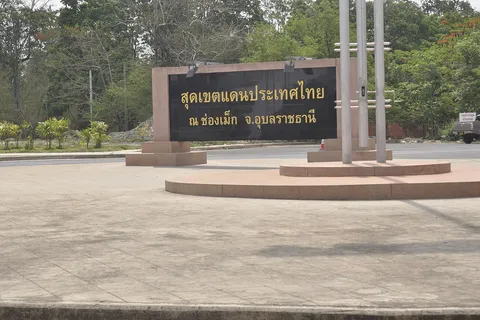
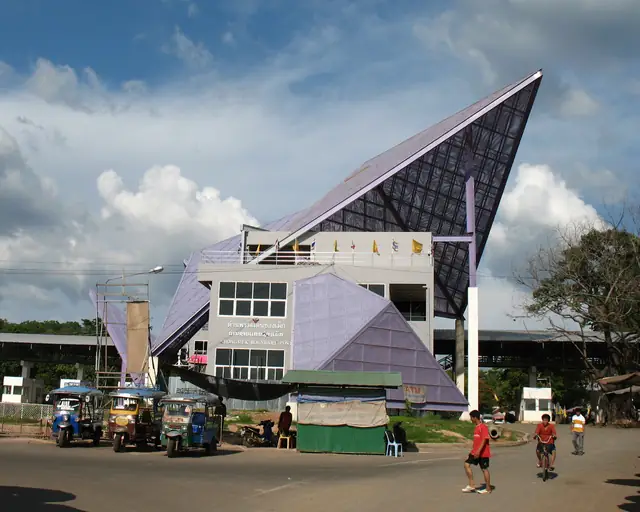
Chong Mek is in Sirindhorn district, about 90 km from Ubon city on Highway 217, which takes about 1 hour 30 minutes to 2 hours. It is the permanent land crossing from Ubon Ratchathani into Laos. Across the line is the Lao post of Vang Tao, and beyond it the city of Pakse. The Thai side closes about 20:00. Check the opening time in the morning with the post before you go.
Most people pass through Chong Mek to reach Pakse, but you can also stop without crossing. Take a photo at the sign for the end of Thai territory, watch trucks and the cross-border bus come and go, and eat nearby before or after the glowing temple. It is a trade post too, with fuel and goods going out and cassava, coffee and electricity coming in.
- If you do not cross, 30 to 45 minutes at the post is enough.
- You can take photos from the plaza beside the checkpoint, but stay out of restricted areas and follow the officers.
- If you plan to cross, read the steps and fees at crossing Chong Mek to Pakse and the Pakse plan below.
- For another view of Chong Mek, see Chong Mek on the Khong Chiam and Pha Taem page.
 12Go
Ubon Ratchathani to Pakse on 12Go
From US$8 (Starting price for the bus)
Price as of 6 Nov 2026The cross-border bus from Ubon bus station through Chong Mek to Pakse costs from about US$8 on the example date 12 Nov 2026, and a sedan taxi is about US$90 per car, as of 6 Nov 2026. Times and prices change by date. The international ticket counter at Ubon bus station sells the same trip for about 200 baht. Check the latest departures before you go.
Book on 12GoUbon to Pakse via Chong Mek: can you do it in one day?
Pakse is the main city of Champasak province in southern Laos, about 40 km from the Chong Mek crossing. It is the base for Vat Phou, a World Heritage site, the Bolaven Plateau with its waterfalls and coffee farms, and Si Phan Don. The question people search most is whether you can go from Ubon to Pakse and back in a day. The short answer is yes if you hire a taxi or a car, but the cross-border bus does not suit a same-day return.
Why the bus makes a day trip hard
- The cross-border bus leaves Ubon bus station about twice a day, about 08:00 to 09:30 and about 15:00 to 15:30. With the border steps it takes about 3 to 4 hours.
- Buses back from Pakse leave about 08:30 and about 15:00 to 15:30. If you take the morning bus out, you reach Pakse around midday or early afternoon and have under two hours in town before the afternoon bus back.
- Timetables shift with season and holidays. At Songkran and New Year buses fill fast, so book several days or weeks ahead.
Three ways that work
| Option | How it works | Best for |
|---|---|---|
| Stay one night in Pakse | Take the morning bus, reach Pakse in the afternoon, see the town or Wat Phousalao, sleep, then do a Vat Phou or Bolaven tour next day and take the afternoon bus back. | Travellers who want a proper look at Laos without rushing |
| Hire a taxi or private car | Leave Ubon early, cross, see one sight and return before the post closes. A sedan taxi from Ubon to Pakse is about US$90 per car on 12Go and about 1 hour 40 minutes of driving, not counting the border. | Groups of 3 or 4 who share the cost and want one day |
| A one-day tour from a Pakse hotel | You need a hotel in Pakse first. The tour picks you up there, visits waterfalls or Vat Phou and drops you back. | Travellers who stay in Pakse and want to see Vat Phou or the Bolaven Plateau comfortably |
At the border and the visa question
- Get your exit stamp from Thailand at the Thai post.
- Walk through the underpass to the Lao post. Ask an officer or your driver if you are unsure.
- Thai and other ASEAN passport holders enter Laos visa free for about 30 days. Other nationalities get a visa on arrival at the post, about US$30 to US$40 depending on nationality. Bring clean US dollar notes and check with the Lao embassy first. The e-visa is not valid at Vang Tao.
- Lao officers sometimes ask for an out of hours or stamp fee of about 100 to 200 baht. Keep small 100 baht notes.
- The through bus waits for passengers and continues to Pakse. It stops at a bus terminal, and you take a sam-lor into town. Agree the price before you get in.
Visitors on a Thai visa exemption may face a limit on repeated land entries each year. The rule changes, so check with Thai immigration before you cross both ways.
What to see in Pakse
- Vat Phou, a World Heritage site, about 43 km south of Pakse. Allow most of a day.
- The Bolaven Plateau with the waterfalls of Tad Fane and Tad Ngueang and coffee farms, about 25 km southeast of Pakse.
- Si Phan Don, the Four Thousand Islands, about 150 km south and under 3 hours away. It suits a stay of several nights.
- The big Buddha at Wat Phousalao, with about 300 steps up to a view of the city and the Mekong.
The Lao currency is the kip, and its value moves a lot. ATMs can charge fees or run out of cash, so carry spare baht to use before and after the crossing.
If you buy a tour, pick by the sight you most want. The options below leave from a hotel in Pakse. Prices change with the date and the option you choose, so check them on the booking page before you decide.
Photos, prices and reviews from Klook
A one-day tour from a hotel in Pakse in English, about 8 hours, with Tad Ngueang waterfall, Tad Fane waterfall with its two streams, a Lao lunch, Vat Phou and a view of Pakse and the Mekong from Wat Phou Salao. Starting price about US$69.89 per person as of 13 Nov 2026, and it changes with the date and the tour type.
Book on Klook| KKday tour | Highlights | Starting price per adult as of 13 Nov 2026 | Book |
|---|---|---|---|
| Bolaven Plateau, pick-up from a Pakse hotel | Tad Fane waterfall, a coffee co-op, a cafe, a blacksmith village; 7 to 8 hours | About US$103, join-in option | Book on KKday |
| Vat Phou and Hong Nang Sida (Pakse or Champasak pick-up) | Vat Phou, Hong Nang Sida, Wat Phousalao; 7 to 8 hours | About US$89, join-in option | Book on KKday |
| Private Vat Phou tour with an English guide | Vat Phou for 2 hours, Hong Nang Sida, Wat Phousalao; starts 08:00 | About US$160 | Book on KKday |
| Vat Phou, Nasinda ruins and Dao Huan market | Vat Phou and museum, old ruins, lunch; suits ages 12 and up | About US$193 | Book on KKday |
| Khone Phapheng waterfall and dolphin boat ride | Waterfall, boat ride, market, lunch and dinner; suits ages 6 and up | About US$230 | Book on KKday |
You can also stay online in Laos with an eSIM that covers the whole country. Check that your phone supports eSIM before you buy.
| SIM and data | Highlights | Price | Book |
|---|---|---|---|
| LaoTel eSIM for all of Laos | 5G and 4G data only, no calls. The QR code arrives right after booking, and you choose the days and data yourself | Depends on the package you choose | Book on Klook |
Phu Chong Na Yoi National Park
Phu Chong Na Yoi is at the far south of the province, beside the Laos and Cambodia borders, in the Dangrek Mountains. It became a national park in 1987 and covers about 428,750 rai across parts of Buntharik, Na Chaluai and Nam Yuen districts. The forest where the three countries meet is often called the Emerald Triangle.
It is about 120 km from Ubon city and takes about 2 hours by car. The roads are highways and district roads and are not hard, but the distance is long and there is almost no public bus. The park office is open daily about 08:30 to 16:30, and you can ask there whether the sights are open. After paying, keep your ticket with you while you are in the park.
Fees and vehicle charges
| Group | Adult | Child |
|---|---|---|
| Thai | About 40 baht | About 20 baht |
| Foreign | About 200 baht | About 100 baht |
| Car | About 30 baht per car | None |
| Motorbike | About 20 baht per bike | None |
As an example, a Thai family of two adults and two children in their own car pays about 150 baht at the gate. A foreign family of the same size pays about 630 baht. These figures follow the current schedule, but rules and the ticket system can change, so check at the gate before you pay.
What else is in the park besides Huai Luang
- Kaeng Silathip, a sandstone terrace with round potholes worn by water. It is not a waterfall.
- Phlan Yao rock garden, a spread of oddly shaped boulders over a wide area.
- Phu Hin Dang, a viewpoint that looks toward Laos and Cambodia.
- Koeng Mae Phong waterfall, which needs a long walk of about 9 km on a nature trail.
- The park has more waterfalls and rapids. Ask the rangers which of them you can reach on the day.
The park has forest walks, camping and bungalows. If you want to stay in the park, phone ahead about rooms and the booking rules and do not plan to find a bed on arrival.
- Allow at least half a day in the park. If you go down to Huai Luang and walk back, allow about 3 hours or more.
- Leave the city before 07:00 and you arrive when the park opens and avoid hurrying in the afternoon.
- There may be restaurants and stalls near the waterfall entrance. Hours vary by season, so carry water and snacks.
- Without a car, hire a car with a driver for the day from the city or rent a car. There is no direct public bus to the park.
- The dense forest is home to wild animals. Stay on the paths, do not feed animals and take your rubbish with you.
 Klook
Ubon Ratchathani Province Car Rental
From US$37.09 (Starting price per day, compact car, as of 13 Nov 2026)
Price as of 13 Nov 2026Phu Chong Na Yoi has no direct public bus. Rent a car at Ubon airport and drive yourself. From about US$37.09 a day for a compact car, as of 13 Nov 2026, and the price changes with the date and the car. Allow for fuel on a round trip of about 240 km.
Book on KlookHuai Luang (Bak Teo) waterfall and the other rapids
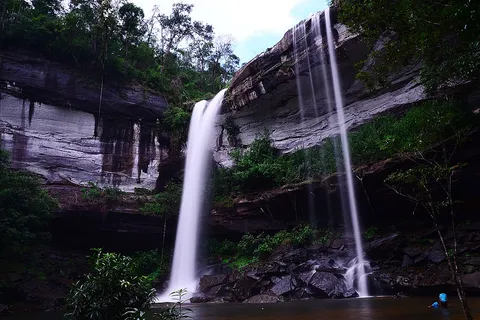
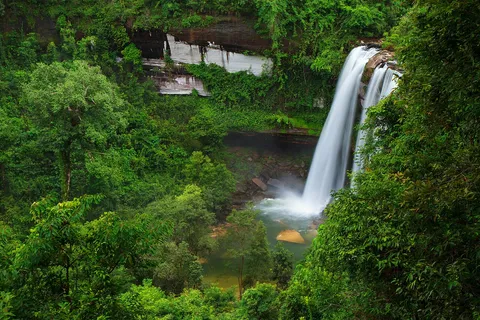
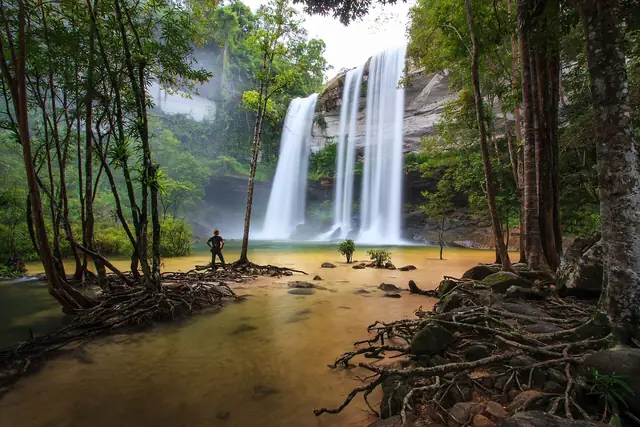
Huai Luang, also called Bak Teo Cave Waterfall, is in Na Chaluai district and is the park's main sight. The large fall drops in three steps, a white curtain in green forest, into an emerald pool below and a broad rock terrace. The way down from the visitor area is a stairway of about 273 steps, easy down and slow up.
You climb back in the heat, so carry water, go slowly and stop on the way. Older visitors, small children and anyone with sore knees should decide whether to go down or wait at the top. Wet rock is very slippery, and trainers or hiking sandals are safer than flat flip-flops. If you plan to swim, carry sandals and change at the water.
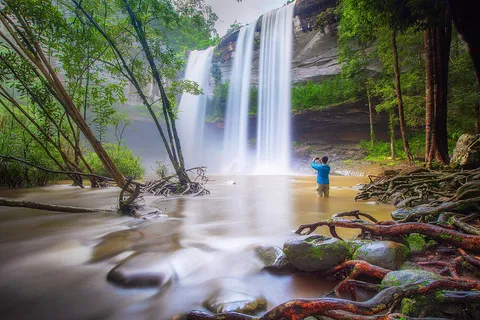
You can swim when the flow is enough. From about August to December the pool is full and green. From about February the water drops and the pool looks less inviting. After heavy rain the current is strong, so do not enter if the water is brown or fast. Keep children in sight and use a life jacket if you go deep. Ubon's rain peaks in September.
| Months | Water and path | Worth going? |
|---|---|---|
| May to July | Rains begin and water builds, paths are slippery, forest turns green | Yes, if heavy rain is not forecast; watch slippery rock |
| August to October | Fullest and strongest water, fast current after rain | The best looking, but check the current and the sky |
| November to February | Still enough water, cool air, dry path | The period most visitors choose |
| March to April | Low water, very hot, steps in the sun are tiring | Fine if you do not plan to swim; go early |
Do not mix this up with the falls on the Khong Chiam side. Soi Sawan and Saeng Chan waterfalls are near Pha Taem, covered under waterfalls at Khong Chiam, and are far from Huai Luang.
If you know the climb will tire you, go down mid-morning to noon while the sun is still lower than in late afternoon, then eat at the stall at the top before you climb.
Prasat Ban Ben: a Khmer sanctuary in the rice fields
Prasat Ban Ben is in Nong O subdistrict, Thung Si Udom district, about 63 km from Ubon city. The Fine Arts Department dates it from the carving style of the lintels to about the late 10th to the 11th century, the Baphuon period of Khmer art. It is a Hindu sanctuary with three brick prang in a north to south row on a shared laterite and sandstone base. They face east through a single gateway and a low stone wall encloses them.
Two important lintels from the site show Indra on the elephant Erawan and the Nine Celestial Guardians. They were moved to the Ubon Ratchathani National Museum, so what remains at the site is mostly brick structure rather than carved decoration. Visiting the museum first helps the ruin make sense. See the museum in Ubon. If you like Khmer ruins, Sisaket is about 66 km from Ubon city. See Sisaket.
Entry is normally free. It is an open site with no direct public bus. The area is open farmland with little shade, and the ground around the brick bases is uneven. Bring water and a hat. Allow about 30 to 45 minutes. If you want to meet a caretaker, go in office hours and check before you go.
To see the actual lintels, go to the city museum on a Wednesday to Sunday. At Prasat Ban Ben you come for the brick proportions and the quiet fields.
- Go early or late. Low light shows the brick surface and the sun is gentler.
- Wear closed shoes, since broken brick and stone can cut.
- Do not climb on the ruin and do not take bricks away.
- Children can come, but stay close because the brick bases are uneven.
Kaeng Saphue at Phibun Mangsahan
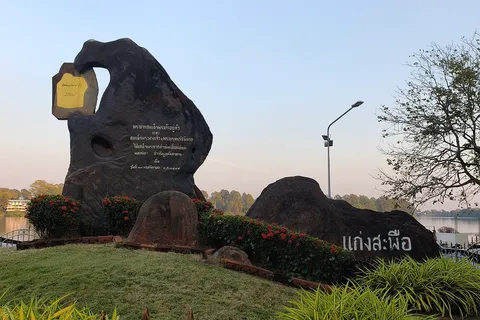
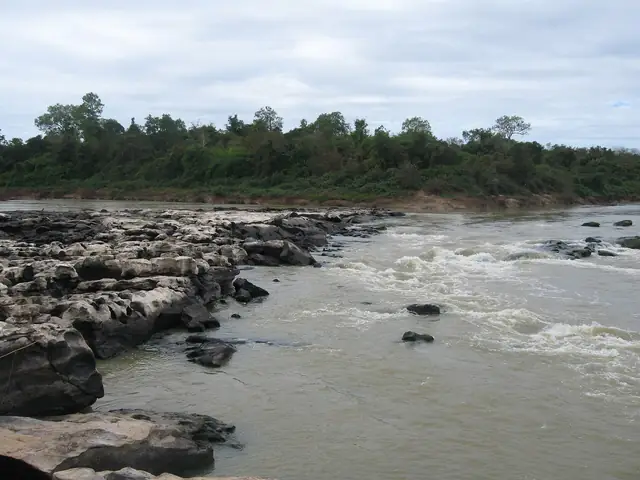
Kaeng Saphue is a stretch of rapids on the Mun River in Phibun Mangsahan district, about 45 km east of Ubon city on Highway 217. The name comes from the Kuy language and means the big snake rapid, and locals say a naga guards it. When the river drops, from about January to May, sandstone rises out of the water as a long line of rapids, and the current has worn hollows in the rock. April is often the busiest month because of the Songkran celebrations at the rapids. In the rainy season the rocks are under water.
Near the car park stalls sell souvenirs and food such as grilled river fish and sticky rice. Only swim in channels that locals say are safe, because the current in the middle of the rapids is strong and is not for swimming. Wear a life jacket if one is available.
A memorial stone marks the visit of the King and Queen on 17 November 1955. Entry is free and there are no fixed hours. It is an open public riverbank.
- Go in the morning, about 08:00 to 10:00. The light is good and the sun is not yet hot on bare rock.
- Bring a hat, water and shoes that grip rock. Flip-flops slip on wet stone.
- On Songkran days in April it is crowded and noisy. For a quieter visit, pick a weekday or go in February or March.
- Allow 1 to 2 hours, then eat in Phibun or continue to Khong Chiam. See Khong Chiam and Pha Taem.
Many visitors continue to a riverside stay in Phibun Mangsahan. See the overview of stays there at where to stay in Phibun Mangsahan.

Bluemoon Riverside Resort
Phibun Mangsahan, on the Mun River
A stay on the Mun River in Phibun Mangsahan district, east of the city on the way to Khong Chiam. Useful if you visit Kaeng Saphue or break the trip without driving back into town. Check rooms and breakfast terms on Agoda or Trip.com.
See prices and availability on the booking page
Rimkuan Lakeview
Phibun Mangsahan
A stay in Phibun Mangsahan district, closer to Kaeng Saphue than a room in the city. Good if you plan to go early to avoid the heat. Compare prices with the riverside option above on the booking page. Check rooms on Agoda.
See prices and availability on the booking page
When to go south: month by month
Ubon is hottest from March to May. The average monthly high is about 35 to 37 degrees, and April has recorded about 43 degrees. Heavy rain runs from about May to October, and from July to September each month brings more than 290 mm. December and January are cool in the morning and at night, with lows around 18 degrees in the city, and it is cooler still on hills and in the forest.
| Months | Weather | Best southern sights |
|---|---|---|
| November to February | Cool, dry, clear skies | Everything. The temple glow is clear, Huai Luang still has water, and Kaeng Saphue begins to show late in the period |
| March to May | Very hot; rain starts late April to May | Kaeng Saphue, the dam late in the day and the temple at dusk. Avoid midday sun |
| June to September | Afternoon to evening rain, green forest, strong waterfalls | Huai Luang if you go in the morning before the rain; quiet dam; Kaeng Saphue under water |
| October | End of the rains, skies clearing | Huai Luang is full, and every sight improves toward the end of the month |
Events to know about. April brings Songkran at Kaeng Saphue, with big crowds and slow roads around Phibun. July is the Ubon candle festival and rooms in the city fill early, so book ahead if you want the Sirindhorn side then. See the Ubon candle festival.
What to do on a rainy day
- Huai Luang in the rains is full and beautiful, but wet steps are slippery. Skip swimming in heavy rain or thunder.
- The dam and the temple are still possible if the rain stops. The sky after rain often makes a fine dusk, though the glow may be fainter.
- If it rains all day, switch to the Ubon Ratchathani National Museum (open Wednesday to Sunday, 09:00 to 16:00) or spend the day eating in town. See food in the city.
- Prasat Ban Ben is slippery and muddy after rain, so keep that visit short.
Plans for 1, 2 and 3 days, with and without a car
The south of Ubon does not suit cramming everything into one day. Choose a side first. The plans below assume a car. If you have no car, see the next section.
One day: the Sirindhorn side, afternoon to evening
- Leave Ubon about 12:30 for Sirindhorn Dam.
- Walk the dam crest and see the reservoir for about 1 hour 30 minutes, with a light snack by the water.
- Drive up to the glowing temple about 17:15, see the hall in daylight and wait for dusk.
- Stay for the glow from about 18:30 to 19:30, then drive back or stay near Sirindhorn.
One day: Phu Chong Na Yoi
- Leave the city before 07:00 and reach the park about 09:00. Buy tickets and head to Huai Luang.
- Walk down the 273 steps about 09:30 and swim or take photos for about 1 hour 30 minutes.
- Climb back slowly before noon and eat at the stall at the entrance.
- In the afternoon, stop at Kaeng Silathip or another viewpoint if you have energy, then drive back before dark.
Two days, one night: Sirindhorn and Phu Chong Na Yoi
| Day | Order | Where to sleep |
|---|---|---|
| Day 1 | Leave Ubon around midday for the dam, go up to the temple at dusk and see the glow | Near Sirindhorn or Chong Mek |
| Day 2 | Leave early for Phu Chong Na Yoi, swim at Huai Luang, lunch, and drive back to the city in late afternoon | Back in Ubon or stay on |
Three days, two nights: every sight
- Day 1: Kaeng Saphue and Phibun Mangsahan in the morning, then on to Khong Chiam or back to town. Sleep in Phibun or the city.
- Day 2: the Sirindhorn side, with the dam and the temple. Sleep near Sirindhorn.
- Day 3: Phu Chong Na Yoi in the morning, then Prasat Ban Ben in the afternoon on the way back if it suits, or the museum in town.
Combining the stops in one or two days
The table sums up the distance and time for each plan. Figures are approximate.
| Plan | Order | Approximate drive | Notes |
|---|---|---|---|
| One day to the southeast | City, Prasat Ban Ben, back | About 63 km, about 1 hour 15 minutes each way | A half-day ruin visit that pairs well with the museum |
| One day to Phibun | City, Kaeng Saphue, Phibun Mangsahan, back | About 45 km, about 1 hour each way | Go in the low-water season, January to May, and leave early to avoid the heat |
| One day to Chong Mek | City, Sirindhorn Dam, Chong Mek, glowing temple at dusk | About 90 km, about 1 hour 30 minutes | Leave after lunch, return in the evening |
| Two days to the far south | Day 1 city to Na Chaluai and sleep near the park, day 2 Huai Luang, then back | About 120 km each way | Do not combine with Sirindhorn in the same day. Book a stay outside the city |
Can you do it without a car?
You can reach some of it, but it is less convenient than with a car. There is no direct public bus to Phu Chong Na Yoi or Prasat Ban Ben, and in the evening do not count on transport back to the city from the glowing temple. These are the options that work in practice.
| Option | How it works | Watch out for |
|---|---|---|
| Taxi from the airport | The counters at the airport sell fixed price coupons. A coupon to Chong Mek is about 1,000 baht per car. Check before you pay. | Agree that the driver waits and brings you back in the evening, or you may be stuck |
| Hire a taxi or van by the day | Agree the price before you set out. It works for the dam and the temple. | Ask whether the price includes fuel, waiting time and the return |
| The cross-border bus through Chong Mek | It runs on the same road as the dam and the temple but is not built for sightseeing. | Ask at the bus station whether you can get off midway and whether there is a bus back |
| Rent a car and drive | The most flexible way. You can time the day to the weather and the light. | The driver needs a valid licence. Check the age limit and the deposit |
For groups of three or four, hiring a car for the day is often cheaper than buying separate tickets, and you set your own timing. If you are alone and do not want to drive, do only the Sirindhorn side in the afternoon and evening and sleep nearby.
 Klook
Ubon Ratchathani Province Car Rental
From US$37.09 (Starting price per day, compact car, as of 13 Nov 2026)
Price as of 13 Nov 2026If you do not want to depend on a taxi back at night, rent a car at Ubon airport and drive yourself. From about US$37.09 a day, as of 13 Nov 2026.
Book on Klook 12Go
Bangkok to Ubon Ratchathani on 12Go
From US$7 (Cheapest fare seen, a bus)
Price as of 6 Nov 2026Coming from Bangkok? There are buses, trains and flights to Ubon. See the latest times and prices on 12Go, then pick up a rental car or taxi to go south. Prices change by date.
Book on 12GoBudget and costs with a known price
Entry to the south is cheap, and several sights are free. The main costs are the car, fuel and a bed. For meals and rooms, check the latest price when you book.
| Item | Approximate price | Note |
|---|---|---|
| Phu Chong Na Yoi, Thai visitors | About 40 baht adult, 20 baht child | Plus about 30 baht for a car |
| Phu Chong Na Yoi, foreign visitors | About 200 baht adult, 100 baht child | Plus about 30 baht for a car |
| Glowing temple, Prasat Ban Ben, Kaeng Saphue | Free | Parking and food cost extra |
| Compact rental car | From about US$37.09 a day | As of 13 Nov 2026, fuel not included |
| Ubon to Pakse bus | From about US$8, or about 200 baht at the bus station counter | Depends on the seller and the date |
| Taxi from Ubon to Pakse | About US$90 per sedan | Share among 3 or 4 people |
| One-day tour in Pakse | From about US$69.89 to US$230 per person | Depends on the programme and the date |
As an example, one day on the Sirindhorn side for two people in a rental car costs the car, which starts at about US$37.09, no entry fees, about 180 km of fuel for the round trip and whatever you eat. A day without a night away stays modest. If you sleep near Sirindhorn, add the room price you see when you book.
With children and older travellers
- Sirindhorn Dam: the crest walk is flat and works for children and older visitors. Bring a hat and water because shade is scarce.
- The glowing temple: a car reaches the car park near the hall, so there is little walking. Go slowly after dark because the ground is uneven.
- Huai Luang: 273 steps. Older visitors and anyone with knee trouble can enjoy the view from the top, and not everyone needs to go down.
- Prasat Ban Ben: a short visit on level ground. Children can run, but keep them close.
- Kaeng Saphue: only wade in channels that locals say are safe. Small children need an adult with them all the time.
- On a long drive with small children, stop every 1 to 2 hours and carry snacks.
If your group includes an older traveller, do the Sirindhorn side for half a day and sleep nearby. Then do Huai Luang another day, only with those who can walk the steps.
What to eat on the way
The south is roadside and sightseeing food rather than a district of famous restaurants. What you most often find is fish on rafts at Sirindhorn reservoir, restaurants and stalls at the entrance to Huai Luang, and grilled Mun River fish with sticky rice at Kaeng Saphue. Ask prices before you order and carry cash everywhere.
- Rafts on the Sirindhorn reservoir: fish and Isan dishes. Ask the price and how the bill is calculated.
- The restaurant at the Huai Luang entrance: eat before you climb the steps back.
- Grilled fish and sticky rice at the stalls by the Kaeng Saphue car park.
- For a proper meal before or after the trip, eat in Ubon city. See food in the city.
Common mistakes
- Visiting Kaeng Saphue in the rainy season and finding only a brown river. Go from January to May.
- Giving Huai Luang too little time. You walk down 273 steps and have to come back up.
- Expecting carvings at Prasat Ban Ben. The lintels are in the city museum.
- Expecting fixed opening hours at every viewpoint at Sirindhorn Dam. Check before you go, because viewpoints can change status.
- Going to the glowing temple in daylight and thinking it never glows. You must wait until it is dark.
- Using flash or a torch at the temple. Switch both off.
- Thinking you can go to Pakse and back by bus in a day. There is not enough time, so stay overnight or hire a car.
- Swimming in the rapids when the water is fast or after heavy rain.
- Combining Phu Chong Na Yoi and Kaeng Saphue in one day. They lie in opposite directions.
- Booking a driver for the day without agreeing the price in advance.
Read next
 Khong Chiam and Pha TaemPha Taem, Sam Phan Bok, the two-colour river, Kaeng Tana, Chong Mek and fees
 Ubon city and templesThe glowing temple, Wat Nong Pa Phong, city wats, museum and food
 Ubon Ratchathani in 2 days and 1 nightDay by day: the city and temples or Khong Chiam and Pha Taem, plus a 3-day loop
 Getting to Ubon RatchathaniFlights, trains, buses, the Chong Mek crossing to Pakse and getting around
 Where to stay in Ubon RatchathaniThe city, Warin Chamrap and Khong Chiam riverside, with 26 hotels
 Ubon Ratchathani tours and ticketsThe Pha Taem and Sam Phan Bok tour, transfers, Bangkok tickets and a Pakse tour
Frequently asked questions
How far is Sirindhorn Dam from Ubon city?
About 70 km, around 1 hour 15 to 1 hour 30 minutes by car. It opens daily about 06:00 to 18:00. Phone EGAT on 0 4536 6081 to 3 about the glass walkway and viewpoints before you go.
How big is the floating solar plant at Sirindhorn Dam?
About 45 MW, combined with hydropower. The panels work by day and the dam's hydropower fills in at night or without sun. It started feeding the grid commercially on 31 October 2021.
What time does the glowing temple glow?
From about 18:30 as the sky darkens, with about 18:00 to 20:00 the usual window. Arrive before sunset and wait until full dark. No flash or torch. The temple opens about 06:00 to 20:00 and entry is free.
Can I visit the glowing temple in the daytime?
Yes. You will not see the glow, but you can see the Lan Xang hall, the gilded pillars, the nagas and the view over the Chong Mek checkpoint and the Sirindhorn reservoir. Wait until dark if you want the glow.
When is the best time for Huai Luang waterfall?
About August to February, when there is enough water to swim. Watch the current after heavy rain. The way down is about 273 steps.
How much is Phu Chong Na Yoi National Park?
About 40 baht for a Thai adult and 20 baht for a child, about 200 baht for a foreign adult and 100 baht for a child, about 30 baht for a car and 20 baht for a motorbike. It opens daily about 08:30 to 16:30. Check at the gate.
Can I reach Phu Chong Na Yoi without a car?
It is difficult. There is no direct public bus to the park, so hire a car with a driver or rent a car. It is about 120 km from the city and about 2 hours by road.
Is Prasat Ban Ben free?
Normally yes. It is about 63 km from the city and you need your own transport. The main lintels are on show at the Ubon Ratchathani National Museum.
When can I see the Kaeng Saphue rapids?
About January to May, when the river drops. April is often the busiest month because of Songkran. In the rains the rocks are under water. Grilled fish stalls stand near the car park.
What time does the Chong Mek border close?
The Thai side closes about 20:00. Check the opening time in the morning with the post. If you plan to cross to Pakse, aim to arrive in the morning.
Can I go from Ubon to Pakse and back in one day?
By cross-border bus it is hard, because buses back from Pakse leave about 08:30 and about 15:00 to 15:30. Stay one night in Pakse or hire a taxi and leave early. Vat Phou and the Bolaven Plateau have day tours from Pakse hotels.
Do I need a visa to cross Chong Mek into Laos?
Thai and other ASEAN passport holders enter Laos visa free for about 30 days. Other nationalities get a visa on arrival at the post, about US$30 to US$40 depending on nationality. The e-visa is not valid at Vang Tao. Check with the Lao embassy first.
Where the facts come from
- Department of National Parks: Phu Chong Na Yoi National Park
- Department of National Parks: national park entrance fee schedule
- EGAT: Sirindhorn Dam
- Thai Holiday Guide: Phu Chong Na Yoi National Park
- Thai Holiday Guide: Prasat Ban Ben
- Thai Holiday Guide: Kaeng Saphue
- Wikipedia: Phu Chong Na Yoi National Park
- Wikipedia: Chong Mek
- Wikipedia: Visa policy of Laos
- Wikivoyage: Pakse
- Bucketlistly: Bangkok and Ubon to Pakse by bus
- Wikivoyage: Ubon Ratchathani