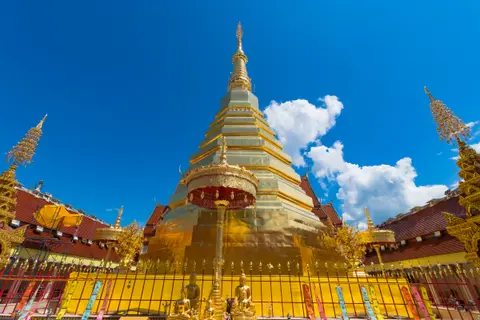
Most visitors who come to Phrae for temples end at Wat Phra That Cho Hae, and that is a fair choice: a gilded chedi 33 m high that the province treats as its anchor. But two more temples lie within 5 km of it and fit into the same morning. Phra That Chom Chaeng has a second golden chedi, and Phra That Doi Leng sits on the highest hill in the province with a view over rice fields in three districts. South of town at Den Chai, Wat Phra That Suthon Mongkhon Khiri adds an 85 m reclining Buddha and more than 30 Lanna-style chedis, an easy stop for anyone arriving by train.
This page orders the temples by distance from town and gives hours, fees, dress rules, festival timing, how to reach them without a car, and half-day and full-day routes. Hours and fees are as of 14 Nov 2026; figures that are not firm are written as about, so check with the temple before you go. For temples inside the city see Phrae old town and teak houses, for how to reach Phrae see getting to Phrae, and for a full day that mixes both see the Phrae one-day plan.
We earn a commission if you book through our links. The price you pay does not change. How we choose
Temples outside Phrae town at a glance
| Temple | Main draw | From Phrae town | Hours and fee |
|---|---|---|---|
| Wat Phra That Cho Hae | 33 m gilded chedi, Year of the Tiger shrine, cloth-wrapped base | About 9 to 10 km | 06:00 to 18:00, free |
| Wat Phra That Chom Chaeng | 29 m golden chedi, Luang Pho Chom Chaeng, large standing and reclining Buddhas | About 10 km (2 km from Cho Hae) | 08:00 to 17:00, free, donation box |
| Wat Phra That Doi Leng | White chedi on a hilltop, viewing deck, morning light | About 11 to 12 km (3 km from Cho Hae) | 08:00 to 17:00, free |
| Wat Phra That Suthon Mongkhon Khiri (Den Chai) | 85 m reclining Buddha, naga stairway, Lanna chedis, teak museum | About 25 km; about 4 to 5 km from Den Chai station | 08:30 to 17:00, free |
| Wat Phra Luang (Phra That Noeng), Sung Men | Leaning Lanna chedi, manuscript library, bell tower, sacred well | About 10 km | 08:00 to 17:00, free |
| Wat Si Dok (Phra Chao Nang Din), Sung Men | Gilded Buddha seated at ground level | About 13 km | 08:00 to 17:00, usually free |
| Wat Phra That Thin Luang | White chedi ringed by stucco elephants, Tai Lue village | About 12 km northeast | No fixed closing time, free |
| Wat Phra That Pu Chae (Rong Kwang) | National ancient monument, naga stairway up the hill | About 20 to 30 km along the Phrae to Nan road, check the route | No clear hours, check before you go |
Distances are approximate road distances from the middle of Phrae town. The first three temples share one subdistrict, Cho Hae, so they chain easily in a morning. Suthon Mongkhon Khiri lies in the opposite direction; treat it as its own trip or as an add-on to a day when you are already going to Den Chai.
With only one morning, reach Cho Hae soon after it opens at 06:00, then Chom Chaeng when its gates open at 08:00, then Doi Leng, and be back in town for lunch.
Hours and fees as of 14 Nov 2026. During festivals and big Buddhist holy days, parking and opening patterns change. Check before you go.
Wat Phra That Cho Hae: the gilded chedi, its cloth wrapping and the Tiger-year shrine
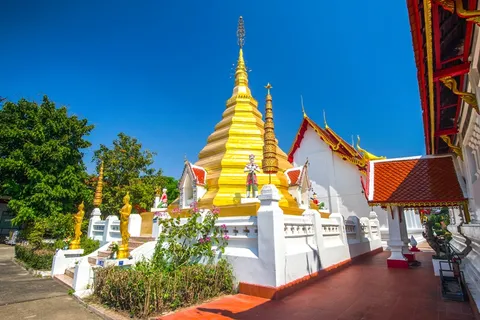
Wat Phra That Cho Hae stands on Cho Hae Road in Cho Hae subdistrict, about 9 to 10 km southeast of Phrae town. The drive along rural road 1022 takes roughly 15 to 20 minutes. It is a royal monastery (phra aram luang) and the temple Phrae people think of first. Anyone born in a Year of the Tiger is said to have this chedi as their birth-year shrine, so visitors come all year, most on Buddhist holy days and during the annual fair.
History and the meaning of the name
Tradition holds that a Lua chieftain, Khun Lua Ai Kom, built the chedi between BE 1879 and 1881 (about 1336 to 1338 CE) and placed under it relics sent by King Maha Thammaracha I (Lithai), then viceroy at Si Satchanalai. The chedi is believed to hold a hair relic and a relic of the Buddha's left forearm. The temple was restored in 1924 by the revered monk Khruba Srivichai of Lamphun, and the Fine Arts Department registered it as an ancient monument on 8 March 1935.
The name Cho Hae is explained locally as coming from fine silk cloth that villagers tied around the chedi as an offering. That is why wrapping the chedi in cloth is still the heart of the festival.
The chedi and the cloth around it
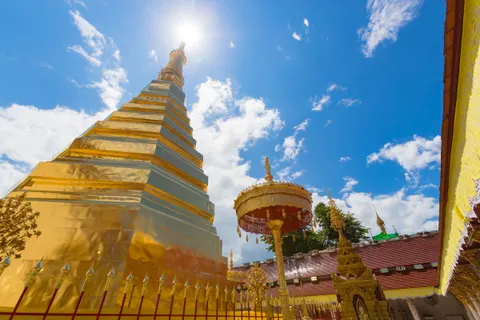
The chedi is octagonal with indented corners, brick and plaster covered in gilded brass plates, in Chiang Saen style, 33 m tall. An iron fence with four gateways in Lanna prasat style surrounds it. Around the base inside the fence you will see yellow cloth wrapped right round the chedi; this is the blessing cloth, replaced at the annual festival. In 2026 a royally granted cloth was carried up the naga stairway, which locals call the Tiger Stairs, before a monks' ceremony at the chedi.
The cloth is wrapped around the chedi, not around trees. The teak to look for is inside the viharn: a carved teak Buddha (Phra Chao Mai Sak), a Lanna-style Buddha carved from golden teak, and an old teak preaching pulpit carved in Thai-Lanna patterns.
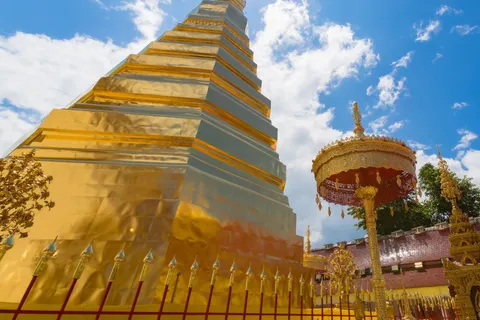
What to see inside the compound
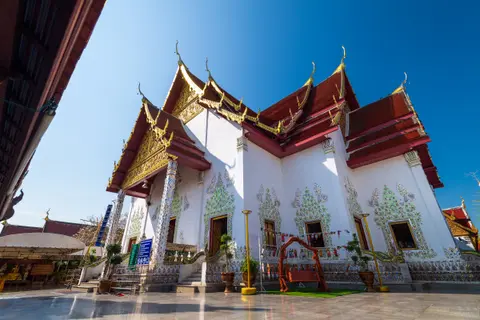
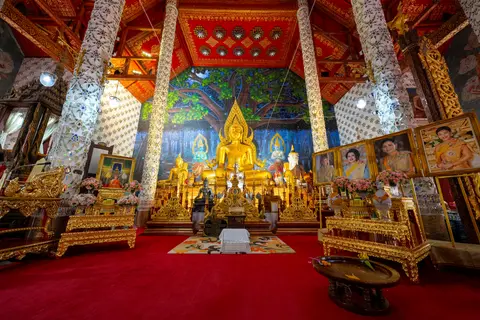
- The ordination hall with Luang Pho Cho Hae as principal image, an old Buddha mixing Lanna, Chiang Saen and Sukhothai styles.
- Phra Chao Than Chai, a plaster Buddha in meditation pose that many visitors come specifically to ask a favour of.
- A Lanna-style viharn with Phra Phutthalokanat Bophit, a naga-sheltered Buddha with a lap width of 3.6 m and height of 7 m, made in 1991, plus murals.
- A reclining Buddha in Burmese style, 3.7 m long, built in 1916.
- The reliquary of Khruba Srivichai, holding the fifth of seven portions of his remains.
- A small museum behind the temple on the history of the site, the Lua and Tai Yuan communities and Khruba Srivichai.
Hours, fee, dress and parking
| Hours | Daily 06:00 to 18:00 |
|---|---|
| Entry | Free; donations are voluntary |
| From Phrae town | About 9 to 10 km, 15 to 20 minutes by car |
| Parking | Below the naga stairway and in front of the temple; toilets available |
| Time needed | About 45 to 90 minutes, plus about an hour for the museum and village |
| Phone | 0 5459 9209 |
Cover shoulders and knees, and remove shoes before entering halls. Vendors near the entrance sell lotus buds, incense, candles and gold leaf for small sums; carry coins and small notes. The naga stairway up to the chedi terrace is fairly long, so older visitors should allow rest stops.
The community and food
The community around the temple is Lua and Tai Yuan, and has been developed for community tourism. There is a produce market in the grounds. Local dishes worth trying are kaeng khae, laab khua and kaeng hangle, the Northern pork curry. Basket weaving for merit offerings, bamboo taplaew charms and hand-made tung banners are shown to visitors, and add about an hour if you want them.
Best and worst times
Before 08:00 the light is soft and crowds are thin; tour groups arrive from late morning. Late afternoon cools off and the gold glows. Weekends and holy days are busier than usual. During the festival, roughly late February to mid March, traffic backs up at the gate and rooms in town fill early. See festival timing.
 KKday
Phrae Day Tour: Wat Phra That Cho Hae, Wongburi House, Wat Phra That Suthon Mongkhon Khiri and a Mo Hom Dyeing Workshop
From US$121.68 (As of 6 Nov 2026: starting price for an adult)
Price as of 6 Nov 2026A one-day tour from Phrae town with an English-speaking guide: Cho Hae, Wongburi House, Suthon Mongkhon Khiri and a mo hom dyeing workshop, from about US$121.68 as of 6 Nov 2026, free cancellation up to 3 days before
Book on KKday Klook
Chiang Mai Province Car Rental (drive on to Phrae)
From US$36.65 (Starting price per day, compact car, as of 14 Nov 2026)
Price as of 14 Nov 2026A rental car from the supplier on the booking page, pick-up and drop-off at the places you choose, insurance and terms as listed. Drivers must be 30 to 65. Cancellation terms differ by car. See the booking page.
Book on KlookWat Phra That Chom Chaeng: a second golden chedi 2 km from Cho Hae
Wat Phra That Chom Chaeng is in Cho Hae subdistrict too, about 2 km from Wat Phra That Cho Hae and about 10 km from Phrae town. Many people drive past on the way to Cho Hae, but it takes little time and has real things to see.
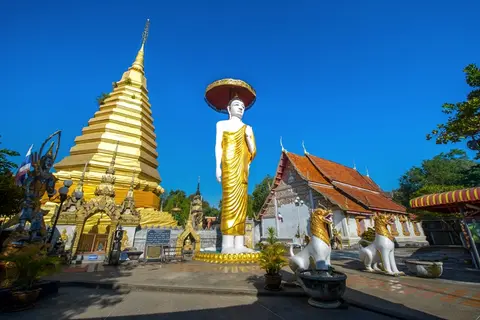
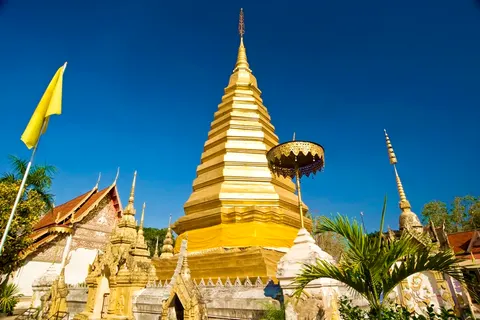
The chedi is gilded, bell-shaped, in a mixed Sukhothai and Wiang Kosai style, with a base 10 m wide and a height of 29 m. A masonry wall with gateways in four directions surrounds it. The legend says the Buddha reached this spot just before dawn, so it was first called Phra That Chuan Chaeng, later shortened to Chom Chaeng. The date often given for building, BE 1331, belongs to the legend and is not a recorded date. The chedi is believed to hold a hair relic and a relic of the Buddha's left hand, and its shape resembles Cho Hae.
- The viharn holds Luang Pho Chom Chaeng, a plaster Buddha in the subduing-Mara pose in mixed Chiang Saen and Sukhothai style, said to be about 600 years old and gilded.
- A Sukhothai-period brick chedi stands behind the viharn and is fairly complete.
- A large standing Buddha and a large reclining Buddha stand in the grounds and photograph easily.
- Women do not enter the walled area around the chedi. You can pay respects and photograph from outside. Check signs on arrival or ask a monk.
| Hours | Daily 08:00 to 17:00 |
|---|---|
| Entry | Free; donation box |
| Time needed | About 30 to 45 minutes |
| Festival | Phra That Chom Chaeng fair around the 13th to 15th waxing days of the 5th northern lunar month, about February, with processions, offering dances and shows. Check dates before you go. |
| Phone | 0 5459 9021 |
Dress modestly as at any active temple. The hilltop is slightly cooler than the valley, and the temple works well as the second stop of a morning after Cho Hae.
Wat Phra That Doi Leng: a white chedi on the highest hill, with views over the rice fields
Wat Phra That Doi Leng is in Cho Hae subdistrict, southeast of Cho Hae and about 3 km from it by a mountain road. The chedi stands on the highest hill in Phrae province. The name comes from a legend that the Buddha rested on this hill and looked out over the old town of Kosai, which in Northern Thai is leng phor, to look and gaze.
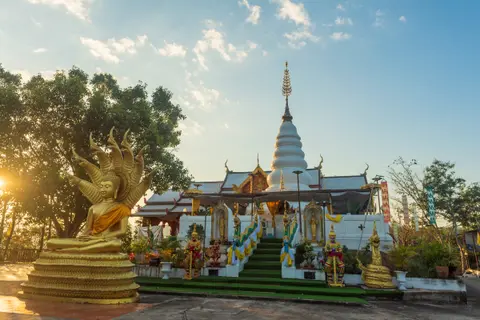
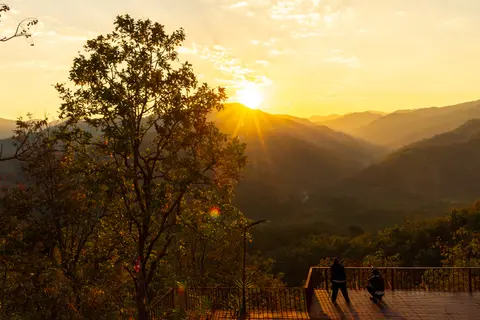
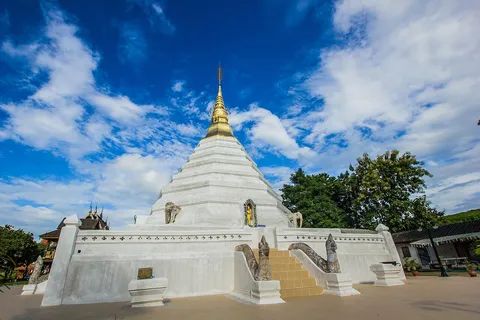
The white chedi is about 11 m tall on a base about 5 m wide, ringed by naga-sheltered Buddhas, with a naga stairway, a standing Buddha, Vessavana and tung banners in the Northern tradition. The wooden ordination hall is carved, and murals show the late King Rama IX and King Rama X during their ordinations. The real draw is the viewing deck: from here you look over the districts of Sung Men, Rong Kwang and Mueang Phrae, and the golden spire of Cho Hae lies below.
Getting up
The road is paved, with a few properly steep sections. It suits a car or a motorbike ridden by someone confident; it is not a place for a first-time scooter rider. Do not go up in rain or after dark. A stairway also climbs the hill for walkers. If you are unsure about steep roads, hire a local driver from Cho Hae.
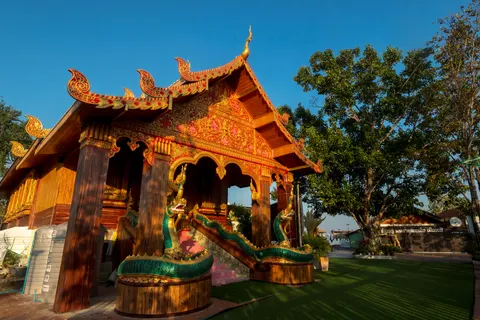
In the temple yard stands a Lanna-style wooden pavilion with stacked roofs and naga guarding both sides of the steps, a second photo spot besides the viewing deck.
| Hours | Daily 08:00 to 17:00 |
|---|---|
| Entry | Free |
| From Cho Hae | About 3 km; from Phrae town about 11 to 12 km |
| Time needed | About 30 to 60 minutes |
| Festival | Khuen Doi Leng, on the 15th waxing day of the 6th northern lunar month, around March, overlapping the Cho Hae fair |
If you want to be on the deck at sunrise, ask the temple beforehand whether you may enter before opening time, and do not drive the steep road in the dark unless you know it.
Wat Phra That Suthon Mongkhon Khiri, Den Chai: an 85 m reclining Buddha and Lanna chedis on Doi Mon Thon
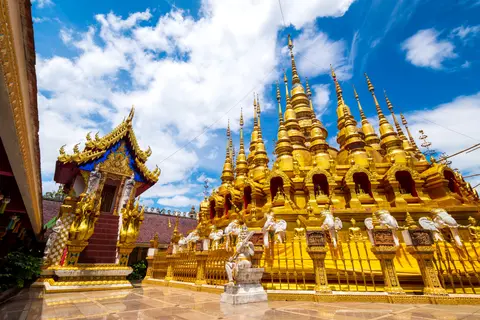
Wat Phra That Suthon Mongkhon Khiri sits on Doi Mon Thon in Den Chai district, beside the Den Chai to Long road. It is about 25 km south of Phrae town and about 4 to 5 km from Den Chai railway station. It was founded in 1977, so it is a new temple and not an ancient monument; what it offers is a collection of Lanna-style Buddhist art copied from several places, built by Lanna craftsmen under the abbot Khruba Noi.
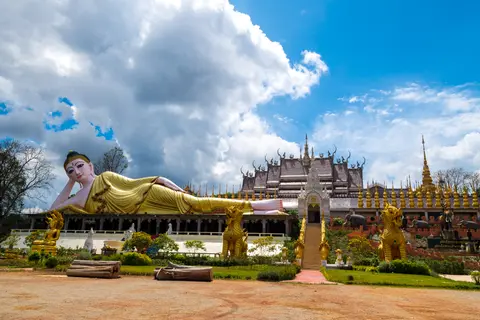
- The reclining Buddha is Burmese in style and 85 m long from the head to the feet, with the 108 auspicious signs on the soles. It is the first thing you see on arrival.
- The ordination hall has Phra Phuttha Chinnaret Nawarat Bophit as principal image, copied from the Phra Phuttha Chinnarat of Phitsanulok.
- Phra That Barami 30 Tat has a two-level octagonal base with stucco elephants and, above, a cluster of 32 round chedis.
- The Suwan Ho Kham Museum is a Lanna building made entirely of teak with 101 teak posts. It displays Buddha images, the Mangrai law manuscripts, lacquerware, Lanna instruments, old weapons and pictures of Northern princes.
- A naga stairway beside the reclining Buddha climbs to the ordination hall; morning light flatters the gold and the crowds are small.
| Hours | Daily 08:30 to 17:00 |
|---|---|
| Entry | Free; carry small notes for donations or lotus offerings |
| From Phrae town | About 25 km on Highway 101, about 30 minutes by car |
| From Den Chai station | About 4 to 5 km; a tuk-tuk or motorbike taxi covers it, agree the price first |
| Time needed | About 45 to 90 minutes |
| Phone | 0 5461 3876 |
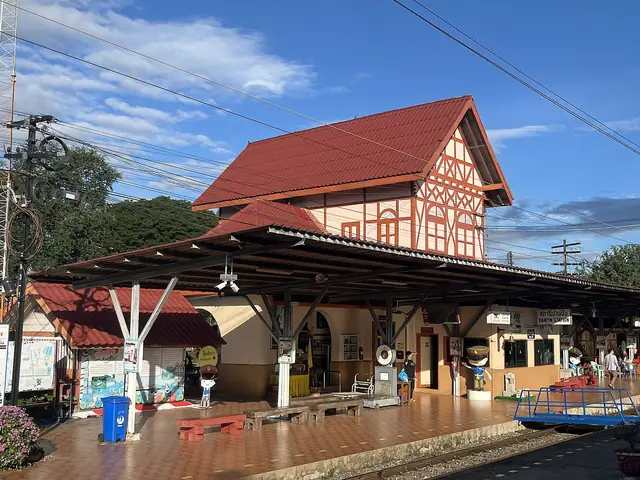
Dress modestly, with shoulders covered and long trousers or a skirt below the knee, and take off shoes before entering halls. No public bus runs to the temple, so arrive by train to Den Chai and take a local ride, or use a car. Tour coaches tend to arrive from late morning, and early visits are quieter.
 KKday
Phrae Day Tour: Wat Phra That Cho Hae, Wongburi House, Wat Phra That Suthon Mongkhon Khiri and a Mo Hom Dyeing Workshop
From US$121.68 (As of 6 Nov 2026: starting price for an adult)
Price as of 6 Nov 2026A one-day tour from Phrae town with an English-speaking guide: Cho Hae, Wongburi House, Suthon Mongkhon Khiri and a mo hom dyeing workshop, from about US$121.68 as of 6 Nov 2026, free cancellation up to 3 days before
Book on KKday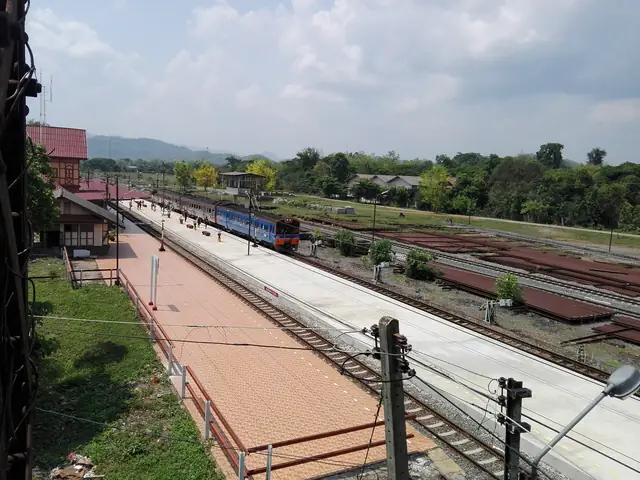 Klook
Chiang Mai Province Car Rental (drive on to Phrae)
From US$36.65 (Starting price per day, compact car, as of 14 Nov 2026)
Price as of 14 Nov 2026A rental car from the supplier on the booking page, pick-up and drop-off at the places you choose, insurance and terms as listed. Drivers must be 30 to 65. Cancellation terms differ by car. See the booking page.
Book on Klook
Denchaicityresort
322 Moo 5, Den Chai
A stay in Den Chai district, about 1.4 km from Den Chai town and 3.7 km from Wat Phra That Suthon Mongkhon Khiri. It suits travellers who arrive by train and want to sleep near Den Chai. Check the distance to the station on the map before you book
See prices and availability on the booking page
Wat Phra Luang, Wat Si Dok, Thin Luang and Pu Chae: older temples for those with a car
None of these four is a must for a first visit, but they suit travellers with their own transport who like old monuments or Tai Lue culture. If you only see one, choose Wat Phra Luang.
Wat Phra Luang (Phra That Noeng), Sung Men
Wat Phra Luang is in Phra Luang subdistrict, about 10 km south of Phrae town. Its brick Lanna chedi leans slightly; noeng is a Northern dialect word for leaning, and a legend says the chedi stands over the burial mound of a giant snake. No one knows when it was built. The temple probably existed from the 16th century, was abandoned, and was restored by Tai Lue settlers from Chiang Saen in 1787. The Fine Arts Department registered it on 8 March 1935.
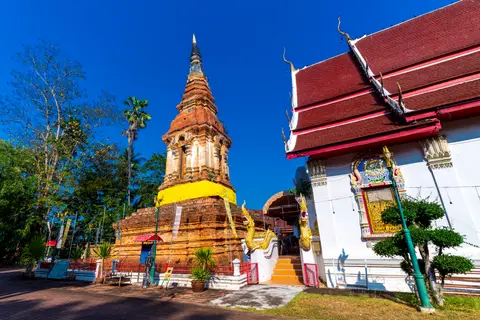
- An octagonal bell tower built in 1913, holding a bronze bell of 157 kg.
- A manuscript library mixing local and Rattanakosin styles, built in 1915 to keep palm-leaf scriptures.
- A sacred well about 5 m deep, one of four in Phrae whose water is used in royal ceremonies.
- A small museum of objects from the temple and village.
Inside the viharn a gilded principal Buddha sits before colourful wall paintings. The front has green and gold glass ornament and small naga on the stair rails.
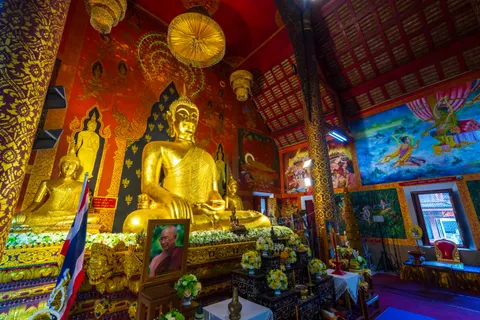
Open daily 08:00 to 17:00, free, phone 0 5454 1327. The festival for Phra That Noeng falls in March on lunar dates. It sits on the same road as Suthon Mongkhon Khiri, so it pairs well with a trip south.
Wat Si Dok (Phra Chao Nang Din), Sung Men
An old temple about 13 km south of Phrae town with no written history. A legend says the Buddha sat under a bodhi tree here and Lua fishermen who had fled in fear came to believe when the tree burst into fragrant flower. The attraction is Phra Chao Nang Din, a gilded plaster Buddha in meditation pose, 60 inches across the lap and about 2 m high, enshrined low on the ground. A senior monk named it the ground-sitting Buddha on 14 February 1971 and told the community never to raise its base. Open about 08:00 to 17:00.
Wat Phra That Thin Luang, Ban Thin
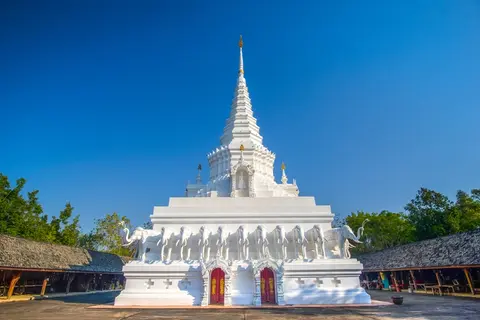
About 12 km northeast of Phrae town, on Doi Den Nang Fa. The white chedi dates from 1996 and is ringed with stucco elephants referring to a legend of an elephant round-up. The village of Ban Thin is Tai Lue, people who moved from Sipsongpanna around 1796 and still keep their language and customs. There are no fixed closing hours, entry is free, and no regular public transport runs there, so you need your own vehicle.
Wat Phra That Pu Chae, Rong Kwang
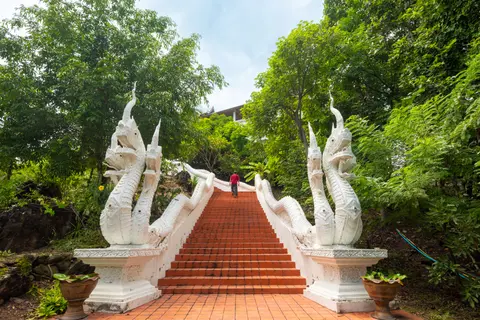
At Ban Bun Roeng in Ban Wiang subdistrict, about 20 to 30 km from Phrae town along the Phrae to Nan road; check the route on a map before you set off. It is a national ancient monument with a square chedi about 4 m on each side and 4 m high, said to hold the Buddha's right ankle bone. A festival is held on the 11th to 15th waxing days of the 3rd lunar month, around February. No set opening hours are published, so visit in daylight and check before you go.
Half-day and full-day routes, by car and without a car
Half-day morning by car: Cho Hae, Chom Chaeng, Doi Leng
- Leave Phrae town about 06:30 and reach Cho Hae about 07:00. Spend about an hour at the chedi and viharn.
- Drive 2 km to Chom Chaeng, arriving about 08:15 after it opens. Allow 30 to 45 minutes.
- Go up Doi Leng about 09:15 for the view and photos, about 45 minutes.
- Be back in town before 11:00 for lunch, then continue to the old town in the afternoon.
Full day by car: Cho Hae in the morning, the south after lunch
Follow the morning route, lunch in town, then head south around 13:00. Stop at Wat Phra Luang in Sung Men for about 30 minutes, then reach Suthon Mongkhon Khiri about 14:30 and give it an hour. If you plan to take a train back, check times at Den Chai station beforehand. Wat Si Dok is on the same road if you have time. This full day is about 80 to 100 km of driving.
Without a car: songthaew and taxi
- Cho Hae has a songthaew from Talat Preeda market on Cho Hae Road for about 30 baht a person. Check the return times before you board.
- A taxi or private songthaew booked through your hotel runs about 300 to 500 baht including waiting time at Cho Hae and Chom Chaeng. Agree the price and the waiting time first; figures can change, so check before you go.
- Chom Chaeng is about 2 km on foot from Cho Hae, pleasant early but hot in strong sun.
- Doi Leng needs a vehicle because of the steep road. If you have no car, hire a ride on from Cho Hae.
- You can rent a motorbike in town. Cho Hae and Chom Chaeng are easy rides; Doi Leng is not for beginners.
- For Suthon Mongkhon Khiri, take the train to Den Chai station and then a local ride for about 4 to 5 km. See getting to Phrae.
If you are staying overnight see where to stay in Phrae, and to add scenery see nature and countryside.
 12Go
Bangkok to Phrae on 12Go
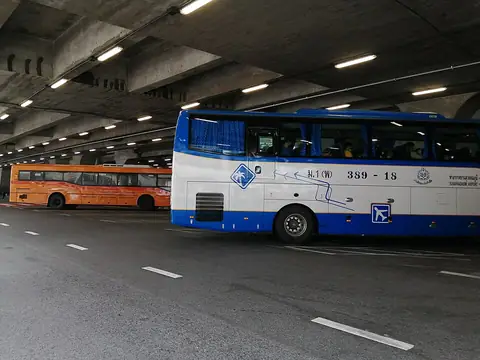
From US$19 (As of 6 Nov 2026: buses from about US$19, Class 3 train seats to Den Chai from about US$7, private vans from about US$357 per vehicle. Prices change by date and operator)
Price as of 6 Nov 2026Buses from Mo Chit to Phrae from about US$19 and trains to Den Chai from about US$7, as of 6 Nov 2026
Book on 12Go Klook
Chiang Mai Province Car Rental (drive on to Phrae)
From US$36.65 (Starting price per day, compact car, as of 14 Nov 2026)
Price as of 14 Nov 2026Rent a car in Chiang Mai, drive up to Phrae in about 3.5 hours and use it for the Cho Hae, Chom Chaeng and Doi Leng loop, from about US$36.65 a day for a compact car such as a Toyota Vios, as of 14 Nov 2026. Drivers must be 30 to 65
See Chiang Mai car hireHow long each temple takes and the best time of day
| Temple | Time inside | Best time |
|---|---|---|
| Cho Hae | 45 to 90 min | Before 08:00 or late, before the 18:00 close |
| Chom Chaeng | 30 to 45 min | After it opens at 08:00 |
| Doi Leng | 30 to 60 min | Cool-season morning; skip wet days |
| Suthon Mongkhon Khiri | 45 to 90 min | Morning, before the coaches |
| Wat Phra Luang (Phra That Noeng) | About 30 min | On the way to or from Den Chai |
The times leave out driving. Cho Hae and Chom Chaeng are about 2 km apart and Doi Leng about 3 km from Cho Hae, so that set is a morning of about 4 hours with driving. Suthon Mongkhon Khiri and Wat Phra Luang together take about 2 hours inside, plus the extra drive south and back.
With only two hours, choose Cho Hae alone and walk the museum behind the temple; that beats rushing three temples without leaving the car.
Cho Hae festival timing and the best season to visit
The Wai Phra That Cho Hae festival, also called Phrae Hae Tung Luang, runs every year from the 9th to the 15th waxing day of the 4th southern (6th northern) lunar month. That puts it between about late February and mid March, and the dates move with the lunar calendar. In 2025 it ran for 9 days and 9 nights up to 13 March; in 2026 it ran from 22 February to 3 March, with the cloth-wrapping ceremony on 27 February. If you plan around it, check the schedule with the temple or the provincial office well ahead.
- The Chao Luang elephant procession; in 2025 it had five elephants.
- Procession groups carrying offerings from all 8 districts of Phrae, plus the Tung Luang banner procession, bells, flower and candle trees and the cloth for the chedi.
- The Fon Pu Ja dance; in 2025 more than 300 dancers performed in front of the chedi.
- A food and craft market, a sermon recital and night shows.
The trade-off is crowds and full hotels in Phrae town. For a quiet visit avoid the festival and go on a weekday. Other temples keep their own dates: Chom Chaeng about February, Doi Leng alongside Cho Hae, Phra That Noeng about March and Pu Chae about February.
Best season
- November to January: cool and clear, the easiest time for the temples and for Doi Leng.
- February: the Chom Chaeng and Pu Chae fairs; late in the month it can overlap the Cho Hae fair, as in 2026 when that began on 22 February.
- March: the Cho Hae fair in the first half, with the Phra That Noeng fair and Khuen Doi Leng; rooms in town fill early.
- April: very hot, so go early in the morning or late in the day.
- May to October: rain. Cho Hae and Chom Chaeng are fine; avoid Doi Leng when the road is wet.

PhoomThai Garden Hotel
31 Sasibutr Road, Nai Wiang, Phrae town
A hotel on Sasibutr Road, about 0.5 km from the centre and 740 m from Wat Phra Bat Ming Mueang Worawihan, for drivers who want to book ahead for festival days
See prices and availability on the booking page
What to wear and how to behave at the temples
- Cover shoulders and knees. Short sleeves and long trousers or a skirt below the knee are fine; skip vests and very short shorts.
- Take shoes off before entering a viharn or ordination hall; leaving them by the steps is normal.
- Walk clockwise around a chedi and do not point your feet at Buddha images.
- Women should not hand things directly to monks; place the item down for the monk to pick up.
- Women do not enter the walled area at Chom Chaeng.
- Carry coins and small notes for merit offerings and for lotus buds, incense and candles.
Common mistakes and who each temple suits
Common mistakes
- Going to Cho Hae at noon, in strong sun and tour-group time. Arrive before 08:00 or in late afternoon.
- Assuming a bus serves every temple. Suthon, Doi Leng and the Sung Men temples have no direct bus.
- Riding a motorbike up Doi Leng in rain or darkness.
- Forgetting the women's restriction at Chom Chaeng and having to wait outside.
- Visiting during the festival without a booked room.
- Treating Suthon Mongkhon Khiri as an ancient temple; it dates from 1977.
Who they suit
- One half-day: Cho Hae and Chom Chaeng are enough; add Doi Leng for the view.
- Born in a Year of the Tiger: Cho Hae is your birth-year shrine, best visited in the morning.
- Photographers: Doi Leng in the morning, Suthon in morning light, Cho Hae in late afternoon.
- Families with older relatives: Cho Hae has a long stairway; Doi Leng needs a car or hired ride; Chom Chaeng and Suthon have parking close to the worship areas.
- No car: Cho Hae by songthaew and Suthon by train plus a local ride work well; hire a ride for Doi Leng and Sung Men.
- Fans of old architecture: Wat Phra Luang and Pu Chae are genuinely old; Cho Hae and Suthon have a lot of recent restoration.
Frequently asked questions
What are the opening hours and entry fee at Wat Phra That Cho Hae?
Open daily 06:00 to 18:00, free to enter, with donations voluntary. Phone 0 5459 9209. As of 14 Nov 2026; during the annual festival check with the temple before you go.
How far is Wat Phra That Cho Hae from Phrae town, and how do I get there without a car?
About 9 to 10 km, 15 to 20 minutes by car. No train or direct bus. Take a songthaew from Talat Preeda market on Cho Hae Road for about 30 baht a person, or book a taxi or private songthaew from your hotel for about 300 to 500 baht including waiting. Check prices before you set off.
Why is it called Cho Hae, and what is the cloth around the chedi?
The name is explained as coming from fine silk cloth that villagers tied round the chedi as an offering. The yellow cloth you see around the base is the blessing cloth, replaced at the annual festival. The teak to look for is the carved teak Buddha and the teak pulpit inside the viharn.
When is the Cho Hae festival?
Every year from the 9th to the 15th waxing day of the 4th southern lunar month, roughly late February to mid March. In 2025 it ran to 13 March and in 2026 it ran from 22 February to 3 March. Dates move with the lunar calendar. The 2027 dates have not been announced; expect about mid March and check ahead.
Can women enter Phra That Chom Chaeng?
Women can visit the temple grounds, but not the walled area around the chedi. Pay respects and take photos from outside, and check signs on arrival or ask a monk.
Is Doi Leng suitable for a motorbike?
The road is paved but has genuinely steep sections. It suits a car or a confident rider, not a beginner, and should be avoided in rain or darkness. It is free and open 08:00 to 17:00.
How do I reach Wat Phra That Suthon Mongkhon Khiri from Den Chai station?
It is about 4 to 5 km from Den Chai station with no bus to the gate. Take a tuk-tuk or motorbike taxi from the station and agree the price first. By car from Phrae town it is about 25 km on Highway 101.
How long do the temples outside Phrae take?
Cho Hae, Chom Chaeng and Doi Leng take about 4 hours with driving, a good half-day. Adding Wat Phra Luang and Suthon Mongkhon Khiri makes a full day.
Is Suthon Mongkhon Khiri an old temple?
No. It was founded in 1977 but gathers Lanna-style art from several places, with a reclining Buddha 85 m long and more than 30 chedis. Entry is free.
What is the Year of the Tiger, and should I visit Cho Hae for it?
The Year of the Tiger is the zodiac year of the tiger, for example BE 2553 (2010) and BE 2565 (2022). People born in it treat Cho Hae as their birth-year shrine and like to visit in the morning and make a small offering. Anyone born in another year can visit just the same.
Where the facts come from
- Thai Holiday Guide: Wat Phra That Cho Hae
- Thai Holiday Guide: Phrathat Doi Leng
- Thai Holiday Guide: Wat Phra That Suthon Mongkhon Khiri
- Thai Holiday Guide: Wat Phra Luang That Nerng
- Thai Holiday Guide: Phrathat Thin Luang
- Thai Holiday Guide: Phra That Chom Chaeng
- Thai Post: Phra That Cho Hae festival
- Thai Post: Phra That Cho Hae and the community
- Thai Post: four Phra That of Phrae and Nan
- Thai Post: cloth ceremony at Phra That Cho Hae 2026
- TrueID Travel: Wat Phra That Chom Chaeng
- KTC: Phrae temples
- Thailandee: Wat Phra That Suthon Mongkhon Khiri
Keep planning
 Phrae: old town, teak houses, Wat Phra That Cho Hae, Phae Mueang PhiThe whole province in three zones, with fees, season, how to get there and where to stay
 Phrae in 1 to 2 daysTimed plans on foot, by car, and for arrivals at Den Chai station
 Phrae dealsBuses, trains, private cars and a day tour, with prices and cancellation terms
 Phrae Nature and CountrysidePhae Mueang Phi, Doi Pha Klong, Wiang Kosai, Mae Yom, Ban Thung Hong mo hom and Ban Pin station, with hours, fees and one and two day routes
 Where to stay in PhraeOld town, town centre, Cho Hae side and Den Chai compared, with 20 hotels and homestays and when to book
 Phrae Old Town and Teak HousesWat Luang, Wat Phra Non, Wat Chom Sawan, Khum Chao Luang, Wongburi House and the Saturday walking street, with hours and fees
 Getting to PhraeTrains to Den Chai, buses from Mo Chit, flight status, driving and local transport, with times and prices