Si Thep and Phetchabun town: the World Heritage ancient city, Phetbura Buddha Park, Thai Lom and Wichian Buri
Si Thep Historical Park is an ancient moated city that UNESCO inscribed on 19 September 2023. It opens daily from about 08:00 to 16:30, with entry 20 baht for Thais and about 120 baht for foreigners, tram included. Allow 2 to 3 hours and go in the morning. Bangkok to Phetchabun buses usually stop at Si Thep on the way, and Phetchabun town adds Phetbura Buddha Park, Wat Maha That and the museums for half a day.
Si Thep is the reason Phetchabun is not only about mountains and mist. It is an ancient town ringed by moats and earth banks, covering about 4.62 square kilometres, with monuments from the Dvaravati period through to the Khmer era. If you drive from Bangkok to Khao Kho you pass close by on Highway 21, so it fits neatly into the afternoon of your first day.
Phetchabun town, Lom Sak and Wichian Buri are lower-key cultural stops: old temples, small museums, Tai Lom food and a Saturday walking street. This page covers what you need before visiting Si Thep and how long each town stop takes. To go on to the mountains see Khao Kho and Phu Thap Boek.
We earn a commission if you book through our links. The price you pay does not change. How we choose
At a glance: how long Si Thep takes and what it costs
Where
Si Thep district, Phetchabun, 208 Moo 13 Si Thep subdistrict, off Highway 21. Bangkok to Phetchabun buses usually stop at Si Thep, but drop-off points differ by operator, so check your ticket
Hours
Daily about 08:00 to 16:30. Check before you go, especially on public holidays
Entry
20 baht for Thais and about 120 baht for foreigners, including the electric tram around the old city
Time needed
2 to 3 hours for the inner city and Khao Khlang Nok, half a day with the information centre and excavation building
Best time
Morning, before the sun gets strong, because the inner city has little shade. November to February is the most comfortable
Bring
Hat, sunscreen, water and comfortable shoes. Parking and toilets are on site
Si Thep is an archaeological site, not a tourist town. Do not count on food inside the park. Take water and a snack, then eat a proper meal at a restaurant near Highway 21.
12Go
Bangkok to Phetchabun on 12Go
FromUS$12(As of 6 Nov 2026: buses from about US$12. Prices change by date)
Price as of 6 Nov 2026
Buses from Mo Chit to Phetchabun usually call at Si Thep, so you can get off there. From about US$12, about 10 hours on the published timetable, as of 6 Nov 2026. Check the drop-off point on your ticket before you book
What the World Heritage listing means and how old the city is
On 19 September 2023 the World Heritage Committee, at its 45th session in Riyadh, inscribed the Ancient Town of Si Thep and its Associated Dvaravati Monuments as Thailand's fourth cultural World Heritage Site and seventh overall.
The ancient town was formerly known as Abhaya Salee and is at least about 1,000 years old. Its layout has a moat and earth bank, with an inner town of about 2 square kilometres, nearly round, and an outer town of about 2.54 square kilometres, rectangular, each with six gateways. More than 70 monuments have been found in the inner town and some have been excavated and restored. People lived here from around the sixth century to the thirteenth, shifting from Dvaravati to Khmer influence.
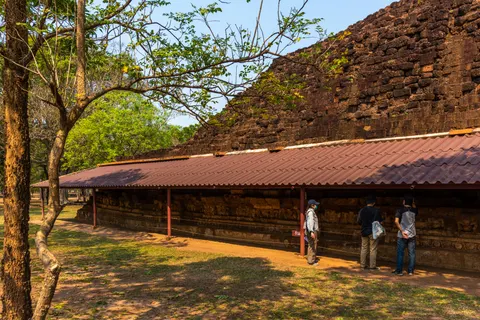
World Heritage does not mean towering stone temples like Angkor. Si Thep is notable for its town plan and for monuments that blend Dvaravati art, Khmer Baphuon style, and Mahayana Buddhist and Hindu roots. If you expect brick-built foundations that reward slow reading of signs, you will be happier than if you expect soaring towers.
The monuments to see: Khao Khlang Nai, Khao Khlang Nok, Prang Song Phi Nong and Prang Si Thep
Stop
What it is
Approx. age
Why stop
Visitor information centre
Exhibition building, book and souvenir shop
Not applicable
Gives the overview and has shade and toilets
Archaeological excavation building
Human and elephant skeletons found in the 1988 dig
Before the city
You see real finds in their pit
Khao Khlang Nai
Laterite base with stucco figures of people and animals
Around the 6th to 7th century, Dvaravati
Near the middle of the town, similar to Nakhon Pathom and Khu Bua
Prang Song Phi Nong
Two prangs on a laterite base facing west
Around the 11th to 12th century, Khmer Baphuon
A lintel of Shiva and Uma on the bull Nandi was found here
Prang Si Thep
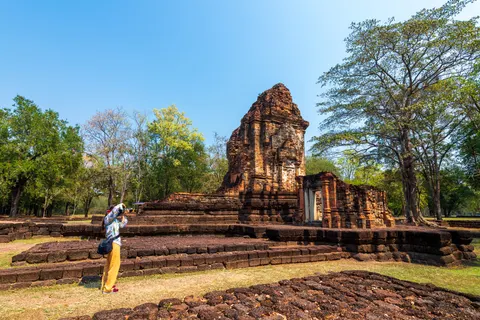
Brick and laterite tower facing west with a lotus-moulding base
Around the 11th to 12th century
Khmer style added after Khao Khlang Nai
Khao Khlang Nok
A great stupa outside the moat, about 2 km north of the old town
Dvaravati
The base is well preserved and follows a mandala plan
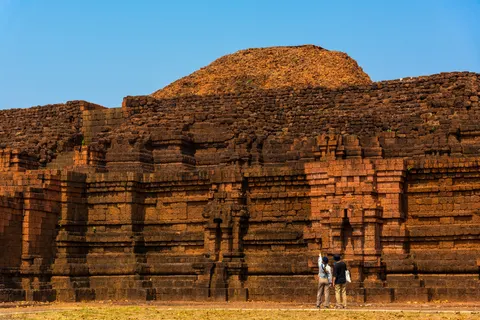
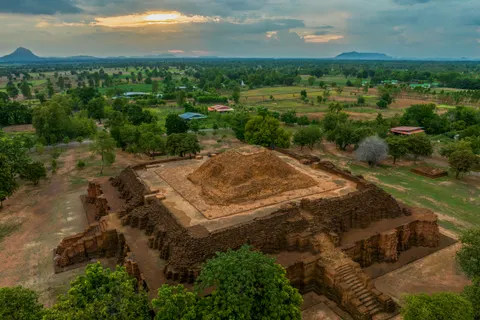
Khao Khlang Nok lies outside the moat and may reflect Mahayana Buddhist thinking, which favoured buildings on tall platforms laid out as a mandala. It is linked to Khao Tha Morat, nearly 20 km to the west, where Mahayana carvings sit in a cave on the summit. Its base is well preserved, and almost no other monument of its period in Thailand is as complete and as large, so do not skip it just because it is outside the town wall. The park tram runs there; if you do not want to walk in the heat, make it your last stop and ride.
Routes inside the ancient city follow the Fine Arts Department's schedule. Some monuments are fenced off for conservation, and the open sections can change with restoration, so ask at the information centre before you set off.
The Chao Pho Si Thep shrine, the information centre and the smaller sites people miss
Beyond the main stops in the table above, smaller monuments are scattered through the old town. South of Khao Khlang Nai there is a laterite ordination hall, boundary stones turn up near the excavation building, and there is a square Dvaravati structure that was built over when Brahmin beliefs arrived. Together they suggest the inner town was first a Dvaravati town and Khmer buildings were added later. If you wander on your own, ask at the information centre which parts are open on the day.
The Chao Pho Si Thep shrine stands just inside the Saen Ngon gate, the western gate of the town. Local people revere it, and a ceremony is held every year on the 2nd to 3rd day of the waxing moon of the third lunar month, around February. If you go then, ask at the information centre for the exact day and time.
The visitor information centre has an older and a newer building. It takes little time and makes the signs in the old town much easier to follow.
Khao Tha Morat is nearly 20 km to the west and is linked to Khao Khlang Nok. The 2 to 3 hours on this page do not include it.
Khao Khlang Nok has yielded a Dvaravati-style Buddha image carved from green sandstone, standing in the teaching pose, 57 cm high.
Planning your visit: order, tram, shade and timing
Arrive when the gate opens at about 08:00, park in the park car park, buy your ticket and either board the tram or walk to the information centre for the overview.
Visit the excavation building first, because it is under cover, before the heat builds.
Walk or take the tram to Prang Song Phi Nong, Prang Si Thep and Khao Khlang Nai while the light is still soft.
In the late afternoon take the tram or drive to Khao Khlang Nok outside the moat.
Leave before closing at about 16:30 and eat at a restaurant on Highway 21 before heading to Khao Kho or Phetchabun.
Si Thep is about 130 km south of Phetchabun town along Highway 21, around two hours' drive. If you take a Bangkok bus, tell the crew or check your ticket for the Si Thep stop, then take a local ride to the park. Check the time of a bus back before you get off, because the stop is on the highway.
With children or older relatives rely on the tram and walk only where there is shade. The hot season, March to April, is brutal, so arrive when the gate opens or at the latest before 09:00, or choose winter.
12Go
Bangkok to Phetchabun on 12Go
FromUS$12(As of 6 Nov 2026: buses from about US$12. Prices change by date)
Price as of 6 Nov 2026
Mo Chit to Phetchabun buses usually call at Si Thep. From about US$12, about 10 hours on the published timetable, as of 6 Nov 2026
Phetchabun town: Phetbura Buddha Park, Wat Maha That and the museums
Phetchabun town sits in a valley by the Pa Sak River at about 120 m. It is a small place that works as an overnight base before Khao Kho or Phu Thap Boek. The main sights are few and together take about half a day.
Phetbura Buddha Park
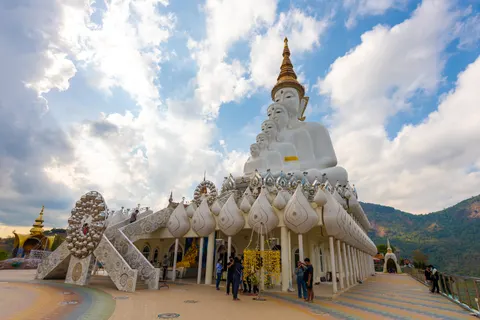
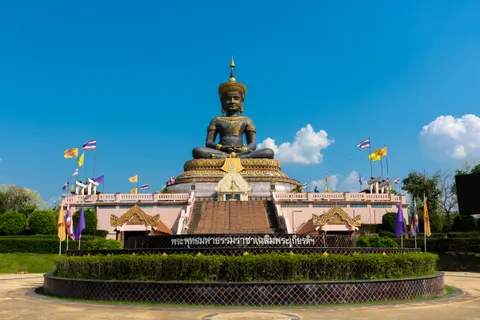
Phetbura Buddha Park, in Sadiang subdistrict, houses the Phra Phuttha Maha Thammaracha Chalerm Phra Kiat, the world's largest replica of the revered Phra Phuttha Maha Thammaracha. It is cast in pure brass, weighs over 45,000 kg, and is 11.98 m across the lap and 16.59 m high. It was made for the 84th birthday of King Bhumibol on 5 December 2011. The grounds have halls and a pond, and suit a stop in the morning or evening.
Wat Maha That and other old temples
Wat Maha That is the town's old temple, founded in B.E. 1926 by the ruler of Phetchabun. Legend says the armies of Chao Phraya Chakri and Chao Phraya Surasi made offerings here before fighting the Burmese at Phitsanulok. A major restoration took place in 1904 under Prince Damrong. It is open from early morning to dusk, free, and you should dress modestly.
Intrachai Archaeology Hall and the Nakhonban Cultural Hall
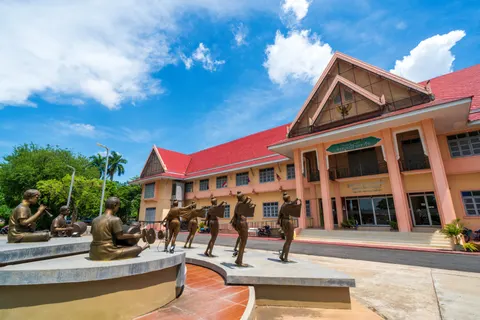
The Phetchabun Intrachai Archaeology Hall on Phet Charoen Road was the old provincial hall, built in 1962, and now tells the province's history, archaeology and culture with digital displays, a Phetchabun Treasures room and a model of the old town. The Nakhonban Phetchabun Cultural Hall was built in 2003 to commemorate 1943 to 1945, when Field Marshal Plaek Phibunsongkhram issued a decree to move the capital to Phetchabun, and it displays photographs and objects lent by the Fine Arts Department.
Budget
SR Residence Hotel
Phetchabun town, Phetchabura Road
On Phetchabura Road in Phetchabun town, handy for the Buddha park, Wat Maha That and the museum
Lom Sak, Tai Lom culture and Wichian Buri: the walking street, temples and hot springs
Lom Sak is the town you pass through before climbing Khao Kho and Phu Thap Boek, so it is natural for a meal or a night. It has its own Tai Lom language, food and old timber buildings.
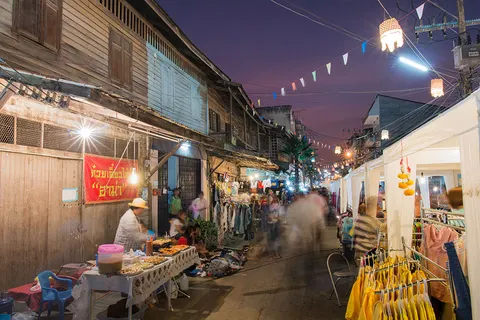
Thai Lom walking street on Ronnakit Road runs every Saturday evening from about 17:00 to 22:00, past old two-storey timber houses, with local dishes such as Tai Lom rice noodles, grilled chicken with rice-flour soup and bamboo-cooked sticky rice.
Lom Sak Museum on Suriyawong Road is the former governor's residence, a colonial-style building from the time of King Rama V. The ground floor covers the town and the upper floor Tai Lom culture.
Than Thip waterfall (Mu Bud) is a single drop about 26 m high and 30 m wide, with water year round. See the parks and waterfalls page.
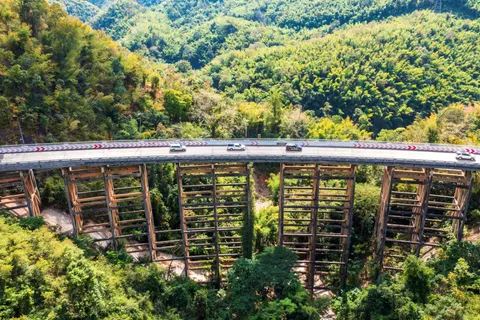
The Pho Khun Pha Mueang (Huai Tong) bridge on Highway 12 is a concrete viaduct on piers about 50 m high and about 103.4 m long, opened in 1975, with a lay-by for photos.
Wichian Buri is further south toward Lopburi. Wat Wichian Bamrung has a gold reclining Buddha in the open air, about 50 m long and 5 m high facing east, with a monument to King Naresuan, Princess Suphankanlaya and King Ekathotsarot behind it and an old dugout boat made from one whole takhian log. There are also hot-spring parks at Phu Toei and Ban Khru, where locals soak their feet.
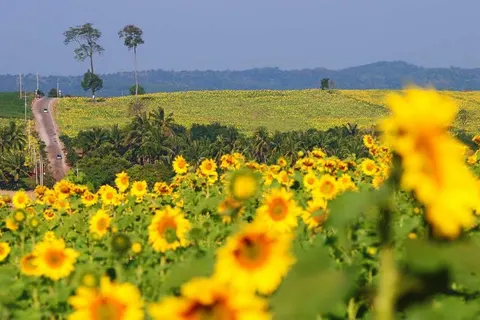
The Bueng Sam Phan sunflower fields are near Bueng Sam Phan and bloom late in the year into the new year. They can be combined with Si Thep. If you plan to go, check the status and bloom dates ahead of time.
Budget
Lom Sak Nattirat Hotel
Lom Sak town, Khotchaseni Road
On Khotchaseni Road in Lom Sak town, a convenient stay for the Saturday walking street and an early start up to Khao Kho or Phu Thap Boek
The story of Si Thep in plain terms, before you walk
Si Thep went through two big periods. The first was Dvaravati, around the 6th to 7th century. The town was laid out with a moat and earth bank, monuments were built of laterite and decorated with stucco figures of people and animals, similar to finds at Nakhon Pathom and Khu Bua. The second was Khmer influence, around the 11th to 12th century, with prangs built of brick and laterite and a lintel carved with Shiva holding Parvati on the bull Nandi. Around the 13th century there was an attempt to rebuild the earlier monuments that did not succeed, judging by the fragments left scattered about.
The name khao khlang comes from a local belief that these large mounds stored weapons and treasure. Khao Khlang Nai ("inner") stands almost in the middle of the town, and Khao Khlang Nok ("outer") lies about 2 km to the north, called outer because it is outside the moat. Knowing this helps you read the signs and understand what is where when you arrive.
The dates given are archaeologists' estimates, and signs in the park may use slightly different ranges.
Photos, prices and reviews from Klook
A private car and driver from Bangkok on a 3, 4 or 5 day package. The sample plans on the booking page put Si Thep before the climb to Khao Kho, so you do not need to find parking or wait for a ride. Entry fees and meals are not included
Si Thep is not complicated, but first-time visitors tend to get the timing and the sun wrong more than anything else.
Arriving at midday and walking in full sun. The inner town has little shade, and a start at about 08:00 is far more comfortable.
Allowing only an hour. The tram stops are spread out and you still walk between monuments, so allow 2 to 3 hours.
Skipping Khao Khlang Nok because it is outside the town wall, when it is one of the most important monuments. The tram goes there.
Expecting an Angkor-style stone temple. Si Thep is a town of brick and laterite that rewards reading the signs, so see the World Heritage section above before you go.
Not bringing water and food. The park does not have busy shops like a tourist town.
Getting off a bus on the highway without checking the return times. Buses may not pass often.
Putting it together: Si Thep, Phetchabun town and the climb
By car from Bangkok, the neat plan is to leave early, reach Si Thep between about 11:00 and 13:00, visit through the afternoon, then drive north to Lom Sak or Khao Kho by evening. By bus, get off at Si Thep in the morning, visit, then take a later bus on to Phetchabun or Lom Sak and sleep in town. Keep Phetchabun town for the morning before you head up the mountain.
Time of day
Plan
Time
Morning to noon
Si Thep information centre, excavation building, Khao Khlang Nai
About 3 hours
Afternoon
Khao Khlang Nok, then drive to Lom Sak or Phetchabun
About 2 hours driving
Saturday evening
Thai Lom walking street in Lom Sak
1 to 2 hours
Next morning
Phetbura Buddha Park, Wat Maha That, the museum, then up to Khao Kho
Half a day
Frequently asked questions
What are Si Thep Historical Park's hours and fees?
Open daily from about 08:00 to 16:30. Entry is 20 baht for Thais and about 120 baht for foreigners, including the electric tram around the old city.
When did Si Thep become a World Heritage Site?
On 19 September 2023, at the World Heritage Committee's 45th session in Riyadh, as the Ancient Town of Si Thep and its Associated Dvaravati Monuments, Thailand's fourth cultural World Heritage Site.
How long do I need at Si Thep?
2 to 3 hours for the old city and Khao Khlang Nok, longer if you read the information centre and the excavation building. Go in the morning because there is little shade.
Can I visit Si Thep without a car?
Yes. Bangkok to Phetchabun buses from Mo Chit usually stop at Si Thep, though drop-off points differ by operator, so check your ticket or tell the crew you want Si Thep. Take a local ride to the park, and check the time of a bus back before you get off, because buses may not pass often.
Where is Khao Khlang Nok and is it worth it?
It is outside the moat about 2 km north of the old town, a Dvaravati stupa with a well-preserved base. It is among the most important monuments at Si Thep, so do not skip it. The park tram reaches it, and if you do not want to walk in the sun, make it your last stop.
What is there to see in Phetchabun town?
Phetbura Buddha Park with a giant replica Buddha, Wat Maha That, the Intrachai Archaeology Hall and the Nakhonban Cultural Hall. Together they take about half a day.
When is the Lom Sak walking street?
Every Saturday evening from about 17:00 to 22:00 on Ronnakit Road, with local food and souvenirs. Stay in Lom Sak on Saturday night if you want to go.
Is Si Thep far from Khao Kho?
Si Thep is in the south of the province on Highway 21 and Khao Kho is in the north, about 3 hours or more by road depending on where you start on the mountain. That is why Si Thep suits the afternoon of the journey up from Bangkok.
Is Si Thep similar to Ayutthaya or Sukhothai?
Different. Si Thep is older, a Dvaravati then Khmer town built mostly of laterite and brick, with stupa bases and prangs rather than rows of temple compounds as at Ayutthaya. If you like reading a town plan, it is rewarding.
Can I take photos at Si Thep?
Yes, in the areas open to visitors, but do not climb the monuments or step past roped-off sections. Drones need permission from the Fine Arts Department first.