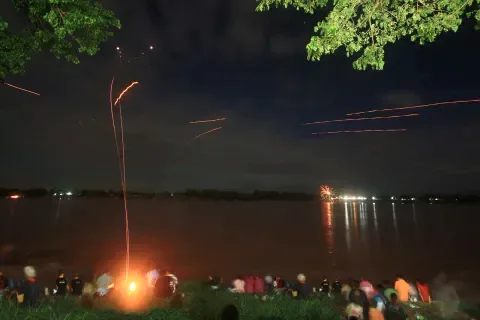
The Naga fireballs are the event Nong Khai and Bueng Kan wait for each year. On the night that ends Buddhist Lent, tens of thousands of people sit along the Mekong bank waiting for pink-red lights to climb out of the water. Some see a hundred. Some wait all evening and see a handful. This page covers the basics (which night, where, what time) and the things people often miss: which spots have had the most lights, how the counts have changed, whether the town festival shows any, and what to expect on the night.
The last part of the page covers Phra That Bang Phuan, an old temple in Mueang Nong Khai district, about 23 km from the town, free every day and an easy half-day before or after the fireball night. Information is as of 6 Nov 2026. For next year's date, check the lunar calendar and the provincial announcement before you book a room. For the town itself, see the one-day plan and the town and riverside page.
We earn a commission if you book through our links. The price you pay does not change. How we choose
At a glance: night, time, spots and cost
| Main night | Night of Ok Phansa, the 15th waxing day of the 11th lunar month. In 2026 that was Monday 26 Oct. For 2027, expect about mid to late October and check the lunar calendar and the provincial announcement before booking. |
|---|---|
| Time of the lights | After dark. In 2026 the first light rose at about 18:00 to 18:20 and lights continued until about 21:00 to 22:00. They come in bursts, sometimes with gaps of 20 minutes or more. |
| Spot with the most lights | Rattanawapi district, Nong Khai, spread over many Mekong villages. Phon Phisai (Nong Khai) has fewer lights but more stages, stalls and ceremony. |
| Quieter options | Pak Khat district in Bueng Kan, and smaller villages on the Rattanawapi bank. |
| Distance from Nong Khai town | Phon Phisai about 50 km, Rattanawapi about 80 km. Check route and time before you go; traffic is heavy on the night. |
| Cost | Watching from the Mekong bank is free. Parking, seats or boats at some spots may be charged. |
| Festival shuttle | None to Phon Phisai or Rattanawapi. Drive yourself or agree a return ride in advance. |
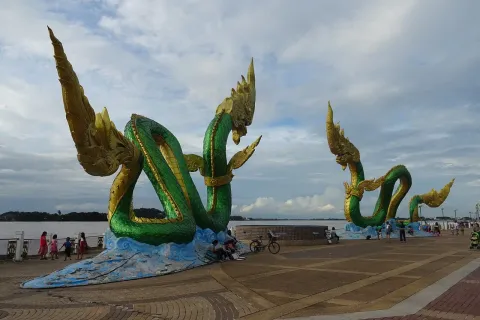
| If you only want the festival | Nong Khai town: the naga plaza on the riverfront in front of Wat Lamduan has the light-and-sound show, boat race, krathong floating and food street, but almost no fireballs. |
| Phra That Bang Phuan | Mueang Nong Khai district, about 23 km from town, daily 08:00 to 17:00, free. |
With one night, pick one district and stay there all evening. Driving between Phon Phisai and Rattanawapi means jammed roads in both directions.
What are the Naga fireballs?
Bang Fai Phaya Nak are pink-red lights that people on both banks of the Mekong believe rise out of the river. They range from thumb-sized to orange-sized, with no sound, smell, smoke or flame trail. They climb about 50 to 150 m above the water, last about 5 to 10 seconds and then go out sharply instead of fading. About 20 spots in Nong Khai province have seen them, most of them in Phon Phisai district, with the display lasting from sunset until about 22:00 to 23:00.
Before 1986 (B.E. 2529) people called them “ghost fireballs” (bang fai phi). The name Bang Fai Phaya Nak, the fireballs of the naga king, came afterwards, in line with local belief. So the night is not just a natural-phenomenon outing. For local people it is a night for honouring the naga, floating fire krathongs and making merit, and visitors should behave accordingly.
Is it only in Nong Khai?
No. The lights are seen along the Mekong through Nong Khai and Bueng Kan. In Nong Khai six riverside districts are named as viewing areas: Mueang Nong Khai, Tha Bo, Phon Phisai, Si Chiang Mai, Sangkhom and Rattanawapi. On the Bueng Kan side they are Mueang Bueng Kan and Pak Khat (Bueng Khong Long is an inland lake, not on the river). In practice most visitors choose Phon Phisai or Rattanawapi, because viewing areas there are set up for crowds.
Why the end of Buddhist Lent
Ok Phansa is the end of the three-month Buddhist Lent for monks, on the 15th waxing day (full moon) of the 11th lunar month. Locals say the naga sends the fireballs to honour the Buddha on the day he came back down from the Tavatimsa heaven. The weeks after are Kathin season. Ok Phansa is not a public holiday, but alcohol sales are normally banned nationwide on major Buddhist days, except in licensed hotels and approved venues. Check the current rule before you go.
When can you see the Naga fireballs?
The main night is the night of Ok Phansa, which follows the lunar calendar. The Gregorian date therefore changes each year. If you plan ahead, first check which date Ok Phansa falls on in your year, then look for flights, buses and rooms.
| Year | Ok Phansa night | Note |
|---|---|---|
| 2568 (2025) | Tuesday 7 Oct 2025 | About 290 lights counted, most of them in Rattanawapi |
| 2569 (2026) | Monday 26 Oct 2026 | More than 200 lights province-wide on the main night, about 150 of them in Rattanawapi, and about 100 more the next night |
| 2570 (2027) | About mid to late October | Check the lunar calendar and the provincial announcement before booking |
If you plan a trip for next year
Treat it as a rule, not a fixed date: the fireballs are tied to the full moon of the 11th lunar month. In 2026 that was late October, in 2025 early October, so next year's date will not match this year's. Rooms in the town and in Phon Phisai sell out early, so book a free-cancellation room first and confirm once the date is clear.
Dates and counts on this page are from past years. They do not promise the same next year. Check the Nong Khai provincial announcement before you travel.
Where to watch: Rattanawapi, Phon Phisai, Pak Khat or Nong Khai town
The most important choice is the district. Lights do not rise evenly everywhere, and each place feels very different. The table gives the summary and the sections below give details.
| Spot | Recent lights | Atmosphere | Best for |
|---|---|---|---|
| Rattanawapi (Nong Khai) | The most: about three quarters or more of all lights in the last three years | Spread over many villages, community feel, fewer people than Phon Phisai | Anyone who mainly wants to see lights |
| Phon Phisai (Nong Khai) | Fewer than Rattanawapi, and some spots have none on some nights | Riverside by Wat Thai, with stage, stalls, naga ceremony and the biggest crowd | Anyone who wants the festival feel and a nearby bed |
| Pak Khat (Bueng Kan) | Lights can rise, but it is not the main spot | Far fewer people than the Nong Khai side | Anyone staying on the Bueng Kan side |
| Nong Khai town | Almost none | Full festival: light-and-sound, boat race, krathongs, food street | Anyone who wants to stay in town and enjoy the event |
Rattanawapi: the most lights
In 2026 Rattanawapi had 13 viewing points along the Mekong, across many villages. The busiest were Ban Tan Chum and Ban Tha Muang, with about 15,000 to 18,000 people each that night. They were also among the spots with the most lights, about 25 to 30 each, as were Ban Nam Pe and Ban Nong Kaeo. Smaller villages such as Ban Ton Noi and Ban Ton Yai counted zero to one light in 2026. They are quiet, but if you came to see lights, pick one of the main spots and arrive early to claim a place.
By 2026 the road from Nong Khai to Rattanawapi was four lanes, with traffic officers along the route, but the night still brings jams in both directions.
Phon Phisai: the most festival
Phon Phisai is the place most people think of for the fireballs. The riverside by Wat Thai, in front of the district office, has a stage, shops and a ceremony to the naga king. In 2026 the ceremony began on the afternoon of Ok Phansa and people laid out mats, chairs and umbrellas from early afternoon in the heat. Other Phon Phisai viewing points used in recent years include the Chumphon subdistrict office, Ban Nong Kung Nuea and Ban Nong Kung Tai.
One thing to know: Phon Phisai and Rattanawapi do not get the same number of lights. In 2026 Rattanawapi had far more, and Phon Phisai fewer, with some spots seeing none. If you come mainly for the lights, choose Rattanawapi. If you bring a family who want stalls, a stage and more going on, Phon Phisai is easier.
Pak Khat (Bueng Kan): fewer people
The Bueng Kan side has viewing points on the Mekong bank in Pak Khat district. It is much quieter than the Nong Khai side and suits anyone already staying in Bueng Kan. It is not worth crossing over from Nong Khai just for this, because of the long drive and the heavy traffic on the night.
Nong Khai town: festival, but almost no lights
Nong Khai town has a big festival at the naga plaza on the Mekong in front of Wat Lamduan. In 2026 it ran from 22 to 28 Oct, with fire krathongs and banana-trunk krathongs floating on the Mekong, a parade of old long boats, a long-boat race for a royal trophy, a light-and-sound show about the naga legend, live music and a food street. It is the easiest base, but fireballs hardly rise at the town. To see them, head to Rattanawapi or Phon Phisai in the afternoon.
There is no festival shuttle to Phon Phisai or Rattanawapi. If you are not driving, agree a return ride with the driver in advance and ask clearly how long they will wait.
What the 2026 festival looked like
In 2026 Nong Khai ran the festival as “Miracle of NAGA: The Essence of Nongkhai 2026”. The programmes in each district overlapped like this:
- Mueang Nong Khai: 22 to 28 Oct, at the naga plaza on the riverfront in front of Wat Lamduan
- Rattanawapi: 24 to 26 Oct
- Phon Phisai: 25 Oct to 3 Nov
On the night of 26 Oct, provincial police put about 400 officers across the province, mostly on traffic, with rescue volunteers. Parents were asked to keep children close, and fireworks, firecrackers and sparklers were banned near the viewing areas.
How many lights actually rose
On Ok Phansa night 2026 the first light in Rattanawapi rose at about 18:00 to 18:20 and lights kept coming until about 21:00 to 22:00. Rattanawapi had about 150 lights and the whole province about 200. The busiest counts were at Ban Tha Muang, Ban Tan Chum, Ban Nam Pe and Ban Nong Kaeo, about 25 to 30 each. Some villages counted only a few or none. On 27 Oct the province counted about 100 more, so the two nights together came to about 300.
Compared with earlier years the numbers are falling: about 370 in 2024, about 290 in 2025, and more than 200 on the main night of 2026. Visitor numbers at Rattanawapi fell from the year before too. All of these are live counts on the night, so read them as a trend, not an exact value.
No one can promise how many lights you will see on any night, and last year's count does not predict the next. Go expecting that you may see fewer than in videos.
Plan the night: arrival, what to bring, crowds and traffic
When to arrive
Arrive at the popular spots from about 15:00 to 16:00 if you want a seat near the bank. Lights start about 18:00 to 18:30, but they come in bursts, sometimes silent for more than 20 minutes and then rising again. If you want to see many, plan to sit for several hours and do not leave after the first half hour.
What to bring
- A mat or folding chair: seating on the bank is limited and the ground can be wet after rain
- Water and food, since you will sit for hours
- A torch and mosquito repellent: the bank is unlit and the riverside has mosquitoes
- Cash: many stalls and vendors may not take cards
- Modest clothes for temples and ceremonies; many Thai visitors wear white
Crowds and traffic
In 2026 about 18,000 people were at Ban Tan Chum and about 15,000 at Ban Tha Muang in a single night, so the entrances and roads of small Mekong villages jam. Some riverside roads are closed or one-way at times. Add extra time for leaving, or stay near the viewing area and drive back to town in the morning.
Safety
The Mekong bank is unlit, uneven, often without railings and slippery after rain. Keep children in sight at all times, do not light firecrackers or fireworks near the viewing area and stay away from the water's edge in the dark.
Parking in Nong Khai town
For the town festival in 2025, free parking was opened at the municipality, Sawang Witthaya school, the municipal bus station, Wat Pho Chai and Yuwaburanbamrung school, with paid lots at several temples. Check the municipality's announcement again for next year.
Book rooms early
Rooms in Nong Khai town and Phon Phisai sell out and cost more in festival week. Book several weeks to several months ahead. If everything is full, Udon Thani is about 1 hour 30 minutes by car from the viewing area; check the real travel time before you go.
Where to stay
Nong Khai town is the easiest base. It has restaurants, the Tha Sadet market, the riverside night market and the town festival. But it means driving to Phon Phisai (about 50 km) or Rattanawapi (about 80 km) and back on a night when the roads are jammed. If the lights are the priority, staying near the viewing area cuts the travel on the night, since over the last three years most lights have been on the Rattanawapi and Phon Phisai side. For all options in town and along the river, see the where to stay page.
These two are in Phon Phisai. Prices and availability change by date, so enter your real dates on the booking page to see festival-night rates.
 Budget
Keerawan House Rim Khong
Wat Luang, Phon Phisai, on the Mekong
A budget stay on the Mekong at Wat Luang, Phon Phisai. It suits anyone who wants a bed near the Phon Phisai viewing area and a shorter journey than from Nong Khai town. Check the map pin for the walk to the riverside by Wat Thai.
See prices and availability on the booking page
 Budget
Rimfangkhong Hotel
Phisai Soradet Road, Chumphon, Phon Phisai
A budget hotel on Phisai Soradet Road, Chumphon subdistrict, Phon Phisai. It suits anyone driving to Phon Phisai who wants a room in the district. Chumphon is also the name of one of the Phon Phisai viewing points (the subdistrict office). Check the map for the real distance on foot.
See prices and availability on the booking page
If you come from Bangkok, train and bus tickets to Nong Khai may sell out early in Ok Phansa week. If you fly into Udon Thani, a van takes you on to Nong Khai.
Bangkok to Nong Khai on 12Go
From US$7 (Lowest fare as of 6 Nov 2026)
Price as of 6 Nov 2026Search trains, buses and other options from Bangkok to Nong Khai and compare times and fares for your real date. Tickets may sell out in festival week.
Book on 12GoUdon Thani Airport to Nong Khai on 12Go
From US$8 (Lowest van fare as of 6 Nov 2026)
Price as of 6 Nov 2026A van from Udon Thani Airport to Nong Khai for anyone who has flown in. Choose a shared or private van on the booking page.
Book on 12GoWhat causes the lights: belief and other explanations
No explanation is accepted by everyone, and nobody has reproduced the effect under natural conditions. These are the main ideas, in neutral order.
Local belief
People on both sides of the Mekong believe the naga in the river releases the fireballs to honour the Buddha on Ok Phansa, the day he descended from the Tavatimsa heaven. The belief is tied to the province's rituals and annual festival. If you go, respect it, even if you do not share it.
Natural hypotheses
Some suggest that methane and nitrogen from bacteria in the river bed rise and ignite on meeting oxygen as the air cools at night. A Thai doctor once collected gas from the Mekong that burned pink-red, and plasma-ball experiments have been done in labs, but nobody has produced the same effect in nature. Another hypothesis is phosphine, though critics say such a gas would be unlikely to ignite by itself or stay lit that long while rising, and one commentator notes that a methane and phosphorus mix is thought to give blue light rather than orange.
Claims about human activity
Some people have suggested the lights are man-made. A 2002 iTV documentary showed soldiers on the Lao bank firing tracer rounds. Skeptics argue the sound would not carry over the cheering crowd, while others dispute the claim and note that the phenomenon has been recorded for centuries before. A Thai biologist concluded from footage that flare guns were used from the far bank. In 2021 the Lao authorities stated after an investigation that it was extremely unlikely anyone fired weapons or flares without the authorities knowing.
You do not have to decide. Most people on the bank come for the evening itself: sitting by the Mekong among people waiting together is worth it without settling which explanation is right.
Photographing the Naga fireballs
A light lasts about 5 to 10 seconds, rises in bursts and the bank is dark, so photographing it is harder than it sounds. The picture at the top of this page is a long exposure: the lights show as bright streaks across the dark above the river, with people waiting on the bank.
- Put your camera or phone on a tripod or a steady surface; long exposures in the dark need stillness
- Use night mode or manual settings, and focus on a distant light on the far bank before the lights rise, because there is no time to focus on a light that lasts seconds
- Shoot repeatedly instead of waiting for a clear light before pressing
- Skip flash and do not shine a torch toward the water; it annoys the people around you and spoils pictures
- Keep time to watch with your own eyes. Real lights may be fewer than in videos, but a shot of the waiting crowd by the river is a good picture too
If you miss the lights on the night, the naga plaza on the Nong Khai riverfront is a much easier place to photograph, by day or in the evening. See the town and riverside page for how to visit it.
If you miss the main night: other nights and a different festival
In 2026 the province also counted about 100 lights on 27 Oct, the night after Ok Phansa. If it rains or the first night is packed, the next night is a reasonable plan B. There are fewer people and also fewer lights. Check locally which villages open viewing areas that night.
Do not confuse it with the Bang Fai rocket festival at Wat Pho Chai
The Bun Bang Fai at Wat Pho Chai in Nong Khai town, to honour Luang Pho Phra Sai, is held around the full moon of the 7th lunar month. It is a tradition of launching rockets into the sky and is a different event from the Naga fireballs at the end of Buddhist Lent. Check the date with the temple or the provincial tourist office. For Wat Pho Chai, see the town and riverside page.
Phra That Bang Phuan: an old temple, half a day from Nong Khai town
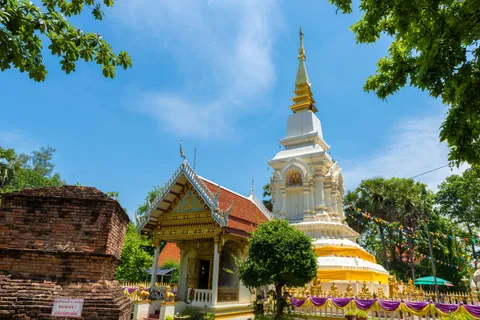
Phra That Bang Phuan is in Mueang Nong Khai district, Phra That Bang Phuan subdistrict (172 Moo 3), about 23 km from the town. Drive along Mittraphap Road (Highway 2) towards Udon Thani, turn right onto Highway 211 towards Tha Bo, and the temple is on the right. It is open daily from 08:00 to 17:00 and free for Thai and foreign visitors.
| Where | Mueang Nong Khai district, about 23 km from town |
|---|---|
| Hours | 08:00 to 17:00 daily |
| Entry | Free |
| Height of the chedi | 34.25 m, on a five-tier base 17.2 m wide |
| Time needed | About 45 to 60 minutes if you walk to the Sattamahasathan and the naga pond |
| Dress | Cover shoulders and knees; take off shoes before entering the hall |
The old chedi fell in 1970 and was rebuilt in 1976 to 1978
The original chedi was brick and collapsed in 1970 after the foundation sank. The Fine Arts Department then repaired it, and the chedi you see today was rebuilt in 1976 to 1978 following the original outline. It is 34.25 m tall on a five-tier base 17.2 m wide, a square body in the prang style with a bell-shaped top and stone Buddha images in alcoves. The Supreme Patriarch of that time also brought relics from Phra That Phanom to be placed in the new chedi.
Legend says five kings helped Maha Kassapa build Phra That Phanom, then fetched 45 relics from India and enshrined them in four places, 29 of them at Bang Phuan.
The Sattamahasathan and the naga pond
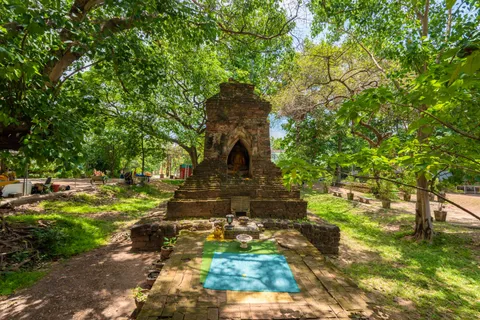
What sets this temple apart is the Sattamahasathan: seven structures standing for the places where the Buddha spent seven weeks after his enlightenment. They are Bodhi Ballang, Animisachedi, Ratana Chongkrom, Ratana Gharachedi, Ajapala Nigrodha, Mucalinda and Rajayatana. It is said that three places in the world have a Sattamahasathan: Bodh Gaya, Wat Chet Yot in Chiang Mai and this temple, and this is said to be the only one where all seven remain.
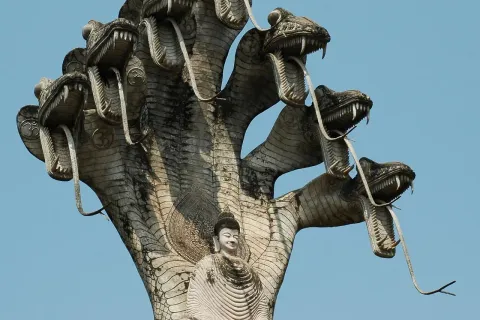
Nearby is the naga pond, Sa Mucalinda. The legend says a spring burst from the ground after the relics were enshrined, so a pond was dug, with a seven-headed naga figure in the middle. Its water is used in important provincial ceremonies. If you came for the fireballs, the pond shows another side of naga belief in Nong Khai.
Planning the stop
- Go before or after the fireball night. If you have to drive to Rattanawapi or Phon Phisai that day, stop here in the morning
- Go by car, motorbike or a taxi hired for half a day; agree the price and waiting time before you go
- Combine it with Wat Pho Chai and the First Thai-Lao Friendship Bridge in town in one day; see the one-day plan
- The temple holds an annual merit-making fair. If you want to visit during it, ask the temple or the Nong Khai provincial tourist office for the date
Frequently asked questions
What date are the Naga fireballs in 2026?
The night of Ok Phansa, Monday 26 Oct 2026 (15th waxing day of the 11th lunar month). Lights also rose the next night, 27 Oct. For 2027, expect about mid to late October and check the lunar calendar before you book a room.
Where is the best place to watch the Naga fireballs?
For the most lights, Rattanawapi has had the most in the last three years. For the festival feel, choose Phon Phisai at Wat Thai. Pak Khat in Bueng Kan has far fewer people, and Nong Khai town has the festival but almost no lights.
What time do the fireballs rise, and when should I arrive?
After dark. In 2026 the first light rose at about 18:00 to 18:20 and lights continued until about 21:00 to 22:00. Arrive from about 15:00 to 16:00 for a good place.
Is it free to watch the Naga fireballs?
Watching from the Mekong bank is free, but parking, seats or boats at some spots may cost money. There is no festival shuttle to Phon Phisai or Rattanawapi, so agree a return ride in advance.
How many fireballs will I see, and is it guaranteed?
It is not guaranteed. About 370 were counted in 2024 and about 290 in 2025. In 2026 more than 200 were counted province-wide on the main night, with about 100 more the next night. Some villages counted none on some nights.
Can I see the Naga fireballs from Nong Khai town?
The town hosts a full festival with a light-and-sound show, boat race, krathongs and a food street, but fireballs hardly rise there. To see lights, travel to Phon Phisai (about 50 km) or Rattanawapi (about 80 km).
What causes the Naga fireballs?
No explanation is accepted by everyone. Locals believe the naga releases them to honour the Buddha, some suggest gas from the river bed, and claims of human activity are disputed. The Lao authorities stated in 2021 that it was extremely unlikely anyone fired weapons or flares without the authorities knowing.
What should I bring?
A mat or folding chair, water, food, a torch, mosquito repellent and cash. Keep children close, since the bank is dark and often has no railings. No firecrackers or fireworks near the viewing area.
How far is Phra That Bang Phuan from Nong Khai town, and is it free?
About 23 km from town, in Mueang Nong Khai district. It is open daily from 08:00 to 17:00, free, and visitors should cover shoulders and knees.
What is the Sattamahasathan at Phra That Bang Phuan?
Seven structures standing for the places the Buddha spent seven weeks after his enlightenment. The temple is said to be the only place where all seven remain. Nearby is a naga pond with a seven-headed naga figure in the middle.
Where the facts come from
- Bang Fai Phaya Nak: dates, viewing areas and getting there (Grab Thailand, Thai)
- The Naga fireballs of Nong Khai (Thai Airways newsletter)
- Naga fireballs: viewing guide (Thai Holiday Guide)
- Naga fireball (Wikipedia)
- Naga fireball counts, 2025 (Nation Thailand)
- Rattanawapi count, 26 Oct 2026 (The Thaiger, Thai)
- Naga fireball totals, 26 and 27 Oct 2026 (Manager Online, Thai)
- Phra That Bang Phuan (Thai Holiday Guide)
Keep planning
 Plan Nong KhaiSala Kaeo Ku, the Mekong, the road to Sangkhom, naga fireballs, Vientiane
 Nong Khai in 1 day or 2 days 1 nightTimed town plan, the Mekong road to Sangkhom, adding a Vientiane day
 Nong Khai town and riversideSala Kaeo Ku, Wat Pho Chai, Tha Sadet, the promenade, the river stupa, food
 The Mekong road and SangkhomSi Chiang Mai, Wat Hin Mak Peng, Pha Tak Suea skywalk, waterfalls, mist
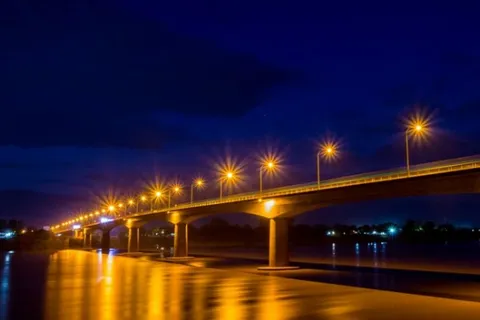 Crossing to Laos from Nong KhaiFriendship Bridge, train, bus, visas, what to bring, on to Vientiane
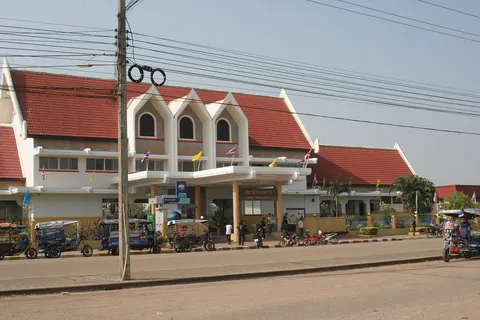 Getting to Nong KhaiTrain, bus, flight to Udon Thani then road, getting around town
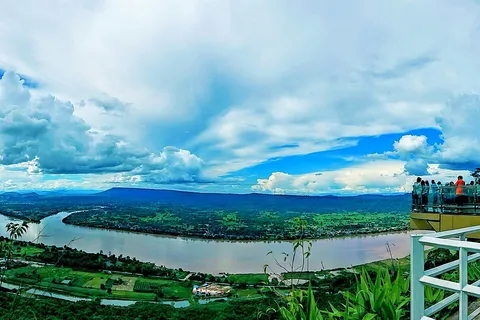 Where to stay in Nong KhaiRiverside, centre, Hat Kham, Sangkhom, Phon Phisai
 Nong Khai dealsTrain, bus and flight tickets, transfers, Vientiane tour