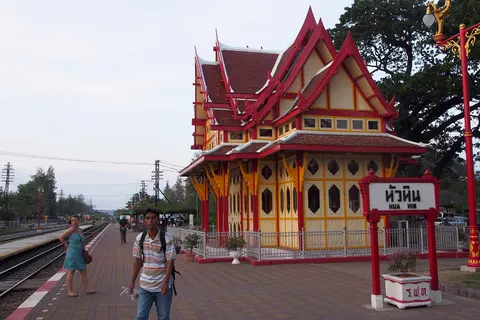
Most railway stations are somewhere you pass through. Hua Hin's is one that people visit on purpose. The royal waiting pavilion, painted red and gold, stands beside the platform with carved wooden gables that make it look more like a small palace than a waiting room. Next to it is the cream and red old station building, and a black steam locomotive stands on display in a garden by the tracks. Trains still stop here every day, so you can look at railway history while the real thing rolls in.
This page covers the station in three ways. First as a sight: what to see, when the light is good, how long to stay and how to photograph it politely and safely. Second as a building that changed in late 2023, when a new elevated station with lifts, escalators and a luggage room opened beside the old one. Third as a way in and out of Hua Hin: the morning train from Bangkok, the return train, the slower and cheaper options, fares by class, how to book on D-Ticket and how to get from the station to your hotel, the beach and the night market. Train times and fares here are approximate and can change, so check the State Railway of Thailand before you commit to a day.
We earn a commission if you book through our links. The price you pay does not change. How we choose
Quick facts before you go
| Fee to look around | Free. You only pay if you travel by train |
|---|---|
| Foreigner price | The same for everyone: nothing to pay to enter the station or the pavilion area |
| Opening hours | A working station, so it is open when trains run. Daylight is best for photos. If the time matters, call the station on 0 3251 1073 |
| Closing day | None. Trains run daily |
| Time needed | About 30 to 45 minutes for the pavilion, the locomotive and the old station building; longer if you wait for a train |
| How to get there | In the town centre, about 850 m from the beach and about 500 m from the night market. Walk, or take a tuk-tuk for a short ride |
| The sights | Phramongkutklao royal pavilion, steam locomotive no. 305, the old station building registered by the Fine Arts Department, and the new elevated station |
| To check times and fares | State Railway of Thailand: railway.co.th for timetables, dticket.railway.co.th for booking, hotline 1690 |
Plan the visit around a train, not the other way around. Seeing a train pull in gives the place its life, and it costs nothing to wait a few minutes with a drink from the shops nearby.
A short history: why this is called one of Thailand's prettiest stations
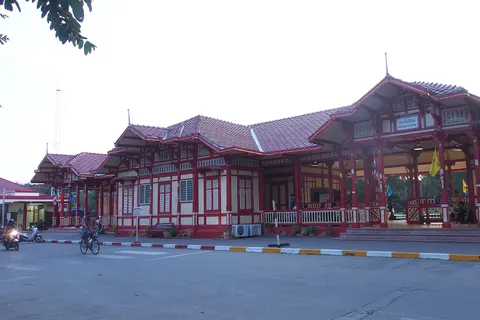
The Southern line reached Hua Hin in the early 1910s. The building that people photograph today dates from 1926, when Prince Kamphaengphet was in charge of the Royal State Railways. It is a half brick, half timber building with Victorian influence, painted cream with red, with decorative brackets on the posts.
Where did the royal pavilion come from?
The red and gold pavilion was not built at Hua Hin. It began as a four-gabled pavilion from the reign of King Rama VI at Sanam Chandra Palace in Nakhon Pathom, used as a royal point for boarding and leaving trains. The railway had it taken down and rebuilt at Hua Hin in the late 1960s, by Thai craftsmen, and it was opened on 6 April 1974 under the new name Phramongkutklao pavilion. That is why it feels like a small palace rather than part of a ticket hall.
From a ground-level station to an elevated one
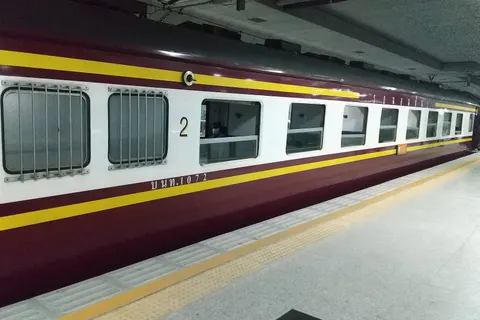
When the Southern line was doubled between Nakhon Pathom and Chumphon, Hua Hin station was rebuilt as an elevated station so that trains no longer cross the roads of Hua Hin town. The new station building opened on 11 December 2023. The old station building, the pavilion and the locomotive were not demolished. They are kept as a heritage site, the old building is registered with the Fine Arts Department, and the railway keeps it open for visitors to look around and photograph.
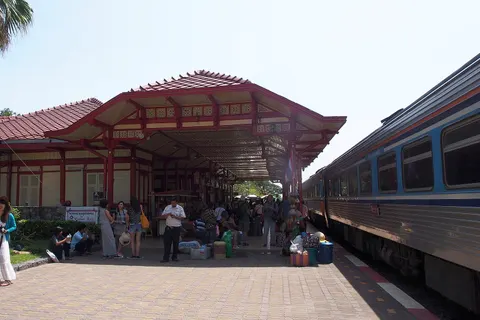
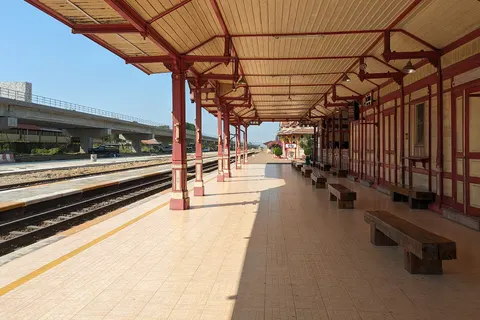
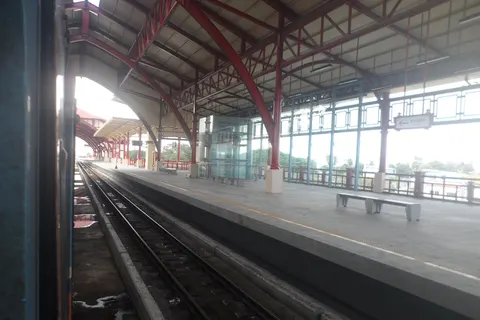
The ground-level platform in the photo above shows the station as it was before the elevated station opened. Passenger trains now stop at the elevated platforms of the new building, while the old building is for looking and photographing.
What to see: the pavilion, the locomotive and the old station building
Everything worth seeing sits within a few minutes' walk of each other, so this is an easy first or last stop of the day, and about 30 to 45 minutes is enough.
The Phramongkutklao royal pavilion
The pavilion has stacked roofs, carved wooden gables and a long row of narrow hexagonal windows. The colours, the carved trim under the eaves and the raised floor are the details to look at. It is an old wooden building, so walk gently, do not lean on the railings and do not climb onto things for a photo.
If the pavilion is closed off or a rope is in place, respect it and shoot from where you stand. Access can change on the day, so treat it as a sight you view and photograph rather than a museum you enter.
Steam locomotive no. 305
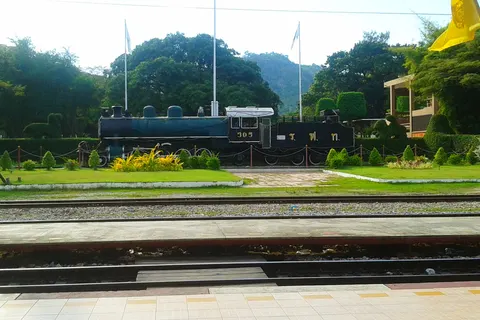
Locomotive no. 305 stands in a garden by the station with a rope around it. It is an old steam locomotive from before the Second World War, and it is the picture many people take: black iron, big wheels, the number 305 and the railway's initials on the side. It is a static exhibit. You can walk around it and photograph it, but do not climb on it, even if other visitors do.
The old station building and platform
The old station building is the heart of the visit. The red timber platform roof, the fretwork under the eaves and the long line of red posts make a Victorian-style railway picture in both morning and evening light. There are vendors and small coffee shops by the tracks, and passengers and staff still walk through, so photograph with care and do not block the way.
If a plaque on site says something different from this page, go by the plaque.
The new elevated station: lifts, escalators, luggage room and connections
If you arrive by train now, you step off at the elevated platforms of the new station building, which opened on 11 December 2023. It sits to the south of the old building, only about 30 to 40 m away. It has three floors plus a basement, and its roofs and red and cream tones were designed to match the old station, so it does not clash with the pavilion beside it.
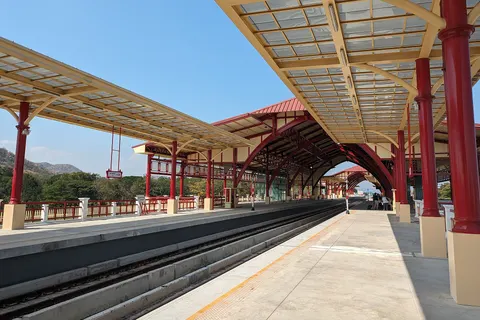
Platforms 1 and 2 each have escalators down to the basement that connects to the new building. There are also lifts, ordinary stairs and fire exits. Inside the building you will find toilets, a nursing room, a waiting room for monks, ticket counters and a luggage storage room. Ask at the station about the luggage fee and hours on the day.
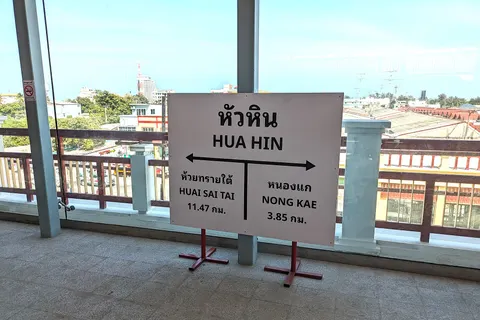
Who benefits from the lifts and escalators?
- People with big bags: use the lift instead of carrying luggage up and down stairs, especially when leaving the elevated platform.
- Older travellers and anyone who finds walking hard: there are lifts and escalators, but allow more time than you expect to reach the exit from the platform.
- Families with pushchairs: lifts help a lot. Arrive early so that nobody has to rush.
- Anyone with time before a train: leave your bag and go to see the pavilion and old building with empty hands.
The station changed shape only in late 2023, so signs, exits and which rooms are open may be adjusted. Follow the signs and staff on the day.
Photographing the station well and safely
The pavilion and the locomotive are very photogenic, and the best pictures come from patience, not from standing in the wrong place. A few ground rules:
- Never stand on or beside the tracks to pose. Trains can arrive quietly and quickly. Stay behind the platform edge and listen for announcements.
- Watch for trains the whole time. If you are lining up a shot with your eye on the screen, glance up every few seconds.
- Do not step into roped areas or onto the locomotive. If you want the pavilion without people in the frame, wait a minute for the group to move on.
- Be polite with people. Passengers and staff are going about their work. Ask before you photograph someone up close, and do not block doorways or the ticket window.
- Drones are not a good idea over a working railway and around royal buildings; leave yours in the bag.
For the pavilion, a slightly wide lens or the wide mode on a phone helps to fit the roof lines in. For the locomotive, step back to keep the number and the trimmed hedges together. Early or late light brings out the red and gold, while harsh midday sun flattens the colours and puts hard shadows under the roof.
Where to shoot for fewer people in the frame
The busiest time is mid-morning to early afternoon at weekends, when tour groups stop here. For a quiet pavilion, come early before the morning train arrives, or in the late afternoon when the light turns yellow. For trains arriving, stand well behind the yellow line, and do not use flash on an approaching train.
Trains to and from Hua Hin: how it works
Hua Hin is on the Southern line, and the long-distance trains from Bangkok now start from Krung Thep Aphiwat (also called Bang Sue Grand), not from Hua Lamphong. Some ordinary third class trains still start from Hua Lamphong or Thon Buri. The choice of station matters, so read the departure point on your ticket twice.
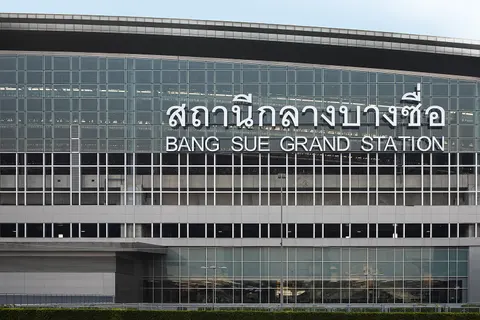
Times and fares below are approximate, and timetables are adjusted from time to time. Confirm them on railway.co.th or by calling 1690, and look at D-Ticket (dticket.railway.co.th), before you plan around any train.
Two ways to ride
- Express trains and other reserved-seat services: air-conditioned seats, booked ahead on D-Ticket or at a station. These suit most visitors.
- Ordinary third class: from about 44 baht, around 4.5 hours, bought at the station on the day with no reservation. It is slow, basic and local, and best for people who want the journey itself.
How long does the journey take?
The fastest morning train takes about 3 hours, most other trains take about 3.5 to 4.5 hours, and ordinary third class takes around 4.5 hours or more. A van or car usually takes 3 to 5 hours depending on traffic, so the train's strength is a predictable time on days when the road is jammed.
Train fares from Bangkok to Hua Hin by class
Fares depend on the type of train and the class of seat. This table gives approximate figures for budgeting. The real price is the one you see on D-Ticket or at the counter, because the railway can change fares and fees.
| Class and type | Approximate fare per seat | How to book | Best for |
|---|---|---|---|
| Third class, ordinary train | From about 44 baht | Buy at the station on the day, no seat reservation | Travellers who want the experience and are not in a hurry |
| Second class, fan | About 150 baht | Reserve ahead on D-Ticket | A budget traveller who wants a guaranteed seat |
| Second class air-conditioned and special express | About 330 to 430 baht | Reserve ahead on D-Ticket | Most visitors: air conditioning and a firmer timetable |
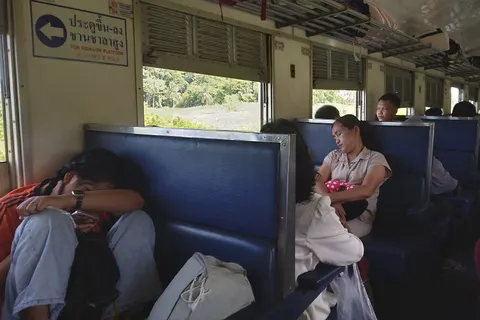
These ranges are for an adult one way from Bangkok. Children and older passengers may get special fares under the railway's rules, so ask at the ticket window. An online booking fee may be added. Sleepers and first class are not the main choice on this short daytime route.
To compare prices for your exact date, the 12Go booking box puts train, bus, van and taxi on one page. The cheapest train seat there can be lower than the air-conditioned fares above.
From Bangkok to Hua Hin by train
The train most visitors choose is the morning special express, a diesel railcar with air-conditioned seats. It leaves Krung Thep Aphiwat at about 07:30 and reaches Hua Hin at about 10:30. The fare is about 330 to 430 baht, so confirm the exact price on D-Ticket.
Other trains on the same line leave through the day. The table gives the pattern for planning, not confirmed times for each train, so check railway.co.th before you buy.
| Time of day | Leaves Bangkok (approx.) | Reaches Hua Hin (approx.) | Best for |
|---|---|---|---|
| Morning | About 07:30 | About 10:30 | A day trip, arriving in time for lunch |
| Later in the day | Check on D-Ticket | Check on D-Ticket; most trains take about 3.5 to 4.5 hours | Staying the night, with a later arrival |
Later trains work if you are staying the night, but you arrive late. For a day trip, the morning train is the comfortable one: you are at the beach in time for lunch.
How to book on D-Ticket
- Open dticket.railway.co.th (the State Railway's own booking system) and choose Bangkok (Krung Thep Aphiwat) to Hua Hin.
- Choose the date. Tickets open about 30 days ahead, so you cannot book for a trip further out. If a date will not select, read the message on the screen.
- Pick the train and the seats, and pay online. Keep the confirmation on your phone and bring your ID.
- If you cannot use the site, buy at a station ticket window or through a booking site, and compare the price with D-Ticket first.
Sundays sell out. Sunday is when many Bangkok residents come home from the coast. If your dates are fixed, book as soon as the window opens.
If the train is full or you want a different time, compare other ways to reach Hua Hin in the booking box below. It shows the train, bus, van and taxi on one page, with the cheapest option for a given date.
Going back to Bangkok from Hua Hin
The matching afternoon special express leaves Hua Hin at about 14:30 and reaches Krung Thep Aphiwat at about 18:00. The fare is about 330 to 430 baht. It is the one that fits a day trip, and if you want it, buy the seat when you buy the outbound ticket.
If that train is full or too early, your other choices are the later services, a bus or minibus from Hua Hin, or a car. Sunday evening is the worst traffic period on the road toward Bangkok, which is a good reason to prefer the train on that day.
If you spend the day at the beach, allow at least 40 minutes from your hotel to the station. You need time to wait for a ride, travel, walk through the entrance of the new station and then take a lift or escalator to the platform.
 12Go
Hua Hin to Bangkok on 12Go
From US$4
Price as of 5 Nov 2026Hua Hin to Bangkok on one page: train, bus, van and taxi compared. Cheapest options for Saturday 7 Nov 2026: train US$4, bus US$7, van US$8, taxi US$55. Prices change by date and seat, so check the day you travel.
Book on 12GoLeaving the station: hotels, the beach and the night market
The station is in the middle of town, so you do not need a long ride as you would in many resort towns. How you continue depends on where your hotel is and whether you carry big bags.
From the station to the beach
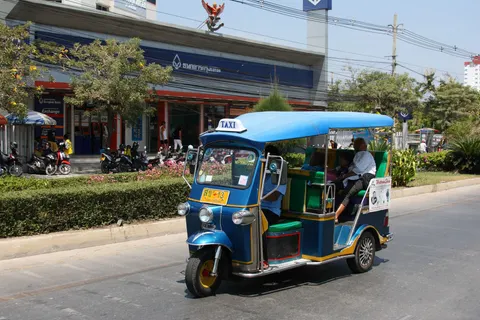
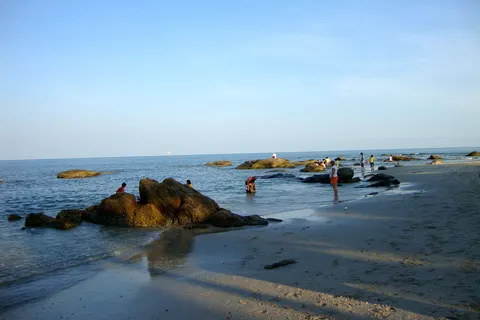
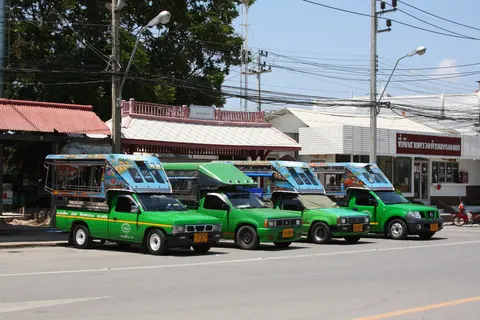
The beach is about 850 m away, a walk of roughly 12 to 15 minutes if you do not have heavy bags. Morning and evening are pleasant. At midday from March to May the sun is strong, so take a short tuk-tuk or songthaew ride instead. Tuk-tuks have no meter, so agree the price before you get in, and expect them to cost more than a songthaew on the same route.
From the station to the night market
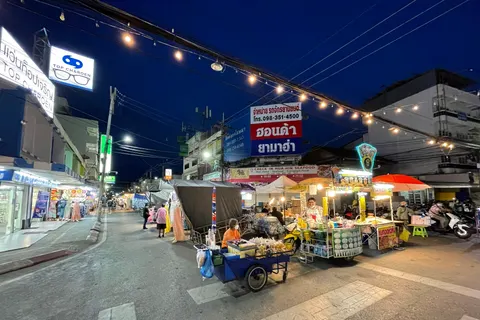
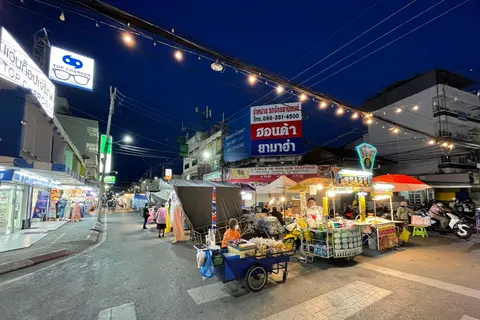
The Hua Hin night market is about 500 m from the station in a straight line, a few minutes' walk. It opens every evening from about 18:00 to 23:00, some stalls later, so read the markets page before you go. If you arrive in the evening, leave your bags and walk straight to dinner.
From the station to a hotel further away
If your hotel is on Khao Takiab beach or on the Nong Kae side, take a tuk-tuk or taxi (agree the price first), or book a transfer in advance if you are a group with many bags. The details of getting around town are in getting around Hua Hin.
Photos, prices and reviews from Klook
Private car between Bangkok and Hua Hin by N&T Travel, priced per car, with the start point chosen from central Bangkok, Suvarnabhumi or Don Mueang airport. The price changes with the car and the start point. A fit for families who do not want to carry bags to the station.
Book on KlookWhat is near the station
The station is in the middle of town, so you can combine it with other short stops without a long ride.
- The beach: about 850 m away, a walk of roughly 12 to 15 minutes. See the Hua Hin hub for how to plan a beach day.
- Night market: about 500 m away on foot; opening times vary, so read the markets page before you go.
- Khao Takiab: the hill and temple at the south end of the beach, about 6 to 7 km from the town centre and 10 to 15 minutes by car. See Khao Takiab.
- Getting around town: songthaews and tuk-tuks are the usual way. See getting around Hua Hin.
For a wider choice of areas and budgets, read where to stay in Hua Hin.
Where to stay near Hua Hin station
Staying near the station suits people who arrive by train, carry big bags or must catch an early train. The trade-off is a short walk or ride to the beach, while the night market and restaurants are nearer. The hotels below are on the town side; choose by budget.
 Budget
Chaba Chalet Hotel
Sa Song Road, 300 m from Hua Hin station
Budget hotel on Sa Song Road, about 300 m from the station. A fit if being close to the station matters more than being on the beach.
See prices and availability on the booking page
 Budget
The Moon Hostel Huahin
Town centre, beside the Clock Tower
Budget hostel in the town centre beside the Clock Tower, adults only, for travellers on a tight budget who want to stay in the walkable part of town.
See prices and availability on the booking page
 Upscale
Putahracsa Hua Hin
Central Hua Hin, near the night market
Upscale hotel in central Hua Hin near the night market, for guests who want comfort and a walk to the market without staying next to the station.
See prices and availability on the booking page
For every area and price level, read where to stay in Hua Hin.
Where to eat near the station
The station area is in the town centre, so there are restaurants and coffee shops both beside the tracks and on the streets around it. If you step off the morning train at about 10:30, you arrive in time for lunch. Walk out toward the town and pick a place where local people are sitting.
- Coffee and snacks: there are small coffee shops by the tracks, handy for anyone who arrives before the train leaves.
- Lunch: walk into town or toward the beach, where seafood and Thai restaurants are within walking distance.
- Dinner: the night market is about 500 m away and open daily, a good dinner before a night train or on the way back to your hotel. See the markets page.
If you take food onto a train, choose things that are easy to eat and not strongly scented, such as cut fruit, snacks or sticky rice with grilled pork, and take your rubbish back to a bin.
Sample plans that start at the station
Day trip by train, back the same evening
- Take the morning express from Krung Thep Aphiwat at about 07:30, and book the afternoon return at the same time.
- Arrive at about 10:30, leave your bag, and see the pavilion and locomotive in about 45 minutes.
- Walk or take a tuk-tuk to lunch near the beach, then walk along the sea.
- In the afternoon, if you still have energy, ride to Khao Takiab as described in Khao Takiab.
- Be back at the station at least 30 minutes before the train leaves at about 14:30.
This plan is tight because you have only about 4 hours in Hua Hin. For more, stay a night and read Hua Hin in 2 days and 1 night.
One night, starting with the morning train
- Arrive at about 10:30 and leave your bag in the luggage room or at your hotel.
- See the old station, pavilion and locomotive in about 45 minutes.
- Spend the afternoon on the beach and in town, and eat at the night market.
- Next morning choose one more stop, then take an afternoon train home.
A stopover while changing trains
If you pass through Hua Hin on the way south and have 2 to 3 hours, leave your bag, see the pavilion and old building, take your photos and have a coffee near the station. Do not go further, because you need time to cross between the platform and the basement.
With children or older travellers
Choose trains that leave and arrive in daylight, use the lifts and escalators rather than stairs, and stay near the station or the night market so nobody has to walk far. Avoid midday in the hot season by resting in an air-conditioned cafe, and hold small children's hands on the platform at all times.
Best time of day and year, and how long to stay
Time of day. Early morning and late afternoon give soft light on the red and gold paint and cooler air on the platform. Midday is harsh and hot, especially from March to May. If you arrive on the morning train, your first minutes here are already in good light.
Time of year. November to February is cool and dry, and the platform is pleasant. March to May is hot, and April and May are the hottest months. June to October is rainy, and the platform roof helps, though the pavilion is best photographed in dry weather.
How long. Plan about 30 to 45 minutes for the sight. Add the time you wait for a train, and the walk to the elevated platform, if you are leaving from here.
Rainy days. In heavy rain, look from under the platform roof and the veranda of the old building instead of walking around the locomotive. Brick and timber floors are slippery, so go slowly and wait out the rain in a coffee shop.
Thai long weekends and school holidays are the real crowd drivers on the Hua Hin line. Trains and the platform fill up, so book ahead on those dates.
Common mistakes at Hua Hin railway station
- Going to the wrong station in Bangkok. Most long-distance trains leave from Krung Thep Aphiwat, not Hua Lamphong. Read the station name on your ticket.
- Booking too late. Morning trains and Sundays sell out. If your date is fixed, book as soon as the system opens.
- Treating it like a museum with fixed hours. It is a working station with no entry fee and no sightseeing hours, so call if the time matters.
- Going at noon in the hot season. The sun is harsh and the photos are flat. Go in the morning or late afternoon.
- Climbing the locomotive or entering roped areas. It is bad manners and can be dangerous.
- Getting lost after the station change. Now that the station is elevated, exits and lifts are in several places. Follow the signs and ask staff.
- Not agreeing a tuk-tuk price. There is no meter, so agree before you get in.
- Leaving too little time for the return. You need to walk to the elevated platform by lift or escalator. Be at the station at least 30 minutes before departure.
If you do not want to plan: tours that stop at Hua Hin station
If the station is only one of several places you want to see, a day tour from Bangkok that stops at Hua Hin station saves you from planning the timings. Both tours below leave from Bangkok, not from Hua Hin.
 KKday
Hua Hin One Day Tour from Bangkok: Khao Luang Cave and Phra Nakhon Khiri
From US$57.61 (Starting price per traveller, joined tour)
Price as of 13 Nov 2026Hua Hin day tour from Bangkok, meeting near MRT Thai Cultural Centre exit 1. Stops include Khao Luang Cave, Phra Nakhon Khiri, Hua Hin station, Hua Hin beach and the Hin Lek Fai viewpoint. From US$57.59 per person on the join-in tour as of 5 Nov 2026; a private tour costs more. About 13 hours 30 minutes, free cancellation 2 days before.
Book on KKday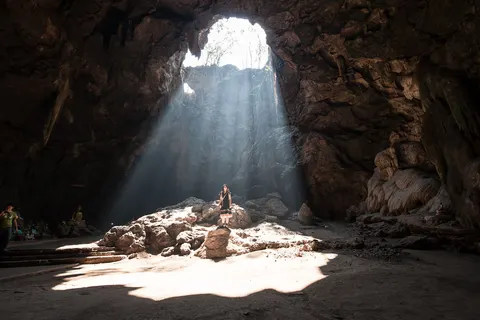 KKday
Hua Hin Private Day Tour from Bangkok: Tham Khao Luang, Phra Nakhon Khiri and Train Station
From US$256.84 (Starting price per set for 2 travellers)
Price as of 13 Nov 2026Private day tour from Bangkok with hotel pickup in Bangkok. Stops include Khao Luang Cave, the train station and a night market. From US$256.73 per set for 2 to 12 travellers as of 5 Nov 2026. About 13 hours, free cancellation 3 days before.
Book on KKdayPhotos, prices and reviews from Klook
Private driver, tolls, fuel and insurance. Admission and meals are extra. Route A: Khao Luang Cave, Hua Hin Railway Station, Memory House Cafe, Hua Hin Beach. Route B: Phra Nakhon Khiri. Duration: About 12 hours. See the booking page for cancellation.
Book on KlookBooking your way to Hua Hin
 12Go
Bangkok to Hua Hin on 12Go
From US$4
Price as of 5 Nov 2026Bangkok to Hua Hin on one page: train, bus, van and taxi. Cheapest options for Saturday 7 Nov 2026: train US$4, bus US$7, van US$8, taxi US$55. About 200 km, 3 to 5 hours by road depending on traffic. Compare departure times and pick the date you need.
Book on 12GoFor the train itself, the official place to confirm timetables and fares is the State Railway of Thailand. See the full overview in Bangkok to Hua Hin.
Frequently asked questions
Is it free to visit Hua Hin railway station?
Yes. Looking around the station, the royal pavilion and the locomotive costs nothing, for Thais and foreigners alike. You only pay if you board a train.
What is the red and gold building at Hua Hin station?
It is the Phramongkutklao royal pavilion. It began as a royal pavilion for boarding trains at Sanam Chandra Palace in Nakhon Pathom and was rebuilt at Hua Hin in the late 1960s. It is an old wooden building, so look and photograph without climbing on it.
What is locomotive no. 305?
A steam locomotive on display in the garden by the station, from before the Second World War. You can walk around it and photograph it, but not climb it.
When did the new Hua Hin station open, and is the old one still there?
The new elevated station building opened on 11 December 2023, about 30 to 40 m from the old one. The old building, the pavilion and the locomotive are still there for visitors to see and photograph.
Does Hua Hin station have lifts and a luggage room?
The new building has lifts, escalators, toilets and a luggage storage room. Ask at the station about the fee and hours on the day, or call 0 3251 1073.
What time is the morning train from Bangkok to Hua Hin?
The fast morning special express leaves Krung Thep Aphiwat at about 07:30 and arrives in Hua Hin at about 10:30. Confirm the time on railway.co.th or D-Ticket before you travel.
How do I get back to Bangkok by train?
The afternoon special express leaves Hua Hin at about 14:30 and reaches Krung Thep Aphiwat at about 18:00. Later trains also run. Check times and book on D-Ticket.
How much is the train from Bangkok to Hua Hin?
Air-conditioned and express trains cost about 330 to 430 baht, second class with a fan about 150 baht, and ordinary third class from about 44 baht but it takes around 4.5 hours with no reservation. Confirm the exact fare on D-Ticket.
How far ahead can I book, and do trains sell out?
D-Ticket opens about 30 days ahead. Sundays and morning trains sell out, so book early for those dates.
How far is the station from the beach and the night market?
The beach is about 850 m away, a 12 to 15 minute walk. The night market is about 500 m away, a few minutes on foot. With big bags or in the heat, take a short tuk-tuk ride and agree the price first.
Where the facts come from
- State Railway of Thailand (timetables)
- D-Ticket, State Railway of Thailand booking
- 12Go: Bangkok to Hua Hin
Keep planning
 Plan Hua HinHow many days, what to see, fees, where to stay
 Hua Hin in 2 days, 1 nightHour-by-hour plan, evening market, beach, costs
 Hua Hin and Cha-am in 3 daysAdds Phraya Nakhon Cave, Pala-U and Cha-am
 Hua Hin tickets and toursWater parks, tours and transfers with prices
 Where to stay: Hua Hin, Cha-am, PranburiPick the area first, then the hotel
 Bangkok to Hua HinTrain, bus, van and private car
 Getting around Hua HinSongthaew, taxi, tuk-tuk, car hire and walking
 Vana Nava Water JungleTickets, prices, hours and Black Mountain compared
 Cicada, Tamarind and the night marketOpen days, hours and how to do them in one evening
 Khao TakiabTemple stairs, monkeys, the beach and seafood
 Phraya Nakhon CaveFees, walk or boat, and the best light
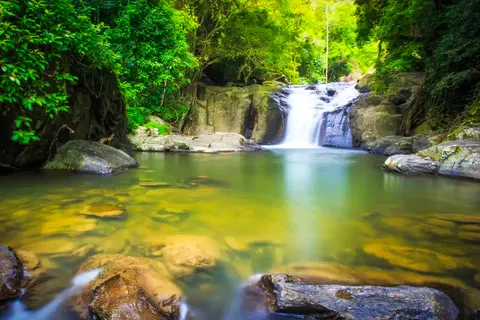 Pa La-U WaterfallFees, the trail and when the water runs
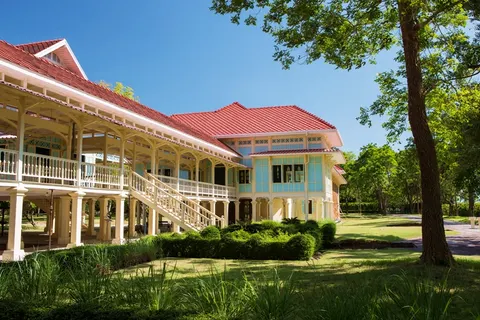 Mrigadayavan PalaceThe teak halls by the sea, dress code and closing day
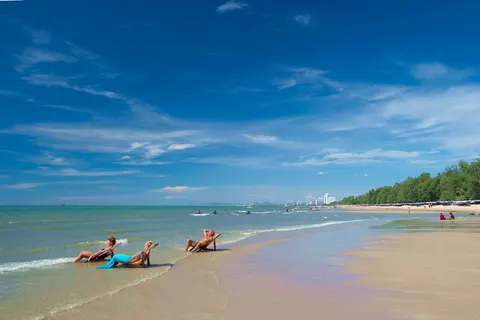 Cha-am beachA long beach, weekend crowds and family stays
 Swiss Sheep Farm, Cha-amEntry fee, advance ticket, feeding animals and how to get there