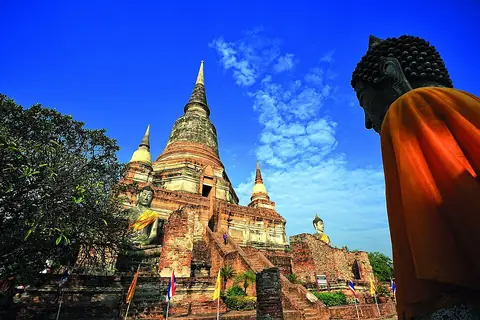
Wat Yai Chai Mongkhon began as Wat Pa Kaeo, founded in 1357 under King U Thong. Today's name comes from the great chedi that King Naresuan ordered built in 1592 after his victory over the Burmese crown prince in an elephant duel. The chedi is about 62 m tall, the highest in Ayutthaya province, and you can see it from far down the road before you reach the gate.
Unlike Wat Mahathat or Wat Ratchaburana, which are ruins, this is a living temple with resident monks and worshippers every day. You walk it like any Thai temple: climb the chedi stairs, drape a cloth on the reclining Buddha, visit the King Naresuan hall at the back, and photograph the long rows of seated Buddhas that everyone remembers.
The fee is set by the temple and can change, so check the sign at the gate when you arrive. This page covers the history, a walking order, the chedi climb, photo spots, manners, every way to get here, sample plans, a budget and where to stay.
We earn a commission if you book through our links. The price you pay does not change. How we choose
Quick facts before you go
| Entry fee | About 20 baht, collected by the temple, not part of the 7-site combo ticket. Foreign visitors pay at the sign; Thai visitors often enter without a fee, so ask at the gate. Carry small cash |
|---|---|
| Opening hours | About 08:00 to 17:00 every day. Check the sign at the gate when you arrive; hours can shift on Buddhist holy days |
| Time needed | About 1 to 1.5 hours. Allow 1.5 to 2 hours if you climb the chedi, visit the reclining Buddha and walk to the King Naresuan hall |
| Highlights | Chedi about 62 m tall, white reclining Buddha, rows of seated Buddhas in orange robes, the ordination hall, Sitthichai shrine, King Naresuan hall |
| Where | Khlong Suan Phlu, south-east of the old island, about 1 km past Wat Phanan Choeng. Phone 0 3524 2640 |
| Getting there | Tuk-tuk, scooter, bicycle, car, or a day tour from Bangkok. Large parking area at the gate |
| Dress | Cover shoulders and knees; take off shoes where signs say so |
| Best for | Anyone who wants a living temple, a big chedi and a shorter visit than the island ruins |
This is a working temple. If monks are chanting or a ceremony is under way, keep your distance, lower your voice and photograph only what is appropriate.
A short history that makes the walk make sense
The temple began as Wat Pa Kaeo, also called Wat Chao Phraya Thai. By the usual account King U Thong founded it in 1357 as the home of a forest-monk order whose monks had gone to study in Sri Lanka and come back. The order was highly respected in Ayutthaya, and its head was named Somdet Phra Wanarat, the Supreme Patriarch of the right. The temple mattered long before the big chedi existed.
The new name came in 1592. King Naresuan the Great defeated the Burmese crown prince in an elephant duel at Nong Sarai in Suphan Buri. The usual story says the monk Phra Wanarat asked the king to spare soldiers who had failed to keep up in the pursuit and suggested building a chedi as a memorial. That became the Chedi Chai Mongkhon, and the temple became Wat Yai Chai Mongkhon. Whether the chedi was built from scratch or enlarged around an older one is not clear.
Earlier, in 1561, the temple is said to have hosted the nobles who planned to remove the usurper Khun Worawongsa and bring Prince Thianracha to the throne. You cannot see that story in the bricks, but it shows why the temple mattered to the court both before and after Naresuan.
After the fall of Ayutthaya in 1767 the temple was abandoned like the others in the city. Monks and nuns later returned and rebuilt it as a meditation centre, and around 1957 it became a working village temple again. The Fine Arts Department registered it as a national monument in 1935. That double status, protected ancient site and living monastery, is why it charges its own fee and runs differently from the Historical Park temples.
Every Visakha Bucha day the temple holds a procession to wrap a new cloth around the chedi, starting with morning alms. If you visit that day expect crowds, and expect some areas to be roped off for the ceremony.
Do not confuse it with other temples called Wat Chai Mongkhon in other provinces. On a map, search for Wat Yai Chai Mongkhon, Ayutthaya.
Wat Mahathat: a royal ruin with no resident monks, for comparison
What to see, in walking order
The grounds are wide and open, with the great chedi in the middle. The easiest route is to start at the chedi, follow the rows of Buddhas around it, visit the reclining Buddha, stop at the ordination hall and finish at the King Naresuan hall at the back. Treat the order as a suggestion: if a ceremony is on, skip that spot and come back.
1. The Chedi Chai Mongkhon
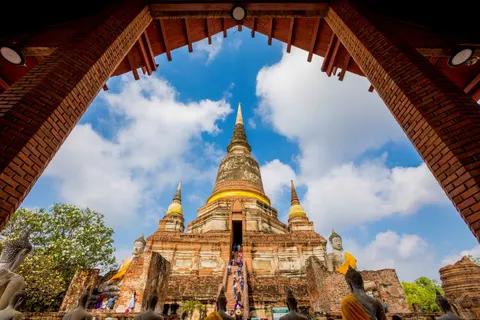
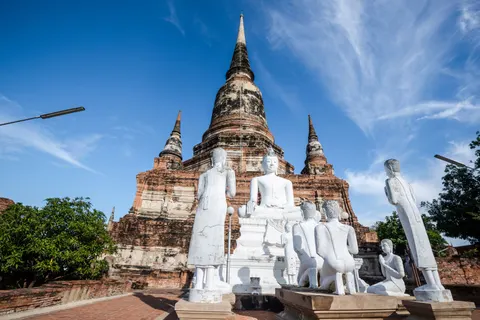
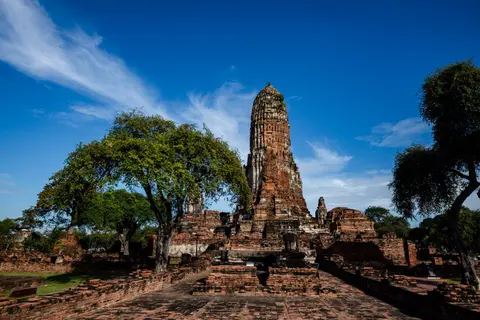
The bell-shaped chedi stands on a square base about 15 m high and about 32 m on each side. The total height from the base to the tip is about 62 m. Four smaller chedis, each about 12 m tall, mark the corners of the base. A yellow or orange cloth is wrapped around the waist of the main chedi, put there by worshippers. At the front, a white seated Buddha sits with standing and kneeling disciples on either side, and this is the most photographed view in the temple.
People say an older, smaller chedi sits inside the present one, and that it holds the Buddhist victory verses (the Bahum chant). That is why many visitors come to ask for success and good luck. To see the full height, walk to the far end of the front courtyard and step back as far as you can; only then does the whole chedi fit in one frame.
2. The chedi stairs and the room at the top
You can climb the front stairs to the terrace that runs around the middle of the chedi, not to the tip. There is a small room where you can pay respects to a Buddha image, and from the terrace you see the whole courtyard and the trees around the temple. The brick steps are steep, narrow and worn. Go up and down slowly, use a handrail where there is one and do not climb at the same time as a crowd. Follow the signs, stay on the open route and never cross a rope or barrier.
If you wear loose flip-flops or the steps are wet after rain, skip the climb. Visitors with weak knees get just as good a view from the courtyard.
3. Rows of seated Buddhas in orange robes
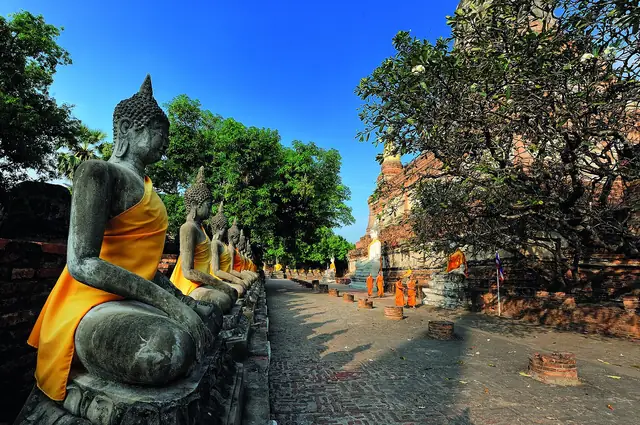
Stone Buddha images in the subduing-Mara posture sit in a long line on a brick wall around the chedi, each wrapped in an orange or yellow cloth. This is the view the temple is known for. The cloths are offerings brought by worshippers; they are not part of the statues. Do not sit on the base, climb the wall or touch the robes. Photograph from the walkway.
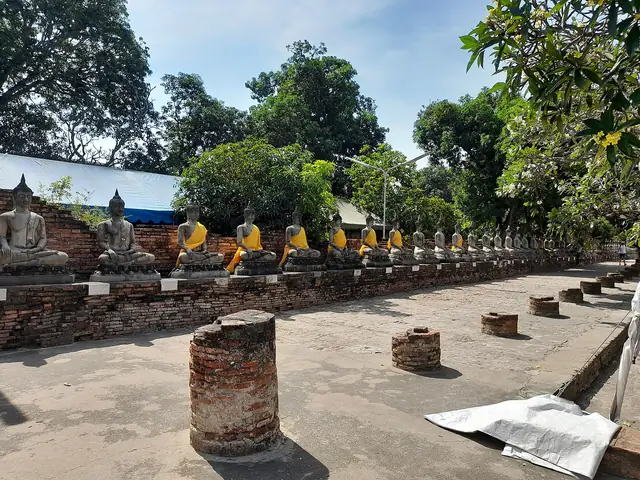
The path inside the row is brick and in places bare earth. In the morning the shadows of the Buddhas stretch along the path; in late afternoon the light falls on their faces, so the same row looks different. Low brick stumps scattered across the courtyard are the remains of earlier buildings and make good leading lines in a photo.
4. The reclining Buddha
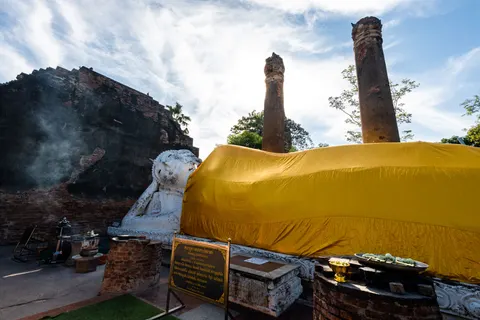
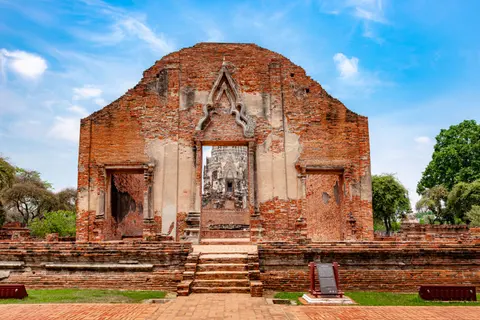
A white reclining Buddha, wrapped in a yellow cloth, lies in the Wihan Phra Buddha Saiyas, a hall that dates from King Naresuan's time. Only two brick pillars and part of the walls of the original hall remain, and the image was restored in 1965. Local people come to drape a cloth on the Buddha and pray for success, kindness or protection from misfortune. Cloths are for sale at the temple at the posted price. Take off your shoes before you go close, and never point your feet at the image.
5. The ordination hall and the Sitthichai shrine
The present ordination hall was built in 1979 on a smaller scale than the original so as to protect the ancient remains. Inside is the sandstone main Buddha, Phra Phutthachai Mongkhon, in the subduing-Mara posture. In front stands a replica of Phra Phutthachinnarat where you can light incense and candles and apply gold leaf. Nearby is the Chao Pho Sitthichai shrine, a building of golden teak, where local people come to pray for children and for good luck in general.
6. King Naresuan hall and monument
At the back of the temple stands the hall of King Naresuan the Great, started in 1992 and completed in 2001. Inside is a royal monument showing the king pouring the water of independence. Worshippers whose wishes have come true leave offerings such as garlands, statues of fighting cocks, soldier outfits and Thai boxing outfits, so you will see roosters of every size. It is quieter than the chedi courtyard and a good place to stand for a quiet moment before you leave.
Wat Phra Si Sanphet and Wihan Phra Mongkhon Bophit on the island
Photographing Wat Yai Chai Mongkhon
The subjects are large and the courtyard is open, so photos come out easily. The usual mistake is to stand square in front of the chedi and press the button, which gives a flat picture. Try these instead.
- The full chedi: walk to the far end of the front courtyard, leave space above so the tip does not touch the frame, stand a little off centre and crouch for a low angle. The chedi looks much taller.
- The rows of Buddhas: stand at the end of the walkway and shoot back along the line, so the near statues are big and the far ones stack up. The line of statues leads the eye to the chedi.
- Through the brick gateway: use the brick frame of the entrance as a frame, with the chedi inside it. Wait for a moment when nobody is walking through.
- Monks: photograph from a distance or ask first, and never use a flash. Monks walking along the rows of Buddhas make a lovely picture, but do not disturb them.
- The reclining Buddha: shoot from the side with the two brick pillars behind. Avoid your own shadow on the cloth and never stand above the Buddha's head.
- A high view: climb the chedi stairs for a shot of the courtyard from the middle terrace. Hold your camera or phone firmly and do not step back near an edge.
The best light is 08:00 to 10:00 and again from about 15:30 until closing. At midday the light is overhead, the shadows are short and the brick looks flat. On a phone, lower the exposure slightly to keep the sky blue and the brick orange. The temple closes at about 17:00, so it is not a sunset spot. For sunset, go to Wat Chaiwatthanaram in the evening.
Making merit and temple manners at an active monastery
Monks live here and local people pray, drape cloths and leave offerings every day. The rules are stricter than at the ruins in the Historical Park.
- Cover your shoulders and knees. No sleeveless tops, short shorts or short skirts. If you forget, carry a light scarf or sarong to wrap around yourself.
- Take off shoes before entering any building with a sign, and take off your hat when you get near the main Buddha.
- Sit with your feet tucked behind you when you pay respects. Never point your feet at a Buddha image and never sit higher than the image.
- Do not climb on the bases of Buddha statues, and do not pose in ways that treat an image as a prop, for example with your back to it, making a joke gesture.
- Women should not touch a monk or hand things directly to him. Place an offering on a cloth he holds out, or on a table.
- Make merit as you wish: drop money in the donation box or buy flowers, incense and candles set out by the temple. There is no set amount.
- Light incense and candles and apply gold leaf only where the temple has set out places for them. Do not stick incense into the brick ruins.
- Keep your voice down. No loud music or phone calls in the courtyard, and let children walk rather than run.
- If monks are chanting or a ceremony is under way, wait at a distance or skip that spot and come back.
On the offerings at the King Naresuan hall: if you do not share the belief, you do not need to buy anything. Standing quietly with your palms together is enough. If you do want to leave something, ask the price before you pay.
Wat Lokayasutharam and the open-air reclining Buddha, a good pairing
Children, older visitors and wheelchairs: how easy is this temple?
It is easier than most temples in the park. The courtyard is open and mostly flat, and there is a large parking area near the entrance. The hardest part is the chedi stairs.
| Visitor | How far can they go | Advice |
|---|---|---|
| Small children | All of the courtyard; the chedi stairs are steep and narrow | Hold hands the whole way up and down. Do not let children run along the rows of Buddhas. Keep them within arm's reach |
| Older visitors | The courtyard is flat and there is room to rest; the chedi stairs are very steep | See the chedi from the courtyard, then visit the reclining Buddha and the ordination hall. Skip the stairs if knees are weak |
| Wheelchair users | Most of the courtyard is brick and concrete, uneven in places | The front courtyard and the ordination hall are reachable. The chedi stairs are not. Ask at the temple which routes a wheelchair can use |
| Fear of heights | The middle terrace is not as high as the tip, but the steps are steep | Skip the stairs. The view of the Buddhas and the chedi from below is just as good |
Shade is limited, and the brick courtyard gets very hot by mid-morning. Bring water, a hat and thin socks for when you have to take off your shoes at a building. Go before 10:00 or after 15:30.
Tuk-tuk, bicycle and ferry on the island, with price warnings
How to get to Wat Yai Chai Mongkhon
The temple lies outside the island to the south-east, about 1 km past Wat Phanan Choeng. By tuk-tuk from the central temples it takes about 10 to 20 minutes depending on traffic.
| Option | Best for | Notes |
|---|---|---|
| Tuk-tuk | Anyone who does not want to cycle far in the sun | Agree the price per vehicle before you get in. About 200 to 300 baht an hour, or roughly 800 to 1,500 baht for a 3 to 4 hour temple circuit; a single tuk-tuk hop between two temples is 60 to 100 baht. Tell the driver whether to wait |
| Bicycle | Cool mornings and the cooler months | About 50 to 100 baht a day to rent a bicycle. The temple is outside the island and farther than the central temples; in the heat a tuk-tuk is easier |
| Scooter | Confident riders with a licence | About 200 to 300 baht a day to rent a scooter, and you can park at the gate |
| Private car or taxi | Families and groups | There is a large car park at the gate. Type Wat Yai Chai Mongkhon, Ayutthaya into your map app and follow its route; the temple is about 1 km past Wat Phanan Choeng |
| Day tour from Bangkok | No planning | Ask the operator beforehand whether this temple is on that day's stops, because some programmes cover only the island temples |
If you arrive by train, take the ferry across the river for about 5 to 10 baht, then a tuk-tuk out to the temple. If this temple is your main goal, agree a tuk-tuk price for the round trip at the pier.
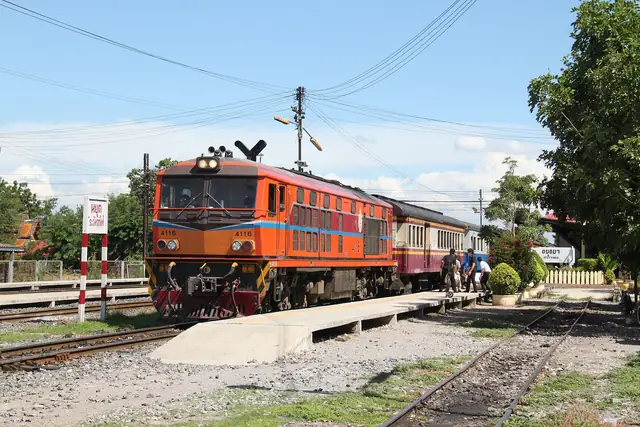 12Go
Bangkok to Ayutthaya on 12Go
From US$2
Price as of 5 Nov 2026Book Bangkok to Ayutthaya train, van or bus tickets in advance. Trains start from US$2 and vans from US$5 (as of 5 Nov 2026).
Book on 12GoTuk-tuk, bicycle and ferry on the island
Bangkok to Ayutthaya: BNEX train, van, bus and boat compared
Pair Wat Yai Chai Mongkhon with other stops: sample plans
Because it is outside the island, treat it as one block of your day instead of a separate trip. Hire a tuk-tuk for the half day or drive, and agree a single price for the route.
Half-day plan with a tuk-tuk: island first, then out
- 08:00 Wat Mahathat and Wat Ratchaburana, about 1.5 hours, before the sun is strong.
- 09:45 Wat Phra Si Sanphet and Wihan Phra Mongkhon Bophit.
- 11:30 Lunch and a rest somewhere air-conditioned.
- 14:00 Tuk-tuk to Wat Phanan Choeng, about 20 minutes' ride and about 30 minutes there.
- 15:00 Wat Yai Chai Mongkhon, 1 to 1.5 hours. Climb the chedi when the sun has softened. It stays open until about 17:00, so there is no rush.
Full day by car
- 08:30 Arrive at Wat Yai Chai Mongkhon before the crowds, park at the gate, climb the chedi and shoot in the morning light.
- 10:00 Wat Phanan Choeng, another active temple that charges its own entry fee, about 20 baht, open about 08:00 to 17:00.
- 11:30 Lunch nearby, then drive into town.
- 13:30 Wat Mahathat and Wat Ratchaburana.
- 15:30 Wat Phra Si Sanphet, about 1 hour.
- 16:45 Arrive at Wat Chaiwatthanaram and buy your ticket before the ticket window closes at about 17:00, then walk around and watch the sun go down by the river at about 17:30 (you can stay in the temple until about 18:00).
If you only have one day and no car
This is the easiest temple to cut when time is short and you have no vehicle, because it is farther out than the rest. If you like living temples and big chedis, swap it for Wat Ratchaburana rather than adding it on top. Too many similar temples in one afternoon is tiring and adds little.
If you would like a guide who speaks English or Japanese and no bargaining, there is a small-group tour from Bangkok that travels by tuk-tuk between temples in Ayutthaya and stops at a cafe.
Photos, prices and reviews from Klook
A 9.5-hour small-group day trip from Bangkok that uses tuk-tuks between temples and stops at a cafe, with an English and Japanese guide and free cancellation 24 hours before. Ask the operator whether Wat Yai Chai Mongkhon is on the route (as of 5 Nov 2026).
Book on KlookAyutthaya in one day, hour by hour
Ayutthaya in two days and one night, with less rushing
Best time of day and year
The cool hours from 08:00 to 10:00 and the late afternoon from about 15:30 until closing are the most comfortable. The light is good and there are fewer visitors than when the tour coaches arrive. From midday to 15:00 is the hottest part of the day, and the brick courtyard and the chedi steps are too hot to walk on barefoot.
| Month | Weather | Advice |
|---|---|---|
| November to February | Cool and dry, the best season | Fine all day, but busiest at the year end. Come early for quiet photos |
| March to April | Very hot; April highs near 36 C | Go before 10:00 or after 15:30. Carry water, climb the chedi slowly and rest often |
| May to October | Rainy season, rain usually in the afternoon | Visit in the morning and carry an umbrella or a rain jacket. Steps and paving are slippery after rain, but skies after a shower are often beautiful and the temple is less crowded |
Weekends and Buddhist holy days bring more worshippers. That adds atmosphere but also crowds in places. For quiet photos, come on a weekday. Visakha Bucha is especially busy, so come early and allow time to park.
If it rains or the sun is too strong
- Almost all of the temple is outdoors. There is some shade from trees and a roof over parts of the reclining Buddha area. In a heavy downpour wait in a shop or your car for 20 to 30 minutes; afternoon rain usually passes quickly.
- In strong sun, see the reclining Buddha and the ordination hall first and leave the chedi for after 15:30.
- If it rains all day, switch to the Chao Sam Phraya National Museum, an indoor building open about 09:00 to 16:00 and closed on Mondays.
Where to eat near Wat Yai Chai Mongkhon
There is no sit-down restaurant inside the grounds, so look for places along the roads near the temple or in town. Boat noodles are a famous Ayutthaya dish, served in small bowls so you can order several, and they suit the end of a hot walk.
- Before you go in: buy cold water and eat something light before the chedi stairs. Do not climb hungry or thirsty.
- After the walk: find a restaurant or boat noodle shop on the roads near the temple, so you do not have to go straight back into town.
- If you want air conditioning: go back into town and pick a riverside or air-conditioned restaurant. From noon to 15:00 is the time to rest.
- Snacks and gifts: roti sai mai (thin roti wrapped around cotton-candy threads) and local Ayutthaya sweets are sold outside popular temples and in town markets.
Boat noodles and simple rice dishes are inexpensive. Check the menu price or ask before you order and carry cash. Cash machines are in town and along the main roads, not inside the temple.
Budget for a visit to Wat Yai Chai Mongkhon
| Item | Rough cost | Notes |
|---|---|---|
| Temple entry fee | About 20 baht | Collected by the temple, not in the 7-site combo ticket. Thai visitors often pay nothing; ask at the gate |
| Merit-making: incense, flowers, candles | As you wish | Use the donation box or buy what the temple sets out. There is no set amount |
| Tuk-tuk from the central temples | About 60 to 100 baht per hop between two temples | A half-day tuk-tuk hire is about 800 to 1,500 baht per vehicle, shared by 3 or 4 people |
| Bicycle hire | About 50 to 100 baht a day | The ride out of the island is longer than it looks. Fine in the morning in the cool season |
| Lunch | About 100 to 250 baht a person | Boat noodles or a simple rice dish |
| Full-day tour from Bangkok | From about US$23.91 on KKday | Hotel pickup in Bangkok. Ask the operator whether this temple is on that day's stops (as of 5 Nov 2026) |
Example for two people sharing a half-day tuk-tuk: the tuk-tuk fare is about 400 to 750 baht each, the temple entry fee is about 20 baht, and lunch about 100 to 250 baht, so about 520 to 1,020 baht each. That does not include entry fees at other temples on the route or the train or van fare from Bangkok.
Common mistakes at Wat Yai Chai Mongkhon
- Assuming the 7-site combo ticket covers it: the temple collects its own fee, so you still pay about 20 baht at the gate even if you have the combo ticket.
- Going at midday: the brick courtyard and the chedi steps are scorching. Go in the morning or late afternoon.
- Hiring a tuk-tuk without agreeing to wait: ask whether the driver waits at the gate and pay only when the trip is over.
- Climbing the chedi in slippery shoes: the brick steps are steep and worn. Wear shoes with grip, not loose flip-flops.
- Standing in front of someone who is praying: the hall of King Naresuan and the reclining Buddha always have worshippers. Wait for a gap or photograph from the side.
- Arriving just before closing: be here by about 16:00 at the latest so you do not rush the chedi stairs.
- Mixing it up with another temple: the name sounds like Wat Chaiwatthanaram. Check the name before you tell the driver.
Where to stay near Wat Yai Chai Mongkhon
Khlong Suan Phlu is close to this temple and to Wat Phanan Choeng. If you have a car or want to see the south-east in the morning, staying here saves you crossing town. If you want evening walks at the market and meals by the river, choose Hua Ro or the riverside in the old town.
 Budget
HOP INN Ayutthaya
Khlong Suan Phlu
Budget, in Khlong Suan Phlu on the way to Wat Yai Chai Mongkhon. A fit for visitors with a car or a tuk-tuk who want to be at the temple before the crowds.
See prices and availability on the booking page
 Upscale
Centara Ayutthaya
Khlong Suan Phlu
Upscale, in Khlong Suan Phlu. A fit for families or anyone who wants a comfortable hotel after a day of temples.
See prices and availability on the booking page
 Mid-range
Ayothaya Riverside Hotel
Hua Ro, on the river
Mid-range, on the river in Hua Ro. A good base if you want to sleep by the water and see the island temples the next day.
See prices and availability on the booking page
Tours and tickets that fit this temple
Most full-day tours from Bangkok focus on the temples inside the old island. Ask the operator beforehand whether Wat Yai Chai Mongkhon is on the day's route. If it is the one temple you want, hire a tuk-tuk in Ayutthaya instead.
Photos, prices and reviews from Klook
A 9.5-hour tour with hotel pickup, join-in or private, covering the historical park and Bang Pa-In Royal Palace (as of 5 Nov 2026).
Book on Klook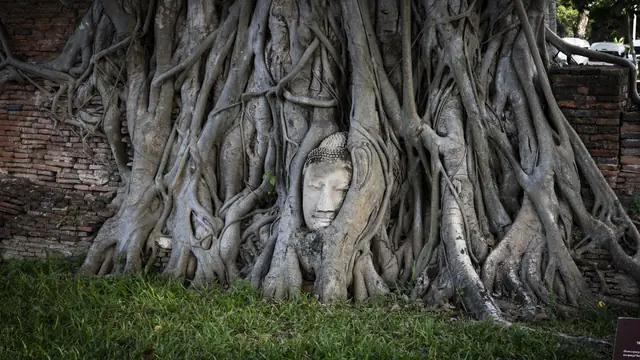 KKday
Ayutthaya Highlights & Ancient Temples Day Tour from Bangkok
From US$23.91
Price as of 5 Nov 2026From US$23.91. A join-in day tour from Bangkok of 9 to 12 hours, with hotel pickup 06:15 to 07:00 or a meeting point on Khao San Road at 07:15, free cancellation 2 days before (as of 5 Nov 2026).
Book on KKdayPhotos, prices and reviews from Klook
A full-day tour from Bangkok to the summer palace and temples, with free cancellation and instant confirmation (as of 5 Nov 2026).
Book on KlookIf you are staying in Ayutthaya and want to see temples in the evening, there is a night tuk-tuk tour that starts and ends in Ayutthaya. Pick the date and time slot on the booking page.
 KKday
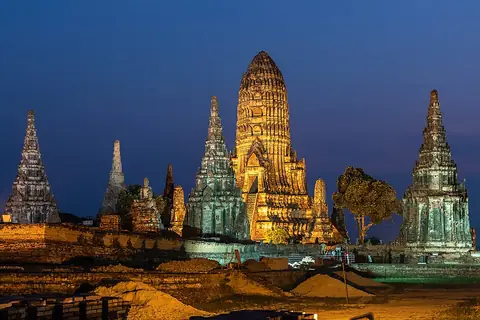
Ayutthaya Night Lights by Tuk Tuk: Famous Temple Tour
From US$25.78
Price as of 5 Nov 2026From US$25.78. A tuk-tuk tour of the famous temples at night, about 2 hours, starting and ending in Ayutthaya, English and Thai guide, free cancellation 1 day before (as of 5 Nov 2026).
Book on KKdayAyutthaya tours from Bangkok on KKday
Photos, prices and reviews from KKday
Frequently asked questions
How much does Wat Yai Chai Mongkhon cost?
About 20 baht, collected by the temple itself at the gate. It is not part of the 7-site combo ticket. Thai visitors often enter without a fee, so ask at the gate. Carry small cash and check the sign.
What time does Wat Yai Chai Mongkhon open and close?
About 08:00 to 17:00 every day. Check the sign at the gate or call 0 3524 2640 if you need to confirm, because hours can shift on Buddhist holy days.
Where is Wat Yai Chai Mongkhon and is it far from the old town?
It is in Khlong Suan Phlu, south-east of the old island, about 1 km past Wat Phanan Choeng. A tuk-tuk from the central temples takes about 10 to 20 minutes. A bicycle works on cool mornings but is farther than the central temples.
Can I climb the big chedi?
Yes, up the front stairs to the terrace around the middle of the chedi and the small room for paying respects, not to the tip. The steps are steep, narrow and slippery when wet. Do not cross barriers, and take care with children and older visitors.
How tall is the Chedi Chai Mongkhon?
About 62 m from the base to the tip, on a square base about 15 m high. It is the tallest chedi in Ayutthaya province. King Naresuan ordered it built in 1592 after his elephant duel victory.
How do I make merit at Wat Yai Chai Mongkhon?
Put money in the donation box or buy flowers, incense and candles set out by the temple, in any amount you wish. You can drape a cloth on the reclining Buddha at the posted price. Dress modestly, take off your shoes, never point your feet at a Buddha, and women should not touch a monk.
How long do I need at Wat Yai Chai Mongkhon?
About 1 to 1.5 hours. Allow up to 2 hours if you climb the chedi, visit the reclining Buddha and walk to the King Naresuan hall.
How is it different from the other temples in the historical park?
It is still an active monastery with monks living there and local people praying, rather than an empty ruin like Wat Mahathat. You can climb the chedi, it has a reclining Buddha you can drape with cloth, and it charges its own fee, not covered by the combo ticket.
When is the best time to visit?
Between 08:00 and 10:00 or from about 15:30 until closing, and between November and February when the weather is cooler and drier. Avoid midday and April.
Is there parking at Wat Yai Chai Mongkhon?
Yes. There is a large car park near the entrance. On weekends and Visakha Bucha it fills up, so come early. If you use a wheelchair or need an accessible toilet, ask at the temple.
Where the facts come from
- Ayutthaya Historical Park, Fine Arts Department (Facebook)
- Opening hours list for Ayutthaya attractions, TrueID (Thai)
- Wat Yai Chai Mongkhon, TrueID (Thai)
- Wat Yai Chai Mongkhon, Kapook (Thai)
- Wat Yai Chai Mongkhon, MThai (Thai)
- Wat Yai Chai Mongkhon, Wikipedia
- Wat Yai Chai Mongkhon, Thai Holiday Guide
- Ayutthaya admission fee table
- UNESCO World Heritage Centre: Historic City of Ayutthaya
Keep planning
 Plan your Ayutthaya tripHow many days, which temples, fees, where to stay
 Ayutthaya in one dayA timed plan from Bangkok with costs
 Ayutthaya in two days, one nightSunset, temples at night, morning market
 Ayutthaya tours and ticketsTours, river cruise, night tuk-tuk, train tickets with prices
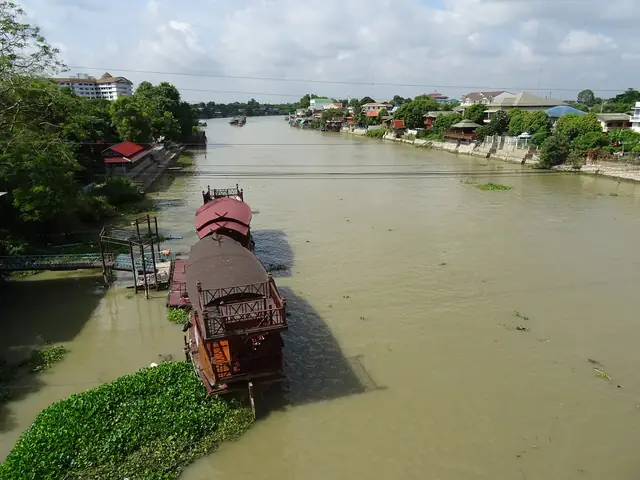 Where to stay in AyutthayaOn the island, by the river, near the station, 9 hotels
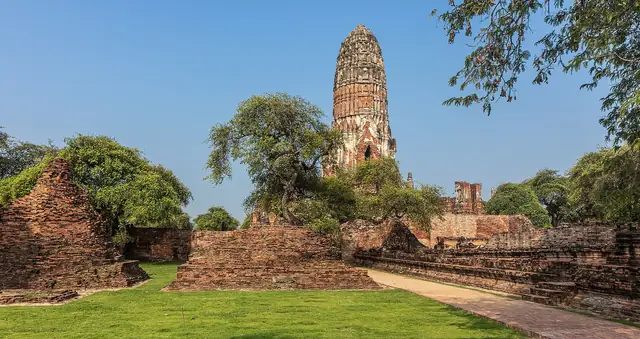 Bangkok to AyutthayaBNEX train, van, bus, boat, times and fares
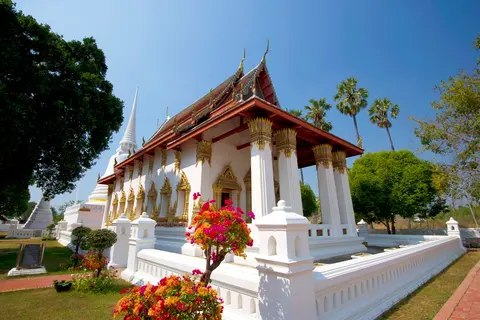 Getting around AyutthayaTuk-tuk, bicycle, ferry, and a note on elephants
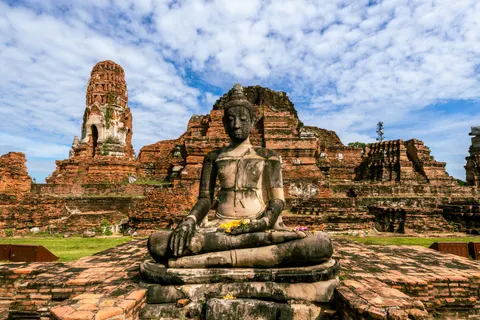 Wat MahathatThe Buddha head in the roots, fees, hours, photo etiquette
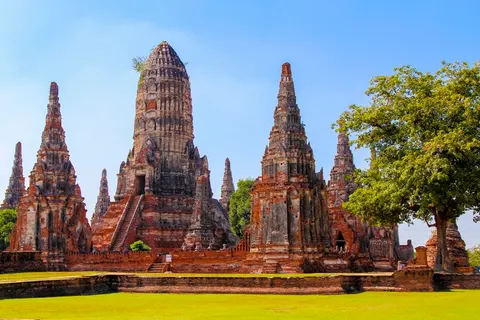 Wat ChaiwatthanaramRiverside prangs, sunset, Thai costume
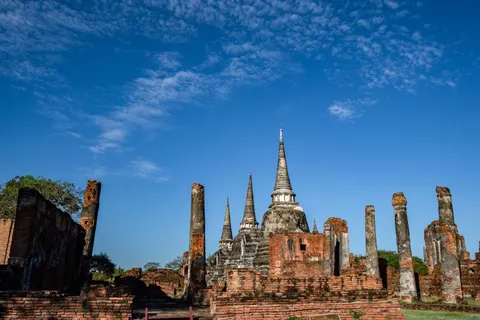 Wat Phra Si SanphetThe three chedis and Wihan Phra Mongkhon Bophit
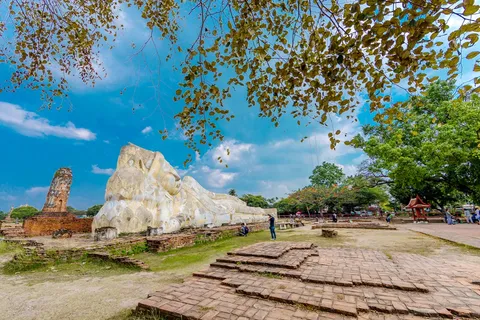 Wat LokayasutharamThe open-air reclining Buddha
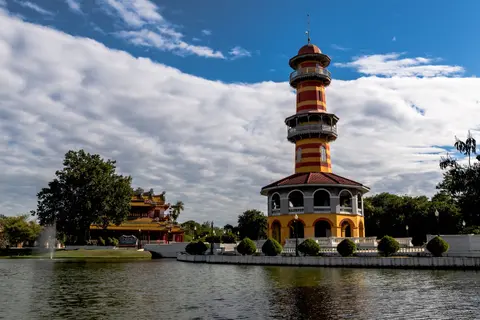 Bang Pa-In PalaceDress code, fees, hours and Wat Niwet Thammaprawat
 Ayutthaya at nightLit temples, night markets and the night tuk-tuk tour
 Ayothaya Floating MarketFees, hours, food and how to get there