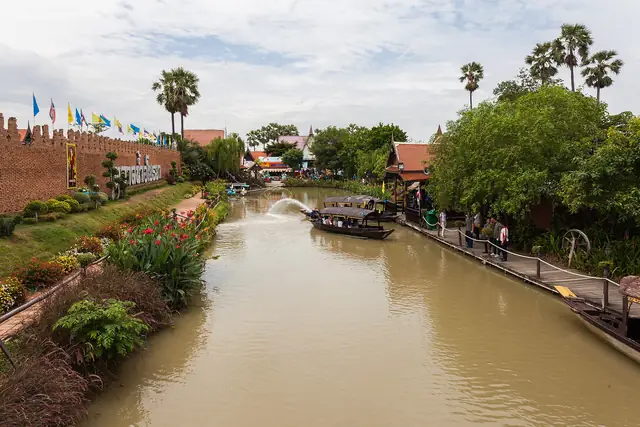
Ayothaya Floating Market sits on the east side of the Ayutthaya old island, near Wat Maheyong. It is built as an old-style Thai waterside market around a pond, with timber walkways, Thai houses, bridges and food boats. It is not where local families buy their daily food. It is where many visitors stop for lunch after half a day among ruins, because it has roofs, seats and a boat ride.
This page covers what the market is, the layout, fees and what to ask at the ticket booth, the boat ride, the show, the food worth trying, how to get there, the best time to go, sample timings, visiting with kids and older relatives, budgets, common mistakes, and the tours and hotels that fit. It also says plainly what kind of place this is, so you can decide whether it is worth your time.
We earn a commission if you book through our links. The price you pay does not change. How we choose
Quick facts before you go
| Location | East side of the Ayutthaya old island, near Wat Maheyong |
|---|---|
| Fee (Thai) | 30 baht |
| Fee (foreigner) | About 100 to 200 baht, check at the gate |
| Opening hours | About 09:00 to 18:00 daily (some shops open later or close earlier) |
| Time needed | 1.5 to 3 hours, depending on what you add and how long you eat |
| What is there | Boat ride, food stalls on boats and on the bank, a history show, souvenir shops, parking, toilets |
| Getting there | Tuk-tuk from the old island, about 10 to 15 minutes, car, or a tour |
| Best for | Families, anyone who wants a varied meal, and a break from the sun after temples |
| Not for | Anyone who wants a working local market. Go to Amphawa or a town evening market instead |
Is Ayothaya Floating Market worth visiting? A straight answer
It is not a must-see on the level of Wat Mahathat or Wat Chaiwatthanaram. Visitors split fairly clearly. People who like it say it is relaxed, easy to walk, full of food choices and fun for kids. People who do not like it say the shops look alike across the whole market and that the entry fee is high for the time you spend walking.
Go if
- You travel with small children or older relatives who cannot manage temples in full sun. There are roofs, seating and a loop path around the pond.
- You want many foods in one place: boat noodles, Thai sweets, fruit and cold drinks.
- You have half an afternoon spare and want a change from ruins to something colorful and busy.
- You want photos of an old-style market, Thai houses and wooden bridges without driving as far as Amphawa or Damnoen Saduak.
- You join a tour with an option that already includes entry and the boat ride, so you do not arrange transport or tickets yourself.
Skip it if
- You only have half a day in Ayutthaya and want to see as many temples as possible. Spend the time at Wat Mahathat, Wat Ratchaburana and Wat Phra Si Sanphet first.
- You want a floating market where locals really trade from boats. This one was built as a set for visitors.
- You dislike busy tourist spots, especially on weekends and long holidays.
- Your budget is tight and you are not interested in the extras, because the entry fee is the main cost before you eat or buy anything.
Ayutthaya in one day, hour by hour, if you are unsure where the market fits
What Ayothaya Floating Market is: background and idea
Ayothaya Floating Market opened on 2 May 2010 and was built from scratch. It was not grown from an old market. The idea was a cultural conservation attraction that recreates life in the Ayutthaya era: clothing, architecture, customs, games, folk performances, old-style food and goods, and a simple Thai way of living.
The name comes from Ayothaya, the kingdom that existed in this area before the city of Ayutthaya was founded. Temples in the area are said to date to that time, such as Wat Phanan Choeng, which was built before Ayutthaya was founded, and Wat Maheyong, the closest to the market. Naming the market after the older kingdom tells the story of the area. It does not mean the market itself is hundreds of years old.
The grounds cover about 80 rai (roughly 31 acres), with water in the center and land around it. The layout is divided into 16 zones named after the 16 districts of Ayutthaya province. Shops stand in Thai houses on the bank and on boats, about 250 in all.
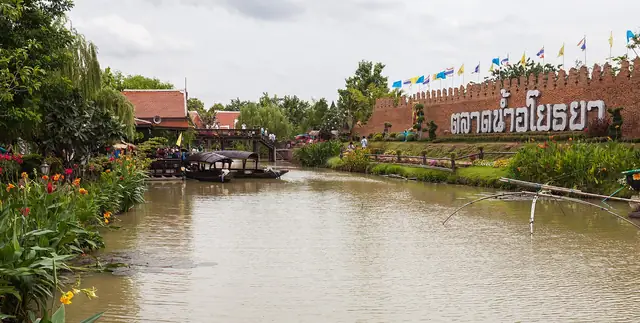
The most important thing to know up front is that this market is different from the traditional floating markets at Amphawa in Samut Songkhram or Damnoen Saduak in Ratchaburi, where communities still trade by boat. At Ayothaya everything is arranged for visitors to walk around. If you accept that, you will not be disappointed. Its strengths are convenience and variety, not authenticity.
The layout and zones: how to walk it without getting lost
The market is laid out as a loop around the pond, so it is simple. Follow the timber walkways and you come back to where you started, with no dead ends. That makes it comfortable for children and older visitors. The downside is that if you walk quickly you finish in half an hour and feel that the shops are similar throughout.
- The entrance is a bamboo gate with the market name on it. The ticket booth is near the entrance.
- Along the bank stand rows of timber Thai houses selling souvenirs, clothing, household goods and snacks.
- On the water there are many food boats, best known for boat noodles and single-plate dishes.
- Wooden bridges cross the water in several places, which lets you loop around, and they are the favorite photo spots.
- The show area hosts the historical performances. The schedule is posted at the entrance.
- The boat pier is on the waterside, for a short ride around the market.
Walk one full loop before you buy anything. You will see which shops have what you want and can compare prices, because shops selling similar goods stand in several places.
Most walkways are timber and there are bridges over the water, so strollers and wheelchairs may struggle in places. Ask the staff at the entrance which route is flattest, and watch your step on wet planks after rain.
What there is to do inside the market
1. The boat ride
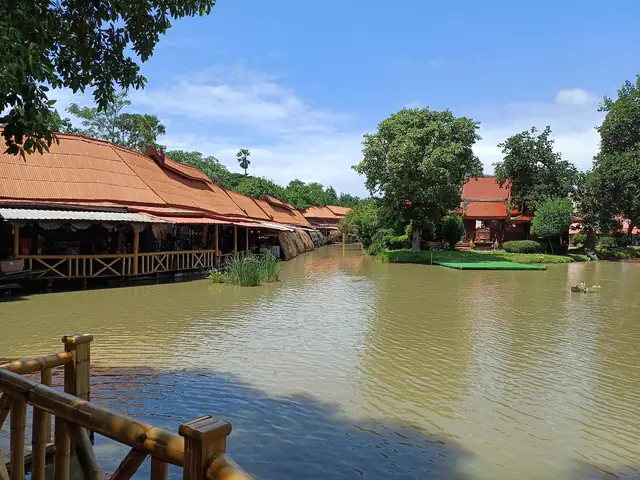
There is a boat ride on the market's waterway. The boats are wooden and covered, and the ride is short. You see the Thai houses and food boats from the water, a view you do not get on foot. Some tickets and some tours include the ride in the price. If you buy on the spot, ask whether the price you pay includes the boat ride and check the board before you pay, because some boat rounds are charged separately.
2. Food stalls
Food is sold on the bank and on boats, from single-plate dishes and boat noodles to Thai sweets and fruit. Prices are at tourist-market level, a little above an ordinary market. Many small stalls take cash only, so bring small notes. The food section below has the details.
3. The show
A historical performance runs in the market. It tells a story from the wars of the Ayutthaya era, with fight scenes and effects. On weekends and public holidays there are several rounds a day, on weekdays fewer. See the show section below.
4. Souvenir shops and crafts
Shops sell clothing, hats, baskets, woven goods, old-style Thai toys and small household items at visitor prices. See the shopping section for what is worth buying and how to bargain.
5. Fish feeding and animals
There is a spot for feeding fish beside the water, which children tend to enjoy. There is an elephant camp nearby offering rides and feeding. If animal welfare worries you, skip that part at no cost.
The historical show: how to catch it and whether it is worth it
The show is what sets this market apart from other floating markets. It is a staged retelling of wars from the Ayutthaya era, with performers in period costume, fight scenes and effects. If you have just walked through temples it makes sense, because you have already seen the ruins of a city damaged in the war of 1767.
| Show times | Several rounds a day on weekends and public holidays, fewer on weekdays. Check the schedule at the entrance or ask at the ticket booth |
|---|---|
| Language | Mainly Thai. If you do not speak Thai, follow the action and the costumes |
| Cost | Ask at the ticket booth whether the show is included or charged separately, because it differs by round and ticket type |
| Seating | Arrive 15 to 20 minutes before the start to find a good place to stand or sit |
Finish eating before a show or after it, not during it. Good spots fill first. If you want the show, ask for the next round time when you buy your ticket.
Show times and prices change with the season and holidays. Check the schedule at the entrance on the day you go.
Souvenir shops: what to buy and how to bargain
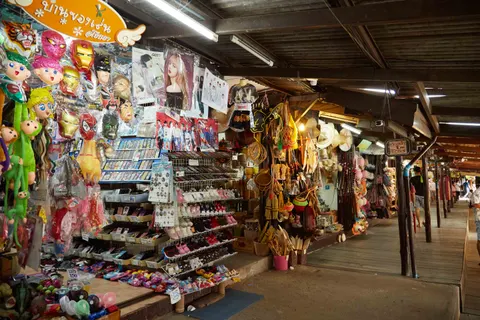
About 250 shops stand on Thai houses and boats. The goods that repeat across many shops are souvenir T-shirts, straw and woven hats, baskets and woven goods, old-style Thai toys, scarves and cloth bags, small home decorations, wood carvings and silk.
- A hat or sun umbrella is useful on a sunny day and cheap.
- Edible gifts such as dried Thai sweets and processed fruit are easier to carry home than household goods.
- Old-style Thai toys make an easy gift for children.
- Clothing and home decorations vary a lot in price, so look across the whole market first.
Many souvenir shops will come down a little on price, especially when you buy several items in one shop. Start politely and do not push too far. Food and drink shops charge the price on the sign and you should not bargain there.
Souvenir prices are at visitor level. For better value, compare with an evening market or a gift shop in town before you decide.
What to eat in the market and in Ayutthaya
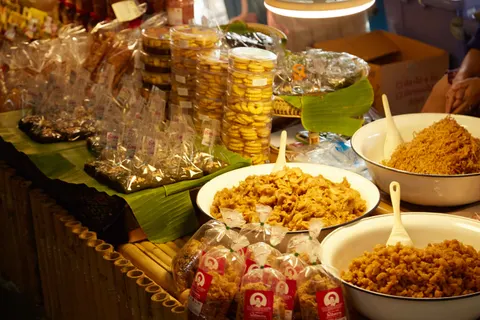
Food is the main reason people come. There are many food boats on the water and several rows of shops on the bank. Pick from this list.
- Boat noodles: small bowls of rich, strongly flavored noodle soup, usually eaten several at a time. Some stalls serve them from boats on the water.
- Roti sai mai: thin roti wrapped around colorful strands of spun sugar, a favorite local sweet. You can watch it being made, and children love it.
- River prawns: grilled, and a famous Ayutthaya dish. Prices vary with size, so ask the weight and the price before you order.
- Single-plate dishes: rice with toppings, pad Thai and grilled skewers, for those who do not want noodles only.
- Thai sweets and desserts: small cups, coconut sweets and fried snacks.
- Fresh fruit, blended fruit drinks, coffee and a cold herbal drink when the midday heat is high.
How to pick a stall
- Choose stalls with seated customers and food cooked to order.
- Ask the price first for anything sold by weight, such as prawns and fish.
- In a group, order several dishes and share, so you taste as many as possible.
Prices differ by stall. Check the sign at each stall before you order.
If you want Ayutthaya's famous dishes outside the market, look at the riverside restaurants and the old boat noodle shops in town, which are covered in the one-day and two-day plans.
Ayutthaya in 2 days and 1 night, with meals and a hotel by time of day
Fees, tickets and what to ask at the booth
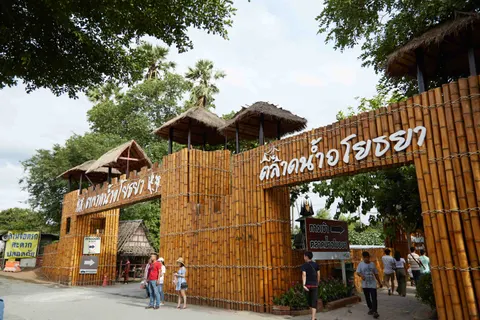
Entry is 30 baht for Thais and about 100 to 200 baht for foreigners, so check at the gate. Tickets come in several types depending on what they include, so always ask before you pay and never assume what one type covers.
| Ask | Why |
|---|---|
| Does this ticket include the boat ride? | Some tickets do. For others you buy a boat round separately |
| Is the show included, and when is the next round? | So you can plan meals and walking around it |
| Is there a child price, and what is the age or height rule? | Saves money if you bring children |
| Can I pay by card or only cash? | The booth and small stalls mostly take cash |
| Is parking charged? | If you drive, you will know the full cost |
The market ticket has nothing to do with the Fine Arts Department temple tickets. The 7-site combined pass is not valid here. If you go on a tour that includes entry, you do not pay again on site. Check the booking page to confirm the option you choose includes market entry and the boat ride.
Fees and show times change by period, so trust the board at the ticket booth. You can contact the market on 0 3588 1733.
How to get to Ayothaya Floating Market
| Option | Best for | Notes |
|---|---|---|
| Tuk-tuk from the island | Anyone staying on, or visiting temples on, the island | About 10 to 15 minutes. Agree the price per vehicle, return included, before you get in. Hourly hire is about 200 to 300 baht an hour |
| Taxi or ride-hailing app | Anyone who does not want to bargain | Show the driver the market name in Thai on your map app. Ask the price first, or use the meter if there is one |
| Car or private taxi | Families and groups | There is a car park. Ask about parking fees at the entrance. Weekends are busier |
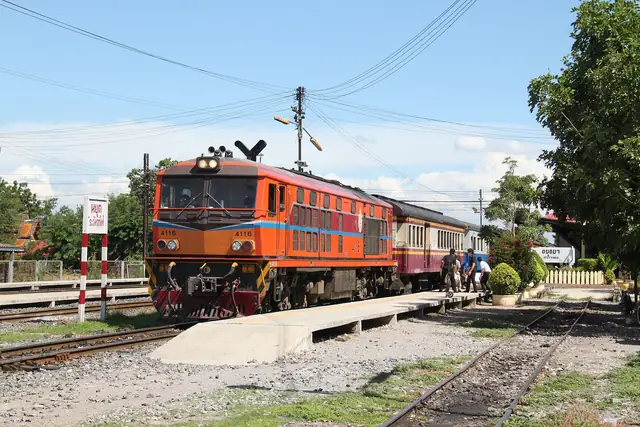
| Train, then a tuk-tuk | Arriving from Bangkok by rail | The market is not far from Ayutthaya station. Take a tuk-tuk or a short ride from there |
| Day tour from Bangkok | No planning | Tours that list the floating market, see the booking boxes below |
The approximate location is 14.359, 100.593, and the address is 65/19 Moo 7, Phai Ling. In a map app, type the market's Thai name. The market is close to Wat Maheyong, so the two combine easily.
Bangkok to Ayutthaya: BNEX train, van, bus and boat compared
Tuk-tuk, bicycle and ferry on the island
If you travel from Bangkok on your own, train tickets on the booking page start from about US$2 and vans from about US$5, as of 5 Nov 2026. See the options and departure times below.
 12Go
Bangkok to Ayutthaya on 12Go
From US$2
Price as of 5 Nov 2026Bangkok to Ayutthaya takes about 1 to 2 hours by train, van, bus or taxi, from Krung Thep Aphiwat and Mo Chit. Train from US$2 and vans from US$5 (as of 5 Nov 2026).
Book on 12GoBest time to visit, by hour and by season
Avoid midday and early afternoon. The open areas and walkways get very hot. Mid-morning, around 09:30 to 11:00, or the late afternoon after 15:00 is more comfortable. The market opens about 09:00. If you arrive at opening you walk while crowds are small, the food stalls are getting ready and the sun is still gentle.
| Time | What it is like | Advice |
|---|---|---|
| Weekday 09:30 to 11:00 | Few people, sun not yet strong | Best for easy walking and photos |
| Weekday midday to 15:00 | Hottest | Eat in a shaded stall or visit at another time |
| After 16:00 | Softer light, cooling breeze | Good for a stroll and waterside photos. Check closing times for shops first |
| Weekends and long holidays | Crowded, several show rounds | Arrive at opening and book tours or rooms early |
Through the year, November to February is the coolest and driest and the most comfortable for open-air walking, and the market is liveliest. March to May is very hot, with April highs near 36 C, so go in the morning and carry water.
The rainy season runs roughly May to October, and the timber walkways can be slippery, so bring a rain jacket. Late in the rains, roughly August to October, water levels are high. After several days of heavy rain, check with the market before you go to see whether it is open and walkable as normal.
Sample timings for Ayothaya Floating Market
Plan A: a short 1.5 hour stop, if you are short of time
- 09:00 Arrive, buy tickets, ask the boat and show times.
- 09:15 Walk the shops once and photograph the bridges and Thai houses.
- 09:45 Take the boat ride.
- 10:15 Eat boat noodles or a dessert.
- 10:30 Leave the market.
Plan B: a full half day of 3 hours, to eat and see the show
- 10:00 Arrive and walk one loop before choosing food.
- 10:45 Boat ride.
- 11:15 Main meal: a single-plate dish and boat noodles.
- 12:15 Dessert or a blended drink in the shade.
- 12:45 The nearest show round, following the schedule at the gate.
- 13:15 Buy souvenirs and head out.
If you hire a tuk-tuk by the hour, count the waiting time. Three hours in the market plus the trip each way comes to about 3.5 to 4 hours. At 200 to 300 baht an hour that is about 700 to 1,200 baht a vehicle. Agree the total with the driver before you set off.
To combine the market with temples on the old island in one day, see the section on pairing the market with Wat Mahathat below.
Visiting with children and older relatives
This is one of the best-suited places in Ayutthaya for families, because the loop is easy to walk, there are roofs, seats, toilets and parking, and children like the activities: the boat, feeding fish, the show and unusual sweets.
- Small children: bring a hat and water, and stay close by the water and on bridges. Some timber walkways have gaps between boards.
- Strollers: usable in parts, but timber and bridges may be uneven. A baby carrier is easier.
- Older visitors: the loop is not long. Go in the morning and eat in the shade.
- Wheelchair users: timber walkways and bridges over the water may be hard to pass. Call the market before you go.
- Toilets are in the market. Use them before the boat ride.
There is no strict dress code like at a temple. Comfortable clothes are fine, but if you plan to visit a temple after the market, cover shoulders and knees. Shoes that come off easily and grip on timber are the most practical.
Plans for heat and rain
| Situation | What to do |
|---|---|
| Extreme midday heat | Arrive at opening, eat lunch in a covered shop, drink often and rest in the shade. A hat, umbrella and sunscreen help a lot |
| Rain while you walk | Shelter under the shop roofs and wait for it to ease. Carry an umbrella and wear grippy shoes, because timber is very slippery when wet |
| Several days of heavy rain | Check with the market that it is open as normal. If it is closed or hard to walk, switch to a shaded temple or a museum |
| Holiday crowds | Arrive before 09:30 or after 15:00 and buy food before the show starts |
If rain spoils the market, the town has indoor options such as Chao Sam Phraya National Museum and Baan Hollanda. Check their days and hours in the one-day plan.
A rough budget, per person and per group
| Item | About | Notes |
|---|---|---|
| Entry (foreigner) | About 100 to 200 baht | Check at the gate. Thais pay 30 baht |
| Tuk-tuk with waiting | About 200 to 300 baht an hour | Agree the total before you get in |
| Food and drinks | Depends on what you order | Tourist-market prices. Check the sign. Prawns and fish are sold by weight |
| Souvenirs | Depends on what you buy | Some souvenir shops let you bargain |
| Parking | Ask at the entrance | If you drive |
A simple example for two people spending three hours there by chartered tuk-tuk: entry for two is about 200 to 400 baht, the tuk-tuk is about 700 to 1,200 baht a vehicle, and food and souvenirs are on top, as you like. On a full-day tour, the transport and the entry the tour includes sit in one price, so you do not pay again on the spot for the parts it covers.
Common mistakes and how to avoid them
- Arriving at midday in full sun. You get hot and tired, so move the visit to mid-morning or late afternoon.
- Not asking whether the ticket includes the boat ride and the show, then paying twice or missing a round. Ask before you pay and check the schedule.
- Agreeing a tuk-tuk one way only and struggling to find a ride back. Agree a return price that includes waiting time.
- Expecting a working local floating market. This is an old-style set for visitors. For a real market, go to Amphawa or an evening market.
- Not carrying enough cash. Small stalls mostly take cash.
- Wearing slippery shoes or heels on timber. Wet boards after rain are very slippery.
- Eating until full before you have seen the whole market. Walk one loop first, then choose.
- Going on a weekend without an early start. It is crowded and hot.
- Giving the market the whole afternoon and leaving no time for temples. If you want to see temples, do them in the morning first.
Pair the market with Wat Mahathat in a single day
- 08:30 Wat Mahathat: the main prang and the Buddha head in the tree roots before the crowds (45 to 60 minutes).
- 10:00 Tuk-tuk to Ayothaya Floating Market (10 to 15 minutes). Walk, eat and take the boat.
- 13:00 Stop at Wat Maheyong, close to the market, or return to the island for another temple if you still have energy.
The reasoning is that temples are best in the morning before the heat, while the market works mid-morning or late afternoon and has seats and food. If you put the market first and the temples after, you walk the ruins in full sun.
Wat Mahathat: fees, hours and the Buddha head in the roots
Ayutthaya in one day, hour by hour
If you would rather not arrange transport yourself, this tour from Bangkok puts Wat Mahathat and the market in one day.
Photos, prices and reviews from Klook
An 8-hour tour from Bangkok with Thai, English and Chinese guides and an option that includes floating market admission and the boat ride. Choose with or without them on the booking page. Free cancellation 24 hours before (as of 5 Nov 2026).
Book on KlookWhat to see near Ayothaya Floating Market
| Place | Why stop | Good to know |
|---|---|---|
| Wat Maheyong | Ruins of an old ordination hall and a temple that still has resident monks. It is the closest to the market | About 08:00 to 17:00 (you can walk until about 18:00). Entry 10 baht Thai, 80 baht foreigners |
| Wat Kudi Dao | Ruins of a large late Ayutthaya temple, across from Wat Maheyong | Check hours and entry at the gate |
| Wat Mahathat | The Buddha head in the tree roots and the great prang. Easy to combine into one day | Entry 10 baht Thai, 80 baht foreigners. Open about 08:00 to 17:00 |
| Wat Phanan Choeng | A huge seated Buddha beside the Pa Sak river, older than the city of Ayutthaya | About 08:00 to 17:00 |
| Baan Hollanda and the Portuguese village | The story of trade with foreigners in the Ayutthaya era | Baan Hollanda about 09:00 to 17:00, Wednesday to Sunday, entry about 50 baht |
Wat Maheyong was a royal temple that fell into ruin after the city fell, then was restored and now has resident monks. Inside is an old ordination hall on a two-level base that is fairly large compared with other ruins. It suits anyone who has had enough of the market and wants to walk somewhere quieter.
Full-day tours from Bangkok that include the floating market
The tour below also puts the floating market on the program. For the 8-hour Wat Mahathat and market tour, see the pairing section above.
Photos, prices and reviews from Klook
A tour from Bangkok to the summer palace, floating market and temples. 7 to 13.5 hours depending on the option, with transfer and guide, English, Chinese and Japanese guides, and optional hotel pickup (as of 5 Nov 2026).
Book on KlookThe other full-day tours below focus on temples and palaces, so open the booking page to see whether they stop at the market, or go to the market yourself by tuk-tuk after a temple tour.
Ayutthaya tours from Bangkok on KKday
Photos, prices and reviews from KKday
Hotels that suit the market and the old island
If you will stay overnight in Ayutthaya and want the market with the temples, choose the area you will use most. Hotels in Hua Ro near the railway station and around Rojana Road are on the east side and not far from the market, while riverside hotels on the south of the island are closer to the temples. Check the map pin before booking.
 Budget
Early Bird Hostel Ayutthaya
Hua Ro, near the train station
Budget, in Hua Ro near the railway station. Convenient if you arrive by train.
See prices and availability on the booking page
 Mid-range
Classic Kameo Hotel & Serviced Apartments
Rojana Road, Phai Ling
Mid-range, on Rojana Road in Phai Ling.
See prices and availability on the booking page
 Mid-range
Ayothaya Riverside Hotel
Hua Ro, on the river
Mid-range, in Hua Ro on the river near the railway station, for anyone who wants to be near both the market and the old island.
See prices and availability on the booking page
Frequently asked questions
How much is Ayothaya Floating Market?
30 baht for Thais and about 100 to 200 baht for foreigners. Check the price at the booth and ask whether the ticket includes the boat ride and the show.
What are the opening hours?
About 09:00 to 18:00 daily. Some shops open later or close earlier, so check the notice at the entrance for the day you go.
What is there to do?
A boat ride, food stalls on boats and on the bank, a history show, about 250 souvenir shops, parking and toilets.
How do I get there from the old island?
By tuk-tuk in about 10 to 15 minutes. Agree the price per vehicle, including the return, before you get in. You can also use a taxi or a ride-hailing app, or go on a day tour.
When is the best time to go?
Mid-morning around 09:30 to 11:00 or after 15:00. Avoid midday heat, and avoid weekends if you dislike crowds. November to February is the most comfortable season.
Is it an authentic local market?
No. It was built in 2010 for visitors, with shows and a set boat ride. It suits families and people who want a meal and a waterside stroll. For a local market, go to an evening market in town.
What should I eat?
Boat noodles, roti sai mai and river prawns are the dishes Ayutthaya is known for. Check the sign at each stall for prices.
How long do I need?
About 1.5 to 3 hours. A short stop to see the shops and take the boat is about 1.5 hours. If you want to eat properly and see the show, allow 3 hours.
Is it suitable for children and older people?
Yes. The loop is easy, with roofs, seats and toilets. But timber walkways and bridges may not suit strollers or wheelchairs, so go in the morning and keep children close by the water.
Are there tours that include the market?
Yes. One tour pairs Wat Mahathat with the market and has an option with market admission and the boat ride. Another full-day tour combines the summer palace, the market and temples.
Where the facts come from
- Opening hours list for Ayutthaya attractions, TrueID (Thai)
- Ayutthaya Historical Park, Fine Arts Department (Facebook)
- Ayutthaya admission fee table
- UNESCO World Heritage Centre: Historic City of Ayutthaya
- Ayothaya Floating Market, Tourism Authority of Thailand (Thai)
- Ayothaya Floating Market official website
- Ayothaya Floating Market, Thai Holiday Guide
Keep planning
 Plan your Ayutthaya tripHow many days, which temples, fees, where to stay
 Ayutthaya in one dayA timed plan from Bangkok with costs
 Ayutthaya in two days, one nightSunset, temples at night, morning market
 Ayutthaya tours and ticketsTours, river cruise, night tuk-tuk, train tickets with prices
 Where to stay in AyutthayaOn the island, by the river, near the station, 9 hotels
 Bangkok to AyutthayaBNEX train, van, bus, boat, times and fares
 Getting around AyutthayaTuk-tuk, bicycle, ferry, and a note on elephants
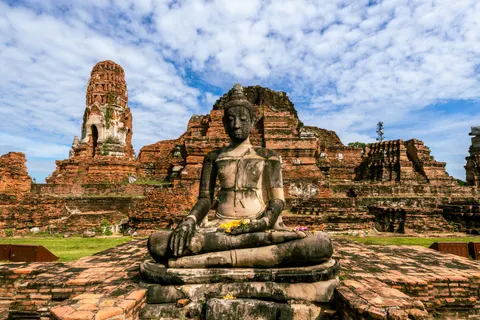 Wat MahathatThe Buddha head in the roots, fees, hours, photo etiquette
 Wat ChaiwatthanaramRiverside prangs, sunset, Thai costume
 Wat Phra Si SanphetThe three chedis and Wihan Phra Mongkhon Bophit
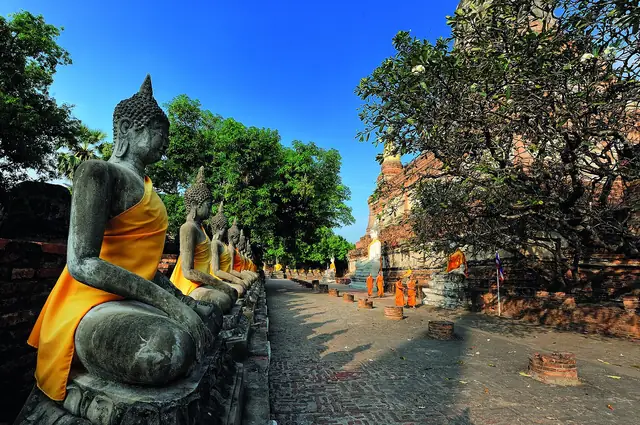
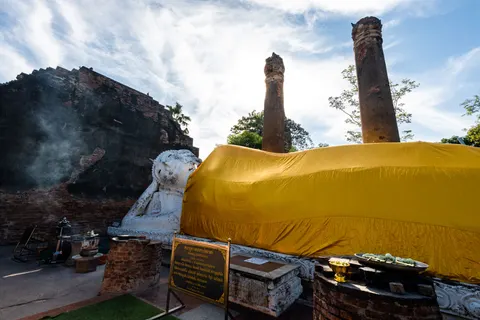 Wat Yai Chai MongkhonThe great chedi, a reclining Buddha, rows of Buddhas
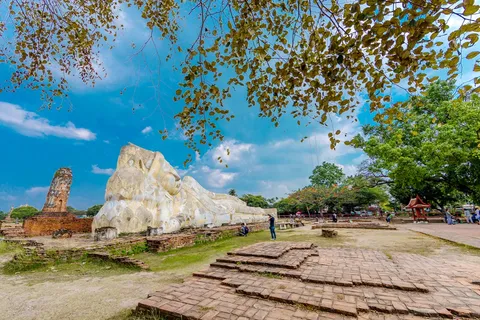 Wat LokayasutharamThe open-air reclining Buddha
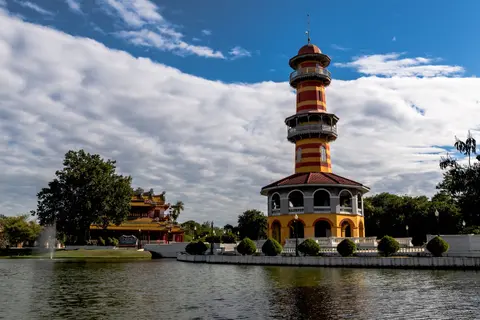 Bang Pa-In PalaceDress code, fees, hours and Wat Niwet Thammaprawat
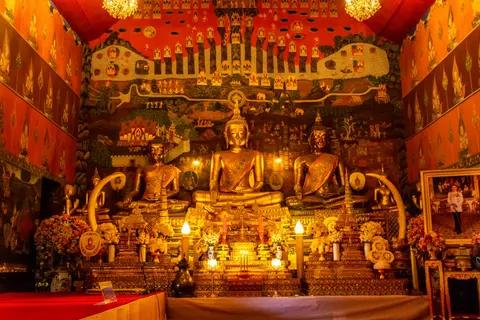 Ayutthaya at nightLit temples, night markets and the night tuk-tuk tour