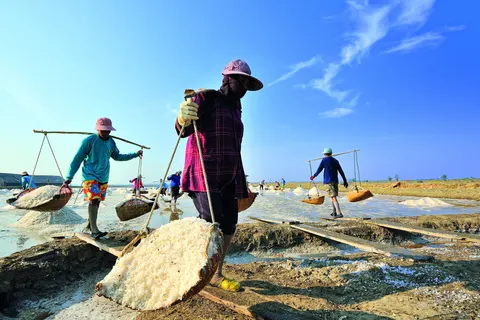
Most visitors know Samut Sakhon for the Mahachai seafood market, but the coast on the other side of the province is worth the drive: wide salt farms, mangrove forest, a red wooden bridge walking out over the sea, and migratory shorebirds in the cool season. These places are spread across several subdistricts, Khok Kham, Bang Ya Phraek, Phanthai Norasing and Kalong, with several kilometres between them. There is no single gate and no single ticket, so the useful questions are which stops, which month and how to get around.
This page is organised by those questions: which month shows people harvesting salt, when the mangrove centre is open, how the Red Bridge differs from the rainbow bridge, whether you can go without a car, whether boats or bikes are an option, and how to fit it into half a day. Prices and times with a date are as of 14 Nov 2026. Where a detail is uncertain, the page says about or check before you go. Every booking button leads to the partner's own page. The Mahachai market and the Wat Chong Lom and Phanthai Norasing area are covered on other pages of this section.
We earn a commission if you book through our links. The price you pay does not change. How we choose
The Samut Sakhon coast in one table
This table says what each stop offers, when to go and how long to allow. Distances between stops are rough map estimates and real driving routes are a little longer. Keep a map open on your phone, because the lanes between the salt farms are narrow and junctions are many.
| Stop | What you see | Best time | Time needed | Entry |
|---|---|---|---|---|
| Khok Kham salt village and the salt school | Salt heaps, workers carrying baskets, a model salt farm showing every stage | Morning or late afternoon, Nov to May, with the busiest harvest about Jan to Apr | 1 to 2 hours | Roadside viewing is open. Call about learning activities |
| Mangrove Research Centre 2, Bang Ya Phraek | Red suspension bridge, a 1.5 km nature walk, mudskippers, fiddler crabs, shorebirds | Morning to mid afternoon. Low tide shows more mud life | 1 to 2 hours | Call the centre first |
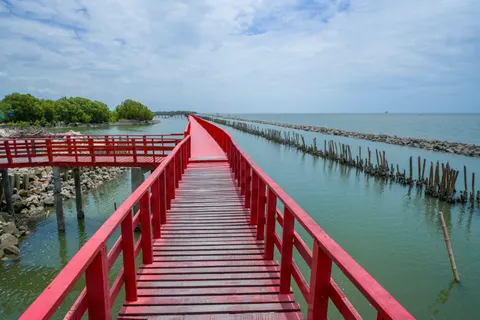
| Red Bridge, Phanthai Norasing | A red wooden bridge about 700 m long beside the sea, bamboo wave breaks, sunrise and sunset | Late afternoon or early morning | 45 minutes to 1 hour | Check before you go. Car park and seafood restaurants at the entrance |
| Rainbow Bridge and the Kalong seashore bridge | A rainbow-painted timber bridge out to sea and a concrete bridge by the mangroves | Evening sea breeze. Mud shows at low tide | 30 to 60 minutes | Check before you go |
| Wat Khok Kham and the Khok Kham canal | Ayutthaya-period temple, the Maha Ut ordination hall, the fourth Phra Phuttha Sihing image | Late morning to early afternoon | 30 to 60 minutes | Check at the temple |
If you only have half a day, do these three
Start at the salt farms in the morning while the sun is low and workers are in the fields. Go on to the Bang Ya Phraek mangrove centre before 11:00, then finish at the Red Bridge in late afternoon with dinner at one of the seafood restaurants at the entrance. If you do not drive, the private transfer or the self-drive rental below is the simplest way, because public transport does not reach these places easily.
Private transfer Bangkok to and from Samut Sakhon (including Wild Encounter pier)
From US$42.79 (Starting price per car (USD read 14 Nov 2026), smallest car)
Price as of 14 Nov 2026A private car with driver from Suvarnabhumi, Don Mueang or a Bangkok hotel to Samut Sakhon city or the Wild Encounter pier. From US$42.79 as of 14 Nov 2026, free cancellation up to 2 days before, with peak-season surcharges on some dates. Good for a group that wants the driver to wait all day. Agree with the operator how many hours the car waits and whether you can stop at the salt farms and the Red Bridge, because the listed pick-up and drop-off points are airports, hotels and the pier.
Book a private transferBangkok car rental, self-drive to Samut Sakhon and the Khok Kham salt farms
Price Check latest price
Check the latest price on the booking pageSelf-drive car rental in Bangkok. Check the latest price on the booking page. About an hour south on Rama 2 Road if you leave early. Good for a day of several stops that public transport does not reach. Read the insurance and terms on the booking page.
Self-drive from BangkokWhen to go: salt harvest and birds month by month
The salt season on the upper Gulf of Thailand starts when the rains end, from about November, and runs to about May. Hand harvesting is at its busiest from about January to April. Outside this window the pans can be dry, flooded or used for other things. The table is a broad frame. If the rains come early or late the season shifts, so call the salt school before you drive out.
| Month | Salt farms | Birds and bridges | Tip |
|---|---|---|---|
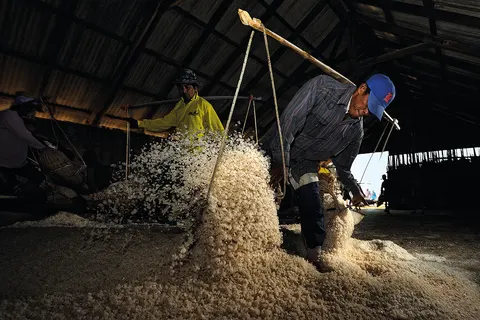
| Jan to Apr | Busiest harvest. White heaps, workers with shoulder poles, trucks loading salt | Shorebirds are still present. In Mar and Apr some migrants pass through | Best months for photographs. Very hot, so go before 09:00 or after 16:00 |
| Nov to Dec | Season starts. Some pans are still being prepared and the salt is not yet thick | Migrants arrive. Large flocks of brown-headed gulls from late October | The coolest and most comfortable weather. The cool winds of Nov to Jan used to bring dolphins near the coast, but sightings are now fewer |
| May | End of the season as the rain begins | Most migrants have left | Hot and humid with afternoon downpours. The Bryde's whale cruise season begins, about May to December |
| Jun to Oct | Rainy season. Pans stop or switch to other uses. The ground is muddy | Shorebirds are not yet back in force. They begin to return in late October | Fine if you want the sea and mangroves, but it is not harvest season. Wear shoes you do not mind getting muddy |
The time of day matters more than the month. There is no shade on a salt farm and the white ground reflects strongly, so from 11:00 to 15:00 it feels hotter than the forecast. Arrive before 09:00 or after 16:00. If you want birds, the tide decides where they feed, so check a marine forecast app for tide times before you leave.
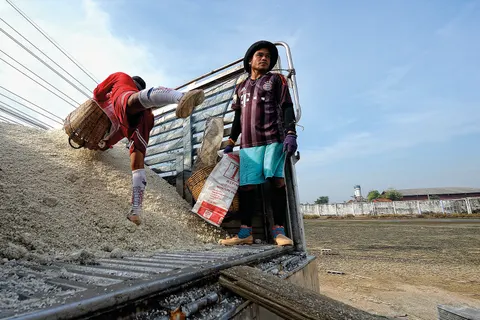
To see white salt, go from January to April and phone the salt school ahead of time. To see shorebirds as well, the best overlap is January to early April.
What the salt farms are: know what you are looking at
You do not need the details to enjoy a visit, but three things make the view mean more. Sea salt is made by letting seawater evaporate in sun and wind. A salt farm is a chain of shallow ponds, and the brine moves from the big pond that takes seawater from the sea to shallower ponds in turn, getting saltier at each step until crystals form. Farmers call the ponds nar tak, nar chuea and nar plong. The brine in the last pond rests for about 10 to 15 days before it crystallises, and workers rake the salt into rows once the crust is thick enough.
Workers shovel salt into baskets and carry it on shoulder poles to a yard or to the long-roofed storehouses you can see from the road. There are several kinds. Flower of salt (dok kleua) is the thin crystal layer that forms first on the surface, and Khok Kham farmers have developed it into products for cooking and skin care. Little figures on a white floor with man-high heaps are the harvest in progress. If you see only flat grey water, the pans are still waiting for sun.
To see every stage at once, call in at the salt school. It has a model salt farm showing the steps from the first pond to each kind of salt, and some hands-on workshops. Contact them before you go, because it is a community learning centre, not a theme park that opens on the hour.
Salt farms are people's livelihood. Look and photograph from the roads and the dykes that are open for walking. Ask before going closer or before photographing a worker's face, and do not walk across pans that are still wet.
Khok Kham salt village and the salt school: real salt and a hands-on try
Khok Kham salt tourism village is a learning centre for salt making set up by farmers in Khok Kham subdistrict. The main site is in Moo 3, Khok Kham, Mueang Samut Sakhon. Searching a map app for the Khok Kham salt school gets you there. Lepong Chanthong started the centre. Opening hours are about 08:00 to 17:00 daily, and the contact number is 08 6524 1021. Call before you go, because learning activities and speakers are not available every day.
What you can do there
- Walk and photograph the real salt farms and salt heaps from the roads and open dykes. Early morning to mid morning gives the best light.
- See the model salt farm at the salt school, from the first pond to each kind of salt. It suits older children and adults who want to understand the process.
- Ask about workshop activities and prices when you call to book.
- Buy sea salt and flower of salt from community shops. The shop sets the price, so ask the weight and the price before you pay.
- Stop at a family-run cafe or restaurant in the area. Ask what is cooked that day, and agree the time and number of people in advance if you come as a group.
What to know before driving in
- Lanes through the salt farms are mostly narrow, a mix of sealed road and dirt. A regular car gets along most of them in dry weather, but after rain the tracks beside the dykes turn into thick mud, so do not push on.
- Park without blocking farmers' access or the salt trucks. Big trucks come and go from the salt yards during harvest.
- There is no shade and few toilets. A public toilet is at the bird centre building near the salt farms, so use it before you walk out.
- Convenience stores line the main roads before the turn-off. Buy enough drinking water for everyone, because nothing is sold between the dykes.
Shorebirds at the salt farms: season, where to stop and what to watch for
The Khok Kham salt farms and nearby coast feed migratory shorebirds in the cool season. The species that draws Thai and foreign birdwatchers is the spoon-billed sandpiper, a critically endangered bird that visits in very small numbers each year. The Khok Kham Natural Conservation Club has followed its return for years. If you really want to see one, go with someone who knows where the bird is that day.
| What you want to see | Likely window | Where to try | Notes |
|---|---|---|---|
| Spoon-billed sandpiper | Late October to early April | Shallow pans near the Khok Kham bird centre | Very few, at most two or three birds. You need binoculars or a scope, and you must not walk close |
| Brown-headed gull, large flocks | Late October to mid April | The Red Bridge and the shoreline | Flocks can reach about a thousand birds, and people feed them so it is lively |
| Passing shorebirds such as the Asian dowitcher | March to April | The mudflats near the Red Bridge | Return passage north. Ask the conservation club or a local birder first |
| Kingfishers and other mangrove birds | All year, easiest at low tide or at dawn | The Bang Ya Phraek mangrove centre | You hear them before you see them. Move slowly |
If you go on your own and you are not a birder
There is no entry ticket for the salt farms, so anyone can go and watch. If you want to find the spoon-billed sandpiper, ask the conservation club or a local birder for help. A beginner is fine with ordinary binoculars and a walk along the pans and the Red Bridge, which already gives good views of the flocks. To contact the Khok Kham Natural Conservation Club, search for its page on Facebook.
Migrants are sensitive to noise and people. Stay at least about 30 metres back and do not walk into pans where birds are feeding or resting to get a closer picture. A bird flushed into the air loses energy it needs for the journey.
Mangrove Research Centre 2 at Bang Ya Phraek: the red suspension bridge and the 1.5 km walk
What people call the Bang Ya Phraek mangroves is the area of Mangrove Resource Research and Technology Transfer Centre 2 in Bang Ya Phraek subdistrict, Mueang Samut Sakhon, on Mahachai Bay. It lies in the Ao Mahachai national reserve forest, about 3,872 rai. A nature study walkway about 1.5 km long lets you walk through the mangrove, and there is a red suspension bridge more than 6 metres high that takes no more than 10 people at a time and shows the mangrove canopy from above.
Hours and what to know
- Hours are about 08:30 to 16:30 daily and closing can be later. Arrive before 15:30 to stay comfortably and avoid a race against closing.
- Phone the centre on 0 3449 8262 or 0 3449 8263 before you go, especially if you come as a large group or want an activity.
- Ask about entry fees and paid activities when you call.
- The red suspension bridge takes at most 10 people at a time. If you come in a big group, go up in batches and wait your turn.
What you can see at each tide
At low tide the mudflat shows and mudskippers and fiddler crabs come out beside the walkway. At high tide the mangrove looks full and green, but the animals tuck into their burrows. If you want animals, go at or near low tide. If you want mangrove reflected in water, go at high tide. A marine forecast app has daily tide tables, so look before you leave home.
Ask when you call whether any activities, such as mud play, are open on your day and whether there is a charge. Wear clothes that can get dirty. A change of clothes and a bag for wet things are a must if you play in the mud.
Shorebirds feed in the study area during the cool months, and more than 20 migratory species have been recorded there.
The Red Bridge and the Kalong rainbow bridge: how they differ and which to visit first
These are the two most photographed bridges on the Samut Sakhon coast, but they are different places with a different mood. This table helps you choose.
| Red Bridge, dolphin viewpoint | Rainbow Bridge, Kalong seashore | |
|---|---|---|
| Subdistrict | Phanthai Norasing, Mueang Samut Sakhon | Kalong, Mueang Samut Sakhon |
| What it is | A red timber bridge about 700 m long running parallel to the shore. The walking surface has been rebuilt in concrete | A timber bridge painted in rainbow colours reaching out to sea, and a concrete bridge with rainbow-painted blocks |
| What you see | Sea, bamboo wave breaks, mangroves, sunrise and sunset | Mangroves along the shore and mud at low tide |
| Best time | Late afternoon before sunset, or early morning | Evening sea breeze |
| Parking and food | A large car park at the entrance and several seafood restaurants within walking distance | Ask your hotel or check the map first. The path is dark in the evening, so watch your step |
| Time needed | 45 minutes to 1 hour, or 2 hours with a meal | 30 to 60 minutes |
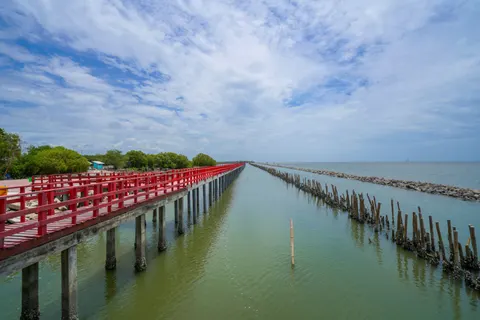
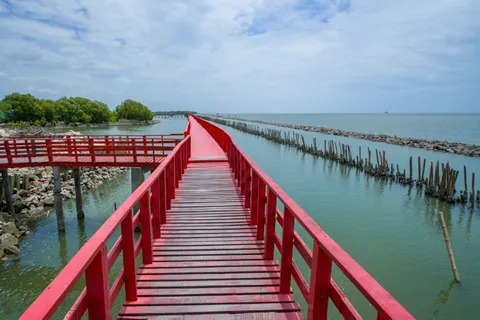
The Red Bridge is also where birders watch gulls and shorebirds. The name dolphin viewpoint comes from the days when cold winds from November to January brought dolphins in to the coast in numbers. Sightings are now much rarer, so do not go to wait for dolphins. The sea view and the sunset are reason enough.
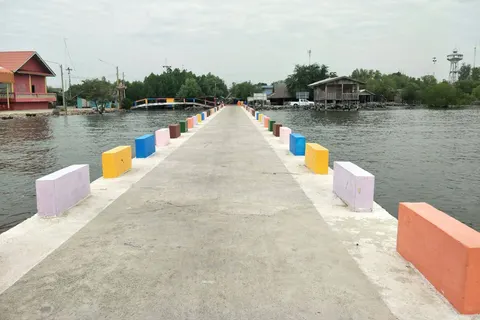
The Kalong bridges are a car or taxi ride from Mahachai town, so check the map for the distance. Train times to Mahachai are on the Mahachai to Mae Klong train page. The walk through the mangrove has no shade and no lighting after dark.
Wat Khok Kham and canal boats: an option that is not salt
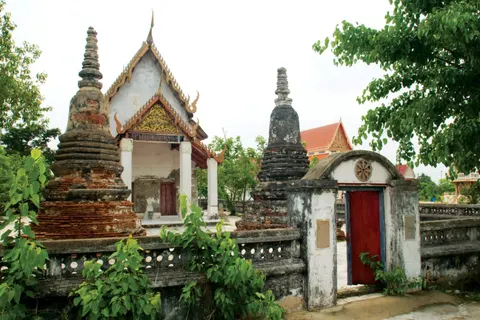
Wat Khok Kham is on the Khok Kham canal. It is an old temple from the Ayutthaya period with the Maha Ut ordination hall, an Ayutthaya-style chedi, and the fourth Phra Phuttha Sihing image, an old Buddha image that belongs to Samut Sakhon. It also has the original Phanthai Norasing shrine and objects said to be linked to the story, such as parts of the royal barge Ekkachai. The temple takes about 30 to 60 minutes to see.
Boat trips on the Khok Kham canal
Visitors can charter a boat on the Khok Kham canal from the Sangwan market pier or from Ban Rai pier near the temple. The trip takes about 2 to 3 hours, and the price depends on the size of the boat and the stops. Agree the price, the stops and the return time with the boat owner before you board, and ask whether the price is per boat or per person. There is no fixed schedule and no advance booking on the big platforms, so treat it as a plan you arrange on the spot or by phone, not for people who need a ticket in hand before they travel.
The newer Phanthai Norasing shrine and the learning park are on the same route as Wat Chong Lom and the Mahachai market, so you can see them in a one-day plan. Read on in the Samut Sakhon one-day plan.
Two famous sea chedis are not in Samut Sakhon: Phra Chedi Klang Nam is in Rayong province and Phra Samut Chedi is at Pak Nam in Samut Prakan province. See Pak Nam and the forts of Samut Prakan.
Getting to the salt farms and the Red Bridge: car, train, bike, boat
The stops are spread out, about 7 to 9 km from the salt village to the mangrove centre and the Red Bridge, and about 15 km from the salt village to the Mahachai market. Public transport does not reach every stop easily. This table helps you choose.
| How | Best for | Know this |
|---|---|---|
| Own car or rental | Everyone, especially families and older people | About 1 hour south on Rama 2 Road if you leave early, much slower in the afternoon. Keep a map open all the time, because the lanes are narrow |
| Private transfer from Bangkok | Groups of 2 to 9 who do not want to drive | Agree the waiting hours and stops first. Peak-season surcharges apply on some dates |
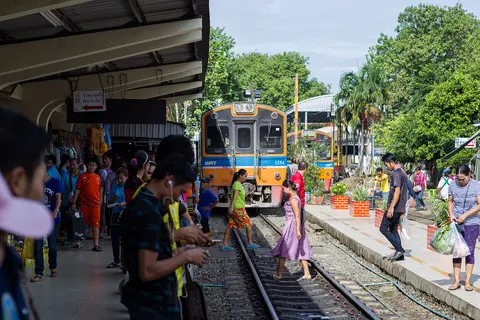
| Mae Klong train then a car | Travellers without a car who like trains | Get off at Mahachai or a station near your stop. You still need a taxi or ride-hailing car for the rest, and you should agree the fare first |
| Bicycle | Fit people who like photography | It is flat and hot with no shade. Bicycles are for rent at Baan Tha Chalom on weekends, but for the Tha Chalom district, which is far from the salt farms, not for riding out to Khok Kham |
| Boat | People who want the canal and the temple | Charter at Sangwan market pier or Ban Rai pier for 2 to 3 hours. Agree the price first |
A bicycle suits a short ride around the salt farms or around the Red Bridge, not a ride to every stop, because of the distances and the sun. Ask your hotel or the club in the area whether bicycles or motorbikes can be borrowed or rented before you decide.
See how to reach Samut Sakhon from Bangkok: train, van, bus, taxi
Plans for the salt farms and mangroves: half day, full day, with or without a car
Half day in the morning, driving
- 07:00 Leave Bangkok on Rama 2 Road and reach Samut Sakhon about 08:00 if there is no jam.
- 08:15 Reach the Khok Kham salt farms. Walk and watch the workers, and use the toilet at the centre first.
- 10:00 Go to the Bang Ya Phraek mangrove centre and walk the 1.5 km path. See mudskippers and fiddler crabs if the tide is low.
- 12:00 Eat at a seafood restaurant near the Red Bridge, or one on the road back to Mahachai.
- 13:30 Return to Bangkok, or carry on to the Mahachai seafood market.
Full day for photographs and sunset
- 06:00 Leave Bangkok and stop for coffee before the salt farms.
- 07:30 Khok Kham salt farms in the morning light. From January to April you see people working across the fields.
- 10:00 The Bang Ya Phraek mangrove centre.
- 12:00 Lunch in the shade or a restaurant, avoiding the hard sun from 11:00 to 15:00.
- 14:30 Wat Khok Kham or a canal boat if you want.
- 16:30 Kalong rainbow bridge or the Red Bridge, waiting for sunset.
- 18:30 Dinner at a seafood restaurant at the Red Bridge entrance, then head back.
Without a car
Take the Mae Klong train from Wongwian Yai to Mahachai and then a ride-hailing car or taxi to the salt farms, or book the private transfer above and let the driver wait. This costs more than driving yourself but gives you the full time. The catch is the return trip in the evening, when ride-hailing cars can be hard to find in out-of-the-way areas. Arrange for the driver to wait or book the return car in advance.
Add Amphawa
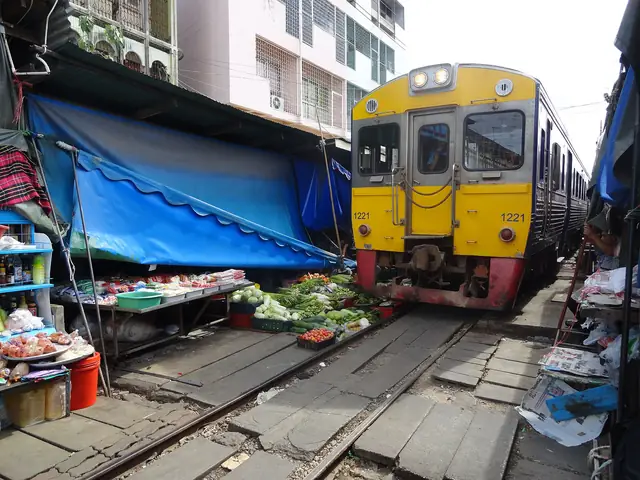
With a full day and a liking for markets, Samut Sakhon and Samut Songkhram are next to each other. Do the salt farms in the morning and the Mae Klong railway market and Amphawa floating market in the afternoon. The markets and train times are on the Amphawa pages, so they are not repeated here. Day tours from Bangkok to Mae Klong and Amphawa can be booked from two partners.
 KKday
Bangkok Floating Market Tour: Damnoen Saduak, Maeklong and Amphawa
From US$25.94 (Starting price per person. The real price depends on the set and date)
Price as of 5 Nov 2026A market tour from Bangkok to Damnoen Saduak, Mae Klong and Amphawa, 7 hours 10 minutes to 8 hours 40 minutes. From US$25.94 as of 5 Nov 2026. A joined tour that does not stop at the Khok Kham salt farms. Good if you want the markets and the salt farms on separate days.
Market tour on KKdayPhotos, prices and reviews from Klook
Damnoen Saduak floating market and Mae Klong railway market tour from Bangkok, joined or private. From US$34.05 per person as of 12 Nov 2026. It does not stop at the Khok Kham salt farms. Good if you want both markets in one day.
Market tour on KlookBryde's whale cruise from Samut Sakhon: a sea trip you can book ahead
If you want to go out on the real sea rather than walk the shore, the Bryde's whale cruise leaving from Samut Sakhon is a boat option you can book ahead. It is a full day of about 8 hours. You meet at Wild Encounter Pier 01 about 07:00, the boat leaves 07:30 and returns to the pier about 14:00 to 17:00 depending on where the whales are. Breakfast and lunch are included and the guide speaks English and Thai. There is no transport from Bangkok in this package, so you drive yourself or book a transfer.
The whale-watching season runs from about May to December. If no whale is seen on your day you can rejoin free another time, so read the terms on the booking page before you pay. Arrive before the meeting time and do not plan anything else for that afternoon.
Bryde's whale watching from Samut Sakhon (double-deck boat, about 8 hours)
Price Check latest price
Check the latest price on the booking pageBryde's whale cruise at Samut Sakhon. Meet at Wild Encounter Pier 01 about 07:00. Breakfast and lunch are included. Free rejoin if no whale is seen, under the terms on the booking page. No transfer. As of 14 Nov 2026 the dates shown were sold out, so look at other dates on the booking page.
Whale cruise on KKdayBangkok car rental, self-drive to Samut Sakhon and the Khok Kham salt farms
Price Check latest price
Check the latest price on the booking pageThe pier is in Samut Sakhon and the cruise has no pick-up. Rent a car in Bangkok and leave early to reach the pier before the meeting time. Check the latest price on the booking page.
Self-drive to the pierWhat to eat and what to buy: Red Bridge seafood and salt gifts
Several seafood restaurants stand at the entrance to the Red Bridge, within walking distance. They suit lunch or dinner after the sunset. Fresh seafood is priced by type and weight, so ask the price per kilogram and how cooking is charged before you order. Restaurants along the road back to Mahachai cover several price levels. If you want a wider choice and to pick seafood yourself, the Mahachai market has more, on the Mahachai seafood market page.
Around the salt farms there are cafes and restaurants run by salt-farming families. Phone ahead for opening hours and order early in the day.
- Sea salt and flower of salt from the Khok Kham salt farms are gifts you will actually use, for cooking or skin care. Buy from community shops near the centre and read the label and the weight before you pay.
- Salt spa products and salt soap are sold in the area. Ask about ingredients if you have sensitive skin.
- Crispy shrimp and dried seafood have more choice at the Mahachai market if you want to compare.
- A small cool box or foam box in the car keeps fresh seafood good until Bangkok if you buy to take home.
Sleep near the salt farms or in Mahachai: choose by your start time
If you plan to be at the salt farms at dawn, or to join the whale cruise that meets at 07:00, sleeping in Samut Sakhon the night before saves a 04:00 wake-up. Hotels on the Khok Kham side are closer to the salt farms and the Red Bridge than hotels in Mahachai town, but have fewer places to eat around them. Hotels in Mahachai town are easier for finding food on foot. The area table and every hotel are on the where to stay in Samut Sakhon page.
Grand Inter Hotel
Khok Kham, Moo 2
A 4-star hotel in Khok Kham, Moo 2. It has free parking, free Wi-Fi, a restaurant and a fitness centre. Good for people who drive to the salt farms and the Red Bridge and want to sleep in Khok Kham. Compare the distance to the salt farms on the map, and ask the hotel about check-in time and breakfast before you book.
See prices and availability on the booking page
Phetara Hotel Mahachai by PCL
Khok Kham, Moo 7
A 4-star hotel in Khok Kham, Moo 7, with an outdoor pool and a kids' pool, mini golf, a fitness centre, free parking and a 24-hour front desk. Good for families who want to rest before or after the salt farms. Check-in is about 14:00 to 23:00, so tell the hotel if you arrive late.
See prices and availability on the booking page
Norn Lay Chom Chan Cafe & Resort
Khok Kham
A cafe and resort in Khok Kham with free breakfast, free Wi-Fi, parking and family rooms. Good for people who like a cafe-resort stay in Khok Kham. Ask about the route in and the cafe closing time before you book.
See prices and availability on the booking page
Chan Le Resort
Ban Rang Koh Kam Road, Phanthai Norasing, next to the Red Bridge coast
A small 2-star resort on Ban Rang Koh Kam Road in Phanthai Norasing, near the Red Bridge side. It has free breakfast, free parking, a garden and a restaurant. Good for people who want to watch birds and the sunrise by the sea.
See prices and availability on the booking page
With children, older people or in the rain: what suits and what does not
- Young children and older people: the salt farms have no shade and few toilets. Bring an umbrella, a hat, water and a cooling cloth. Go before 09:00 or after 16:00. The lanes take cars, but the walking paths along the dykes are not suited to strollers.
- The red suspension bridge at the mangrove centre takes at most 10 people and is more than 6 metres high. Children afraid of heights should stay with an adult. The 1.5 km nature walk is flat but is a timber surface, so look at its condition before you walk.
- Rainy days: the salt farms stop working and the lanes turn to mud. Switch to Wat Khok Kham, the Mahachai market or a family cafe in the salt farms. Do not go on the Red Bridge in a thunderstorm, because it reaches out into the open sea.
- Clothes: light, breathable colours, shoes that can get wet, a spare shirt for children if they play in mud at the mangrove centre, and sunscreen and sunglasses because the white salt reflects strongly.
Common mistakes at the salt farms and the Red Bridge
- Going between noon and 15:00, when the sun is hardest, the white ground makes photographs difficult and it is too hot to stay. Go early or late.
- Going in the rainy season hoping for salt heaps. Rain stops the work and the ground is mud. For workers carrying salt, go from January to April.
- Assuming every stop is close. They are about 7 to 9 km apart and public transport is poor. Book a car ahead if you do not have one.
- Walking into a farmer's pan without permission. It is their living.
- Waiting for dolphins at the dolphin viewpoint. They are seen far less today. Go for the view and the sunset.
- Not checking the tide. If you want mudskippers or shorebirds, a high tide hides the mudflat.
- Not carrying water, a hat and some cash for small shops in the farms.
See tours, tickets and transfers for a Samut Sakhon trip
The province overview is on the Samut Sakhon guide, hotels are on the where to stay page, and the market is on the Mahachai seafood market page.
Frequently asked questions
Where are the Khok Kham salt farms and how do I get there?
They are in Khok Kham subdistrict, Mueang Samut Sakhon, on the sea side of the province. By car from Bangkok on Rama 2 Road it takes about 1 hour if you leave early. Public transport does not reach the farms easily. Without a car, take the Mae Klong train to Mahachai and then a ride-hailing car, or book a private transfer.
Which month shows people harvesting salt?
The salt season runs from about November to May, and hand harvesting is busiest from about January to April. If the rains come early or late the season moves. Phone the salt school on 08 6524 1021 before you go, and go before 09:00 or after 16:00.
Do the Khok Kham salt farms charge an entry fee?
There is no ticket for watching the salt farms from the roadside. Learning activities and workshops at the centre may cost something, so phone to ask before you go.
What time does the Bang Ya Phraek mangrove centre open?
Mangrove Research Centre 2 is open daily about 08:30 to 16:30. Closing can be later, so arrive before 15:30 and phone 0 3449 8262 or 8263 first. The red suspension bridge takes at most 10 people at a time.
What is the difference between the Red Bridge and the rainbow bridge?
The Red Bridge is in Phanthai Norasing, a red timber bridge about 700 m long beside the sea, good for sunset and seafood. The rainbow bridge is in Kalong, painted in rainbow colours and reaching out to sea with a mangrove walk, best in the evening for photographs.
Can I visit the salt farms without a car?
You can, but it is hard. Public transport does not reach the salt farms easily and the stops are about 7 to 9 km apart. The options are the Mae Klong train to Mahachai and then a ride-hailing car, or a private transfer or self-drive rental. Arrange the return trip before evening.
Can I book a salt farm tour in advance?
There is no direct Khok Kham salt farm tour to book on Klook or KKday as of 14 Nov 2026. You can book a private transfer or car rental, and the Bryde's whale cruise from Samut Sakhon. To learn salt making properly, phone the salt school.
Is there a lighthouse or a floating chedi at Khok Kham?
No visitor lighthouse is known at Khok Kham. The floating chedi, Phra Chedi Klang Nam, is in Rayong province, and Phra Samut Chedi is at Pak Nam in Samut Prakan province. Neither is in Samut Sakhon.
Where should I stay if I want to see the salt farms early?
Hotels on the Khok Kham side or near the Red Bridge get you to the salt farms quickly. If you want to walk to food in the evening, choose a hotel in Mahachai town. The area table is on the Samut Sakhon where to stay page.
Keep planning
 Samut Sakhon trip plannerStart here: market, sea, salt farms
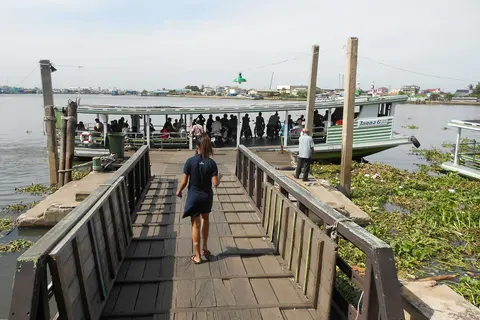 1 to 2 day planWat Chong Lom, Tha Chalom, Phan Thai Norasing shrine
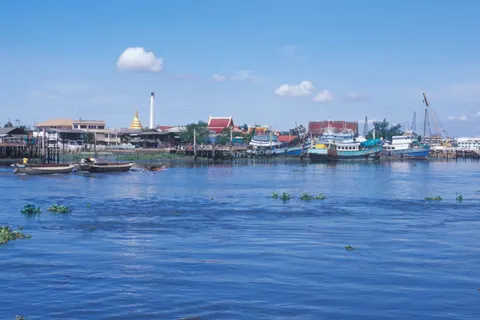 Mahachai Market and Talad Thale ThaiHours, what to buy, where to eat
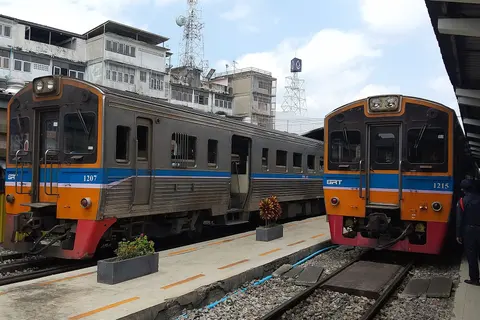 Mahachai to Mae Klong trainTimetable, fares and the Tha Chalom ferry
 Getting to Samut SakhonTrain, bus, van, taxi and car from Bangkok
 Where to stay in Samut SakhonWhere to stay in Samut Sakhon
 Book Samut SakhonCars, set meals, car rental, hotels