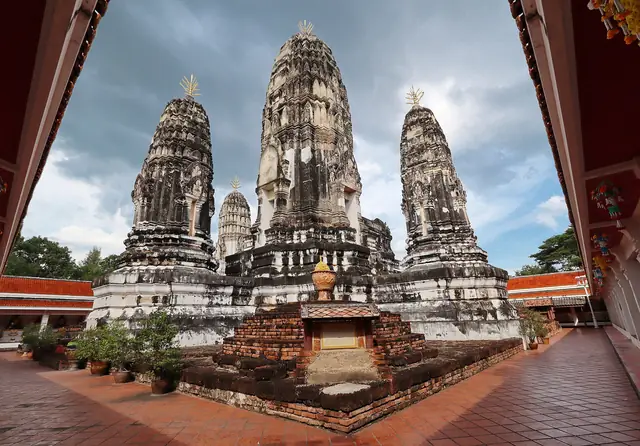
Ratchaburi does not have one central spot to wander. It splits into two clear zones. The town sits on the Mae Klong river and holds Wat Mahathat Worawihan, Khao Ngu Stone Park and the dragon jar factories that earned the province its nickname as the pottery city. The second zone is Photharam, north of town, a Mon and Chinese district with the Wat Khanon shadow puppet museum, old murals at Wat Khongkharam and well known local food.
This page lays them out as two half days: town first or Photharam first depending on the day of the week, with Nong Pladuk Junction and the ancient town of Khu Bua as add-ons. If you want to finish with the bats at sunset, read the caves and bat flight page. How to get here from Bangkok is on the getting there page.
We earn a commission if you book through our links. The price you pay does not change. How we choose
Ratchaburi town and Photharam at a glance
| Town | The Mae Klong river runs through the centre. Highlights are Khao Ngu Stone Park, Wat Mahathat Worawihan and the dragon jar factories. About half a day. |
|---|---|
| Photharam | About 22 km north of town. Wat Khanon with its nang yai museum, Wat Khongkharam, and Mon and Chinese food. About half a day. |
| Days that matter | Shadow puppet shows are on Saturday at about 10:00 and Sunday at about 11:00, so check first. The Wat Khongkharam murals open on Saturday and Sunday, about 09:00 to 16:30. |
| Getting around | Songthaews and tuk-tuks work in town. Photharam needs your own car or a taxi. |
| Check first | The exhibition building of Ratchaburi National Museum has been closed for renovation since 1 October 2025, with no reopening date. Phone 032-321-513 before you go. |
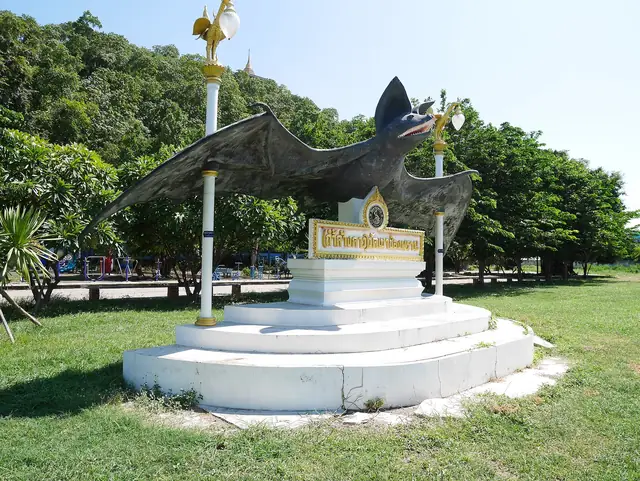
| Link with bats | Wat Khao Chong Phran is in Photharam and the bats start about 17:30 to 18:00, so it fits the end of the second half day. |
Route order for one day or two
The town and Photharam are in different directions, so they make two natural half days. On a Saturday or Sunday, do Photharam first. The puppet show is a morning event and the only thing here you cannot make up later. The town can wait until the afternoon, and Khao Ngu is at its best in late light.
One full day, Saturday or Sunday
- Reach Wat Khanon half an hour before the show. See the shadow puppet museum and the performance (Saturday about 10:00, Sunday about 11:00, check first).
- Eat lunch around Photharam. Try black tofu or Ban Sing beef tom yum. Dry rice (khao haeng) is at Lak Ha floating market, not in Photharam itself.
- Early afternoon, go to Wat Khongkharam for the roughly 250 year old murals. Closing is about 16:30.
- Late afternoon, drive to Wat Khao Chong Phran, arrive about 17:00 and wait for the bat flight from about 17:30. Details are on the caves and bats page.
- Sleep in town or go back to Bangkok. If you stay, spend the next morning on Khao Ngu and the dragon jars.

Western Grand Hotel Ratchaburi
Ratchaburi town centre area
A hotel in the Ratchaburi town centre area. If you plan two days, sleep in town and head to Photharam early to catch the late morning puppet show.
See prices and availability on the booking page
A half day in town: times and costs
- 08:30 Wat Mahathat Worawihan, 30 to 45 minutes, free.
- 09:30 Drive about 15 to 20 minutes to Khao Ngu Stone Park. Walk the lake, see Ruesi and Fa Tho caves, 1.5 to 2 hours, free, pedal boat about 20 baht.
- 11:45 Back to town for lunch at Sanam Ya market.
- 13:30 Pottery Legend (about 190 baht) or Tao Hong Tai (free), 1 to 2 hours.
- 15:30 Stroll the river embankment and see the dragon jar fountain. On Friday to Sunday, stay for Khoyakee in the evening.
Entry comes to about 0 to 210 baht per adult, not counting food and fuel. Province-wide budgets are on the Ratchaburi page.
Ratchaburi town: the river, the market and Wat Mahathat
The Mae Klong river is the spine of Ratchaburi. It flows through the middle of town before it heads on to Samut Songkhram, and old houses and shops line its banks. Sanam Ya market, beside the clock tower on the river, is where locals actually shop, not something staged for visitors. Use it for a meal and small souvenirs rather than planning a whole day around it.
Wat Mahathat Worawihan
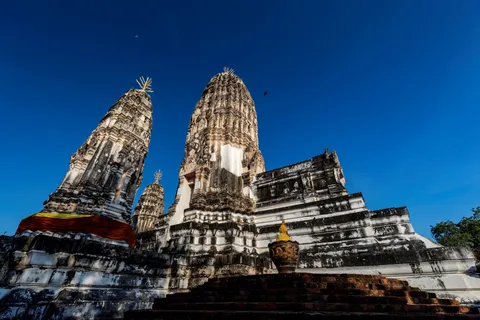
Wat Mahathat Worawihan (also called Wat Na Phra That) sits in the town centre on Khao Ngu Road, Na Mueang sub-district. The site goes back to the Dvaravati period, and the Khmer-style prang, about 24 m high, was added later. In the main viharn you find Phra Mongkhon Buri, and a second Buddha image called Phra Rak Mueang sits back to back with it. The temple is open daily from about 08:00 to 17:00, free, so dress modestly with shoulders and knees covered. Allow 30 to 45 minutes. The prang photographs best in the morning or late afternoon when the light is low, not at noon when the shadows are harsh.
Sanam Ya market
Sanam Ya means the lawn market. It is also called Talat Ratchaphatsadu, the all-night market and the clock tower market. It began as a lawn with a fountain more than 50 years ago and was roofed over as a market in 1984. People stop for a soda ice-cream float, pandan custard bread, beef or braised duck noodles, and chicken stewed with pickled lime. Stalls keep different hours, so check first, and ask the price before you order if there is no sign.
Khoyakee walking street and the dragon jar fountain
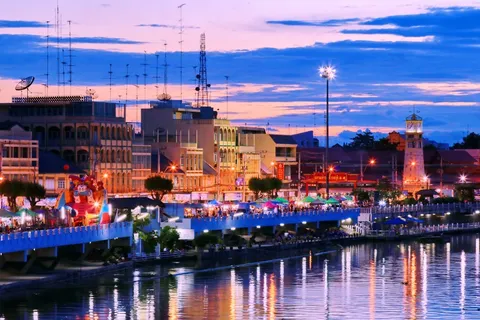
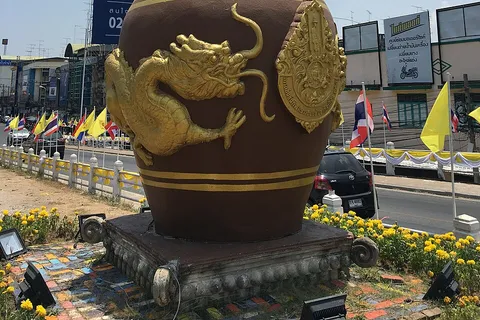
Khoyakee is the old riverside quarter where dragon jars were loaded onto boats. Today it is a walking street on Worachet Road, open Friday to Sunday evenings, about 16:00 to 21:00, so check first. Nearby on the embankment stands the dragon jar fountain: a jar about 6 m high with two gold dragons spouting water, built in December 2022. Check the fountain times before you go. The embankment runs about 700 m from the museum to the bridge and makes an easy evening stroll.
Khao Ngu Stone Park: lake, caves and Dvaravati carvings
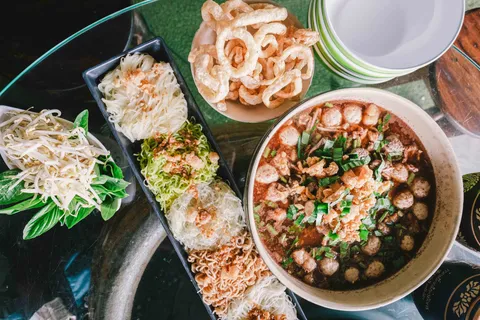
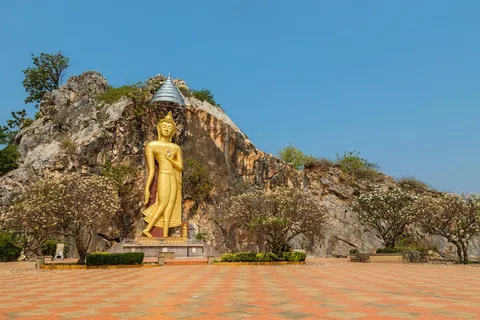
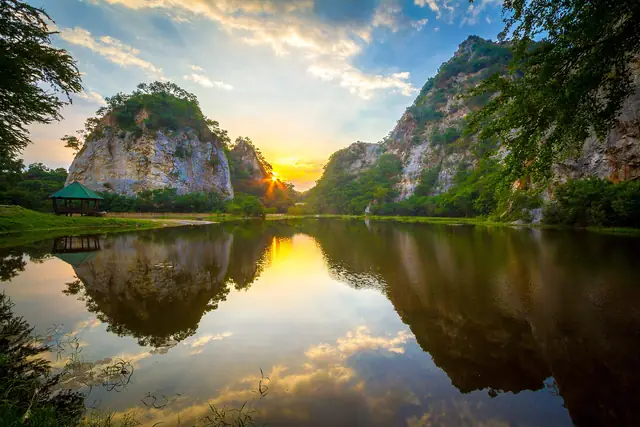
Khao Ngu Stone Park is in Ko Phlap Phla sub-district, about 8 km from town, a 15 to 20 minute drive. It was a stone quarry that was blasted and left, and the pit filled with green water inside limestone cliffs. Today it is a municipal park run by Khao Ngu sub-district, where locals relax, and an archaeological site with stucco Buddha images and carvings in its caves.
| Hours | About 09:00 to 17:00 daily. The grounds may stay open longer, so check before you go. |
|---|---|
| Entry | Free, and parking is free |
| Pedal boat | About 20 baht for adults and 10 for children, for about 20 minutes. Check at the pier. |
| Caves | Five caves on the hillside: Ruesi, Fa Tho, Chin, Cham and Rakhang. See the caves section below. |
| Sky Walk | Only a proposed project, not an open walkway. The hanging bridge and boardwalk round the lake already exist. |
| Time needed | About 1 to 2 hours, or 2 to 3 if you climb to the caves. |
The lake is at its prettiest in late afternoon, when low light turns the cliffs gold-orange and the water goes still. At noon it is hot and flat. The path round the lake is level and easy, though some stretches are slippery. Wear shoes with grip. There is a small market and a few restaurants at the entrance, and bikes can be rented.
Monkeys are numerous around the paths and caves, and some grab things and have damaged car window seals. Keep car windows shut, food and bottles in your bag and not in your hand, and do not feed them.
What to do
- Walk the boardwalk round the lake and cross the hanging bridge.
- Pedal a duck-shaped boat out on the lake.
- Hire a bicycle for the park and feed the fish.
- Take the nature trail up to the viewing pavilion.
- Ride the tram to Phu Pha Rat, a granite cliff. Ask about times and price at the park.
- Eat at the market and restaurants at the entrance, where there is a weekend market.
When to go
Go in the morning or late afternoon when the sun is soft. In the rainy season paths and steps are slippery. Allow 1 to 2 hours in the park, or 2 to 3 hours if you climb to the caves.
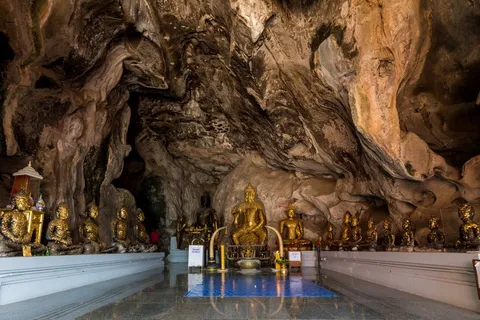
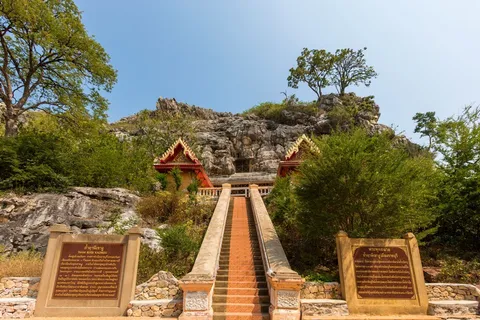
The caves at Khao Ngu: Ruesi, Fa Tho, Chin, Cham and Rakhang
The limestone caves at Khao Ngu are not deep passages like Khao Bin. They are shallow recesses holding stucco Buddha images and carvings from the Dvaravati period, about the 7th to 8th century. They sit on the hillside across the road from the bridge. Turn in at the large standing Buddha a short way past the park entrance. Monkeys are everywhere on the way, so keep food out of sight.
Ruesi Cave
The easiest cave, right by the road with the fewest steps. A seated Buddha with legs hanging down, in the Dvaravati style, is known as Phra Phutthachai Tham Ruesi Khao Ngu. A Pallava script inscription in Sanskrit reads Sri Samadhigupta. A festival is held at the cave on the first waxing day of the 11th lunar month, so check the date.
Fa Tho Cave
Many steps, with shaded pavilions on the way up. The highlight is a relief of the Buddha entering parinirvana, 8.75 m long, with stucco deities above it. Visitors compare it with the paintings at Ajanta in India.
Chin and Cham caves
These two share a hillside and one shorter climb than Fa Tho. Chin Cave holds two seated stucco Buddhas. Cham Cave lies about 100 m further on and shows the Great Miracle at Savatthi, a reclining Buddha and a Buddha sheltered by a naga.
Rakhang Cave and the footprint on the summit
Rakhang Cave, also called the bat cave, carries the royal monogram of King Rama V with the year 118, which is 1899. A Buddha footprint sits on the summit. If the climb is too much, skip it. Ruesi and Fa Tho are enough.
If you walk slowly or travel with older relatives, see Ruesi Cave by the road, which has the fewest steps, then stroll round the lake instead of climbing to the other caves.
Ratchaburi dragon jars: factories, what to buy and how to carry it
Ratchaburi is known as the jar city. The glazed earthenware jars with a dragon pattern are the symbol of the province. The story goes that Chinese migrants found fine red clay, called mun pu clay, in Ratchaburi paddy fields and began making jars. The dragons came later, painted in white clay when stamping the pattern proved too slow. Several old factories now let visitors watch the work and buy.
Tao Hong Tai
Tao Hong Tai is at 234/1 Moo 2, Chedi Hak Road, Chedi Hak sub-district, Mueang Ratchaburi. It is open daily from about 08:00 to 17:00, and entry is free. There are throwing and glazing demonstrations, jars and pots in more than 600 glaze colours, a dragon kiln that fires above 1,300 degrees, a garden, a cafe and art shows. The phone is 08-6344-9292. Phone to ask about the weekly closing day and demonstration times before you go. Weekdays can have fewer craftsmen at work than weekends.
Rueang Khong Ong (Pottery Legend) is in Don Tako sub-district, Mueang Ratchaburi. It is a learning centre with a 3D animation room, live jar-making demonstrations, a replica kiln, paint-and-shape workshops, a restaurant and a shop. It is open daily from about 09:30 to 17:30. Thai adults pay about 190 baht and children about 100, and foreign visitors pay more, so check first. Visits run in timed rounds and take 1 to 2 hours. The phone is 098-241-9148. It suits children best, because they shape or paint clay themselves.
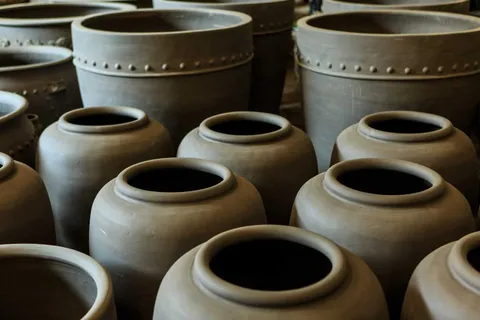
Rattanakosin Ceramic factory
An old jar factory on about 23 rai that used to teach throwing and painting. It is open daily from about 08:00 to 17:00. Ask first whether it still runs activities.
Which one to pick
| Place | Best for | Entry | Time |
|---|---|---|---|
| Tao Hong Tai | Photos, kilns, glazes | Free | About 1 hour |
| Pottery Legend | Families with children | About 190 baht | 1 to 2 hours |
| Rattanakosin factory | Old factory, painting | Ask first | About 1 hour |
What to buy and how to carry it
- Small items travel easily: saucers, cups, small plant pots and magnets. Wrap them in paper and pack in a small box.
- Medium pieces, such as pots and jugs, fit a suitcase wrapped in soft clothing.
- Large dragon jars go by private car only. Ask the shop to pack them for breakage and strap them to a seat. If you are heading to Bangkok, ask whether the shop can arrange delivery.
- On a flight, check pieces in the hold in the box the shop packed. Do not carry them into the cabin.
Ratchaburi National Museum
Ratchaburi National Museum is on Worachet Road, in the former provincial hall built in 1922. It holds Dvaravati Buddhas, a Bayon-style Avalokiteshvara, one of five found in Thailand, and dragon jars. When it is open, it runs Wednesday to Sunday, 09:00 to 16:00, and is closed on Monday, Tuesday and public holidays. Entry is 20 baht for Thais, 100 baht for foreign visitors, and children are free. The exhibition building has been closed for renovation since 1 October 2025, with no reopening date. Phone 032-321-513 before you go. If it is shut, the same period is easier to see at Khu Bua and the cave carvings at Khao Ngu.
Photharam: Wat Khanon shadow puppets, Wat Khongkharam and Mon-Chinese food
Nang yai and UNESCO
In June 2007 UNESCO and the Asia Pacific Cultural Centre (ACCU) named the revival of nang yai at Wat Khanon one of six outstanding communities for safeguarding intangible heritage. That is not a World Heritage inscription. In 2026 the Thai cabinet approved, on 26 March, a nomination of the community-based revival of nang yai for UNESCO's Register of Good Safeguarding Practices. It is under evaluation.
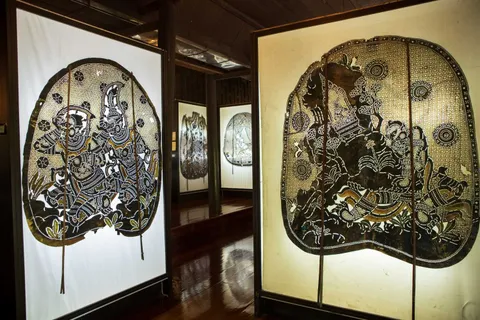
The nang yai festival
The 19th Wat Khanon nang yai festival ran on 13 and 14 April 2026, during Songkran, with free entry, shows with puppets worn on the body (nang tit tua khon) and fire shadow plays by three troupes. The next edition is expected around the same days. Check the dates.
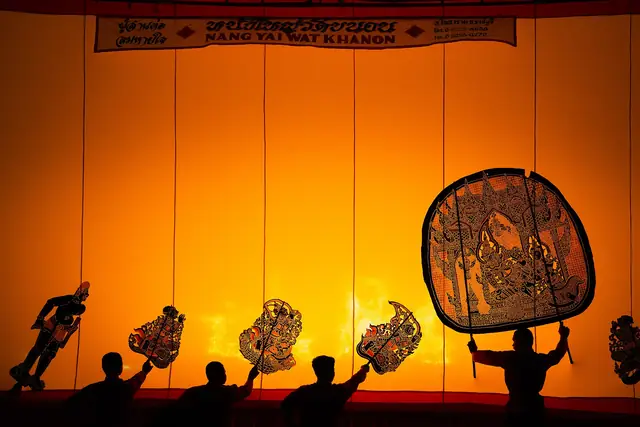
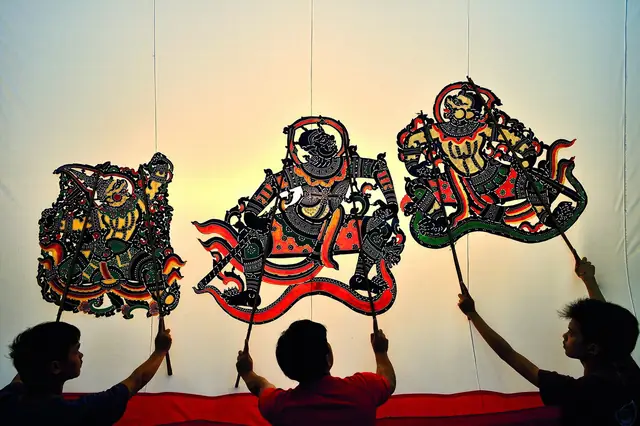
Photharam is about 22 km north of Ratchaburi town, a 30 to 40 minute drive. Mon and Chinese communities have lived here for generations. If you have seen southern Thai shadow puppets, Ratchaburi nang yai will look different. The leather figures are huge and finely cut, and several puppeteers move them in front of a lit screen.
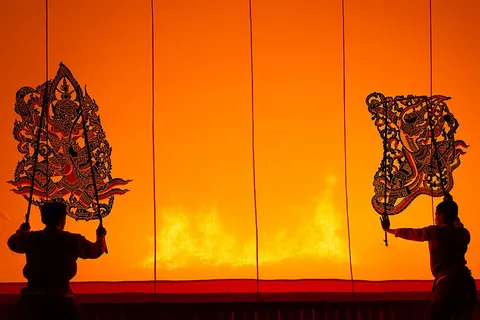
Wat Khanon and the nang yai museum
| Where | Soi Fa sub-district, Photharam district, on the Mae Klong river, about 10 km from the district centre |
|---|---|
| Hours | Museum open daily 08:00 to 17:00 |
| Entry | Free. There is a donation box. |
| Shows | Saturday about 10:00 for about an hour, performed by the temple's pupils. Sunday about 11:00, check first. None on weekdays unless a group arranges one. |
| Collection | 313 nang yai puppets, mostly Ramakien scenes |
Wat Khanon keeps and passes on nang yai, the large shadow puppets of Thailand. The figures are carved from cow hide and show characters from the Ramakien. The museum holds 313 puppets in good condition. The first set made was Hanuman Offers the Ring, carved by the temple's abbot in the reign of King Rama V with local craftsmen. The name comes from a tax checkpoint, a khanon, on the river. Only three communities still perform nang yai: Wat Khanon, Wat Sawang Arom and Wat Ban Don.
Wat Khongkharam and the Mon murals
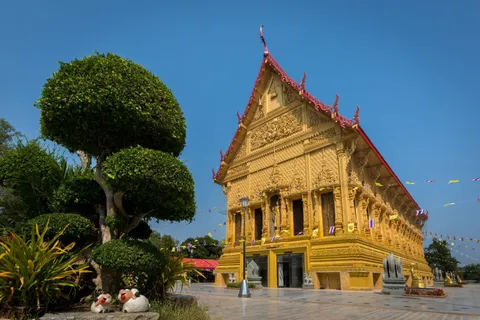
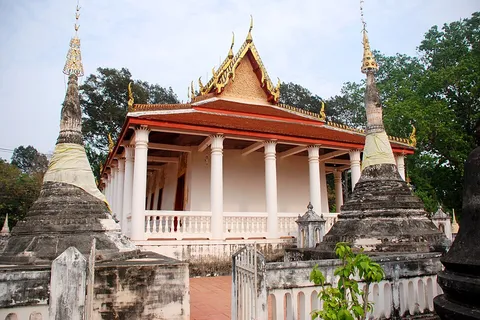
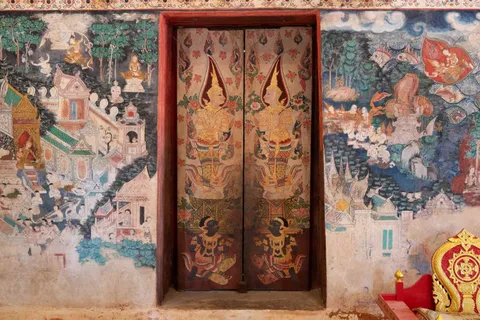
Wat Khongkharam is a Mon temple on the Mae Klong riverbank in Khlong Ta Khot sub-district, about 22 km from town. The star is the mural painting in the ordination hall, roughly 250 years old, showing Buddhist stories with Mon clothing and houses that differ from ordinary Thai temple murals.
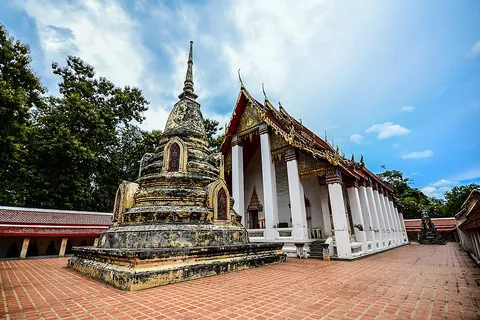
The temple was built by Mon chiefs, registered as a temple in 1777 and consecrated in 1787. It used to be called Wat Klang. Seven Ramanya-style chedis stand around the ordination hall for seven Mon rulers, and a nine-room Thai house from the Thonburi period is now a folk museum.
| Temple | About 08:00 to 17:00 daily |
|---|---|
| Murals and Mon folk museum | Saturday, Sunday and public holidays, about 09:00 to 16:30. On weekdays, groups must book ahead, so ask the temple first. |
| Entry | About ten baht. Check before you go. |
| Route | Highway 4, then Highway 3080 for about 1 km |
What to eat
- Black tofu: Teochew-style tofu simmered in braising spices for 3 to 4 days, firm and dark, a Photharam classic.
- Ban Sing beef tom yum: beef simmered tom yum style in a hot and sour broth, a Photharam signature.
- Dry rice (khao haeng): a Chinese-style rice dish like a dry congee, served with soy-braised chicken, duck blood, pickled mustard greens and crispy garlic. The place to find it is Lak Ha floating market, on the border of Damnoen Saduak and Ban Phaeo, not in Photharam. A light meal.
- Mon mataad curry: a sour Mon-style curry made with the mataad fruit, which gives it a jelly-like texture; try it when you see it at a local restaurant.
 KKday
Ratchaburi 2 Days 1 Night Tour from Bangkok: Wat Khanon, Na Satta, Suan Phueng and Khao Ngu
From US$110.23 (Starting price per person)
Price as of 6 Nov 2026A 2 day 1 night tour from Bangkok. Day 1 takes you to the Wat Khanon nang yai museum and Ratchaburi old town, and day 2 ends at Khao Ngu. The old town market runs on weekends only, and at least 2 paying guests are needed. See the booking page for the full list.
Book on KKdayPhotos, prices and reviews from Klook
A private 2 day 1 night tour from Bangkok: Damnoen Saduak floating market, Maeklong Railway Market, a night at The Camping Field in Suan Phueng and Alpaca Hill. Includes the night, breakfast, dinner and hotel transfers. At least 2 guests. It does not stop at Wat Khanon or Ratchaburi town. Check the latest price on the booking page.
Book on KlookMore in Photharam: Wat Phra Si An, markets and what to eat
Wat Phra Si An
Wat Phra Si An is in Ban Lueak sub-district on Highway 3080, about 500 m from the Bang Phae junction and about 20 km from Ratchaburi town. Its golden ordination hall is in late Ayutthaya style, with hand-worked stucco and murals of the Mahajanaka, the Dasa Jataka and five Buddhas. The temple covers about 40 rai, opens daily from about 07:00 to 17:00 and is free. Allow 30 to 45 minutes.
Photharam market
Photharam market is an old market from the reign of King Rama V in three parts: upper, middle and lower. The middle part sells black tofu, and the upper part has an old cinema that has closed. The market sits by the river, and the riverside can flood at the end of the rainy season. In late September and early October 2026 the Mae Klong flooded in Photharam. If you go late in the rainy season, check before you set out.
Sa Suk Chai Mon market at Wat Don Krabueang
The Thai-Mon market Sa Suk Chai is inside Wat Don Krabueang and runs on Saturday and Sunday, about 09:00 to 19:00, with vendors in Mon dress. Good for a stroll and a snack. Check that it is running before you go.
What to eat in town and Photharam
| Dish | Where | What it is |
|---|---|---|
| Black tofu | Photharam market, middle | Braised 3 to 4 days, firm |
| Ban Sing beef tom yum | Ban Sing area, Photharam | Hot and sour beef and offal soup |
| Dry rice | Lak Ha floating market | Chicken, duck blood, garlic |
| Mataad curry | Mon restaurants | Sour and spicy, soft fruit |
| Soda ice-cream float | Sanam Ya market | A snack in town |
Riverside and town cafes come and go. Check the latest hours on the map before you go, and do not build a whole day around one cafe.
Ban Pong and Nong Pladuk Junction: where the Death Railway began
Nong Pladuk Junction is in Ban Pong district. It opened on 19 June 1903 and is the point where the southern line meets the western line to Kanchanaburi and the Suphan Buri line. In the Second World War it was the starting point of the Thai-Burma railway, known as the Death Railway. Construction began in 1942, and a prisoner camp stood near the station.
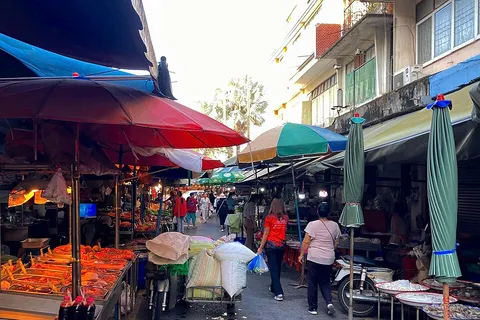
The station still works, so it is a stop rather than a museum. Allow 30 to 45 minutes to see the platforms, which were rebuilt with a new building and raised in 2024, and to eat the banana-leaf rice with curry sold near the station, about 10 baht a leaf cup and sold for over 40 years. For the rest of the line, read the Death Railway page and Bangkok to Kanchanaburi.
Wat Muang Folk Museum and Wat Pho Ratanaram
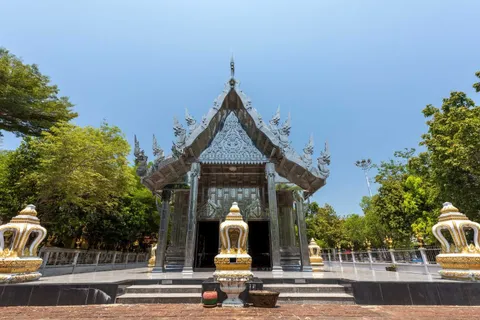
Ban Pong also has the Wat Muang Folk Museum, a Mon temple museum run by volunteers, open daily from about 09:00 to 17:00, free, since 1993 (not the Wat Muang in Ang Thong). Wat Pho Ratanaram, also called Wat Pho Khu, in Pak Raet sub-district, has the second ordination hall in Thailand clad in stainless steel and opens about 08:00 to 17:00. Both are easy stops if you pass through Ban Pong.
Khu Bua ancient town and Na Satta light festival: add-ons
Khu Bua ancient town
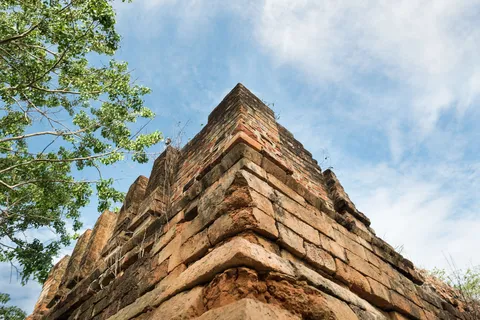
Khu Bua is a moated Dvaravati city in Mueang Ratchaburi district, a rectangle about 800 by 2,000 m with more than 60 monuments, open air and free to walk. Wat Khlong Suwan Khiri has monument no. 18, the largest, and Luang Pho Daeng. The Khu Bua community museum, a Thai Yuan museum at the same temple, is open daily from about 09:00 to 16:00 and is free. The Khu Bua community market (a Thai Yuan market) runs Friday to Sunday from about 09:00 to 19:00 and sells tin-chok skirts, so check before you go. About 45 minutes to an hour is enough.
Na Satta Thai Park light festival
Na Satta Thai Park is in Wang Yen, Bang Phae district. The park covers about 42 rai, with about 60 fibreglass and wax figures and a Buddha jataka cave. It normally opens Tuesday to Sunday and is closed on Monday. The latest Na Satta Light Festival runs from 20 November 2026 to 28 February 2027, with the light show from 18:00 to 22:00. Allow 1 to 2 hours and go after sunset. Prices and dates are on the booking card below.
Photos, prices and reviews from Klook
Entry ticket to the Na Satta Thai Park light festival. It is an entry ticket only, with no transfer. Dates and prices are on the booking page.
Book on KlookFees and opening hours
These figures are approximate, as of 13 Nov 2026. Hours and fees change, so check before you go.
| Place | Hours, about | Entry | Notes |
|---|---|---|---|
| Khao Ngu Stone Park | 09:00 to 17:00 | Free | Pedal boat about 20 baht, five caves |
| Wat Mahathat Worawihan | 08:00 to 17:00 | Free | Dress modestly |
| Tao Hong Tai | 08:00 to 17:00 | Free | Phone 08-6344-9292 |
| Pottery Legend (Rueang Khong Ong) | 09:30 to 17:30 | Thai adult about 190 baht | Timed rounds, make-your-own |
| Ratchaburi National Museum | Exhibition building closed | Thai adult 20 baht when open | Phone 032-321-513 |
| Wat Khanon and nang yai museum | 08:00 to 17:00 | Free (donation) | Shows Sat about 10:00, Sun about 11:00 |
| Wat Khongkharam | Temple 08:00 to 17:00, murals 09:00 to 16:30 on weekends and holidays | About ten baht | Weekdays: book ahead, ask the temple |
| Nong Pladuk Junction | Station hours | Free | Platforms and banana-leaf rice |
| Wat Khao Chong Phran | Bats start about 17:30 to 18:00 | Free | See the caves page |
| Wat Phra Si An | 07:00 to 17:00 | Free | Golden hall, Highway 3080 |
| Khu Bua museum | 09:00 to 16:00 | Free | Wat Khlong Suwan Khiri |
| Wat Muang Folk Museum | 09:00 to 17:00 | Free | Ban Pong, volunteers |
| Na Satta Thai Park | 18:00 to 22:00 (20 Nov 2026 to 28 Feb 2027) | Book on Klook | Buy ahead |
By car, or by public transport
With your own car
A car is by far the easiest. The town and Khao Ngu are about 8 km apart and Photharam is about 22 km away. Arrive early on weekends, when Khao Ngu is busy. The lane to Wat Khongkharam is narrow, so drive slowly.
Without a car
In town, songthaews and tuk-tuks reach Wat Mahathat and the market, but agree the fare first. For Khao Ngu, a taxi or hired driver is simpler and can wait for the return. Photharam has no public transport that links the temples, so hire a taxi or a driver for the day and ask the price before leaving.
No car: the train from Bangkok
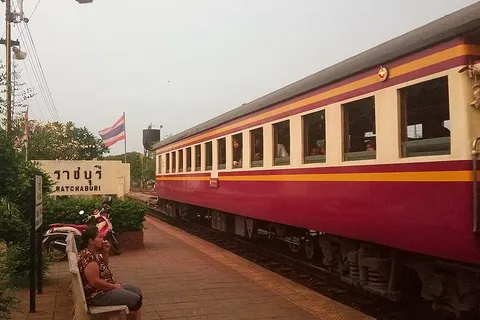
Train 43 leaves Krung Thep Aphiwat at 07:30 and reaches Ratchaburi about 09:07, with several afternoon trains too. Check fares and times on 1690 or dticket.railway.co.th. The first useful trains back leave Ratchaburi about 16:09 and 16:31, so a day trip means leaving Ratchaburi about 16:00 to 16:30. From the station hire a taxi or hired driver for Khao Ngu and the town. For Photharam, hire for half a day and agree the price first. The full set of ways to get here is on the getting there page.
 12Go
Bangkok to Ratchaburi on 12Go
From US$5.39 (Cheapest minibus seen)
Price as of 6 Nov 2026Compare train, minibus and taxi from Bangkok to Ratchaburi. Times and prices change by day, so check the booking page.
Book on 12GoChildren, older travellers and rainy days: what to pick
| Who | Go to | Watch out |
|---|---|---|
| Children | Pottery Legend, Khao Ngu boats | Monkeys at Khao Ngu, slippery paths |
| Older travellers | Wat Mahathat, Sanam Ya market, Ruesi Cave | Steps at Fa Tho and Cham caves |
| Rainy day | Nang yai museum, Khongkharam murals, Pottery Legend | Slippery Khao Ngu, riverside flooding |
On a drizzly day go where there is a roof: the Wat Khanon nang yai museum, the Wat Khongkharam mural hall (Saturday and Sunday), the Pottery Legend learning centre and the cafe at Tao Hong Tai. The caves at Khao Ngu and the lake path are slippery and can be misty. If rain is heavy, drop Khao Ngu.
When to go: events and seasons for town and Photharam
| Period | What is on | Good to know |
|---|---|---|
| Nov to Feb | Cool, pleasant weather, Na Satta light festival | Weekends are busy |
| March | Ratchaburi Muang Ong and Red Cross fair, about 10 days at the Provincial Hall | 2026: 20 to 29 March. 2027: check |
| April | Wat Khanon nang yai festival, at Songkran | 2026: 13 and 14 April. The hottest month |
| May to Oct | Rainy season, heaviest in Sep and Oct | Late Sep 2026: Mae Klong river flooded |
Common mistakes
- Going to Wat Khanon on a weekday and expecting a show. There is none. Pick Saturday or Sunday.
- Going to Wat Khongkharam on a weekday and finding the murals closed. If you want the murals, pick a weekend or a public holiday.
- Walking up to Ratchaburi National Museum without phoning. The exhibition building is closed for renovation.
- Buying a large dragon jar without a plan to carry it. A small saloon will not take it, so ask the shop about delivery or pick a smaller size.
- Reaching the bats late. Arrive about 17:00 to 17:30, because the densest part of the flight is the first 15 to 20 minutes.
- Expecting dry rice (khao haeng) in Photharam town. The place to find it is Lak Ha floating market.
- Looking for a Sky Walk at Khao Ngu. It is only a proposal, not an open walkway.
- Visiting Na Satta Thai Park on a Monday. It is normally closed, so check the festival schedule first.
- Reaching Wat Mahathat after 17:00, when it closes.
If you would rather not drive
 KKday
Ratchaburi 2 Days 1 Night Tour from Bangkok: Wat Khanon, Na Satta, Suan Phueng and Khao Ngu
From US$110.23 (Starting price per person)
Price as of 6 Nov 2026A 2 day 1 night tour from Bangkok with hotel pickup at about 11:00. Day 1 covers the Wat Khanon nang yai museum, the old town and the Na Satta lights, with the night in Suan Phueng. Day 2 has O-Poi market, The Scenery Vintage Farm or Veneto and Khao Ngu. At least 2 paying guests are needed, and the old town and O-Poi markets run on weekends only. Entry fees and the car are included per the booking page; a guide and tips are not.
Book on KKdayPhotos, prices and reviews from Klook
A private 2 day 1 night tour from Bangkok: Damnoen Saduak floating market, Maeklong Railway Market, a night at The Camping Field in Suan Phueng and Alpaca Hill. Includes the night, breakfast, dinner and hotel transfers. At least 2 guests. It does not stop at Wat Khanon or Ratchaburi town. Check the latest price on the booking page.
Book on KlookFrequently asked questions
How long does Ratchaburi town take?
The town, Khao Ngu and a dragon jar factory take about half a day, roughly 4 to 5 hours. Photharam takes another half day. Doing both in one day means an early start and only the main stops.
Is Khao Ngu Stone Park free, and when does it open?
Entry is free, and so is parking. It is open about 09:00 to 17:00 daily, and the grounds may stay open longer, so check before you go. The only paid item is the pedal boat, about 20 baht per adult for about 20 minutes.
When are the Wat Khanon shadow puppet shows?
Saturday at about 10:00 for about an hour, performed by the temple's pupils, and Sunday at about 11:00, so check first. On weekdays the museum is open but there is no performance.
When are the Wat Khongkharam murals open?
The murals and Mon folk museum open on Saturday, Sunday and public holidays, about 09:00 to 16:30, for about ten baht, so check first. On weekdays groups must book ahead, so ask the temple.
Is Ratchaburi National Museum open?
The exhibition building has been closed for renovation since 1 October 2025, with no reopening date. When it is open it runs Wednesday to Sunday, 09:00 to 16:00, and costs 20 baht for Thai adults and 100 baht for foreign visitors. Phone 032-321-513 before every visit.
How do I carry a dragon jar home?
Small items wrap in paper and fit in a bag. Large jars need a private car, with the shop packing them against breakage, or the shop's delivery. For a flight, check them into the hold in the shop's box.
Can I get to Photharam by public transport?
You can reach the town, but there is no easy service between the temples. Use your own car, a taxi or a driver for the day, and ask the price before you set off.
Can I see the bats at Wat Khao Chong Phran on the same day?
Yes. The temple is in Photharam and the bats start about 17:30 to 18:00. Arrive about 17:00. See the caves and bats page.
What is there to see at Nong Pladuk Junction?
It is a working station that opened on 19 June 1903 and was the start of the Thai-Burma railway. It was rebuilt with a new building and raised platforms in 2024, and banana-leaf rice with curry is sold near the station. Allow 30 to 45 minutes.
When is the Na Satta light festival?
The latest run is from 20 November 2026 to 28 February 2027, with the show from 18:00 to 22:00, in Wang Yen, Bang Phae district. Check dates and prices on the booking page.
Which dragon jar place is best in Ratchaburi?
With children, choose Pottery Legend, where they shape and paint clay, about 190 baht for Thai adults. For photos, kilns and hundreds of glaze colours, choose Tao Hong Tai, which is free. Both open daily in daytime, so check first.
How many caves are there at Khao Ngu Stone Park?
Five on the hillside: Ruesi, Fa Tho, Chin, Cham and Rakhang. They are shallow caves with stucco Buddhas and carvings from the Dvaravati period. Ruesi is the easiest, right by the road.
Is nang yai at Wat Khanon a UNESCO listing?
Not a World Heritage listing. In 2007 UNESCO and ACCU named the Wat Khanon revival one of six outstanding communities, and in 2026 the government nominated it for UNESCO's Register of Good Safeguarding Practices, which is under evaluation.
When is the Khoyakee walking street open?
Friday to Sunday evenings, about 16:00 to 21:00, on Worachet Road by the Mae Klong river. Check first. The dragon jar fountain is nearby on the embankment.
When is Na Satta Thai Park open, and when is the light festival?
It normally opens Tuesday to Sunday and is closed on Monday. The light festival dates are in the Na Satta section above, and prices are on the booking card.
Can I visit Ratchaburi town without a car?
Yes. Train 43 leaves Krung Thep Aphiwat at 07:30 and arrives about 09:07. Hire a taxi or driver for Khao Ngu and town. The first useful trains back leave about 16:09 and 16:31. For Photharam hire for half a day.
Where the facts come from
- Fine Arts Department: Ratchaburi National Museum
- Khao Ngu Municipality: Sky Walk project notice
- Thai Holiday Guide: Khao Ngu Stone Park
- Thai Wikipedia: Ratchaburi National Museum
- Wikipedia: Nong Pladuk Junction railway station
- Thai Wikipedia: Wat Khlong Suwan Khiri
- KTC: Ratchaburi simple moments
- Wikivoyage: Ratchaburi
- Thai Holiday Guide: Nang Yai Museum, Wat Khanon
- Thai Holiday Guide: Tao Hong Tai
- Thai Holiday Guide: Wat Mahathat Worawihan
- Thai Holiday Guide: Ratchaburi National Museum
- Thai Holiday Guide: Ban Khu Bua ancient town
- Thai Holiday Guide: Wat Phra Si An
- Thai Holiday Guide: Wat Muang Folk Museum
- Sanook: Pottery Legend
- Thai PBS Foodwork: Sanam Ya market
- Manager Online: Photharam market
- Manager Online: Wat Khanon nang yai festival
- Ratchaburi Public Relations Office: Wat Khanon nang yai
- Thairath English: nang yai UNESCO nomination
- Trip.com: Wat Khongkharam
- Bangkok Biz News: Wat Khongkharam
- Bangkok Biz News: Khao Ngu caves
- Fine Arts Department: Khao Ngu archaeological site
- It's Better in Thailand: Khao Ngu Stone Park
- Theo Courant: Na Satta Light Festival
Keep planning
 Plan a Ratchaburi tripSuan Phueng, caves, bats, temples and old town
 Ratchaburi in 2 days, 1 nightA Suan Phueng weekend from Bangkok
 Suan PhuengBo Khlueng, farms, cafes and getting there without a car
 Caves and batsKhao Bin, Chom Phon and the Wat Khao Chong Phran bat flight
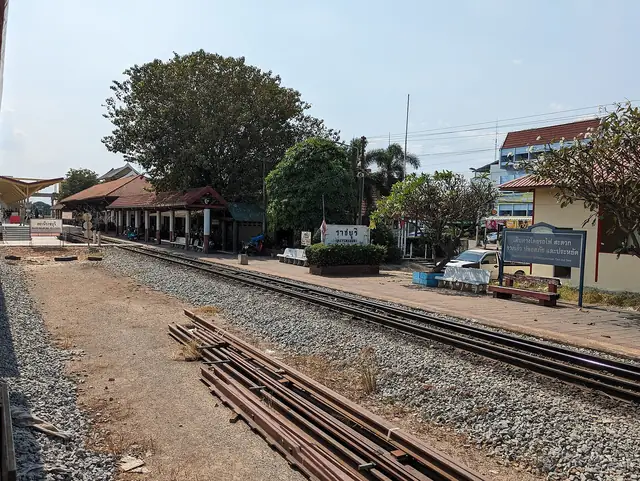 Getting to RatchaburiBus, train and car, onward to Suan Phueng and Kanchanaburi
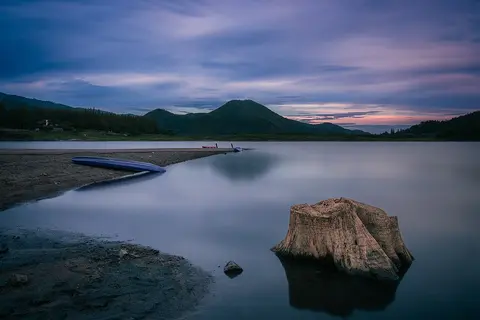 Where to stay in RatchaburiSuan Phueng resorts or town hotels
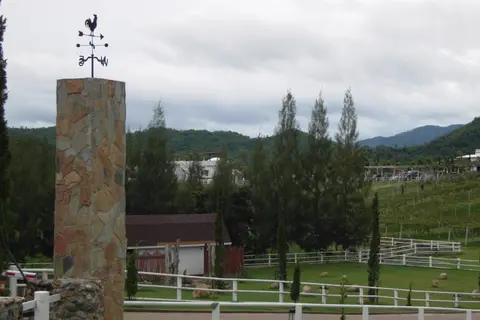 Ratchaburi tours and transportSuan Phueng tours, Na Satta tickets and Bangkok transfers