Wat Phra That Doi Suthep sits at about 1,050 m above Chiang Mai, roughly 11 km and 30 to 40 minutes by road from the Old City. Locals say you have not really been to Chiang Mai until you have been up this mountain. This page answers the questions people search first: what it costs, tram or stairs, what time it opens, what to wear, and how to get up without losing time.
The mountain is more than one temple. All of it lies inside Doi Suthep-Pui National Park, with Huay Kaew and Monthathan waterfalls, the forest temple of Wat Pha Lat, Bhubing Palace, the Hmong village on Doi Pui and hiking trails to the park's highest peak. Below you will find hours, fees, food and coffee on the mountain, one-day plans with and without a car, a budget, a month-by-month guide and the mistakes visitors make most.
We earn a commission if you book through our links. The price you pay does not change. How we choose
Quick answers before you go
| Temple fee, foreign visitor | 30 baht per person. Children are free. |
|---|---|
| Temple fee, Thai nationals | Free |
| Electric tram (optional) | 20 baht for Thais and 50 baht for foreigners, which includes the 30 baht temple fee. Read the sign at the ticket office to see whether the fare is one way or return. |
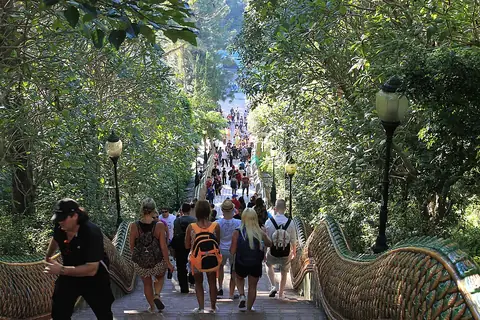
| Naga stairs | About 300 steps. Free to climb. Allow 10 to 30 minutes depending on your pace and the crowd. |
| Temple hours | Daily 05:00 to 21:00 |
| Tram hours | About 06:00 to 18:00. Confirm at the station. |
| Time needed | 1.5 to 2.5 hours at the temple, half a day with Wat Pha Lat or the palace, a full day with the waterfalls and the Hmong village |
| Dress code | Shoulders and knees covered. Shoes off before the chedi terrace. |
| Getting up | Shared red songthaew from the Chiang Mai University entrance on Huay Kaew Road (about 40 to 50 baht per person), Grab, a rented scooter or car, or a half-day tour |
| National park fee | Not charged to visitors who go to the temple and Wat Pha Lat by the main road. Other spots inside Doi Suthep-Pui park do charge. See the fees section. |
| Park office | Doi Suthep-Pui National Park, 0 5321 0244 (08:00 to 17:00) and 0 5329 5041 (24 hours) |
Doi Suthep fees: 30 baht or 50 baht?
The two numbers are not a contradiction. 30 baht is the temple admission for foreigners. 50 baht is the tram fare for foreigners, which is the 30 baht admission plus a 20 baht ride. Thais pay 20 baht for the tram and nothing for the temple. If you climb the naga stairs, a Thai visitor pays nothing and a foreign visitor buys the 30 baht ticket on the terrace.
| Item | Thai nationals | Foreign visitors | Note |
|---|---|---|---|
| Temple admission | Free | 30 baht | Children free |
| Electric tram | 20 baht | 50 baht (includes temple admission) | Read the ticket office sign for one way or return |
| Naga staircase | Free | Free | You still need the 30 baht admission ticket as a foreigner |
| Bhubing Palace | Adults 20 baht, children 10 baht | Adults 50 baht, children 10 baht | Tickets sold until 15:30. Golf cart inside 300 baht per cart, up to 3 people |
Separate from the temple: since 1 October 2025 several spots in Doi Suthep-Pui National Park charge an entrance fee. Foreign adults pay 100 baht and foreign children 50 baht, Thai adults 20 and Thai children 10, at the Pha Lat nature trail, Huay Kaew waterfall, Wang Bua Ban-Pha Ngoap waterfall, Doi Pui and Suan Son Resort. Tourists visiting Wat Doi Suthep and Wat Pha Lat by the main road pay no entrance fee. If you plan several park spots in one day, ask at the checkpoint whether one ticket covers more than one stop before you pay twice.
If you walk to Wat Pha Lat on the forest trail instead of taking the road, carry cash for the park fee.
All fees on this page are the rates in use as of 6 Nov 2026. The park rates are new, so keep some cash spare and ask at each checkpoint.
How to get up to Doi Suthep, every option
The temple is about 11 km from the Old City, 30 to 40 minutes depending on traffic. The road is steep and winding.
- Red songthaew, sharedCheapest
Leaves from the Chiang Mai University entrance on Huay Kaew Road. The service runs about 05:00 to 17:00. The fare is about 40 to 50 baht per person, and from Chang Phueak Market it can be around 60 baht. The truck waits until it fills. Agree how you will get down before you climb in, because the driver may not wait.
- Red songthaew, charteredFlexible
Price is negotiated with the driver. Ask for the return fare, the waiting time and the stops before you get in. It suits groups of 4 to 6 who want the waterfalls or the palace on the way.
- Grab or taxiEasy
Order from your hotel. Price varies with time of day, so check the fare in the app before you confirm. Agree a return pickup with the driver for the trip down.
- Rented scooter or carFreedom
Up Huay Kaew Road. Many bends and a steep grade, so only if you ride confidently. It lets you stop at Huay Kaew waterfall, Wat Pha Lat and the palace. For Doi Pui use a bike with some power.
- Half-day tourNo logistics
Hotel pickup and a guide. Starting prices in the boxes below run from US$13.32 to US$26.85 as of 4 Nov 2026. Check whether the tram is included.
 KKday
Chiang Mai | Doi Suthep Temple & Hmong Hill Tribe Village Half-Day Tour | Departure from Chiang Mai
From US$15.33
Price as of 4 Nov 2026Half day, 4 to 4.5 hours. Temple plus the Hmong village. Hotel pickup in Night Bazaar, Old Town, Nimman and part of Santitham.
Book on KKdayPhotos, prices and reviews from Klook
Half day, leaves 08:00 with hotel pickup and drop-off. Temple plus Chiang Mai University.
Book on KlookTram or naga stairs: which way up?
Both end at the same terrace. They differ in effort, time and feel. The seven-headed naga staircase is the image most people remember: a long serpent balustrade through the trees, photogenic from the first step. The tram is for anyone who cannot or does not want to climb.
| Naga stairs | Electric tram | |
|---|---|---|
| Cost | Free (foreigners buy the 30 baht temple ticket on the terrace) | 20 baht Thai, 50 baht foreign, includes temple admission |
| Time | 10 to 30 minutes | A few minutes, plus a queue when it is busy |
| Runs | Whenever the temple is open | About 06:00 to 18:00 |
| Best for | Anyone who can walk and wants the stair photos | Older relatives, small children, anyone hot or tired |
With mixed ages, take the tram up and walk down. Anyone who cannot manage the steps can ride the tram down, and you meet at the car park.
The path to the stairs runs past stalls selling souvenirs, textiles and hill-tribe goods. If you plan to buy, do it on the way down rather than carrying bags up.
A simple route through the temple
- Get out at the lower car park. The path to the stairs is lined with stalls.
- Choose how to go up: the seven-headed naga staircase (about 300 steps), or the electric tram beside it, which also ends at the temple terrace.
- Pay the 30 baht admission as a foreign visitor, then take off your shoes before the chedi terrace.
- Walk clockwise around the golden chedi. Many Buddhists go around three times with flowers, incense and candles.
- Look at the city viewpoint, the murals of the Buddha's life and the bells you can ring.
- Go down by stairs or tram. If you have time, continue to Wat Pha Lat, the palace or the Hmong village.
In hot midday sun, or with older relatives or small children, use the tram one way and walk the other.
What to see inside the temple, and the story behind it
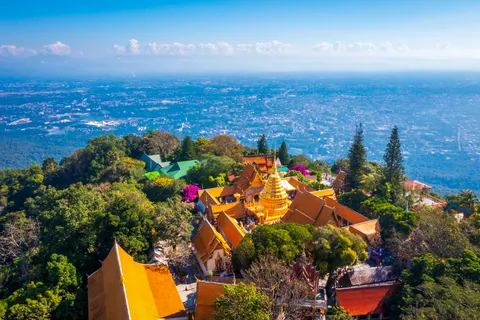
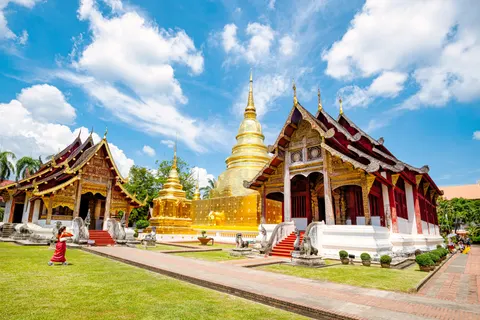
Phra That Doi Suthep is the relic shrine for people born in the Year of the Goat and the symbol of Chiang Mai. The legend says a relic of the Buddha was placed on a white elephant, which climbed the mountain, trumpeted three times and lay down. People took it as an omen and built the temple on that spot. The mountain was then called Doi Aoy Chang, and the name Suthep is linked to a hermit named Sutheva said to have lived here. The temple dates to the late 14th century in the Lanna period.
The first road up the mountain was built around 1935 with Khruba Srivichai leading local villagers. Before that, the only way up was on foot. At the foot of the mountain on Huay Kaew Road there is a monument to Khruba Srivichai that you pass on the way.
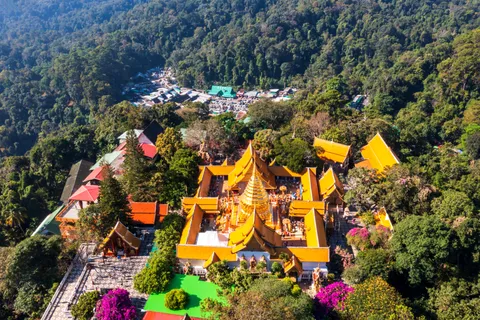
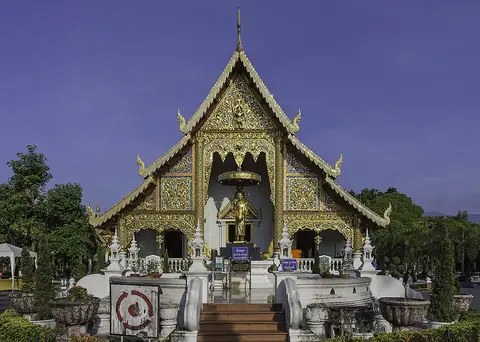
- The golden chedi: the relic tower is gold-plated and about 24 m tall, with brass umbrellas around it and shrines to the four guardian kings at the cardinal points. It is the centre of the terrace.
- The hall and murals: the walls tell the life of the Buddha. Monks chant at set times, and many visitors come around 17:00 to listen (confirm on the day).
- The viewpoint: you look down over Chiang Mai. On clear days you see far across the plain.
- The bells: people ring them for luck. Ring softly and wait your turn.
- Flowers, incense and candles: if you plan to circle the chedi as worshippers do, buy them from the stalls on the way up.
Each year on Visakha Bucha day the relic is bathed in a ceremony, and Chiang Mai families climb the mountain on foot in a tradition called Tiaw Khuen Doi. Some sleep on the terrace overnight. This day and Songkran are the busiest times of the year. Unless you want to join the festival, avoid them or arrive at 5 am.
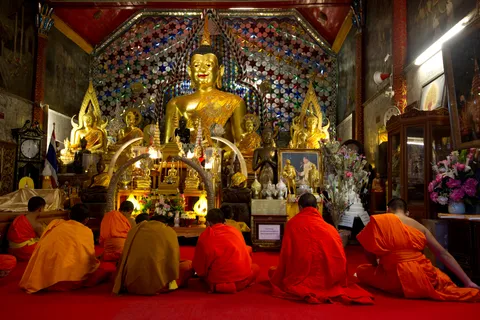
Dress code, manners and common mistakes
- Cover shoulders and knees. No very short shorts, strappy tops or see-through tops. Sarongs are sold or lent near the entrance, but do not rely on it.
- Take shoes off before the chedi terrace. Socks help on hot stone around noon.
- Do not point your feet at Buddha images. Do not climb on or sit on bases of shrines.
- Speak quietly in the hall and silence your phone. Do not photograph monks at prayer up close without asking.
- Do not assume the tram ticket is the whole price. The 50 baht foreign tram fare already includes the temple admission, but if you climb the stairs you still buy the 30 baht ticket on the terrace.
- The Bhubing Palace grounds are stricter than the temple. See below.
Best time of day
- Early morning, before 8 am: the quietest terrace, and the best time for thin mist. The temple opens at 05:00, the red songthaew starts about 05:00 and the tram about 06:00.
- Late morning to afternoon: strong light for architecture photos, and the busiest time when tour groups arrive.
- Late afternoon, about 16:00 to 18:00: soft light over the city, city lights coming on at dusk and evening chanting. Ask about the last ride down.
- Late rainy season to early cool season, roughly September to November: cooler and misty.
- Smoke season: late February to April. PM2.5 in Chiang Mai has exceeded the standard for weeks in these months, and the city view from the temple can be hazy. Check live readings on Air4Thai, run by Thailand's Pollution Control Department, before you book those months.
The temple is open until 21:00, but the tram stops about 18:00 and the university songthaew runs until about 17:00. If you plan to stay into the evening, agree a ride down with a driver or book a car in the app before it gets dark.
Sunrise and morning mist
The morning view is the reason people get up early for Doi Suthep. From the viewing tower the first light touches a sea of mist over the city, thickest from the end of the rainy season through winter. Sunrise in Chiang Mai falls between about 5:45 and 6:40 across the year, latest in December. Check the time for your date and aim to be on the terrace at least 30 minutes before.
- The temple opens at 05:00, but the tram starts about 06:00, so you will need to climb the stairs to be there before first light.
- The shared songthaew starts about 05:00 but waits until it is full, so you need a full group or a charter.
- For an empty terrace, arrive before 7. Large tour groups usually come after 9.
- Another dawn spot is the camping area near the Doi Pui summit, about 10 km above the temple. Camping costs about 150 baht and a rented tent with mat about 250 baht. Check with the park office.
If you do not want to arrange a dark-hour ride yourself, a half-day tour with early hotel pickup and a stop at Wat Pha Lat is the easy option.
Photos, prices and reviews from Klook
A 5-hour half day: sunrise at Doi Suthep and Wat Pha Lat, with hotel pickup.
Book on KlookDoi Suthep month by month
| Month | Weather on the mountain | Good to know |
|---|---|---|
| January | Coolest of the year. Early mornings on Doi Pui can drop to about 10 to 12 C | Clear skies, best city view. Wild Himalayan cherry blooms from about December to February depending on the year. Busy around New Year |
| February | Cool early, warmer late | Crop-burning smoke begins. The view can be hazy. Check air quality |
| March | Hot, strong sun | Smoke can be at its worst. If you go, go at dawn |
| April | Hottest | Songkran: traffic and crowds on the terrace. Haze can linger |
| May | Rains begin | Smoke eases, afternoon showers start. Visakha Bucha brings the relic ceremony and crowds |
| June to August | Wet, cloudy | Waterfalls are full and photogenic. Rocks are slippery and afternoon rain is common. Clouds can hide the view |
| September | Late rains, mist starts | Waterfalls are still strong. Fine if light rain does not bother you |
| October | Cooling, skies opening | Beautiful morning mist and less rain |
| November | Cool and clear | Start of high season. Good for the temple and walks |
| December | Cold at altitude, clear | Holiday crowds. Leave before 8 am and book tours ahead |
For both view and weather, November to January is the best window. For waterfalls, September to October after the heavy rain. Check air quality before booking anything from February to April.
The mountain is several degrees cooler than the city, especially in the morning and on Doi Pui. From November to February bring a thin long-sleeved top.
Half-day tours: Klook vs KKday compared
Two kinds of half-day tour cover Doi Suthep. One adds the Doi Pui Hmong village and one adds Chiang Mai University. Each kind is paired below so you compare like with like.
Type 1: temple plus Hmong village (about 4 hours)
 KKday
Chiang Mai | Doi Suthep Temple & Hmong Hill Tribe Village Half-Day Tour | Departure from Chiang Mai
From US$15.33
Price as of 4 Nov 20264 to 4.5 hours. Attraction tickets included (the tram is not). Hotel pickup in Night Bazaar, Old Town, Nimman and part of Santitham. Free cancellation up to 2 days before.
Klook runs about 4 hours with optional hotel pickup and a higher starting price. The KKday price includes attraction tickets. Check what the Klook price covers before you pay. KKday starts US$11.52 lower.
Type 2: temple plus Chiang Mai University (half day)
Photos, prices and reviews from Klook
Leaves 08:00 with hotel pickup and drop-off (be in the lobby 15 minutes early). Free cancellation 24 hours before.
KKday takes about 4 hours, with free cancellation up to 2 days before. Pickup is from a hotel lobby within 1 km of the Old City, or meet at the McDonald's near Tha Phae Gate. The adult ticket is for height 141 cm and over; children 100 to 140 cm pay less. KKday starts US$4.93 lower.
If you want to go at dawn
Photos, prices and reviews from Klook
A 5-hour half day: sunrise at Doi Suthep and Wat Pha Lat, with hotel pickup.
Book on KlookWhat actually differs between Klook and KKday here
- Cancellation: KKday allows free cancellation up to 2 days before; Klook up to 24 hours before.
- Pickup: KKday uses fixed pickup zones. Klook picks up from your hotel address.
- The tram ticket is usually an extra. The KKday price does not include it.
- Prices above are as of 4 Nov 2026. They change with the date and group size, so confirm on the booking page.
When a tour beats going alone
For one or two people who are not in a hurry, the shared red songthaew is cheapest. With three or more, or if you want Wat Pha Lat and the Hmong village without arranging transport, a tour that bundles the vehicle and guide is usually better value than paying a charter fee plus separate entry fees. For families with small children or older relatives, hotel pickup saves more effort than it costs.
Huay Kaew waterfall: the easiest stop on the way up
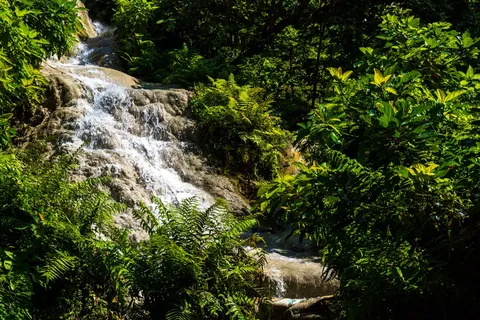
Huay Kaew waterfall is at the foot of Doi Suthep on Huay Kaew Road, about 6 km from the city centre and right beside Chiang Mai Zoo, so you can stop on the way up without a detour. From the car park it is about a 5-minute walk. The fall is modest in size and runs over stepped rock into a pool, with a spot to stand and a place to dip your feet where the current is gentle.
- Hours: morning to evening. Opening times vary by season, so confirm at the checkpoint or call 0 5321 0244.
- Fee: one of the park spots charging since October 2025, 100 baht for foreign adults and 20 baht for Thai adults.
- Time needed: 30 to 60 minutes.
- Best season: about July to October. It still flows in other months but looks thinner.
- Bring: shoes with grip, water, a rain jacket in the wet season. There are food and drink stalls near the fall and picnic mats to rent for about 20 baht.
Go early on weekends, because the car park fills fast. You can also stop on the way down, but rocks and paths are more slippery if rain has set in.
Monthathan waterfall: forest shade and a cool paddle
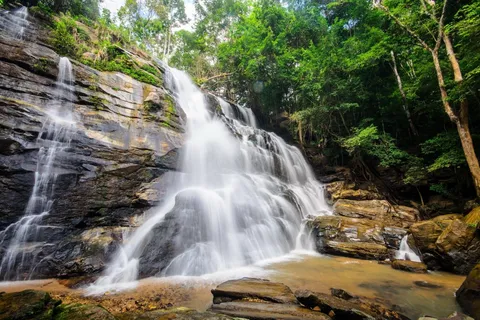
Monthathan waterfall is on the same stream as Huay Kaew, along the mountain road before Wat Pha Lat. It has 9 tiers. The lower tier is the one visitors reach easily, on a path of about 1.5 km that is clear and easy in the first part. Higher up the path becomes narrow and steep, and what you can reach depends on season and trail condition. If rock is wet or covered in algae, do not push on.
- Hours: about 08:00 to 16:30. Confirm before you go. It can close for heavy rain or flash-flood risk.
- Fee: park rules apply, so ask the rate at the checkpoint. Parking is about 20 baht for a motorbike and 30 baht for a car (check before you go).
- Time needed: 1 to 2 hours including the walk.
- Best season: the end of the rainy season into early winter, when flow is good and the forest is green.
- Bring: drinking water, non-slip shoes and a bag for your own rubbish. Do not get in the water during or after heavy rain.
It suits anyone who wants a short forest walk without climbing to the Doi Pui summit, and it pairs with Huay Kaew as a half morning before the temple.
Wat Pha Lat: the forest temple below
Wat Pha Lat is about 2 km from the main temple on a forest trail that takes around 2 hours. The name means the monastery at the sloping rock. It sits beside a stream in the forest on the flank of Doi Suthep. By tradition it was founded around 1355 in the reign of King Kue Na, at the place where the white elephant carrying the relic rested before it climbed to Doi Suthep, and it served as a rest stop for monks. It was quiet for many years and was revived around 1991. Today it has a Burmese-style chedi, a Buddha image beside the rock and a stream-side hall that is a protected ancient monument.
By the main road it is free of park fees. On the forest trail the park fee in the fees section applies.
There is a local belief that carrying meat past the temple brings headaches or stomach aches. It is a belief, not a rule, but there is no need to eat there.
A common plan is Wat Pha Lat early before the sun gets strong, then the main temple. The Klook sunrise tour follows the same order.
Bhubing Palace (Phra Tamnak Phu Phing Ratchaniwet)
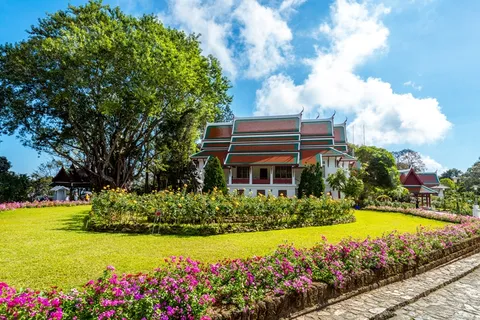
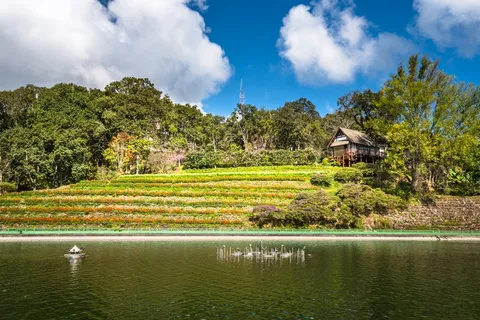
The palace is on Doi Buak Ha, about 4 km above the temple. King Bhumibol had it built in 1961 as the royal winter residence and a guesthouse for state visitors. The grounds hold Phruksa Wisuitthikhun Palace, a log-cabin style eucalyptus palace, a guest house, a large reservoir, a natural fern garden and flower gardens with many rose varieties. Visitors walk the gardens and the paths that are open.
- Hours: daily 08:30 to 16:30, tickets sold until 15:30.
- Fee: Thai adults 20 baht and children 10 baht, foreign adults 50 baht and children 10 baht.
- Golf cart inside: 300 baht per cart, up to 3 people, for those who prefer not to walk.
- Phone: 0 5322 3065.
- Time needed: 1 to 1.5 hours for the gardens.
It is a royal residence, so the dress code is stricter than at the temple. If you wear shorts or a short skirt, clothing rental is available inside, but dress modestly from the start. The palace can close for periods when the royal family is in residence, so call the number above or check with the Royal Household Bureau before you go.
Doi Pui Hmong village
The village is further up the mountain past the palace, inside the park on the slope of Doi Pui, several degrees cooler than the city. Half-day tours stop here. You will find shops selling local produce and souvenirs, traditional weaving and embroidery, a cool-climate flower garden and an outdoor display of Hmong farm life. Walkers in the surrounding forest may see deer and barking deer.
Doi Pui is on the list of places that charge the national park fee from October 2025. The KKday tour price includes attraction tickets. On your own, ask the rate at the checkpoint before you enter the village.
Ask before you photograph people, and buy what you like rather than haggling hard. Sales are the main income for many households.
Photos, prices and reviews from Klook
Half day, 4 hours. Doi Suthep and the Hmong hill-tribe village, with optional hotel pickup.
Book on KlookDoi Pui: hiking to the park's highest peak
Doi Pui is about 1,685 m and the highest peak in Doi Suthep-Pui National Park. The summit forest is montane evergreen and pine, and the air stays cool year-round. On clear days you can see the city from the viewpoints. There are three marked nature trails of roughly 4.5 to 7.5 km round trip and 2.5 to 5 hours of walking.
- Doi Pui summit to Doi Hua Mu: about 4.9 km round trip, about 3.5 hours. For people interested in forest ecology and city views.
- Emerald trail to Doi Hua Mu: about 4.5 km round trip, about 2.5 hours. Good for birdwatching and an easy walk.
- Long trail to Ban Khun Chang Khian: about 7.5 km round trip, about 5 hours. Steep, for fit hikers who want to see the Hmong village from the other side.
Along the way are viewing terraces, information signs, plants that are found only on Doi Suthep, wild orchids, green lichen on the path that gives the descent its nickname Emerald Road, and wild Himalayan cherry that blooms from about December to February depending on the year (confirm before you go). The park has more than 300 bird species, which makes it one of Chiang Mai's best birdwatching spots.
Arrange hiking through the park office or a guide in advance, and call several days ahead on 0 5321 0246 or 0 5321 0244. Without a car, you can get a red songthaew from in front of the temple, with the fare agreed with the driver.
The climb is harder than the descent. Start early, carry water and snacks, wear proper shoes, and be back before dark because light fades fast on the mountain.
What else to add on the same mountain
- Huay Kaew waterfall: at the foot of the mountain, an easy stop on the way up. See above.
- Monthathan waterfall: 9 tiers and a short forest walk. See above.
- Doi Pui summit: about 1,685 m. The shortest trail is around 2.5 hours round trip.
- Chiang Mai Zoo: at the start of Huay Kaew Road, if you have small children and want one more stop.
- For other full days from the city, compare Doi Inthanon and White Temple tours on the day trips page.
Chiang Mai day trips compared: Doi Inthanon and the White Temple
Doi Inthanon: fees, hours and full-day tours
Photos, prices and reviews from Klook
For a full day on Thailand's highest mountain: Doi Inthanon small-group tour, 8 hours (08:00 to 17:00). Meet at McDonald's near Tha Phae Gate. No hotel pickup.
Book on KlookWhat to eat and where to get coffee on Doi Suthep
The mountain is not a restaurant district. Options are mostly roadside stalls and small shops at the temple car park and a few places in the Hmong village. Proper restaurants are at the foot of the mountain around Huay Kaew Road and Nimman.
- Car park and the path to the stairs: shops selling water, snacks and souvenirs. Good for a drink before you climb, not a main meal.
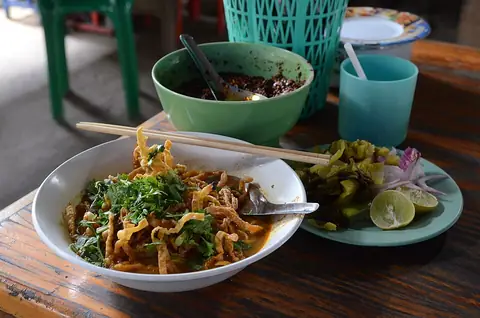
- Doi Pui Hmong village: small restaurants and shops, including a khao soi place people often stop at around midday. Check opening times before you go. Simple northern Thai food.
- Cafe de Doipui: a coffee and tea shop near the village entrance, open Tuesday to Sunday about 10:00 to 20:00, under 100 baht per person. The owner is Japanese, and visitors like the city view from its seats. Check hours before you go.
- Huay Kaew waterfall: food and drink stalls near the fall, good for a light meal.
- Foot of the mountain and Huay Kaew Road: khao soi and northern food, plus the cafes and restaurants of Nimman, the closest for a meal after you come down.
If you buy food to carry, eat it before or after Wat Pha Lat, because a local belief says meat should not be carried past the temple.
If you start very early, eat breakfast in town first. Not every stall on the mountain opens at dawn, and it is wise to carry water along the whole route.
Sample plans: one day and two days, one night
One day with a car
- 07:30 Leave town and drive up Huay Kaew Road. Stop at Huay Kaew waterfall for a short walk if it is open.
- 09:00 Arrive at the temple car park. Take the stairs or tram, walk around the chedi, enjoy the view and murals.
- 11:00 Drive on to Bhubing Palace (tickets until 15:30).
- 12:30 Lunch and coffee at the Doi Pui Hmong village. Buy souvenirs.
- 14:30 Drive down and stop at Wat Pha Lat by the main road or Monthathan waterfall.
- 16:30 Back in town for the shops and cafes of Nimman.
One day without a car
- 07:30 Take a red songthaew from the Chiang Mai University entrance on Huay Kaew Road (runs about 05:00 to 17:00). Agree your return time with the driver.
- 09:00 Arrive at the temple. Take the tram or stairs, walk and photograph.
- 11:30 From the temple front, a chartered songthaew can take you on to the Hmong village or palace if the price works, or eat at the terrace.
- 13:30 Ride down with the driver you agreed with, and stop at Huay Kaew waterfall if you still have energy.
- 15:30 Back in the city, or get off in Nimman for food and coffee.
If you have no car and do not want to arrange rides yourself, a half-day tour with hotel pickup wastes the least time. See the booking boxes above.
Two days, one night
- Day 1: Dawn at Doi Suthep for the view and the temple, then Wat Pha Lat. Rest in town in the afternoon. Evening in Nimman or the Old City.
- Day 2: Late morning to afternoon at Huay Kaew and Monthathan waterfalls, Bhubing Palace and the Hmong village. If you have the energy, a short Doi Pui trail with a park-arranged guide.
- With another day, add Doi Inthanon or the White Temple from the day trips page.
Budget for Doi Suthep per person
| Item | Lean (foreign visitor) | More comfortable |
|---|---|---|
| Transport, return | Shared songthaew about 80 to 120 baht | Grab or a chartered songthaew split, price in the app |
| Temple | 30 baht (stairs free) | Tram about 50 baht including temple admission |
| Bhubing Palace | 50 baht | Add the golf cart, 300 baht per cart split by 3 |
| Huay Kaew waterfall or park checkpoints | 100 baht per charging spot | As charged |
| Food and coffee | About 150 to 300 baht | About 400 baht and up for a town meal |
| Half-day tour instead of all of the above | Starting prices US$13.32 to US$26.85 as of 4 Nov 2026 | Includes transport and guide. Check what is included |
A solo traveller who picks only the temple, with shared songthaew, temple fee and a light meal, spends about 250 to 400 baht. Adding the palace and a waterfall adds about 150 baht plus the cost of a chartered ride. Thais pay less because the temple is free.
These figures are approximate as of 6 Nov 2026. Songthaew fares and food prices change with time of year, so check before you go.
Doi Suthep with older relatives and small children
- Take the tram: anyone who cannot manage the stairs can ride in a few minutes.
- Go early: cooler air, fewer people, and the stone terrace is not yet hot.
- Shoes and socks: you must take shoes off before the terrace. Thin socks help on hot stone around noon.
- Small children: children enter the temple free, but the stairs are steep and busy, so hold hands.
- Travel sickness: the road up is full of bends. Travel on a light stomach, sit in front and open a window.
- Groups needing frequent breaks: a chartered car or a tour with hotel pickup is easier than a shared songthaew.
Rain or cloud: is Doi Suthep still worth it?
Yes, but plan differently. Rain on Doi Suthep-Pui falls mostly from May to October, and August is usually the wettest. Cloud can hide the city view, but the temple still looks good in mist.
- Go in the morning, since rain usually comes in the afternoon.
- In rain: stay in the halls and covered areas, cut time on the terrace and wear shoes with grip. The naga stairs are slippery when wet.
- Skip the Wat Pha Lat forest trail and Monthathan waterfall during or just after heavy rain: slippery rock and flash-flood risk.
- Bhubing Palace can still be walked in light rain. Bring an umbrella.
- If the mountain is in cloud, spend the day in the Old City, at Wat Chedi Luang and in cafes, and try Doi Suthep another day.
Common mistakes at Doi Suthep
- Arriving late into the tour crowds: after 9 am in the high season the terrace and stairs are packed. Be there before 8.
- Not agreeing a ride back: the songthaew waits until full and may not be there near dusk. Settle it on the way up.
- Dressing wrong: you may be asked to buy or borrow a sarong, which wastes time. Bhubing Palace is stricter.
- No cash: park checkpoints, roadside shops and songthaews mostly take cash.
- Visiting in smoke season: from late February to April the view can be nearly gone. Check air quality before you book.
- Thinking the tram ticket covers everything: it covers temple admission only, not the palace, waterfalls or Doi Pui.
- Riding a scooter up without experience: the road is steep with bends and gets slippery in rain. If unsure, use a songthaew or Grab.
- Carrying meat past Wat Pha Lat: not against the rules but against local belief.
- Not asking about park fees: the new rates are not widely known. Ask at the checkpoint.
- Trying to do every stop in one rushed day: you can fit the temple, a waterfall, the palace and the village, but with less time pick the temple plus one or two stops.
Where to stay for an easy trip up Doi Suthep
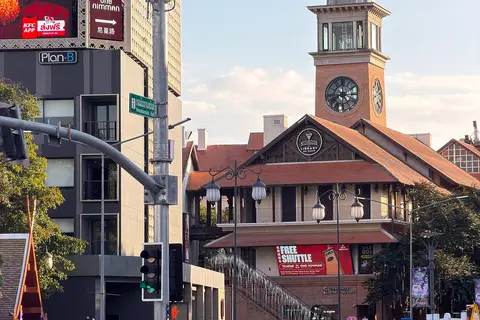
The closest areas to the road up are Nimman, which sits right beside Huay Kaew Road, and Santitham, which reaches Huay Kaew Road without crossing the centre. The Old City is further but better for walking to temples and markets. If you plan a dawn trip, Nimman cuts the ride.
 Mid-range
Travelodge Nimman Chiang Mai
Nimmanhaemin
Nimmanhaemin, mid-range, on the side of Huay Kaew Road that leads up Doi Suthep. Restaurants and cafes are close, which suits an early start.
See prices and availability on the booking page
 Mid-range
POR Santitham
Santitham
Santitham, mid-range, north of the Old City, with access to Huay Kaew Road without going through the centre.
See prices and availability on the booking page
Frequently asked questions
How much does Doi Suthep cost for foreigners?
30 baht to enter the temple. The tram is 50 baht for foreigners including that 30 baht admission. The naga stairs are free to climb, but you still buy the temple ticket on the terrace.
Is Doi Suthep free for Thais?
Entry is free for Thai nationals. The tram costs 20 baht if they choose it.
How many steps are the naga stairs, and is the tram worth it?
About 300 steps. Most people manage them. The tram is worth it in midday heat or with older relatives or small children. Both end at the same terrace.
What time does Doi Suthep open?
The temple is open daily 05:00 to 21:00. The tram runs about 06:00 to 18:00. Arrive before 8 am and leave before 18:00 for the easiest day.
How do I get to Doi Suthep by red songthaew, and how much is it?
Take a shared red songthaew from the Chiang Mai University entrance on Huay Kaew Road. The fare is about 40 to 50 baht per person, around 60 baht from Chang Phueak Market, and the truck leaves when full. Settle your return trip before you go up.
What should I wear at Doi Suthep?
Cover your shoulders and knees and take your shoes off before the chedi terrace. The palace grounds are stricter.
Do I pay the national park fee at Doi Suthep?
Visitors to the temple and Wat Pha Lat by the main road pay no park fee. Other spots in Doi Suthep-Pui, such as Huay Kaew waterfall, the Pha Lat trail and Doi Pui, charge 100 baht for foreign adults since 1 Oct 2025.
Is a tour better than going by myself?
For one or two people the shared red songthaew is cheapest. A tour is worth it if you want Wat Pha Lat or the Hmong village without arranging transport. Half-day tours here start between US$13.32 and US$26.85 as of 4 Nov 2026.
When is Bhubing Palace open and what does it cost?
Daily 08:30 to 16:30, with tickets sold until 15:30. Foreign adults pay 50 baht and children 10 baht. It can close when the royal family is in residence, so call 0 5322 3065 before you go.
What is the best time of year to visit Doi Suthep?
November to January is cool and clear, the best for views. Go before 8 am any day. From late February to April smoke can hide the view, so check air quality first.
Where the facts come from
- Thai Holiday Guide: Wat Phra That Doi Suthep
- Trip.com guide to Wat Phra That Doi Suthep
- Bangkok Airways blog: Wat Phra That Doi Suthep
- Rail Travel Station: Doi Suthep Cable Car
- Chiang Mai CityLife: Entrance fees at Doi Suthep-Pui from October 2025
- Thansettakij: national park fee groups effective 7 Jun 2022
- Thai Post: Doi Pui nature trail (Thai)
- Wikipedia: Wat Phra That Doi Suthep
- Wikipedia: Doi Suthep-Pui National Park
- Wikipedia: Wat Pha Lat
- The Lost Passport: Doi Suthep National Park
- Wongnai: Cafe de Doipui
- Wongnai reviews: Phra Tamnak Phu Phing Ratchaniwet
- Thai PBS: why Chiang Mai is buried in dust (Thai)
- Thai Post: Chiang Mai PM2.5 above the standard (Thai)
- Air4Thai, Pollution Control Department: live air quality
Keep planning
 Chiang Mai trip plannerStart here
 3 days in Chiang Mai4 plans for different trips
 Tours and tickets with pricesUSD prices as of 4 Nov 2026
 Where to stayOld City, Nimman, riverside, Night Bazaar, Santitham
 Day trips from Chiang MaiDoi Inthanon and the White Temple
 Elephant sanctuaries comparedOnly listings that say no riding
 Airport to the cityTaxi, Grab, red songthaew, transfer
 Bangkok to Chiang MaiFlight, sleeper train, bus
 Doi InthanonFees, route, tours
 The White Temple (Wat Rong Khun)As a day trip from Chiang Mai
 Sunday Walking StreetHours, route and food
 NimmanCafes, food and hotels
 Chiang Mai Night SafariTickets, hours and the tram
 Wat Chedi LuangHours, fees and an Old City walk