Sukhothai Historical Park preserves the remains of the capital of the Sukhothai kingdom, which flourished in the 13th and 14th centuries and is often described as the first major Thai kingdom. It is a calmer alternative to busier ruin sites: wide lawns, lotus ponds, slender stupas and serene Buddha images. This guide explains how the park is organised, the sights worth prioritising, how to get around, what to budget and how to behave respectfully. For wider context see the Sukhothai hub.
How the park is organised
The park lies about 12 km west of New Sukhothai, the modern town where most buses arrive. It is divided into several zones, each with its own ticket arrangements and clusters of ruins.
| Zone | Character | Typical highlights |
|---|---|---|
| Central (inside the old city walls) | The densest cluster; flat and walkable | Wat Mahathat, Wat Sa Si, Wat Si Sawai, Wat Traphang Ngoen, Ramkhamhaeng National Museum nearby |
| North | A short ride outside the walls | Wat Phra Phai Luang, Wat Si Chum |
| South | Quieter, spread out | Wat Chetuphon and several smaller temples |
| East | Lightly visited | Wat Chang Rop and others (check current access) |
| West | Hilltop and forest temples | Wat Saphan Hin, Wat Aranyik; panoramic views |
Ticket rules and zone boundaries are set by the Fine Arts Department. The central zone typically has its own entry fee for foreigners, and additional zones may be charged separately or bundled; check the price at the gate (as of 2026). Cycle, motorbike or car hire may carry additional fees at the entrance.
Priority sights
Wat Mahathat is the largest and most important monastery in the old city, with a central lotus-bud chedi surrounded by ruins of smaller stupas and rows of seated Buddhas. Allow 45-60 minutes.
Wat Sa Si sits on an island in a pond, reached by a small bridge. The setting is photogenic at sunrise or late afternoon.
Wat Si Sawai shows Khmer-influenced prangs, which differ from the typical Sukhothai lotus-bud style. It is usually quick to visit.
Wat Traphang Ngoen stands beside a large pond and features a lotus-bud chedi and a walking Buddha image, a classic element of Sukhothai art.
Wat Si Chum in the northern zone houses a large seated Buddha, Phra Achana, inside a tall roofless enclosure. It is among the most memorable images in the park.
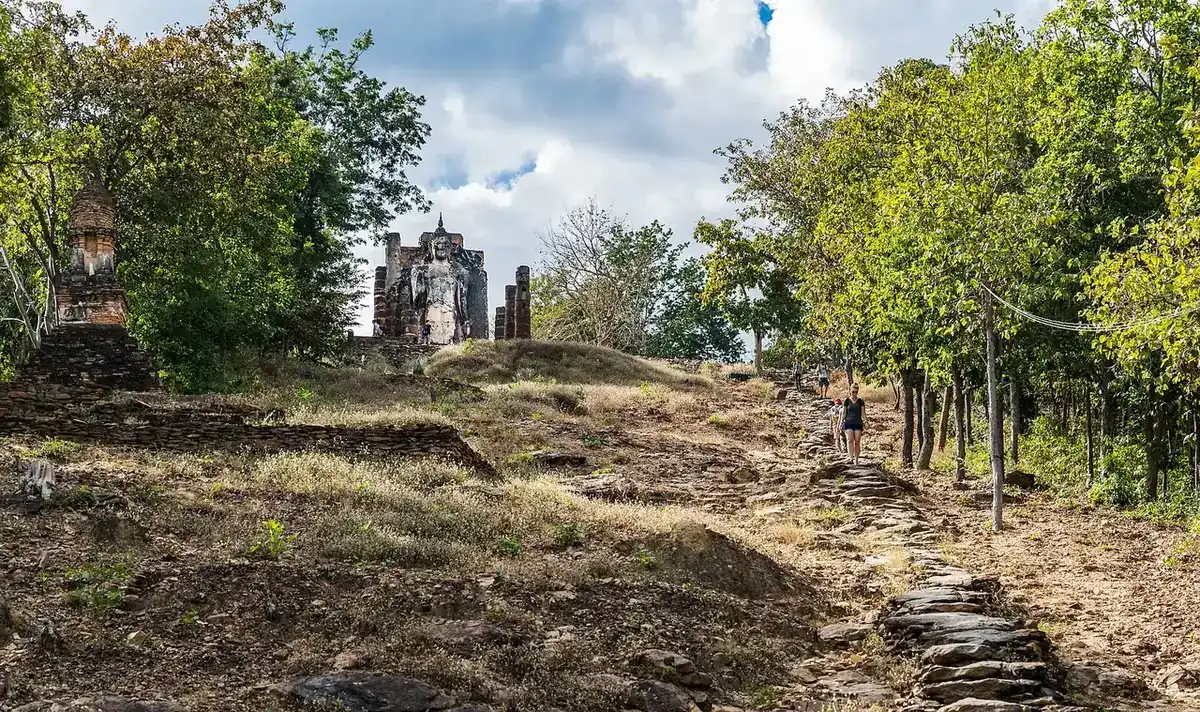
Wat Saphan Hin is on a small hilltop in the west with a stone stairway and a standing Buddha facing the plain. Come for the view and a quiet moment.
Wat Chang Lom at Si Satchanalai, if you extend the trip, has a bell-shaped chedi with elephants around its base and is part of the same World Heritage listing.
Getting around
- Bicycle: The most popular choice for the central zone, which is flat and compact. Rentals are available near park entrances and many guesthouses; check the brakes and tyres first.
- Tram: Electric trams or open-sided shuttles have operated in the central zone. Check at the gate whether they are running in your season.
- Scooter or car: Useful for the outer zones. Roads are quiet but narrow in places.
- Tuk-tuk or songthaew: Local transport can be hired by the hour or half-day; agree the route and price before leaving.
- Walking: Possible in the central zone, but temperatures and distances limit this to short stretches.
Rent a bicycle and start at opening time. Cycling through the central zone in cooler air lets you see the main temples before the heat and the tour groups.
One-day plan
| Time | Plan |
|---|---|
| 7:30-8:00 | Breakfast; rent bicycles near the central zone |
| 8:00-9:30 | Wat Mahathat |
| 9:30-10:30 | Wat Sa Si and Wat Traphang Ngoen |
| 10:30-11:00 | Wat Si Sawai and the museum, or a break |
| 11:00-13:00 | Lunch in town and rest |
| 13:00-14:30 | Wat Si Chum and Wat Phra Phai Luang (north zone) |
| 15:00-16:00 | Wat Saphan Hin (west zone), if you are up for it |
| 16:00-17:30 | Return to the central zone for late light or leave for town |
If you stay a second day, consider Si Satchanalai Historical Park, about an hour north by car, or Kamphaeng Phet, a quieter third World Heritage component.
Costs
All figures are approximate and may change (as of 2026); check each provider's own page.
| Item | Approx. cost (THB) |
|---|---|
| Central zone entry (foreigners) | Check at the gate; typically under 200 |
| Other zones | Check at the gate; may be per zone or per site |
| Bicycle rental | 30-100 per day |
| Scooter rental | 200-350 per day |
| Songthaew from New Sukhothai | 30-60 per person |
| Meal in a local restaurant | 60-250 |
| Guesthouse per night | 500-1,500 |
| Mid-range hotel per night | 1,500-3,500 |
A bicycle-based day with local meals is among the cheapest cultural days in Thailand; most of the cost is accommodation and getting to Sukhothai.
Best time to visit
November to February is the most comfortable, with cooler mornings. March to May is very hot and the park has limited shade; plan sightseeing before 10:00 and after 16:00. The wet season (roughly June to October) is green and quiet but showers can interrupt cycling. Loy Krathong, usually in November, brings a festival with performances and lanterns; dates follow the lunar calendar, so check with the Tourism Authority of Thailand for the current dates and book accommodation early. See Thailand best time by region.
Etiquette
Sukhothai's ruins are sacred sites. Cover shoulders and knees, do not climb on structures or Buddha images, and avoid posing in a way that mimics images. Keep your voice low near monks or worshippers. Do not take sand, bricks or stones. Drone use near heritage sites is regulated in Thailand; check current rules.
Getting there
From Bangkok, direct buses to New Sukhothai usually take 6-7 hours; trains reach Phitsanulok, with a road transfer of roughly an hour; and some seasons have flights to Sukhothai or Phitsanulok. See the Sukhothai hub for the full transport overview, or the Thailand getting around guide. From Chiang Mai, buses and vans typically take around 5-6 hours; check schedules.
Combining with other stops
Sukhothai fits between Ayutthaya and Chiang Mai on a northbound route. A common plan is a night in Ayutthaya, a night or two in Sukhothai and then onward by bus or van to Chiang Mai.
Safety
Emergency numbers are 191 (police), 1669 (medical emergency) and 1155 (Tourist Police). Heat is the main risk: carry water and take breaks. If you ride a scooter, wear a helmet and carry a valid licence and insurance. Cycle with care on roads shared with trucks and motorbikes.
FAQ
How much time do I need at Sukhothai Historical Park?
A full day lets you see the central zone and one other zone; two days adds Si Satchanalai or a slower pace.
Is it better to cycle or take a tram?
Cycling is flexible and cheap, though hot in the middle of the day. A tram, when running, can ease the heat; check the current service at the gate.
Where should I stay for the park?
Staying near the old city gives early access and a quiet setting. New Sukhothai has more restaurants and transport but is about 12 km away.
Is the park open at night?
Some zones are lit and open for festival nights or special events. Check the opening hours and any evening arrangements with local officials (as of 2026).
Do I need a guide?
Not necessarily. Signs explain the main sights. A guide can add historical context; compare prices and what is included.
Official sources and further reading
Prices, schedules and entry rules change. Figures here are approximate as of 2026; always confirm on the official or operator page before you book. Spotted something out of date? Tell us.