Ayutthaya, the former capital of Siam, lies about 80 km north of Bangkok and is the easiest historical site to reach from the city. A day is enough to see the highlights, but only if you plan the route, start early and choose your transport carefully. This guide covers how to get there, how to move around, a realistic itinerary and what everything typically costs. For wider context, see the Ayutthaya hub and the Bangkok day trips overview. Thai-speaking readers can use the Thai version.
Is a day trip enough?
Ayutthaya Historical Park, a UNESCO World Heritage Site, spreads across an island and the surrounding area. Most first-time visitors see five to seven sites in a day. If you want to include Bang Pa-In Palace, riverside temples or a slow sunset, consider an overnight stay. A day trip works best if you start before 8:00 and are comfortable walking, cycling or riding in a tuk-tuk in the heat.
Choosing how to get there
Schedules and fares change, so check each operator's own site for the current situation (as of 2026).
| Option | Typical time | Typical cost (approx.) | Pros | Cons |
|---|---|---|---|---|
| Train | 1.5-2.5 hours | THB 20-400 depending on class | Cheap, scenic, runs through the day | Timetables vary; delays possible; station is across the river from the island |
| Minivan or bus | 1.5-2 hours | THB 60-250 | Frequent, direct | Traffic variable; drop-off points vary |
| Private car or taxi | 1.5-2 hours | THB 1,800-3,500 for the car | Flexible, door to door | Costs more; tolls and traffic |
| Day tour | 8-10 hours | THB 800-2,500 | Transport, guide and entry bundled | Fixed schedule; check what is included |
| River cruise one way | Half a day | Varies | Memorable journey | Fixed timetable; usually paired with coach |
The State Railway of Thailand publishes timetables. At the time of writing, Krung Thep Aphiwat Central Terminal handles most long-distance trains from Bangkok, but confirm which station your chosen train uses.
If you take the train, check the return timetable before you go. Late-afternoon departures can fill up, and missing the last convenient train means a van or taxi back.
Getting around Ayutthaya
- Tuk-tuk or songthaew charter: The common way to cover many sites in a few hours. Agree the price, number of stops and total duration before you get in. Prices are often quoted per hour or per trip.
- Bicycle: Flat, shaded in places and cheap to hire near the station and island. Hot at midday, so plan breaks.
- Scooter: Possible, but traffic can be chaotic and you need a licence and insurance coverage.
- Boat: Small longtail boats circle the island and give a different perspective.
- Walking: Wat Mahathat, Wat Ratchaburana and Wat Phra Si Sanphet are within a short walk or ride of each other, but the full area is too large to walk in one day.
Be cautious with tuk-tuk drivers who offer very cheap "special tours", especially if the route includes shops or places you did not choose. Agree your list of temples in advance and decline unwanted stops politely.
A one-day itinerary
This itinerary assumes arrival around 8:30-9:00. Adjust to your transport.
| Time | Activity |
|---|---|
| 8:30-9:00 | Arrive; hire a bicycle or agree a tuk-tuk route; coffee or breakfast |
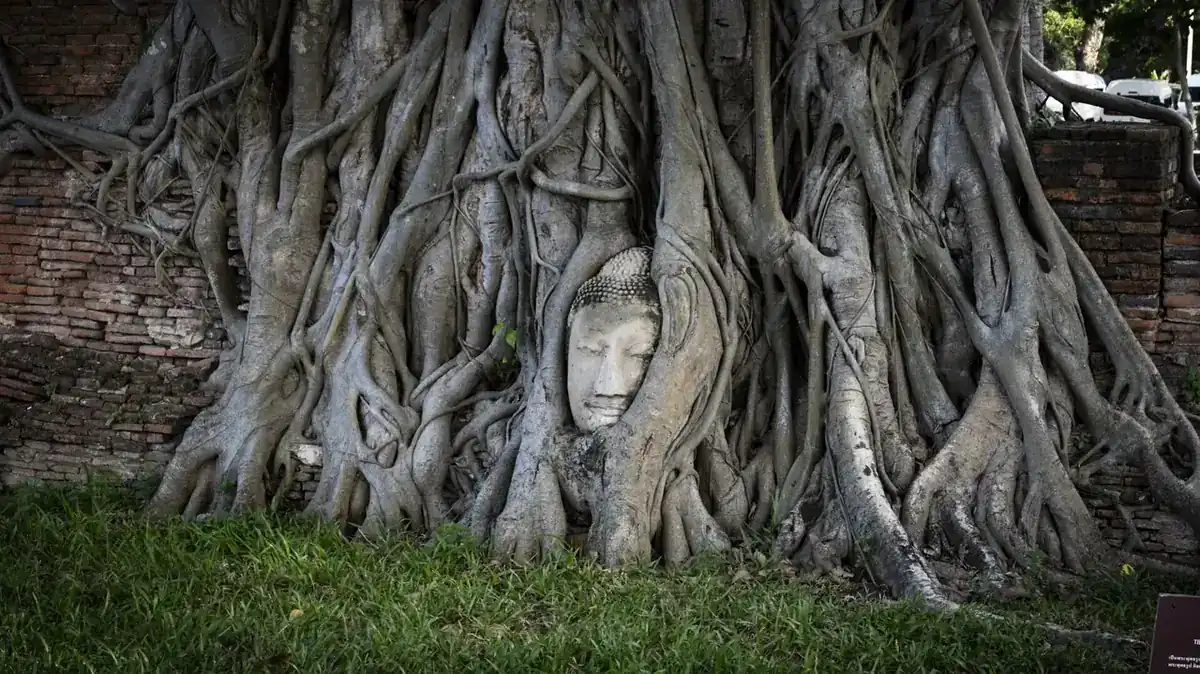
| 9:00-10:30 | Wat Mahathat: the Buddha head in tree roots and the main ruins |
| 10:30-11:00 | Wat Ratchaburana nearby, with its tall prang and crypt (check current access) |
| 11:00-12:00 | Wat Phra Si Sanphet: three iconic chedis |
| 12:00-13:30 | Lunch near the river or at a local restaurant; rest in air conditioning |
| 13:30-14:30 | Wat Lokayasutharam reclining Buddha, and Wat Phra Ram or other ruins |
| 14:30-16:30 | Wat Chaiwatthanaram on the western bank |
| 16:30-17:30 | Sunset viewing, or a short boat ride |
| 18:00 onwards | Return to Bangkok |
Highlights in more detail
Wat Mahathat was among the most important temples of the Ayutthaya kingdom. Many people visit for the sandstone Buddha head entwined in a banyan tree, a photogenic spot where visitors are expected to crouch or kneel so that their heads are lower than the Buddha's. Follow the signs and the staff's guidance.
Wat Phra Si Sanphet lay within the royal palace grounds and features three bell-shaped chedis in a row. It is one of the most recognisable symbols of Ayutthaya.
Wat Chaiwatthanaram is a Khmer-style temple beside the Chao Phraya. Its central prang and surrounding chedis are especially photogenic at golden hour. Some visitors pay to hire traditional clothing for photos; this is optional, and you should check prices before agreeing.
Wat Lokayasutharam has a large reclining Buddha in the open air, a calmer stop that works well after lunch.
Wat Yai Chai Mongkhon is an active temple with a large chedi and reclining Buddha, a little farther out and often combined with other stops by tuk-tuk.
Costs
All figures are approximate and may change; check each provider before travelling (as of 2026).
| Item | Approx. cost (THB) |
|---|---|
| Transport Bangkok-Ayutthaya, return | 40-600 per person depending on mode |
| Entry to individual historic sites | Typically 50 per site for foreigners; some sites cost more; check at the gate or via the Fine Arts Department |
| Bicycle rental | 50-100 per day |
| Tuk-tuk for 3-4 hours | 400-1,000 for the vehicle |
| Lunch | 80-300 |
| Drinks and snacks | 50-150 |
A self-organised day by train, bicycle and local lunch can cost THB 500-1,000 per person; a private car with driver and a guided tour can cost several times that. Compare before booking and check what each price includes.
What to wear and bring
- Clothes that cover shoulders and knees. Active temples enforce this; the ruins are less strict but respect still matters.
- A hat, sunscreen, sunglasses, water and a light scarf.
- Comfortable shoes that are easy to remove; paving and brick surfaces are uneven.
- Insect repellent in the wet season.
- Small notes and coins for entry tickets, bicycles and tuk-tuks.
Etiquette at the ruins
The ruins are religious sites. Do not climb on structures, sit on Buddha images, or pose in ways that imitate or mock them. Take care not to touch fragile brickwork. Avoid pointing your feet at images. If you see a sign restricting an area, follow it. Drone use is regulated in Thailand; check current rules before flying one near heritage sites.
When to go
The cool season from November to February is the most comfortable. March to May can be very hot, so schedule most walking before 11:00 and after 15:00. During the rainy months showers often arrive in the afternoon, and low-lying areas can flood in heavy years. Weekends and public holidays are busier with Thai visitors. See Thailand best time by region for broader season guidance.
Combining with other stops
- Bang Pa-In Palace lies about 20 km south of the island and is often visited by car or as part of a tour.
- Lopburi is another ancient city north of Ayutthaya, known for Khmer ruins and its monkeys; it is a separate trip.
- Overnight stay: Adds sunrise and sunset visits with fewer crowds. The island's guesthouses and riverside hotels are the usual choice.
- Onward to Sukhothai: See the Sukhothai hub if you are heading north.
Safety
Thailand's emergency numbers are 191 (police), 1669 (medical emergency) and 1155 (Tourist Police). Heat is the main practical risk: drink water regularly and avoid exposed midday walking. Keep valuables close in crowded areas and carry travel insurance. Stray dogs and monkeys are present at some sites; avoid feeding or provoking them.
FAQ
What is the best way to get from Bangkok to Ayutthaya?
The train is the cheapest and most scenic option, while a minivan is often the quickest and most direct. A private car or tour is the most convenient if you want door-to-door transport.
How early should I leave Bangkok?
Aim to arrive by about 9:00, which usually means leaving Bangkok between 6:30 and 7:30 depending on transport and traffic.
Do I need a guide?
No. Information boards explain major sites. A guide can add historical context, and tours are available at many price points, so compare what is included.
Can I visit on a weekend?
Yes. Expect larger crowds and slower traffic on weekends and public holidays, so leave earlier.
Is Ayutthaya suitable for children and older travellers?
Yes, with preparation. Tuk-tuks or a private car reduce walking, and shade and water breaks help. Uneven surfaces and steps can be difficult for strollers and limited mobility.
Can I combine Ayutthaya with Kanchanaburi or Sukhothai in one day?
Not practically. Each is a full outing. See the Kanchanaburi hub and Sukhothai hub to plan them separately.
Official sources and further reading
Prices, schedules and entry rules change. Figures here are approximate as of 2026; always confirm on the official or operator page before you book. Spotted something out of date? Tell us.